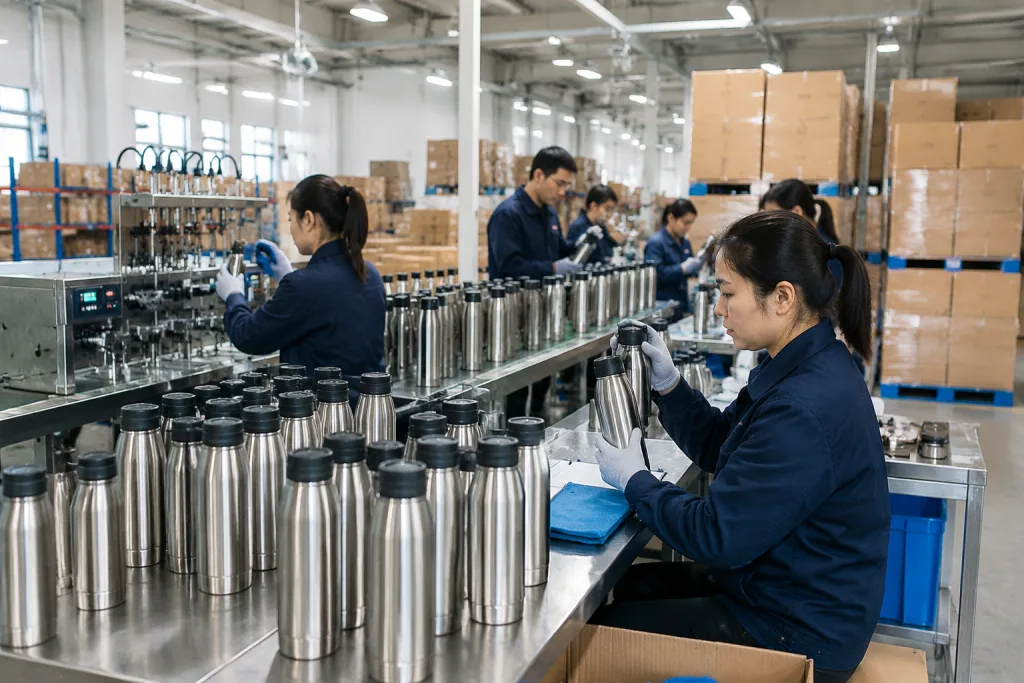
Key Takeaways
- For polypropylene outer thermos with 304 stainless liner, practical MOQ starts at 3,000 pcs per color and 5,000 pcs for custom molds
- A reliable vacuum flask should lose no more than 20-25°C over 6 hours in a 95°C hot water test
- Logo method changes cost by USD 0.08-0.65 per unit depending on silkscreen, heat transfer, laser, or full-wrap artwork
- Plan 30-45 days production after sample approval, plus 25-35 days ocean transit to Europe or North America
If you sell outdoor gear or run promotional drinkware programs, polypropylene thermos bottle wholesale comes down to 2 checks: the PP outer shell and the stainless steel vacuum liner inside. Photos lie. A clean quote photo can survive the first buyer meeting, then QC pulled the sample on the line and found a 0.6 mm lid gap, PP smell after a 95°C hot-water test, and heat retention 8°C below the buyer’s spec. That sample failed.
From our Hangzhou, Zhejiang production base, we ask buyers to lock 4 items before serious price talk: bottle structure, capacity, decoration method, and the compliance file. Price is the wrong first question. If the structure is wrong, the math does not work, even with a lower unit price. We run 500 ml and 750 ml samples first, check lid torque with a handheld torque tester, and match the carton mark against the PO; one “750ML” typo entered as “700ML” once held a shipment for 3 days. Small stuff bites. Get these details right, and a bulk thermos order becomes predictable. Get them wrong, and you spend 45 days importing inventory that your distributor thermos customers will not reorder.
Start With The Bottle Structure
The first decision is not logo position or carton artwork. It is structure. Buyers searching for polypropylene thermos bottle wholesale often write “plastic thermos” on the RFQ, then ask for 6 hours above 55°C. That spec will not pass on a single-wall PP bottle. In our Hangzhou sample room, we cut the body with a pipe cutter, put the liner on the stainless bench, and show the real build: PP outer shell for hand feel and Pantone color, plus a 304 stainless steel inner liner for food contact and heat retention. Simple check. Real thermos or plastic bottle?
A pure polypropylene bottle is fine for cold water, school channels, or a low-cost promo order under 5,000 pcs. It will not perform like a vacuum thermos. PP cannot hold a vacuum layer by itself, and heat resistance is limited. We saw this go sideways with a hiking-chain buyer who approved a “thermos” sample, then their customer poured in 95°C coffee and flagged the temperature drop after 3 hours. Wrong product. If outdoor retail customers expect hot coffee after a morning hike, we run double-wall stainless vacuum construction inside the PP housing. The buyer asked for 6 hours; the test sheet showed 49°C at hour 4.
For a serious customized thermos program, we quote the structure before we talk about logo size:
- PP shell + 304 stainless inner liner: works when the buyer needs Pantone color matching with a molded grip texture, not just a plain printed tube. We check the PP shell on a digital caliper because a 0.2 mm shrinkage change can make the liner sit off-center.
- Full stainless body with PP lid and handle: better for premium custom thermos ranges where the shelf price has to look justified. QC runs a 70°C hot-water odor check on the lid, because buyers reject even a light plastic smell.
- Stainless vacuum body with PP sleeve: fits orders that need a softer touch while still asking for vacuum insulation. The sleeve fit must stay within about 0.3 mm, or the line gets visible assembly gaps near the bottom ring.
Wall thickness matters. For stainless liners, 0.40 mm inner wall and 0.50 mm outer wall are common in mid-range factory thermos production. Going thinner can save USD 0.10-0.18 per unit, but denting and vacuum failure complaints rise. The math does not work if a 20,000 pcs order saves a few thousand dollars and then fails AQL 2.5 for side dents. For PP outer parts, the material grade must be food-contact safe, odor controlled, and stable after dishwasher testing if you print “dishwasher safe” on the color box. QC pulled one sample last year with a sharp smell from the lid gasket area after 10 dishwasher cycles; the buyer flagged it before we packed the pre-production samples. In China, cheap recycled PP is still offered by some thermos suppliers. Do not use it for food-contact lids, inner caps, or mouth-touch parts.
Match Capacity To Retail Channel
The second decision is capacity. Camping shops and promo buyers do not buy the same bottle. For a distributor thermos line, we run 500 ml, 750 ml, and 1,000 ml because the shelf needs a daily carry size plus one outdoor size with enough volume for a 6-hour hike. Promo orders land on 350 ml or 500 ml about 8 times out of 10 in our Hangzhou sample room. One Germany buyer rejected 750 ml after seeing the 24 pcs carton on our packing table and wrote “too fat for gift pack” on the approval sheet.
For thermos bulk orders, 500 ml is the cleanest size. It fits most car cup holders, the retail price still works, and the logo area gives the printer enough straight wall before the artwork hits the shoulder curve. A 750 ml custom thermos sells better in hiking and worksite channels, where buyers accept a taller carton and a heavier master case. A 1,000 ml bottle looks right for outdoor use. Filled weight is the complaint. If you ship 3,000 pcs of 1,000 ml bottles to North America, freight can change the landed cost by USD 0.45-0.80 per unit compared with 500 ml depending on season and port; our export clerk has seen the CBM line on the PI get flagged before the buyer even asked about color.
Decide early whether the item is a drinking bottle, a food flask, or a pour-and-cup thermos, because the lid drives the tooling and the leak test. A one-touch drinking lid looks good in photos, but it adds silicone parts, springs, and extra leak points. QC pulled the sample. That happens. A screw cap with stainless cup drinks slower, yet it survives winter outdoor use better. A wide-mouth food thermos needs a larger neck, usually 70-85 mm, and that opening cuts heat retention unless we adjust the vacuum structure and inner wall spacing; we check that gap with a cut sample before mass production.
At BottleForge Industrial in Zhejiang, our normal production capacity for stainless vacuum drinkware is about 420,000 units per month across standard shapes. For a new polypropylene sleeve or special lid, plan a lower first run: 3,000 pcs per color for existing tooling, or 5,000-10,000 pcs if your thermos manufacturer must open new injection molds. This is not a sales trick. The math is simple. On the line, mold setup, color change, PP shrinkage testing, and first-article checks with a digital caliper create fixed cost before the cartons move to final packing.
Price The Program, Not One Unit
The third decision is cost structure. A FOB Ningbo or FOB Shanghai unit price alone does not tell you the margin. Price the whole program: sample fee and mold charge, logo setup plate with retail box, carton drop-test requirement, pre-shipment inspection, sea freight, duty, warehouse handling, and 1-2% spare stock for replacements. Small misses hurt. We have seen buyers approve USD 3.85 on the PI, then lose margin because the PO missed “inner box required”; the line repacked 3,000 pcs by hand with tape guns, corner protectors, and new 5-layer cartons. Painful work.
For a PP shell and stainless liner customizable thermos, realistic FOB China pricing often lands in these ranges for 3,000-5,000 pcs: 350 ml at USD 3.20-4.30, 500 ml at USD 3.70-5.10, 750 ml at USD 4.60-6.40, and 1,000 ml at USD 5.80-8.20. These are working ranges, not promises for every artwork file and lid structure. A flip lid needs hinge tooling and spring-cycle testing on the bench. Powder coating means we mask the mouth thread, then check film thickness with the gauge, usually 60-80 μm. Full-color heat transfer raises the cost fast, especially when the buyer asks us to match a retail box render instead of a real Pantone chip.
MOQ is tied to material and decoration. Standard PP colors from an existing thermos factory mold may start at 3,000 pcs. Pantone-matched PP usually needs 5,000 pcs because the resin supplier has minimum batch rules, and the first color chip is often off by 1-2 Delta E under the light box. QC sees this early. Stainless powder coating may accept 1,000 pcs per color if the base bottle is in stock. A true customized thermos with PP body color, custom lid, and retail box rarely works below 3,000 pcs without an inflated price. The math doesn’t work. Last month the buyer flagged a “cream white” sample that looked fine in the office, but under our D65 light box it read too yellow.
Be careful with the lowest supplier thermos quote. If one thermos vendor is 18% below the market, ask what changed: 304 stainless thickness, vacuum test time, lid silicone hardness, carton K=K grade, or inspection level. We run vacuum checks with hot water and pull random samples before packing; once QC pulled the sample and found the lid gasket was 0.6 mm thinner than the approved part. That quote was cheap for a reason. For export orders from China, a practical AQL inspection is usually general inspection level II with AQL 2.5 for major defects and 4.0 for minor defects. If your retailer requires stricter testing, say it before deposit, not after production is packed and the cartons are already sealed with shipping marks.
Choose Decoration Before Sampling
The fourth decision is decoration. Artwork changes the sample, the surface finish, and sometimes the bottle tooling, so lock it before we cut the sample ticket. For a corporate promo thermos, we often run one white logo at 55 mm wide, centered 38 mm below the shoulder with the positioning jig. Simple job. A retail outdoor line is not the same: matte PP grip checked for hand feel, stainless badge fitted with a 0.2 mm edge tolerance, hang tag hole position, color-coded lid, and lid resin matched to the approved chip beside the injection machine. Same 500 ml body. Different work order.
For thermos custom decoration, we quote silkscreen printing, laser engraving, heat transfer, UV printing, embossed PP molding, and stainless nameplates. The right choice depends on artwork size, touch area, and how the bottle will be handled after sale. Silkscreen is economical, often USD 0.08-0.18 per position, and works on flat or mildly curved PP and coated stainless surfaces; we run a 200-mesh screen when the logo has 1.2 mm small text. Laser engraving is tougher on stainless, usually USD 0.15-0.35, but it looks weak on PP. Buyers flag the low contrast more often than factories expect. Heat transfer handles full-color graphics and larger wrap areas, often USD 0.35-0.65, but ask for abrasion testing if the bottle is sold for outdoor use. We have seen this go sideways after 300 cycles on the rub tester.
If your brand needs exact Pantone color, ask for resin chip approval and a pre-production sample checked under daylight and LED light. PP color shifts after injection because barrel temperature, mold texture, and 1.8 mm versus 2.3 mm wall thickness change the final look. QC pulled one sample last month that passed under office LED but looked two shades warmer near the window, measured beside the light booth at 6500K. A thermos promotional buyer may accept a close match. A retailer with a planogram and seasonal color story usually will not. Saving two days here is bad math.
Packaging is decoration too. A bulk thermos for distributors can ship in white boxes with barcode labels, 24 pcs per master carton if the bottle size allows it. Amazon or retail-ready programs need UPC, FNSKU if applicable, warning text, country of origin, recycling marks, and carton drop-test strength written into the artwork file before plate making. For Europe, we often prepare multilingual box panels and check the tiny recycling icon with a 10x loupe. For North America, buyers usually want a cleaner retail sleeve plus a master carton that survives 1A drop handling; the carton engineer will ask for gross weight in kg before confirming the flute. Decide this before you approve the bottle sample, or you lose 7-10 days revising dielines. We lost 9 days once because the PO had “FNSK” instead of “FNSKU.”
Set Compliance And Test Rules
Compliance is where a lot of thermos manufacturer talks get slippery. Do not accept “food grade” as the full answer. For Europe, put LFGB food-contact migration on the test plan; add REACH if the quote includes coated handles, polyester carry straps, screen printing, or soft-touch paint. For the United States, ask for FDA food-contact compliance. If the bottle targets children, add CPSIA and the applicable ASTM checks before the artwork is approved. For Canada, confirm the importer’s test file before mass production, not after the goods are on the water. We had one PO arrive with “LFGB lid only” typed in the remarks, while the buyer expected the full cup tested. QC caught it during document review with a red pen on the spec sheet, but that typo can turn a 12-day approval into 18 days if samples need retesting.
For stainless parts, 304 stainless steel is the normal choice for inner liners. 316 stainless is available, but the math does not work for most outdoor and promotional programs unless the bottle is for saltwater use or a premium specialty channel. For PP parts, write “food-contact virgin PP” into the BOM for lids and straws; if the drinking rim is PP, list that surface separately so purchasing cannot swap resin to save RMB 0.08 per lid. This happens. Silicone gaskets should be food-grade and removable enough for cleaning with a 3 mm brush. Smell complaints usually come from cheap silicone, recycled plastic, or parts packed before post-molding ventilation is finished. We see it fast on the line. We check gasket fit with a plug gauge and Shore A tester; a lid that feels fine by hand can still leak if the gasket is 1 mm thin.
Performance testing belongs in the purchase order. No shortcut here. A common hot retention test fills the bottle with 95°C water, closes the lid, stores it at 20°C room temperature, then measures after 6 or 12 hours. For a 500 ml stainless vacuum thermos, a reasonable 6-hour result is often above 68-72°C, depending on mouth size and lid type. Wide-mouth food jars usually read lower because the lid area loses heat faster. Cold retention can be tested with 4°C water under the same room setup. We run the check with a calibrated digital probe thermometer, and QC records the start temperature, room temperature, final reading, and lot number on one sheet. If a supplier only says “keeps hot all day,” ask for the sheet. Otherwise, the claim is just carton copy.
Leak testing should include upside-down storage and horizontal rolling, not just a quick shake at the packing table. For vacuum integrity, factories use hot water testing or vacuum detection equipment. At our Hangzhou facility in China, we run 100% vacuum screening before packing and random finished-goods inspection by lot. QC pulled a 750 ml sample last month after the buyer flagged seepage near the flip lid; the cup body passed, but the lid hinge pin was 0.4 mm off. That small miss matters. New thermos manufacturers should show the test record format, sample size, test time, and pass/fail rule before you release the deposit. A verbal promise is not inspection.
Control The Order Timeline
A solid order schedule protects both sides. For an existing thermos body with a standard lid, sample prep is usually 5-10 days. If you need Pantone PP resin, a new logo plate, or a custom retail box with barcode position marked, plan 10-18 days; our sample room will ask for the Pantone code for the plastic, the logo AI file at 1:1 size, and the box dieline with flute direction before anyone starts the CNC engraving plate. New injection tooling for PP shells or lids normally takes 25-35 days before first trial samples. A lid sounds simple until the sealing ring groove is off by 0.2 mm and the mold master has to rework the shut-off surface. Small miss, big delay.
After sample approval and deposit, mass production is normally 30-45 days for 3,000-20,000 pcs. Peak season in China, especially before export shipping windows and Chinese New Year, can add 10-20 days if you book late; last November we saw one Ningbo vessel roll from ETD 12 days to 18 days after cutoff. Book early. Outdoor retailers should place spring and summer programs earlier than their sales team wants to. The line does not speed up just because the shelf date is fixed. Promotional brands with fixed event dates should count backward from the delivery date, not from the quote date. We have seen this go sideways when a buyer approved artwork on Monday but still expected Friday ex-factory, with 48 cartons sitting near the UV dryer waiting for logo curing.
Inspection should happen when at least 80% of goods are packed, but before final balance payment. If you need third-party inspection, reserve it 7 days ahead; SGS and BV inspectors do not wait at the gate because a carton mark file was revised late. A standard pre-shipment inspection checks appearance, quantity, barcode scan result, carton marks, lid function, leakage, print adhesion by 3M tape test, and basic dimensions with calipers. For thermos distributors, we recommend opening retail cartons from different pallets because packing errors often hide at the end of the line. QC pulled the sample last month and found 6 inner boxes with the old item number after the PO had one typo corrected.
Shipping terms matter. FOB is clean for experienced importers. DDP works for smaller promotional thermos buyers, but the wrong question to ask is only “how much delivered?” You need to know who controls customs clearance, who pays duty, and who handles delivery appointments if the truck reaches Amazon or a distributor DC late. Missed-slot charges are not theory; we saw one buyer get billed after a 9:00 appointment became 14:30. If you sell through distributors thermos channels, late delivery damages the relationship more than a USD 0.12 price difference. A realistic timeline from artwork approval to your warehouse is often 65-95 days by ocean freight, and we ship better when that timing is written into the PO instead of guessed after production starts.
Pick A Supplier You Can Audit
The last call is supplier fit. A factory built for 3,000 pc cheap promo cups will not suit an outdoor retail program with carton drop-test rules, spare gasket requests, and warranty cards in 6 languages. A premium thermos manufacturer can also be too slow or too expensive for a 10,000 pc event giveaway. Match the factory’s daily line to your sales channel. Simple point. We see this in Hangzhou every month: the buyer writes “best quality, lowest price,” then QC pulls the sample under the D65 light box and the gift box paper measures 250 gsm instead of the agreed 350 gsm.
Ask blunt questions. What is the monthly stainless vacuum capacity? Which parts are made in-house, and which parts go outside? Can they provide BSCI, ISO 9001, or social audit documents? Do they weld and vacuum in their own workshop, or only assemble purchased bodies? How do they trace a lot if a lid gasket fails after delivery? A serious thermos supplier will send audit files, workshop photos, and a lot code sample, not just “dear friend, don’t worry.” We check this with a simple paper trail: PO number, production date, carton mark, and the gasket batch on the incoming inspection sheet. One typo on a PO carton mark can burn 4 hours on the line.
For polypropylene thermos bottle wholesale, check injection molding first. PP shells, caps, buttons, handles, and sleeves need stable molds, clean color matching, and repeatable shrinkage control within about 0.3 mm on fitted parts. If your supplier thermos partner sends every PP part to a small outside shop, 12-day molding plans can become 18 days, and beige can arrive as three beige tones in the same shipment. Outsourcing is not the problem. Uncontrolled outsourcing is. We have seen this go sideways when the buyer flagged a Pantone mismatch after 40 cartons were already packed and the injection shop had no signed color chip on file.
We prefer straight trade-offs. If your target price is USD 4.00 FOB for a 500 ml stainless-lined PP thermos, we can tell you where the math works: simplify the lid with one silicone ring instead of two, change the color box to a white box, use one-color print, or move to a standard body with an existing mold. What we will not do is quote a fantasy price and wait for the trouble after deposit. The math doesn’t work. That game is common enough in China, and buyers pay for it through rework, air freight, and missed shelf dates. A stable thermos vendor should help you build a product you can reorder, not just win one purchase order with a pretty PI.
Build a thermos program buyers can reorder
Send your capacity, target FOB price, logo plan, and delivery market. We will suggest the most practical PP and stainless structure.
Frequently asked questions
Is a polypropylene thermos bottle safe for hot drinks?
It depends on the structure. A bottle with a PP outer shell and 304 stainless steel inner liner is suitable for hot drinks when the drinking surfaces, lid, and gasket use food-contact materials. A fully PP bottle is not a true vacuum thermos and usually should not be marketed for long hot retention. For wholesale orders, ask for FDA or LFGB food-contact reports on PP, silicone, and stainless parts. Also confirm the lid design: the hot liquid should contact stainless steel or tested food-grade PP only. We normally test with 95°C water for heat retention and leakage before shipment.
What MOQ should I expect for polypropylene thermos bottle wholesale?
For existing molds, a practical MOQ is usually 3,000 pcs per color for a PP shell with stainless liner. If you need Pantone-matched PP resin, expect 5,000 pcs because resin suppliers have minimum mixing quantities. For a new PP shell, handle, or lid mold, 5,000-10,000 pcs is more realistic, plus tooling cost. Some factories may accept 1,000 pcs, but the unit price often rises by 20-35%, and color matching becomes less stable. If you are testing a new channel, start with a standard mold and customize logo, packaging, and color first.
How long does a custom thermos order take from China?
For a standard stainless thermos with PP lid or sleeve, sample production usually takes 5-10 days, or 10-18 days with Pantone color and retail packaging. After you approve the sample and pay deposit, mass production normally takes 30-45 days for 3,000-20,000 pcs. Ocean freight to Europe or North America often adds 25-35 days, plus customs and local delivery. A realistic total timeline is 65-95 days. If your project includes new injection molds, add 25-35 days before final sample approval. Chinese New Year can add another 2-4 weeks if you book late.
Which logo method is best for promotional thermos programs?
For promotional thermos orders, one-color silkscreen printing is usually the best cost-performance option at about USD 0.08-0.18 per position. It is fast, clear, and works well for event logos. For a more durable stainless look, laser engraving costs around USD 0.15-0.35 but is mainly for metal surfaces, not PP. Full-color heat transfer or UV printing can cost USD 0.35-0.65 and should be tested for abrasion. If the thermos will be used outdoors, request tape testing, alcohol rub testing, and at least a simple scratch test before approving mass production.
What quality checks should I require before shipment?
Use a written inspection plan. For normal export orders, AQL general inspection level II with AQL 2.5 major and 4.0 minor is a practical baseline. Checks should include quantity, carton marks, barcode scanning, visual defects, lid fit, leakage, print position, print adhesion, odor, and heat retention samples. For stainless vacuum bottles, ask whether the factory performs 100% vacuum screening before packing. For PP parts, check color consistency across cartons and confirm there are no sharp edges, sink marks, or strong plastic odor. Inspection should occur when at least 80% of goods are packed.