Key Takeaways
- PP thermos bottles can start around USD 1.35-2.20 FOB, while stainless vacuum thermos usually starts around USD 3.20-6.80 FOB
- For outdoor retail, 304 stainless steel with 0.45-0.55 mm wall thickness is usually the safer long-term product
- Typical MOQ is 1,000 pcs for standard colors and 3,000 pcs for custom molded PP parts or Pantone powder coating
- Plan 25-35 days for mass production after sample approval, plus 7-10 days for decorated pre-production samples
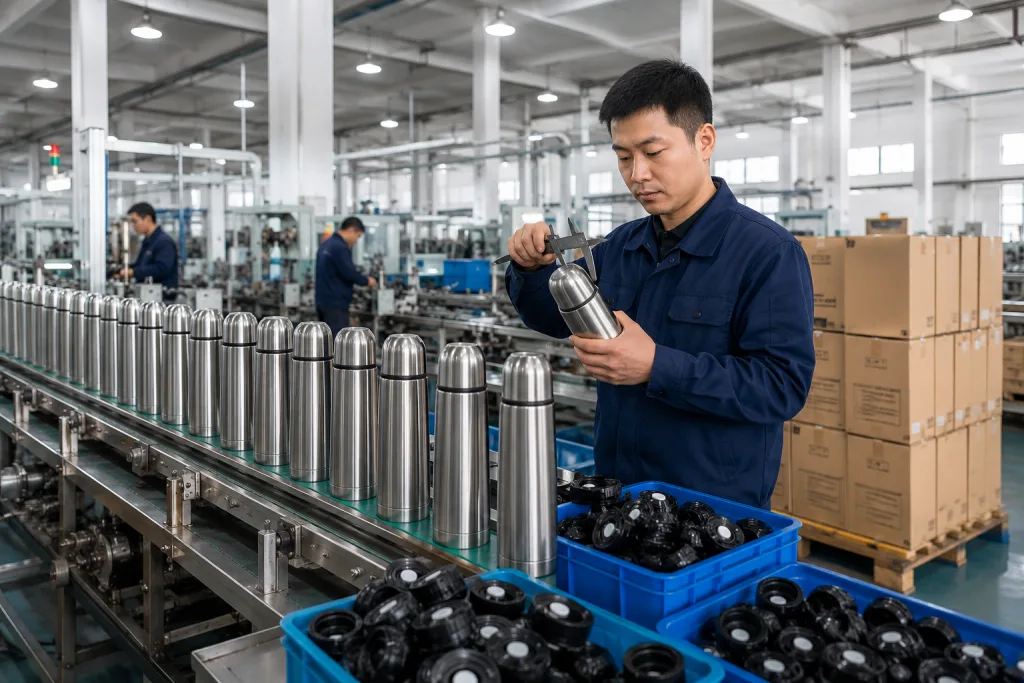
If you search for a polypropylene thermos bottle supplier, you are probably pricing more than PP. You are testing whether a cheaper insulated bottle can match a custom 304 stainless thermos on shelf feel, heat retention, carton weight, and margin. We run this 15 to 20 times a month on RFQs: the buyer sends a PP target price, then asks for a stainless sample with laser logo, 500 ml capacity, and a retail color box. Wrong comparison. On our Hangzhou sample bench, the Mitutoyo caliper shows a 2.1 mm PP wall; the stainless vacuum body goes through drawing, welding, polishing, and leak testing on another line.
The wrong choice burns money fast. PP works for a giveaway job when the FOB target sits below USD 2.00. The math does not work if the buyer expects 304 stainless vacuum performance. In our Zhejiang factory, QC pulled a 600 ml stainless sample last month after 24 hours in the heat-retention test; the PP comparison piece was already cold. We logged 63°C vs room temperature on the test sheet. Outdoor retailers keep moving to stainless because the buyer picks up the bottle and feels the weight in hand. Promotional brands still ask for PP when the campaign budget is tight. Both can fit, but the job must be defined before tooling, artwork, and MOQ get locked; we have seen this go sideways when a PO says “thermos” but the approved sample is only a single-wall PP bottle.
The real comparison buyers face
A polypropylene thermos bottle supplier and a stainless thermos manufacturer are not quoting the same product, even when the CAD outline looks almost identical. PP usually wins on FOB cost and carton weight; our injection line can push promo bodies fast, and a 600 ml PP bottle often comes in under 135 g before packing. Stainless steel wins when the buyer is selling heat retention, heavier hand feel, dent resistance, and retail margin. For a low-cost promotional thermos at a 3-day event, PP is fine. Low risk. If the bottle carries an outdoor brand logo and has to survive one winter season without returns piling up at the retailer, stainless steel is the better call. We have seen this go sideways: one buyer checked only unit price, then their customer flagged the 6-hour heat-retention claim printed on the hangtag after a kettle test showed barely 3.5 hours.
This is the blunt comparison we use with new buyers after QC pulls the first sample, weighs it on the 0.1 g bench scale, and checks the lid thread fit with a go/no-go gauge:
| Spec point | PP thermos bottle | Stainless vacuum thermos | Better fit |
|---|---|---|---|
| Typical FOB China | USD 1.35-2.20 | USD 3.20-6.80 | PP for giveaways, stainless for retail orders |
| Insulation structure | Foam or air gap | Double-wall vacuum | Stainless |
| Heat retention | 2-4 hours practical | 8-18 hours depending capacity | Stainless |
| Common capacity | 350-600 ml | 350 ml to 1.2 L | Both |
| Branding | Screen print, IML, stickers | Laser logo, screen print, powder coat with emboss option | Stainless for premium logo |
| Retail shelf value | Low to medium | Medium to high | Stainless |
About 7 out of 10 outdoor retailers who contact us ask for a customizable thermos with a stainless body and polypropylene lid. That mix works. The drinking surface and thread parts can use food-grade PP, while the bottle body uses 304 stainless steel. We run this construction often because the lid tool keeps weight and cost under control, and the 304 body still gives the buyer a product they can price like outdoor gear. A 0.4 mm wall on the body with a PP screw lid is normal for Europe and North America orders from Zhejiang, China; last month QC rejected 38 lids from one trial run because the thread flashed at the parting line. Asking for a full stainless lid on a mid-price manufacturer thermos program is the wrong question. The math doesn't work unless the retail price can carry it.
Material choices and hidden tradeoffs
For a PP thermos, ask this before price: which PP grade is on the BOM, which COA proves the color masterbatch is food-contact safe, and whether hot water ever sits against a plastic liner. We check the masterbatch COA before the first color trial; one EU buyer flagged a missing food-contact page after our merchandiser had already typed the PO with the wrong color code, PMS 2995U instead of 2995C. Painful fix. For a stainless thermos custom project, the wrong question is “can you make it cheaper?” The right question is: what steel touches the drink? We run 304 stainless steel for the inner wall. Some low-cost thermos suppliers quote 201 stainless outside with 304 inside. That can work for price-sensitive promotional thermos orders under about 3,000 pcs, but for outdoor retail, 304 inner with 304 outer keeps the complaint math cleaner.
Wall thickness matters. No shortcut here. A real stainless vacuum flask usually has an inner wall around 0.30-0.40 mm and an outer wall around 0.45-0.55 mm before polishing or coating; our QC checks this with a digital micrometer before the body goes to powder coating. If the outer wall drops to 0.38 mm, dent claims rise after carton drop testing. If it goes past 0.60 mm, weight and FOB cost climb fast. A 500 ml bottle at 280-330 g is a normal retail range. A 500 ml PP insulated bottle may be 150-220 g. Too light feels cheap on the shelf, and the buyer usually flags it after holding the gold sample for ten seconds.
Lids kill about 6 out of 10 messy projects we see. PP lids are common even on stainless bottles, but seals should be LFGB-grade or FDA-grade silicone, not cheap TPE if the item will touch hot drinks. Ask your thermos factory for a lid torque check with a torque meter, a leak test at 45 degrees plus inverted position, and clear dishwasher guidance. Most powder-coated stainless bodies should be sold as hand-wash only unless testing supports dishwasher claims. We have seen this go sideways: the buyer printed “dishwasher safe” on 12,000 color boxes before the coating test came back with edge peeling near the bottom weld.
Do not let the word “customized thermos” hide basic construction. Steel grade, lid resin, silicone gasket spec, and coating thickness decide the complaint rate; QC pulled the sample for a reason.
Use-case fit for outdoor retail
Outdoor retailers should separate PP from stainless before anyone builds the line sheet. PP fits summer camp kits, USD 3.99 accessory bins, youth event giveaways, and bundle packs where the buyer is not asking for 8-hour heat retention. We have had buyers push back after PP was pitched as a winter hiking bottle. Wrong shelf. The math does not work. Put PP near lunch bags or entry-price seasonal bins, not beside insulated coffee gear. It should not be the hero item in ski shops, hunting stores, or premium camping sets where a customer fills it with coffee at 6 a.m., leaves it in a pack, then complains before lunch. One REI-style buyer flagged this exact issue on a sample call after the water dropped below 45 C before noon.
For an outdoor stainless thermos, we usually run three shelf jobs, not one generic bottle story. A 500 ml travel size fits day hikes and commuter racks; we run this with a 60-65 mm body diameter so it still fits most car cup holders. A 750 ml or 1 L bottle with cup lid works better for camping and cold weather because the filled weight is higher and the cap is part of the drinking method. A 350-450 ml compact bottle fits kids, school, and short trips, so the line gets extra checks on straw parts, bite valves, and lid torque. Different bottle, different test. The 1 L bottle needs tougher drop testing because the loaded weight can pass 1.3 kg. The kids bottle needs attention to straw components, small parts, and ASTM or CPSIA requirements if sold in the United States; QC pulled one sample last season because the silicone straw plug came loose after a 90-degree pull test.
If you are building a distributor thermos line, keep the first launch tight. Two capacities, three colors, one logo position, and one carton format are easier to control than eight SKUs with mixed lids and mixed cartons. Our Zhejiang production line can make about 450,000 stainless drinkware units per month, but mixed small batches still lose hours on powder changeover, pad-printing fixture setup, and carton label checks. A clean thermos bulk order of 3,000 pcs per color runs smoother than 500 pcs across six colors. We have seen this go sideways when a PO listed “sand beige” while the artwork file said “warm grey”; the line waited half a day for the buyer to confirm the Pantone. Half a day matters.
For retail packaging, stainless has the easier job. A matte powder-coated bottle in a kraft gift box or color box can support a stronger MSRP when the front panel shows capacity, 304 stainless, and hot/cold icons in plain view. PP usually needs low-cost packaging because the product itself cannot carry the premium claim. If your margin model depends on a USD 14.99-29.99 retail price, stainless gives you more room. We ship PP in simple white boxes or OPP bags for price programs; for stainless, a 350 gsm color box with an EPE insert can reduce corner dents that AQL 2.5 inspection will flag. The buyer sees the box first.
Branding methods side by side
A custom thermos is not just a bottle with a logo on it. Decoration changes unit cost, lead time, reject rate, and shelf value. PP bodies usually run screen print, heat-transfer print, or label. On our PP line, a 500 ml body with a 38 mm logo area needs a clean jig; if the clamp is loose, the print can walk 1-2 mm around the curve. We check that with a curved-position gauge before the operator loads the next tray. Molded-in color is also possible, but the MOQ is usually higher because the resin, masterbatch, and molding setup are tied to your order.
Stainless steel gives buyers more branding choices. Laser engraving is clean and durable, especially on powder coating, but it is one-color by nature because it cuts down to the metal or underlayer. Silk screen printing fits simple logos and keeps cost low at scale. QC pulled one matte-black sample last month because the white ink edge broke near the weld line. Heat transfer or water transfer can handle larger graphics, but approve abrasion testing before mass production; 3M tape and 500-cycle rub tests catch problems before cartons leave Hangzhou. For premium custom thermos programs, embossed stainless badges or debossed silicone grips work, but tooling may add USD 300-900 depending complexity. The math does not work on a 500 pc trial unless the buyer accepts the tooling spread.
Typical decoration costs from China are simple to quote when the artwork is clean. One-position laser engraving may add USD 0.12-0.35 per pc. One-color silk screen may add USD 0.06-0.18 per pc after screen setup. Full-color heat transfer can add USD 0.25-0.70 per pc. We run these quotes by position, not by "one logo," because a front mark plus a back slogan means two setups on the job sheet. Small detail. Big cost difference. Before opening the screen, we check the AI file size, Pantone code, and print height in mm; last quarter one PO showed 42 mm on the artwork and 48 mm in the email thread. If your promotional thermos budget is fixed, decoration can decide PP vs stainless.
For outdoor brands, we usually push back on over-decorating the first order. Pick a coating that fits your shelf, apply the logo cleanly, and spend the balance on insulation and leak performance. Simple sells. A thermos promotional campaign may need bright all-over graphics, but a retail outdoor bottle often sells better when it looks restrained and reliable. We have seen this go sideways when a buyer approved a 6-color mountain wrap, then flagged scratches after the first carton drop test. QC marked 7 scratched pcs out of the first 80 after the 60 cm drop, and the line had to stop for a recheck.
MOQ, price, and production timing
A thermos quote can look clean in the first email, then get messy once the buyer adds color, logo, and gift-box requests. Split MOQ into four lines: bottle MOQ, color MOQ, logo MOQ, and packaging MOQ. No shortcut here. In our Hangzhou stainless programs, a standard model from an existing mold starts around 1,000 pcs per order. Standard colors can be mixed at 500 pcs per color when the warehouse has shells on the rack; our stock sheet shows finish code, carton balance, and last QC status, not just “available.” Pantone powder coating is closer to 3,000 pcs per color because the coating line loses powder during gun cleaning and booth washdown. Last month QC pulled 46 pcs with dust spots after a rushed color change, and the line had to wipe the booth filters before restarting.
PP molded items run on different math. Existing molds with standard colors sit at 2,000-3,000 pcs. Ask for a new lid shape or an exact Pantone resin color, and the MOQ can jump to 5,000-10,000 pcs because the injection machine needs a stable run after purging the barrel. Tooling for PP parts can run from USD 1,500 for a simple cap insert to USD 8,000 or more for a full bottle set. Stainless tooling is often lower for logo fixtures but higher if you change body shape. Here is our pushback: if the buyer wants 800 pcs with a private PP lid mold, the math doesn't work. The mold room will still cut steel, test T0 samples, and adjust the 0.2 mm lid fit with a plug gauge on the bench.
Lead time needs to be built line by line. A stock sample can ship in 3-5 days. A decorated sample normally takes 7-10 days after artwork confirmation, and we start counting only after the AI file, logo size, and print position are signed off. No file, no clock. Mass production is commonly 25-35 days after sample approval and deposit. Add 3-7 days for final inspection, carton marks, palletizing, and export booking. We have seen this go sideways when a PO typed "matte black" but the approved sample was "sand black"; the buyer flagged it at pre-shipment inspection, not during sampling. QC had the signed sample on the table, but the carton label followed the PO typo, so 38 cartons needed new side marks before loading.
Price should be quoted with trade terms. FOB Ningbo or FOB Shanghai is common for Zhejiang suppliers thermos exports. EXW can look cheaper by USD 0.08-0.15 per pc on paper, but it leaves local trucking, customs paperwork, and export coordination on your side. For new buyers, FOB is cleaner. We ship more repeat orders that way, especially when the forwarder asks for VGM, SI cut-off, and pallet size two days before closing. One late VGM form can miss a vessel, and then your “cheaper” EXW quote loses 12 days vs 18 days on the sailing plan.
Compliance checks before purchase orders
For Europe and North America, compliance is not a quote decoration. For stainless and PP drinkware, ask the thermos vendor for food contact reports that match the sales market and the exact part touching the drink. Europe usually means LFGB and EU 10/2011 for plastics, with REACH screening on coatings and outside trim. The United States means FDA food contact compliance, CPSIA for children’s products, and ASTM checks when the age grade or product claim triggers them. We see this 6 times a quarter: the buyer approves 304 stainless steel for the inner cup, then QC checks the BOM and finds the PP lid resin grade is not the same grade named on the EU 10/2011 report.
A practical inspection plan needs AQL written into the PO. Put it in black and white. For drinkware, most of our export buyers set AQL 2.5 for major defects and 4.0 for minor defects, with critical defects at zero tolerance. Critical means a sharp burr on the drinking rim, black contamination inside the liner, leakage at the lid thread, unsafe small parts, wrong material, or missing warning labels where the market requires them. For vacuum bottles, add insulation testing from each production batch. We fill the sample with 95°C water, lock the lid, record the temperature after 6 hours with a probe thermometer, then compare it with the approved standard sample. Simple test. It catches weak vacuum before 3,000 pcs are packed.
Ask for a pre-production sample made from actual materials, not a “similar sample” pulled from the showroom shelf. The sample should use the final coating and logo, the final lid gasket, and the final retail pack with barcode and FNSKU label if you sell through marketplace fulfillment. If you use Amazon FBA, check carton size, gross weight, suffocation warnings for polybags, and scannable labels before goods leave China. We have seen this go sideways over one PO typo: 15.2 kg written as 12.5 kg, then the forwarder flagged the carton data at booking. The line was ready. Shipping lost 2 days.
Factory audits matter, but this is the wrong question to ask if you treat the audit as a shield. BSCI, Sedex, or ISO 9001 does not guarantee a perfect bottle; it only shows how the factory controls labor records, document flow, and production process. A serious thermos manufacturers partner will not get defensive when you ask for test reports, audit documents, and batch traceability from stainless coil to finished carton. On our line, QC pulled a sample last month because the laser logo position moved 2 mm after the fixture was changed. If a supplier avoids the compliance question, the risk is usually hiding in the price, and the math does not work after one failed inspection.
Choosing your supplier path
If the order is for one event and the buyer is squeezing landed cost, a polypropylene thermos bottle supplier is usually the right fit. Keep it simple: stock body, one-color pad print, no heat-retention promise. We run PP jobs best when the quantity is high enough that the injection line is not stopping every 40 minutes for a color change or logo plate swap. For a 3,000 pcs school campaign, charity run, or budget corporate gift, PP can do the job.
If you are building an outdoor bottle line with repeat POs, choose a stainless thermos supplier that already runs vacuum production and coating control, with export paperwork handled before booking space. Ask for steel grade, vacuum failure rate, salt spray testing hours, coating adhesion, carton compression, and AQL; if the answers stay soft, the math does not work. We run leak tests with 95°C water, and QC pulled the sample more than once because the lid thread was 0.3 mm off. A trading company can push through a quick order, but distributor thermos programs need factory feedback from the line, especially when the buyer flags cap wobble after the first retail drop test.
The decision rule is simple. Choose PP when price beats performance. Choose stainless when the end user will judge heat retention and brand feel after 30 days of use. For 7 out of 10 promotional brands we quote, the better middle path is a stainless bottle with a PP lid and a controlled logo process, usually laser marking or a fixed-position screen print checked with a 0.5 mm alignment tolerance. It looks cleaner than a full PP bottle and avoids a custom mold that can add 12 days to sampling.
Before you place a thermos customized order, send one clean RFQ: capacity, target FOB, market, compliance needs, color, logo method, packaging, annual forecast, and required delivery date. A serious manufacturer thermos team in Zhejiang, China can quote realistic options after checking coating stock, carton size, and the current line schedule. We ship cleaner when the spec sheet matches the PO. We have seen this go sideways from one typo on a PO, like 500 ml written as 350 ml, so confirm the spec sheet before you approve the cheapest sample.
Send your thermos RFQ for factory review
Share capacity, logo, packaging, target FOB, and delivery date. We will suggest PP or stainless options that fit your market.
Frequently asked questions
Is a polypropylene thermos bottle suitable for outdoor retail?
Only for low-price or light-use programs. A PP thermos bottle usually provides 2-4 hours of practical heat retention, depending on wall structure and lid design. For hiking, camping, ski, or winter retail, stainless vacuum construction is much stronger. A 500 ml stainless bottle can often hold useful heat for 8-12 hours if the vacuum is stable and the lid seals well. Outdoor shoppers also expect a more solid hand feel, so a 280-330 g stainless bottle normally supports a better retail price than a 150-220 g PP bottle.
What MOQ should I expect for a custom stainless thermos?
For an existing stainless thermos mold, expect MOQ around 1,000 pcs for a simple logo order. If you need Pantone powder coating, many factories require 3,000 pcs per color because of coating line setup and powder waste. For custom packaging, 1,000-2,000 pcs is common, but special color boxes may need 3,000 pcs. If you change the bottle shape or lid mold, tooling and MOQ increase quickly. For PP custom molded parts, MOQ can reach 5,000-10,000 pcs depending resin color and tooling complexity.
What is the normal FOB price difference between PP and stainless?
A standard PP insulated bottle may quote around USD 1.35-2.20 FOB China in bulk, before complex printing or special packaging. A stainless vacuum thermos usually starts around USD 3.20 and can reach USD 6.80 or more depending capacity, steel grade, coating, lid design, and decoration. A 1 L stainless bottle with cup lid costs more than a 500 ml travel bottle because steel weight, vacuum processing, and carton volume all rise. Always compare landed cost, not only FOB, because cartons for large thermos bulk orders affect freight.
Which logo method is best for promotional thermos orders?
For PP promotional thermos orders, one-color silk screen is usually the lowest-risk choice. It is cheap, fast, and suitable for simple event logos. For stainless, laser engraving is the most durable and often adds about USD 0.12-0.35 per pc depending logo size. Silk screen can cost less, around USD 0.06-0.18 per pc, but abrasion resistance depends on ink and coating. If you need full-color artwork, heat transfer works, but approve a decorated sample and rub test before mass production. Do not choose decoration only by sample appearance.
What tests should I require before shipping stainless thermos bulk orders?
At minimum, require leakage testing, vacuum insulation testing, coating adhesion, visual inspection under AQL, carton drop or compression checks, and food contact documentation. Many buyers use AQL 2.5 for major defects and 4.0 for minor defects, with zero tolerance for critical defects such as sharp edges or serious leakage. For insulation, fill bottles with 95°C water and record temperature after 6 hours against the approved sample. For Europe, ask about LFGB, EU 10/2011 for plastic parts, and REACH. For the US, request FDA food contact support and CPSIA if children use the bottle.