Key Takeaways
- Start RFQs with capacity, steel grade, PP resin, insulation target, logo method, carton pack, and AQL 2.5/4.0
- A practical custom thermos MOQ is 1,000-3,000 pcs per color, with 25-35 day bulk lead time after sample approval
- PP parts should be food-contact grade, BPA-free, odor checked, and matched to LFGB, REACH, or FDA requirements
- Your PO should separate tooling, pre-production samples, bulk goods, spare lids, packaging, inspection, and FOB China terms
If you search for a polypropylene thermos bottle manufacturer, you are usually trying to make two materials behave as one product: food-contact PP parts and a stainless vacuum body that survives retail shelf handling, a backpack drop, and the first return claim. We see it 3 or 4 times a month. An outdoor buyer asks for a 280 g lightweight bottle in 6 colors at a low target price, then the heat-retention line on the PO calls for 304 stainless steel, copper plating, and a PP lid that passes a -10°C freezer test with no hairline cracks. Nice spec. Tough math.
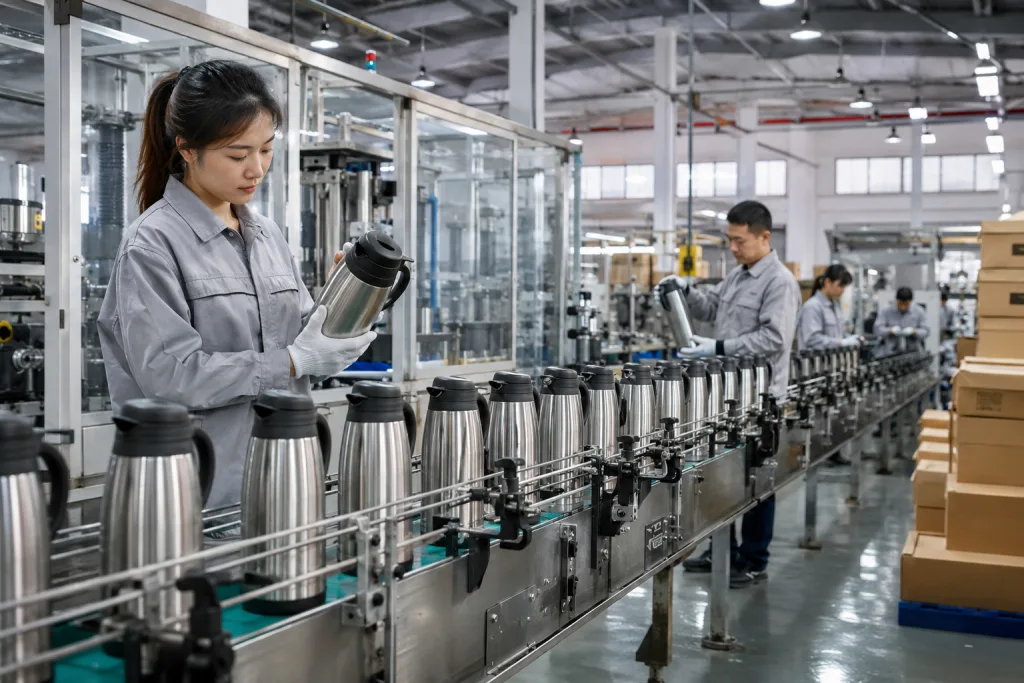
That mix is normal in China manufacturing. Our Hangzhou, Zhejiang team runs stainless thermos programs with PP lids, handles, straws, buttons, and outer shells, usually from a 1,000 pcs color MOQ per SKU. The hard part is not finding a thermos supplier. Wrong question. The hard part is writing a PO that blocks wrong steel grade, weak silk-screen ink, loose caps, and late cartons; last month QC pulled the sample after a 0.6 mm lid gap failed the leak test on the pressure jig, and the buyer flagged a missing Pantone code on the same PO.
Start With The Real Bottle
A clean RFQ saves more money than another 3% squeezed in negotiation. If a buyer asks for a polypropylene thermos bottle manufacturer, we ask one thing first: what bottle are we quoting? Fully PP means a single-wall plastic drinking bottle. Stainless with a PP outer shell means a metal liner inside a plastic body. Stainless vacuum with a PP lid and handle means an insulated thermos. Do not put these SKUs under one drawing name. A fully PP bottle is not a vacuum thermos. It is fine for gym use or a giveaway campaign, but it will not keep 65°C water for 6 hours without a stainless vacuum body inside. We see this mistake about 8 times a month; last week QC pulled a line sample, checked the cut edge at the mouth, and the “thermos” had no vacuum layer at all.
For outdoor retail, we run 304 stainless steel inner wall, 201 or 304 outer wall, vacuum insulation, and injection molded PP parts for the lid, handle, or base. For promotional thermos programs, we ship 350 ml, 500 ml, 750 ml, and 1,000 ml most often. Wall thickness is usually 0.4-0.5 mm for the inner tank and 0.45-0.6 mm for the outer body, depending on shape and dent resistance. The caliper tells the truth. One buyer asked us to keep the same dent resistance after cutting the outer body to 0.38 mm; the math didn’t work, and the first 1.2 m drop-test sample showed a flat spot near the shoulder.
Your first PO line items should be simple and measurable:
- Product: 500 ml stainless vacuum thermos with PP screw lid
- Material: 304 inner, 201 outer, food-grade PP lid, silicone gasket
- Performance: 95°C water above 55°C after 6 hours at 20°C room temperature
- Logo: one-color silk screen, 70 x 45 mm print area
- MOQ: 2,000 pcs per color, 4,000 pcs total
- Trade term: FOB Ningbo or FOB Shanghai, China
This is where a solid thermos factory should push back if the target price fights the structure. A 1,000 ml bottle with a wide mouth, short height, plastic cup lid, and low price will not insulate like a narrow 500 ml flask. Wrong question. The buyer should ask whether the structure can pass the heat test at the quoted cost. We’ve seen this go sideways: 4,000 pcs packed in export cartons, carton mark approved, PO showed “PP thermos” instead of “stainless vacuum thermos,” then the buyer flagged customer returns after the first retail shipment.
Build An RFQ That Factories Respect
Last quarter, 38 RFQs landed in our inbox with only “custom thermos, send best price.” That is not an RFQ. It gives you soft pricing, then a fight after the buyer flags a missing color box, logo charge, or inner carton. A manufacturer thermos quote should break out tooling charge, mold status, packing style, test cost, sample fee, logo setup, and production time as separate lines. No separate lines, no clean comparison. If those items are missing, the math doesn’t work; you are comparing supplier thermos offers built on guesses, not the same spec. We had one PO typo last month: “1 color logo” in the email, “2 sides” in the attachment. QC caught it, but costing was already wrong.
For a customized thermos, freeze the technical package before asking for USD pricing. Send a drawing or reference photo with target capacity; lid style and drinking method; surface finish; logo process with color count; sales market with annual forecast. Use mm, not “about this size.” Our engineer still checks the cup mouth, thread, and lid fit with a Mitutoyo digital caliper before costing, because 0.3 mm at the seal can decide whether the sample leaks. If you sell to Europe, ask about LFGB, REACH, and food-contact migration. If you sell in North America, ask about FDA food-contact material, CPSIA if children may use it, and ASTM-related packaging or labeling needs when applicable. Asking “best price” first is the wrong question to ask.
A proper RFQ for thermos bulk buying should request:
- FOB unit price at 1,000 / 3,000 / 5,000 pcs, with the port named clearly, usually Ningbo or Shanghai for our line
- Sample cost and sample lead time, normally 7-12 days for available molds, after artwork is confirmed in AI or PDF
- Bulk lead time after approval, normally 25-35 days for standard items, counted from deposit and signed sample
- Carton size, gross weight, and units per carton, so your forwarder is not guessing CBM from a photo
- Logo method options: silk screen for simple artwork; laser engraving when the buyer wants 304 stainless exposure; heat transfer for full-color marks; powder coating plus engraving for retail sets
- AQL inspection level, usually General II with Critical 0, Major 2.5, Minor 4.0, and note whether you need drop test or leakage test in the final report
At BottleForge Industrial in Zhejiang, our monthly stainless thermos capacity is about 450,000 units across standard molds. That number is real. It does not mean every custom thermos can ship tomorrow. Powder coating colors, injection molded PP parts, and retail packaging all fight for the same line time; last month QC pulled a sample because the PP lid gasket sat 0.6 mm high and failed the leak test. For promotional thermos orders tied to an event date, lock artwork and deposit at least 45-60 days before the delivery deadline. We’ve seen this go sideways when a PO says Pantone 186C but the artwork file says 185C.
Confirm PP Parts Before Samples
PP parts need checking earlier than 8 out of 10 buyers schedule it. Stainless steel gets the premium story, but the lid is what the user touches, smells, drops, and photographs when it cracks. On our line, we check lids with a Shore A gasket gauge, a 0.01 mm digital caliper on the thread start, and a 24-hour closed-carton odor check. A polypropylene thermos bottle manufacturer should confirm the PP grade, color masterbatch code, gasket material, and lid assembly method before samples leave the line. “Food grade” is not a spec. No joke. Without documents and a controlled material-change record, the math doesn’t work for retail compliance.
Ask whether the PP is virgin material, recycled material, or a blend, then put the answer on the sample sheet. For food-contact lids, we recommend virgin PP unless the item is non-food-contact and your compliance consultant approves the other option in writing. Outdoor bottles need temperature and impact checks. A lid that passes at 23°C can turn brittle at -10°C. For ski and camping retail, request a low-temperature drop check from 1.0 m with the bottle filled to 90% capacity. QC pulled one sample last winter after the push button split at the 2.6 mm hinge pin, even though the same lid looked fine on the bench.
Your sample PO should separate the parts so nobody guesses. Short lines help. Last month a buyer wrote “black lid” on one line, then flagged the sample because they expected a matte black PP lid with a glossy silicone carry loop. We’ve seen this go sideways. Put each part in writing:
- Sample line 1: 3 pcs existing mold stainless thermos, black PP lid, no logo
- Sample line 2: 3 pcs with custom logo, selected print method
- Sample line 3: PP color chips, 3 options matched to Pantone reference
- Sample line 4: silicone gasket sample and spare lid assembly
- Document line: material declaration for stainless steel, PP, silicone, coating
This is where you decide if custom tooling makes sense. A new PP lid mold can cost USD 1,500-6,000; sliders, thread complexity, a drinking button, and a leakproof lock all add steel work. A full new stainless body mold set can be higher. If your forecast is only 1,000 pcs, this is the wrong question to ask. Use an existing thermos factory mold and customize color, logo, sleeve, or packaging instead. We ship faster that way, often 12 days for samples vs 18 days for fresh lid adjustments, and the first article check is cleaner because the thread gauge, torque test, and leak test already have production history.
Approve Samples Like A Buyer
Sample approval is not “looks good.” Treat it like a small pre-shipment inspection on 3 to 5 pieces. We put each sample on a 0.1 g digital scale, fill it to rated capacity, check height and body diameter with a caliper, then test lid thread fit, logo position, print adhesion, odor, leakage, and insulation. Don’t skip threads. QC pulled one 500 ml sample last month where the lid felt smooth by hand, but the thread gauge showed a 0.4 mm mismatch. That one would have leaked in a backpack after two subway rides. Seal one approved sample in your office and ask the factory thermos team to keep one golden sample at the line, preferably in a carton sleeve with the version label taped on. When the buyer flags a dispute, the golden sample beats memory.
For insulation, use one fixed method. Fill the thermos with 95°C water, close the lid within 60 seconds, place it in a 20°C room, and record temperature after 6, 12, and 24 hours. A typical 500 ml stainless thermos can be specified as above 55°C after 6 hours and above 40°C after 12 hours, but neck size and lid structure change the result. We run wide-mouth outdoor food jars on a different curve from narrow-mouth travel flasks, because the heat loss at the mouth is not the same. The math does not work if the buyer compares a 78 mm food jar mouth with a 42 mm travel flask mouth. Ask for the test sheet with room temperature, start time, and probe model written on it. No guessing.
For logo durability, silk screen should pass a basic 3M tape pull test after curing. Laser engraving should show clean edges without rust marks, especially around the lower curve where polishing marks hide. Powder coating needs a check for orange peel, scratches, and coating thickness consistency; our QC usually checks 5 body points with a coating thickness meter. On the line, we also look at the bottle shoulder under a white LED inspection lamp, because small coating skips hide there after tumbling. If you plan Amazon or retail distribution, scan the barcode on the gift box and master carton before bulk production, not after the container is packed. We have seen this go sideways from one wrong FNSKU digit on a PO.
Your sample approval PO amendment should state:
- Approved sample version and date, such as V2 signed on March 18, matching the sticker on the sealed sample bag
- Final Pantone color or physical color chip kept with the sealed sample, not a phone photo from a meeting room
- Logo artwork file name and print size, measured in mm on the bottle body with the same caliper used by QC
- Packaging dieline version, barcode, FNSKU if needed, with one scan record attached from the gift box and master carton
- Accepted variance, such as capacity ±5% and logo position ±2 mm, written before the line starts packing
A serious thermos manufacturer will accept this discipline. It protects both sides. Zhejiang factories move fast, but this is the wrong place to save 1 day. Speed without a signed sample standard creates rework, repacking labor, and arguments nobody budgeted for. We ship better when the approved sample, PO amendment, and QC checklist say the same thing.
Write The Bulk PO Properly
The bulk PO is where 8 out of 10 custom thermos disputes start. If the PO says “500 ml blue bottle, logo as sample,” the buyer thinks the order is fixed. On our side, the clerk still has open boxes to tick: carton layout, gasket color, lid PP grade, and whether the outer shell is 201 or 304 stainless. Bad wording burns money. We once stopped the line for 6 hours because the PO missed the lid spec, and the line leader had to compare the signed sample with the PP lid bin card before packing could restart. Your PO should read like the production sheet clipped to our line board before the first carton is opened.
For a distributor thermos or promotional thermos program, keep commercial items separate from technical items. Commercial terms cover price, order quantity, payment dates, shipment port, and late-delivery penalties with calendar dates, not “ASAP” or “around May.” Technical terms should name the material grade, surface finish, logo method, retail packaging, test standard, inspection level, and spare parts packing. If you buy from thermos suppliers in China, write clearly whether the price includes export carton, pallet, inner box, polybag, desiccant, instruction sheet, and compliance labels. We once had a buyer flag a missing “recyclable PP” mark after QC pulled the pre-shipment sample; the artwork file showed it, but the PO did not, so purchasing never ordered that 18 mm label roll.
A strong bulk PO layout looks like this. We run this style because purchasing checks cost lines, while production and QC check specs against the sample card on one page. The USD 0.28 color box line is not free, even though buyers sometimes treat it that way:
- Line 1: 5,000 pcs 750 ml stainless vacuum thermos, 304 inner, 201 outer, PP lid, matte powder coating, FOB Ningbo, USD 4.85/pc
- Line 2: one-color logo silk screen, two positions, included in unit price
- Line 3: retail color box, E-flute insert, barcode sticker, USD 0.28/pc
- Line 4: spare PP lids, 2% of order quantity, packed separately
- Line 5: third-party inspection, AQL General II, Critical 0, Major 2.5, Minor 4.0
- Line 6: lead time 30 days after deposit and final artwork approval
Payment is normally 30% deposit and 70% before shipment for first orders. Established distributors thermos buyers can negotiate OA terms later, but asking for credit on a first custom order is the wrong question to ask. The math does not work when steel, PP resin, cartons, and printing plates are all prepaid on our side. If your order must meet BSCI, ISO 9001, or retailer factory audit requirements, confirm before deposit. Audits cannot be built during final inspection week. We have seen this go sideways when the auditor was measuring logo position with a 0.5 mm tolerance gauge and QC had 80 packed cartons waiting at the dock.
Control Production Before Cartons Close
Control the order while the line is still running. Ask for a pre-production sample made from the same 304 stainless coil, PP lid resin, silicone ring, powder coat, and color box paper used for bulk production. Do not accept a polished showroom sample from last season. Ask for line photos at three points: raw stainless bodies before coating, printed bottles before packing, and packed cartons with shipping marks. Basic step. It still catches 7 out of 10 avoidable mistakes we see, including one PO last month where the buyer typed “matte black” but the approved sample tag said “sand black.” The line leader caught it only after comparing the tag under a D65 light box.
For thermos custom orders, the risk sits in five places: vacuum failure, coating scratches, wrong logo size, lid leakage, and carton damage. A failed vacuum will not always show on the table. We run a hot water or temperature decay check by batch, with the probe reading logged after 6 hours on a simple Excel sheet beside the welding station. Test 2-3 pcs per welding batch internally, then have the third-party inspector pull random samples during final inspection. Leak tests should include inverted standing for 30 minutes and shake testing for drinking lids. QC pulled the sample twice last quarter because a flip lid passed standing but leaked after 20 hard shakes. Small leak, big claim.
Outdoor retailers should push packaging harder than promotional buyers. A bottle sold through specialty retail gets handled by the DC, placed on shelf, shipped online, and sometimes returned by the consumer, so the carton takes more hits than the product photo suggests. Use a 5-ply export carton for heavy 1,000 ml thermos bulk orders, with carton gross weight preferably below 15 kg. For e-commerce, run individual drop testing with ISTA-style logic, even when a formal ISTA report is not required. The math doesn't work if you save USD 0.18 on a thinner carton and then get 2% crushed corners after UPS handling. We ship enough 1,000 ml bottles to say this plainly: weak cartons are not a saving.
Your inspection booking should specify:
- Inspection date after 80-100% goods finished and at least 80% packed
- AQL level and defect classification list, with logo scratch over 3 mm marked as major if it faces front
- Function tests: leak, insulation, lid torque, barcode scan, carton drop where needed
- Reference sample and approved artwork available to inspector, including Pantone card or signed color chip
- Shipment hold until written inspection release
A thermos vendor that resists inspection is a warning sign. Good China manufacturers thermos teams know a USD 250-350 inspection is cheaper than sorting 5,000 bottles after arrival. We have seen this go sideways: one buyer skipped final inspection, and the line had packed 126 cartons with the old shipping mark before anyone caught it. The buyer flagged it after photos arrived at 9 p.m., too late for a clean repack without losing 2 days.
Ship With After-Sales Data
After the cartons close, sourcing is not finished. We check the packing list against carton side marks, confirm the HS code, save container loading photos, and record spare lids or silicone gaskets by SKU. Last month QC pulled one sample carton with a cutter and a counting sheet: packing list said 48 pcs, outer carton printed 50 pcs. Small typo. Big customs headache. Stainless vacuum bottles are declared as stainless steel vacuum flask in some markets, while other ports use a local line item, so let your freight forwarder or customs broker confirm the HS code for that destination. Do not copy a code from a 2022 shipment and hope it passes. We have seen that go sideways.
For FOB China shipments, the supplier thermos factory delivers to the named port warehouse or terminal according to the booking. From our Hangzhou line, Ningbo and Shanghai are the normal ports for Zhejiang drinkware production. Factory-to-port lead time is 1-3 days, but a booked truck with a 9.6 m trailer can still lose half a day if the driver waits for the VGM slip or the warehouse cuts off at 16:30. This happens. Space and holiday congestion are easy to forecast. Customs inspection is not. Around Chinese New Year, plan an extra 20-30 days or place orders before December, because the line staff leave before the office calendar says so.
Ask your thermos supplier for a shipment file within 48 hours of loading. It should include the commercial invoice and packing list, bill of lading draft with shipper details checked, carton photos showing side marks, loading photos, final inspection report, and material declarations. We shoot the photo set beside the loading bay scale; buyers often ask later whether mixed PO cartons were separated. If you are a promotional brand shipping to 6 campaign locations, request carton numbering by PO or SKU before mass packing starts, not after the first 300 cartons are taped. If you are an outdoor distributor, keep defect feedback by SKU, lid type, and production batch. That data makes the next manufacturer thermos order easier to quote and easier to control.
For reorder planning, watch real sell-through and warranty claims. If lid leakage is 0.4% and coating scratches are 0.7%, you have usable information. If the only report is “customers like it,” the math does not work for the next customizable thermos. The buyer flagged this once after 12,000 pcs shipped: two lid complaints came from one batch with a 0.3 mm gasket gap, not from the bottle body. Good programs get boring in the best way: stable molds, controlled PP parts, repeat cartons with the same ECT spec, predictable 30-day production, and fewer surprises every season.
Send Your Thermos RFQ For Engineering Review
Share capacity, lid style, logo, target market, and quantity. We will reply with practical MOQ, FOB pricing, and sample steps.
Frequently asked questions
Can a polypropylene thermos bottle keep drinks hot like stainless steel?
Not by itself. PP is useful for lids, handles, cups, straws, and sometimes outer shells, but it does not create vacuum insulation. A real hot-water thermos normally uses double-wall stainless steel with vacuum insulation, often 304 stainless inside and 201 or 304 outside. PP parts can still be critical because they affect leakage, drinking comfort, odor, and impact resistance. If you want a 500 ml bottle to stay above 55°C after 6 hours, specify a stainless vacuum body with food-grade PP lid and silicone gasket. If your product is only molded PP, treat it as a sports or promotional bottle, not a high-performance thermos.
What MOQ should I expect for a custom stainless thermos with PP lid?
For existing molds, a realistic MOQ is usually 1,000-3,000 pcs per color, depending on coating color, logo process, and packaging. At BottleForge Industrial in Zhejiang, many standard stainless thermos projects start at 2,000 pcs per color and 4,000 pcs per PO for efficient production. If you need a new PP lid mold, the factory may ask for a larger forecast because tooling setup, injection trials, and color matching add cost. For a first promotional thermos order, use an existing mold, then customize powder coating, logo, sleeve, gift box, or carton marks before investing in new tooling.
How much does a bulk thermos order cost from China?
For standard stainless vacuum bottles, FOB China pricing often ranges from about USD 3.20 to USD 7.50 per piece for 500-1,000 ml sizes, depending on steel grade, lid complexity, coating, logo, and packaging. A basic 500 ml bottle with silk screen logo may sit near the lower end. A 750 ml outdoor bottle with handle lid, powder coating, retail box, and spare gasket will be higher. Tooling, third-party inspection, compliance testing, and freight are usually separate. Always compare quotes at the same quantity, same packaging, and same trade term, such as FOB Ningbo, otherwise the cheapest thermos supplier quote may not be cheaper.
Which tests should outdoor retailers request before approving bulk?
At minimum, request leak testing, insulation testing, coating adhesion, logo adhesion, odor check, capacity check, and carton drop review. For insulation, use a written method: 95°C water, closed within 60 seconds, stored at 20°C, then measured after 6 and 12 hours. For lids, test inverted leakage for 30 minutes and shake leakage for drink-through caps. For Europe, ask about LFGB and REACH documentation for food-contact and chemical compliance. For North America, request FDA food-contact material declarations and any retailer-specific labeling. Use AQL General II with Critical 0, Major 2.5, Minor 4.0 for final inspection.
How long does sampling and bulk production normally take?
For an existing stainless thermos mold, plain samples usually take 5-7 days, and logo samples take about 7-12 days after artwork confirmation. If powder coating color matching is required, add 3-5 days. Bulk production normally takes 25-35 days after deposit, final artwork, and sample approval. Custom PP tooling can add 20-35 days for mold making, T1 trial, adjustment, and color matching. China holiday periods matter. Before Chinese New Year, many factories stop accepting new bulk schedules early, so place spring orders 60-90 days ahead if you cannot miss a retail or promotional delivery date.