Key Takeaways
- For new custom thermos orders, a realistic MOQ is 1,000-3,000 units per color depending on tooling and decoration
- 304 stainless steel is standard for the inner wall; PP is usually used for lids, handles, buttons, and outer trims
- AQL 2.5/4.0 inspection plus leak, vacuum, and coating tests should be agreed before deposit
- FOB China production lead time is usually 30-45 days after approved sample and packaging artwork
If you are searching for a polypropylene thermos bottle factory, you probably do not mean a plain PP cup. In 8 out of 10 RFQs we receive, the buyer is asking for a stainless vacuum thermos with PP parts: an outer lid shell, carry handle, straw cap assembly, push button, or inner stopper. The wording matters. On the line, a 0.2 mm gap between the PP stopper and silicone gasket can turn a good 304 stainless body into a leaking sample. QC pulled this twice last month during 100°C water testing, then checked the stopper lip with a digital caliper before we let the sample room remake it.
From Hangzhou, Zhejiang, we see buyers lose 5 to 7 days by asking each thermos supplier for “your best price” before they lock the basics: 500 ml or 750 ml capacity, screw lid or flip lid, laser logo or powder coating, and FDA or LFGB market. Wrong first question. Send the target volume, lid drawing, logo size in mm, and compliance requirement at the start. Then we can quote the right mold cost, run the sample, check the PO details, and ship from China without chasing a missing Pantone code or finding “750ML” typed as “705ML” on the order.
Start with the product architecture
The first call is product architecture: true vacuum stainless thermos, plastic insulated bottle, or a stainless body with PP functional parts. “Polypropylene thermos bottle factory” gets used loosely on RFQs; last quarter we had 11 RFQs using that phrase, and buyers meant 3 different products. In export drinkware, we usually ship a double-wall stainless body with food-contact PP on the parts people touch. The vacuum chamber holds temperature. PP does the hand work: flip lid for commuters, cup lid for outdoor sets, carry loop, straw port, lock button, or kids’ spout. Small parts matter. On our line, QC checks lid fit with a 0.10 mm feeler gauge because a small PP shrinkage change can turn into a leak complaint.
For outdoor retail, I would start with a 500 ml, 750 ml, or 1,000 ml stainless thermos, then choose the lid after the sales channel is clear. A typical build uses 304 stainless steel inner wall, 201 or 304 outer wall, 0.4-0.5 mm wall thickness before forming, vacuum insulation, copper plating when the heat-retention target is tighter, and PP lid parts with silicone sealing rings. For promotional thermos projects, 350 ml and 500 ml sizes sell cleaner because cartons stay under about 14 kg and the logo panel still looks strong. We run the 500 ml body on a hydraulic forming press, then the sample goes through vacuum testing before polishing. Not after logo printing. That sequence saves arguments when the buyer flags heat loss at the pre-shipment check.
The trade-off is simple. More plastic features feel convenient, but each button, hinge, and straw joint adds mold risk and another leak point. A one-touch PP lid works for a commuter custom thermos. A screw stopper is safer for camping and distributor thermos programs where one return can eat the margin on 20 units. For outdoor retailers, durability beats novelty. For corporate gifts, logo area and perceived function often carry the order. The math doesn't work if the lid is clever but unstable. We've seen this go sideways: one buyer pushed for a fancy push-button lid, then flagged 6 leaking samples during the 45-degree tilt test on the inspection table.
Ask your thermos factory for an exploded drawing before sample approval. You should see the steel grade, PP grade, silicone gasket position, lid thread type, and the surfaces that touch water or lips. If the supplier thermos quotation only says “stainless steel + PP,” the spec is too thin for a serious bulk thermos buy. Push back. This is the wrong place to save 10 minutes. On one PO we received, the buyer typed “PP lid” but forgot the stopper material, and QC pulled the sample because the gasket groove was 0.3 mm shallow against the approved drawing.
Choose capacity before chasing price
Capacity sets the cost before your logo file reaches our pad-printing desk. It changes steel weight, deep-drawing pressure, vacuum chamber loading, carton cube, freight, and shelf fit. Start here. A 1,000 ml outdoor bottle uses only a little more 304 stainless than a 750 ml body, but carton volume can jump 20-30%; last month QC measured a 1,000 ml master carton at 58 x 42 x 39 cm with a tape measure, and it broke the buyer's pallet plan. If you ship to North America by ocean freight, that gap is real money. Amazon FBA is stricter. Oversized cartons trigger handling charges that never appeared in the first quotation.
For most outdoor retailers, we run 750 ml to 1,200 ml. Those sizes fit hiking, fishing, truck, and campsite orders, and they still pass a basic grip check when the body diameter stays around 75 mm. For promotional brands, 350 ml to 600 ml is safer because gift buyers fight over unit cost and box size. The 500 ml factory thermos with powder coating and one-color logo is usually the cleanest pick: enough print area, stable carton packing, and fewer complaints from procurement. We once had a buyer type "5000 ml" on the PO instead of 500 ml. The line stopped. Nobody wants to mold a bucket by mistake.
Our rule with repeat buyers is simple: do not ask for five capacities unless you can carry the MOQ on each one. Small runs look flexible on paper. The math doesn't work. At BottleForge Industrial in Zhejiang, a common MOQ is 1,000 units for an existing stainless body with standard color, and 3,000 units when you need a custom molded PP lid color, new packaging, or a special coating. Some thermos manufacturers in China will quote lower, but ask one direct question: does that price include Pantone color checking under the light box, final inspection, and 5-layer export cartons?
FOB pricing moves with steel grade, surface finish, lid structure, and order size. As a working range, 500-1,000 ml regular stainless vacuum bottles often land between USD 3.20 and USD 7.80 FOB Ningbo or Shanghai. Cheap offers cut something. We have seen this go sideways: thinner outer wall, weak powder coating, basic carton, skipped individual leak test, or loose AQL control. QC pulled the sample after a 24-hour leak test once. One wet carton killed the saving.
Decide what must be polypropylene
Polypropylene is not trim. On a custom thermos project, PP decides odor, lip feel, lid strength, dishwasher wording, and the test file your buyer wants before deposit. We list food-contact PP on the BOM with resin grade, Pantone or masterbatch code, and the supplier name exactly as printed on the COA. EU and US buyers check those lines. For Europe, most importers ask for LFGB or EU food-contact declarations, plus REACH and RoHS where applicable. For the US, FDA food-contact requirements are the baseline, and children’s products may trigger CPSIA and ASTM-related checks. QC pulled one lid sample last year after a 70 C hot-water soak for 2 hours because the PP insert still had odor. The buyer flagged it before we did, which is never a good look on a pre-deposit sample.
PP works because it is light, tough, low cost, and clean in injection molding when the resin is dried and the gate position is right. Normal drink temperatures are fine. Boiling-water claims on flip lids are the wrong question to ask. Steam works on the hinge pin, button spring seat, and lock slider after repeated opening, especially when the customer flips the lid straight after filling. Silicone gaskets carry the seal load; PP holds the structure. If your customized thermos has a push button or folding handle, the PP resin and mold tolerance matter as much as the 304 stainless body. We run hinge gaps at about 0.15-0.25 mm on better lids. Once the gap goes wider, the line starts finding loose buttons during assembly, and QC will start writing the same note on every IPQC sheet.
The trade-off is tooling versus flexibility. Existing PP lids keep MOQ and lead time down, often 1,000-3,000 pcs with sampling in about 7-12 days when the color is standard. A new lid mold gives you a shape competitors cannot buy from the same catalog page, but it can cost USD 2,000-8,000 depending on cavity count, texture depth, slide structure, and testing. Tooling can take 20-35 days before production sampling. For a promotional thermos campaign with a fixed event date, use an existing lid. For an outdoor retailer building a private-label range, a custom lid can pay back after 2-3 repeat orders if the volume is real. We have seen this go sideways: one buyer approved a new flip lid 18 days before a trade show, then asked for color correction after T1 samples. The math does not work.
Ask your thermos manufacturer to confirm the PP color matching method. Pantone on plastic is not the same as powder coating on steel. A molded PP lid, silicone ring, and coated bottle body can shift under store lighting, especially with ivory, sage green, warm gray, or low-gloss black. For premium programs, approve a physical color chip and a pre-production sample, not only a PDF mockup. We check PP color in a D65 light box and compare the cap against the coated body after the sample cools for 24 hours. Fresh molded plastic can read half a shade different on day one, and we have had a buyer reject 2,400 lids because the PO said “warm grey” while the approved chip was closer to Pantone Cool Gray 3 C.
Branding method changes the risk
A customizable thermos is not a blank sticker sheet. The branding risk changes by surface finish, logo stroke width, MOQ, and the channel where the bottle will sit. For outdoor retail, we run laser engraving on powder coating because it survives pocket knives, car keys, and shelf scuffing better than ink. For promotional thermos orders, silk screen printing is still the cheapest stable choice for one- or two-color logos when the buyer is chasing a low unit price. Heat transfer can handle gradients, but QC needs an abrasion test with a 500g load before we trust the job. Full-wrap artwork looks good in a PDF. On a tapered 500ml body, we have seen the overlap drift 1.5mm at the seam and turn 300 finished pieces into rejects.
Laser engraving usually costs more than one-color print, but it removes the ink adhesion complaint and looks clean on matte coating. Silk screen is the right call for most budget campaigns above 1,000 units; below that, the screen setup charge bites. UV printing works for multi-color artwork, but some soft-touch coatings fail after an alcohol rub with a white cotton cloth. Test first. Before you confirm the thermos vendor, ask for cross-hatch adhesion results on your selected finish, then ask for the alcohol rub and 3M tape test photos. We had one buyer approve a black sample under office light, then flag the grey logo shade after QC pulled the sample beside the line under 6500K inspection lamps. That delay was avoidable.
Packaging is branding. Treat it that way. A distributor thermos going to retail needs a barcode, country of origin, warning text, capacity marking, and sometimes multilingual claims. A corporate gift may only need a white box or kraft box, but the PO should still state box size, logo position, and carton mark text. If you need FNSKU labeling, carton marks, pallet labels, or mixed-SKU packing, put it in the RFQ before we quote. Repacking in China after production is possible, but the math does not work: 12 days of relabeling and carton change can push an 18-day shipping window into missed delivery. We once found one digit wrong on a carton EAN code during final inspection, checked it with a handheld scanner, and the buyer paid for full carton sticker correction.
Our practical advice from Zhejiang: lock the artwork early. Production lead time of 30-45 days starts after approved sample and final artwork, not after the first email. If your purchasing team approves the bottle but marketing changes the logo one week later, the thermos suppliers cannot protect your delivery date. We run the line by approved files, Pantone number, print jig, and sample sign-off sheet; a late 3mm logo move is not a small change once coating and printing slots are booked. We have seen this go sideways.
Build testing into the quotation
A low unit price means nothing if 18 bottles leak inside one master carton. Put the tests into the quotation before we open tooling or buy PP resin. We run an inline water leak test with inverted bottles on the pressure bench, vacuum performance testing with a calibrated thermometer, 3M tape coating adhesion, 24-hour salt spray for metal accessories when the buyer specifies it, lid open-close cycle testing on the hinge jig, and carton drop testing from 76 cm. For a double-wall stainless thermos, heat retention is checked with hot water filled to the same shoulder line, room temperature logged at 20°C, and readings taken after 6, 12, or 24 hours. No guessing.
“Keeps hot all day” is the wrong quotation line. It starts arguments after shipment. Write the test method instead: 95°C starting water, 20°C ambient temperature, and a measured result after 12 hours. Last month QC pulled a 500 ml sample at 63°C after 12 hours, so we wrote 63°C on the spec sheet instead of polishing the claim. Different capacities and lid structures give different results. A wide-mouth food thermos loses heat faster than a narrow-mouth bottle because the lid area is larger and the PP stopper has more surface exposed; we have measured 8°C to 12°C difference on the same bench.
For inspection, about 7 out of 10 export buyers we work with use AQL 2.5 for major defects and AQL 4.0 for minor defects. Critical defects such as leakage, sharp edges, broken lid locks, wrong material, or unsafe contamination should be zero tolerance. For a distributors thermos order shipping to 3 countries, define cosmetic limits before the carton artwork is approved: scratches longer than 5 mm, color spots over 1 mm, logo position tolerance in mm, dent size by diameter, and visible welding marks near the bottom seam. Put it in writing. We have seen this go sideways when the PO says only “good finish”; the buyer flagged 2 mm specks on matte black powder coating under the light box, and the factory had no signed limit to point to.
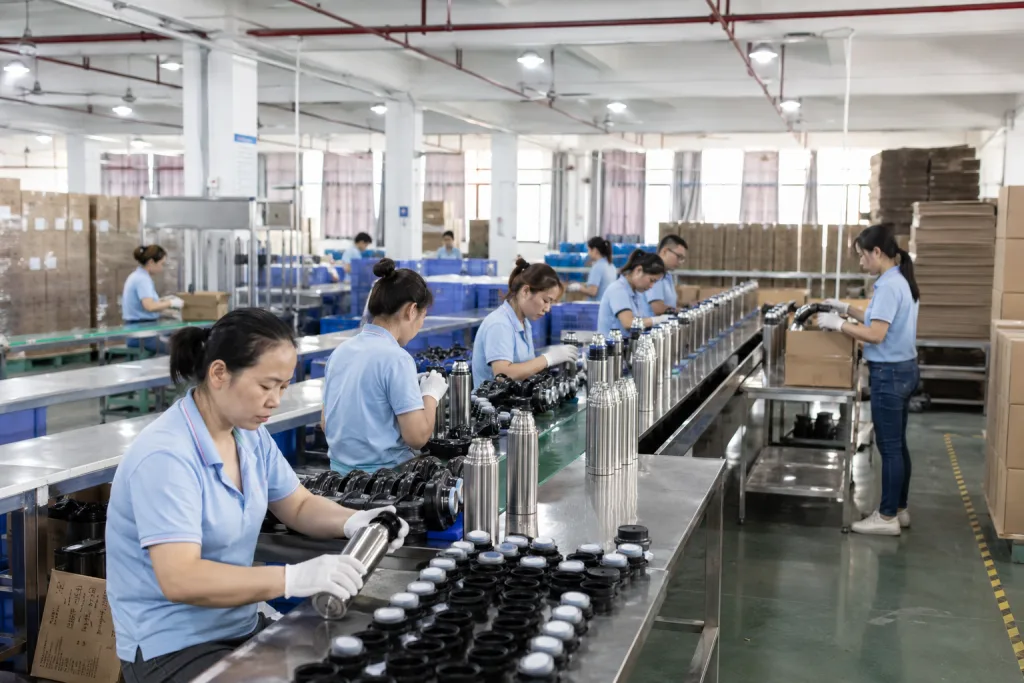
At BottleForge Industrial, our monthly drinkware output can reach 300,000 units across stainless bottles and travel tumblers with PP lids and accessories, but capacity does not replace process control. A serious thermos factory in China should share inspection photos, material certificates, and production checkpoints without making the buyer chase them for 4 days. We ship from Hangzhou, and the line records vacuum test readings by batch number before packing; one missed digit on a batch sticker can cost half a day in the warehouse. If a supplier avoids AQL language, treat it as a warning sign.
Compare suppliers on execution
Do not compare thermos manufacturers by FOB price alone. Compare what happens after the PO lands on the merchandiser's desk. Before we open the tooling file, we ask the awkward questions: target retail price, sales country, dishwasher wording, carton drop height, spare gasket ratio, GS1 barcode format, and adult or child use. Last month a buyer sent a PO with “kids bottle” in one line and a 500 ml straight stainless body in the artwork file. QC pulled the sample. The mouth edge radius and lid torque did not support the child-use claim, and our torque meter showed the lid opening above the agreed range. Say yes too fast, and the line pays for it later. We've seen this go sideways.
For outdoor retailers, ask whether the manufacturer thermos line can run repeat orders in the same color for 12-18 months. Powder coating can shift by 1-2 Delta E between batches. PP lid resin can move after a new color masterbatch lot, and silicone rings can change when the supplier swaps hardness from 55 Shore A to 60 Shore A. Shelf buyers notice. If your range depends on one olive green or matte black, put the color tolerance in writing and keep an approved master sample at the factory, not only in your office. We keep ours in a labeled sample cabinet beside the coating line, with the Delta E reading taped to the bag. Not in a sales drawer. For promotional brands, ask for the photo sample schedule. Seven to ten days is normal for an existing bottle with laser logo. Fifteen to twenty days is more realistic for custom color coating and printed box, because the coating line needs a trial panel before we run bottles.
Audit documents help, but they do not seal a lid. BSCI, ISO 9001, and factory social compliance reports tell you something about the plant. They do not tell you whether your stopper leaks after a 45-degree tilt test. You still need sample approval, signed specifications, and final inspection with AQL 2.5 or your own limit. We have seen a clean audit paired with a cap gasket sitting 0.4 mm proud in the groove. The buyer flagged it during pre-shipment video, and the shipment waited while the line changed rings. If your buyer requires REACH, LFGB, FDA, or CPSIA documentation, confirm lab cost and sample quantity before deposit. Lab testing can add 7-12 working days. Saving two days here is the wrong question to ask.
A serious thermos vendor should spell out Incoterms before price comparison. FOB Ningbo, FOB Shanghai, EXW Zhejiang, and DDP to your warehouse are different deals, not new labels for the same shipment. For first orders, FOB is usually the cleanest choice because you control freight and insurance, and the forwarder can check carton CBM against the packing list before vessel booking. We run that check against the outer carton size in mm and gross weight in kg before the vessel space is booked. If you ask suppliers for DDP thermos quotes, check duties, customs bond, and who pays if the shipment is examined. We had one buyer push back on a USD 0.18 per piece DDP gap; after customs exam fees, the cheaper quote lost money. The math did not work.
Make the buying decision visible
The cleanest way to buy from a polypropylene thermos bottle factory is to show the buying decision before the final quotation. One page is enough. Put capacity, body shape, stainless grade, PP lid type, color, logo method, packaging, compliance market, MOQ, inspection level, Incoterm, and delivery deadline on that sheet. We run it against the sample tag and the PO before mass production. Miss that step and a 500 ml bottle becomes 520 ml in the sales copy, then 480 ml on the carton mark, because three files sat with three people. We caught that exact mismatch on a carton layout at 9 p.m., with the CTP plate supplier waiting for release. That mistake costs days.
Here is the buying order I would use. First, pick the real selling case: outdoor retail needs hang tags, barcode labels, and a rub test on printed warnings; corporate gift usually cares more about laser logo position and gift-box dents; school programs need a 45 mm name-sticker area that does not peel after washing; distributor thermos replenishment needs stable carton size and repeat color. Second, set the risk level: existing mold for speed, modified PP lid or silicone ring color for a small difference, or new tooling when you need ownership. Third, decide the proof required: factory QC photos, third-party inspection, or full lab testing. Fourth, choose the commercial model: one-time promotional thermos order, seasonal thermos bulk program, or private-label range with repeat colors. QC pulled one sample last month because the buyer wrote “matte black” on the artwork file but “gloss black” on the PO. The line stopped for a Pantone card check under the D65 light box.
There are trade-offs. The math gets blunt. Existing molds can ship faster and keep MOQ near 1,000 units, but your bottle will look close to other bottles in the same channel. A fully customized thermos can protect your range, but it may need 3,000-5,000 units per SKU and more sampling time, often 12 days for a lid color sample versus 18 days when we adjust a mold insert. A stainless 304/304 body costs more than 304/201, but it is easier to defend for outdoor retail when the buyer asks for the spec sheet. A complex PP lid sells features on the shelf, while a simple screw lid brings fewer leakage complaints after the 100% water-fill test on the line, where we invert every bottle for 30 seconds. We have seen fancy lids fail at the 0.35 MPa air-pressure jig. Nice sample, bad repeat order.
If you are new to sourcing from China, keep the first order controlled: one capacity, one color, one logo method, one packaging format. Ship the boring version first. After the product sells and return data is clean, add colors or a second lid. We have seen this go sideways when a first order tries to cover 6 SKUs, 3 gift boxes, and 2 logo processes, then the buyer flags mixed cartons during AQL 2.5 inspection. One PO even had “silver” in the item line and “black” in the packing list header. That is the wrong place to be creative. Experienced thermos distributors build stable margins by turning approved samples into repeat purchase orders, not by collecting good-looking samples that never leave the shelf.
Send your thermos specification for a factory quote
Share capacity, lid type, logo, packaging, market country, and target MOQ. We will return a practical FOB China quotation.
Frequently asked questions
Is a polypropylene thermos bottle the same as a stainless thermos?
Usually, no. In B2B sourcing, the phrase often means a stainless vacuum bottle with polypropylene components such as the lid, stopper, handle, straw cap, or push button. The body should normally be double-wall stainless steel, often 304 inner and 201 or 304 outer. PP does not create vacuum insulation; it supports sealing, drinking, and carrying functions. If you want a true stainless custom thermos, ask the factory to list each material by part: inner wall, outer wall, lid shell, gasket, straw, coating, and base pad. This avoids a quotation that hides lower-grade materials behind broad wording.
What MOQ should outdoor retailers expect for custom thermos orders?
For an existing stainless body and standard PP lid, 1,000 units per color is a realistic starting MOQ in Zhejiang and other China production areas. If you need custom powder coating, molded PP color, printed retail box, or a new silicone part, expect 3,000 units per SKU. New PP lid tooling can push practical order quantities to 5,000 units because the setup and color matching work must be spread across enough units. Some suppliers quote 500 units, but check whether they are using stock bottles and charging higher decoration and packing costs.
Which logo method is best for a promotional thermos?
For a simple one-color promotional thermos, silk screen printing is usually the most economical above 1,000 units. For outdoor retail or premium corporate gifts, laser engraving on powder coating is more durable and avoids ink adhesion issues. UV printing works for multi-color artwork, but you should test adhesion on the exact coating. Ask for a 3M tape test, alcohol rub test, and scratch check before mass production. Logo size also matters: a 60 mm wide logo on a straight 500 ml bottle is easier to control than a full wrap on a tapered 1,000 ml bottle.
How long does production take after sample approval?
For a normal stainless vacuum thermos using existing molds, plan 30-45 days after approved sample, deposit, and final artwork. Add 7-10 days for a logo sample if it is not already approved. Add 20-35 days if a new PP lid mold is required before mass production. Lab testing for LFGB, REACH, FDA food-contact, or CPSIA can add another 7-12 working days depending on the lab and test scope. Ocean freight to Europe or North America is separate, so work backward from your retail launch or event date.
What defects should we inspect before shipment?
Use AQL 2.5 for major defects and AQL 4.0 for minor defects as a common baseline. Critical defects should be zero tolerance: leakage, broken lid locks, sharp edges, wrong material, contamination, or failed vacuum performance. Also define cosmetic limits before production, such as scratches over 5 mm, visible dents, color mismatch, tilted logos over 2 mm, coating bubbles, and dirty packaging. For thermos bulk orders, add carton drop testing and barcode scanning. If the order ships to several thermos distributors, consistent labeling and carton marks are as important as bottle appearance.