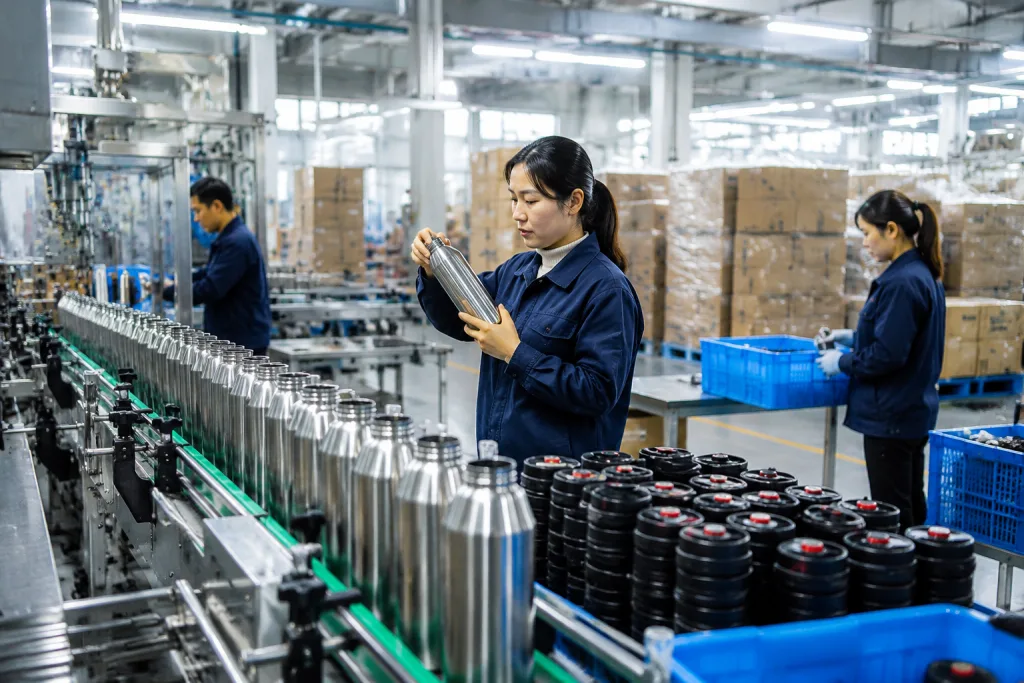
Key Takeaways
- A 1,000-unit MOQ is realistic for one color and one logo on a custom thermos
- PP shell or lid parts reduce cost, but the inner liner still drives heat retention
- Use AQL 2.5/4.0 inspection for functional and visual defects before shipment
- FOB China pricing should list packaging, logo, lid type, and test requirements separately
A polypropylene thermos bottle custom project looks simple until 3 quote sheets hit your inbox and none match. One supplier writes “PP shell,” another writes “304 liner,” and the third price skips the cup lid, color box, and 1.2 m drop test. We saw this last month: the buyer flagged a PO typo, “PP body” instead of “PP outer cup.” Four words. Different cost. For outdoor retailers and promo brands, those gaps turn into 12-day shipment delays, squeezed margins, and end users saying the bottle feels cheap.
From our Zhejiang factory, we run a custom thermos as a controlled spec job, not a catalog item with a logo added after lunch. PP parts, stainless steel gauge, vacuum performance, decoration method, carton strength, and compliance each change the final FOB China price, so asking “what is your cheapest thermos?” is the wrong question. The math doesn’t work if the carton crushes at 18 kg stacking pressure or the lid leaks during a 1.2 m drop test. QC pulled the sample on the line and checked the lid thread with a caliper; 0.3 mm off was enough to cause wobble. Our regular MOQ starts at 1,000 units per SKU, with sample lead time around 7-10 days and mass production around 30-45 days after approval.
Start with the material line
The first line on a polypropylene thermos bottle custom spec should not be capacity or logo. Put the material stack first. Buyers write “PP thermos” in at least 6 ways on RFQs: PP outer housing, PP lid, PP handle, PP drinking cup, PP base, or a stainless vacuum flask with only PP trim. Those are different bottles. On the line, the supervisor will ask which mold set to pull, the 750 ml PP shell mold or the stainless outer-body tooling, before anyone checks the logo AI file. That choice changes unit cost, hand feel, drop test result, and the compliance file we attach to the PI.
For outdoor retail, the workable build is a stainless steel vacuum liner with food-contact PP parts. The inner tank should be 304 stainless steel for normal beverage use. If you are selling into a higher-positioned camping channel, 316 stainless can be requested, but it can add 8-15% to the bottle cost depending on capacity and order quantity. The outer shell may be stainless steel, PP, or a mixed build. A PP outer shell feels warmer at minus 5 C and takes small knocks better than painted steel; after a 1.2 m carton drop test, we saw paint-chip complaints fall from 9 cartons to 2 cartons on one trial run. Good result. It also feels less premium in hand. The buyer flagged that on a 750 ml sample last March after weighing it beside a 412 g steel-shell version on our QC bench scale, and they were right.
For promotional thermos programs, PP gives one clean advantage: molded color. If your brand color is close to a standard PP masterbatch, we can skip painting cost and cut scratch claims from warehouse handling. The catch is paperwork. Do not call it “eco” unless the resin supplier gives recycled-content paperwork or an approved sustainability claim. We have seen this go sideways when a PO says “recycled PP” but the BOM lists virgin PP, then QC pulled the sample at the packing table before the 20 pcs pre-shipment check. European buyers should request LFGB or EU food-contact migration reports for PP contact parts. North American buyers usually ask for FDA food-contact conformity and, for children’s items, CPSIA-related checks.
Our Zhejiang team normally splits the spec into inner liner, outer body, lid, sealing ring, strap, and packaging. Six lines. That makes a manufacturer thermos quote easier to compare because you can see where the cost sits, from the 304 stainless liner to the 0.6 mm PP color chip and the 5-ply export carton. If a quote only says “PP thermos bottle,” this is the wrong question to ask and the math does not work for sourcing. Ask for the material line first.
Capacity and wall thickness matter
Capacity is not a catalog number. It decides the mold set, carton cube, freight bill, and whether the bottle bangs like a hammer when it is clipped to a backpack strap. We run the common outdoor sizes at 350 ml, 500 ml, 750 ml, and 1,000 ml. Promo buyers usually land on 500 ml because it fits a USD 0.38 color box and keeps the master carton under about 14 kg. Outdoor retailers push 750 ml or 1,000 ml for hiking and jobsite use, because one refill is not enough on an 8-hour shift. One buyer flagged this on a PO and called a 750 ml bottle "family size"; our sample room checked it with a 1 L measuring jug and sent back the photo.
Wall thickness exposes weak thermos custom quotes fast. A standard vacuum model often uses about 0.4 mm for the stainless inner wall and about 0.5 mm for the outer wall. On price-driven thermos bulk orders, some factories cut gauge to save USD 0.06-0.10 per piece. Bad trade. The bottle dents faster, and vacuum failure risk climbs after a rough LCL trip. QC pulled a sample last month with a 0.33 mm inner wall on a Mitutoyo digital thickness gauge, and the math did not work for a winter item. For PP outer bodies, the plastic wall usually sits around 1.8-2.5 mm depending on ribbing, mold flow, and how the part fills near the handle boss.
Check the neck diameter early. A 45-55 mm mouth is easier to clean and takes normal ice cubes from a hotel ice machine. A narrow neck holds heat a little better, but users complain when they pour powdered drink mix or soup. We have seen this go sideways after PP sample approval. If the buyer only asks for "good insulation" and skips daily use, this is the wrong question to ask. If the lid works as a cup, ask for usable cup volume, not only bottle capacity. A 150 ml cup lid feels practical; an 80 ml cap feels like a sample room shortcut.
For carton planning, get gross weight, net weight, carton size, and units per master carton from the thermos supplier before artwork approval. We ship 1,000 ml customized thermos orders where one extra EPE foam sleeve pushed the carton past a dimensional weight break, adding about USD 0.22 per unit by air. The unit price looked fine. The freight did not. Ask for the packed carton measurement in mm, then check it against your forwarder's calculator before signing the PI.
Vacuum performance is the core
The word “thermos” is a promise printed under your logo. If heat drops fast, the buyer blames the brand, not our welding station. We run the shop-floor check with 95°C water, a calibrated probe, the cap locked, and the bottle sitting 6 hours in a 23°C test room. Simple test. For a 500 ml stainless vacuum bottle, I use 60°C or higher after 6 hours as the pass line. A 750 ml or 1,000 ml bottle usually holds better because it carries more liquid mass, so QC still writes the final reading on the inspection sheet instead of accepting a sales claim.
Do not accept “keeps hot 12 hours” without data. It means nothing. Ask for the report with starting water temperature, room temperature, fill volume, test time, and final reading from the probe. We have seen a PO list “12H hot” while the approved color box artwork claimed 24H; the buyer flagged it only after the pre-shipment sample landed on his desk. That mistake cost 9 days because 8,000 color boxes had already been printed. If your packaging makes a heat-retention claim, the production lot needs repeatable test results, not one polished sample from the sales desk.
The vacuum process drives the rejection rate. After welding and vacuum pumping, the line should check each risk batch for insulation failure with a hot water tank and an IR thermometer, or run a temperature decay check when the order has a tight claim. QC pulled one sample last quarter that looked clean outside but rose 7°C on the shell after 10 minutes. Bad sign. At our China facility, high-risk orders are screened before packing, and final inspection can be arranged under AQL 2.5 for major defects and AQL 4.0 for minor visual issues. Leakage and failed vacuum belong in critical or major defects; a small paint speck is a different problem.
PP outer shell models still depend on the stainless vacuum liner. The polypropylene body is only the outer housing; it does not create insulation by itself. For polypropylene thermos bottle custom orders, ask the supplier to cut one cross-section sample and weigh the finished bottle in grams on a bench scale. When a supplier thermos offer sits 15% below the normal market price, “Can you match the target?” is the wrong question to ask. Ask what liner structure they are using. We have seen low-price offers turn out to be double-wall plastic with foam or an air gap, not vacuum insulation, and the math does not work once the buyer adds a real heat test.
Lids, seals, and drinking control
The lid system decides whether a custom thermos gets reordered or comes back in full cartons. For outdoor retail, we spec screw lids first in most quotes: fewer parts, easier brush cleaning, and fewer claims after samples sit overnight at -10°C in a warehouse truck. Simple wins. Push-button stoppers pour cleanly, but springs and pins add failure points, so we run a parts count and spring rebound check before quoting. Flip lids fit sports positioning. Hot liquid is different. It needs a tested latch and a vent that opens cleanly under heat. If the vent spits during first sample review, the buyer will flag splash risk before we even talk about logo color.
A usable spec line should name the lid housing material and gasket material, then call out thread type, tightening torque, and the leak test method. PP is common for lid housings because it is food-contact safe, molds cleanly, and keeps the unit price under control; our mold shop checks the thread with a 0.02 mm feeler gauge during trial fitting. Silicone sealing rings are still the safer choice for flexibility and heat resistance. TPE can cut cost, but check odor, migration, and compression set after heat aging at 70°C. A loose gasket is not a small issue. We saw one distributor program get 37 lid complaints in the first two weeks because the gasket groove was 0.3 mm too shallow.
For promotional thermos orders, the lid often needs a wide decoration area or a color-matched cap. It can be done, but the math doesn't work if the drawing only chases appearance. A glossy PP lid shows scratches after carton rubbing; QC pulled one black sample last month with visible scuff marks after a 1.2 m drop test. Matte texture hides handling marks, but it can hold finger oil. Navy and black show it first. If the lid doubles as a cup, check the rim feel and confirm whether the inner wall is stainless or plastic. Some buyers prefer a stainless-lined cup for hot drinks because it still feels cleaner after 200 uses, not just on the showroom table.
Testing should be written plainly: fill to marked capacity, invert for 30 minutes, then run a 30-second shake test and inspect the lid seat and vent area for leakage. We tighten to the agreed torque with a torque meter, then lay samples on white tissue so one small bead shows. If the bottle is designed for carbonated beverages, say so early. Most vacuum thermos suppliers do not recommend hot liquid plus pressure, and the warning label must match the product design. One PO typo changing "no carbonated drinks" to "for carbonated drinks" can stop shipment at final inspection.
Decoration changes the production plan
A customizable thermos is not a blank bottle getting a logo at packing. Decoration changes MOQ, lead time, scrap rate, and color tolerance. On 304 stainless, laser engraving is still the cleanest choice for outdoor programs; we run fiber laser machines at around 0.03 mm line accuracy, and the mark does not peel after 6 months in a backpack. Screen printing costs less for a one-color logo. Still risky. If the powder coat cure misses by 5°C or the hardener ratio is off, the ink scratches before the buyer sees the shelf sample. QC pulled samples last month after 50 tape-test pulls because black ink lifted on a matte green body. Heat transfer and full-wrap printing sell better at retail, but artwork control is tighter and we need one extra pre-production check before the line starts.
On PP outer bodies, the decoration plan changes fast. Screen printing works on 2 or 3 common textures, but adhesion depends on resin grade, surface grain, and flame or plasma pre-treatment. We run a Dyne pen check before printing if the buyer picks a soft-touch PP shell. Pad printing works better for small curved spots, such as a 22 mm logo near the grip recess. In-mold labeling can work for large-volume PP programs, but it is the wrong question for a 1,000-unit trial order; the math does not work once tooling, film waste, and label setup are counted. A molded logo is strong for private-label outdoor gear, but it means mold modification, usually 12 days for simple cavity work versus 18 days or more if the buyer changes the logo depth after T1 samples.
For a normal thermos promotional order, plan 7-10 days for pre-production samples after artwork confirmation. Mass production usually takes 30-45 days after sample approval, or 40-55 days if you need custom molded PP color, special packaging, or third-party testing. Our BottleForge line in Zhejiang can handle about 300,000 drinkware units per month across stainless thermos and travel tumbler programs, but capacity still needs booking before peak Q3 export season. We ship tighter schedules when cartons and artwork are locked early. We have seen this go sideways from one PO typo: "Pantone 348C" was written as "384C", and the color chip had to go back to the mixing room.
Define logo size in millimeters, Pantone color, placement tolerance, and the acceptance standard before the first sample is made. A 2 mm left-right tolerance may pass on a camping bottle, but it fails fast if your gift box window exposes the logo alignment. Small detail. Big argument. If you need Amazon or retailer labels, add FNSKU, carton marks, and barcode verification to the spec before production starts, and ask QC to scan at least 32 cartons during pre-shipment inspection under AQL 2.5.
Compliance belongs in the quote
Put compliance in the first quote, before anyone wires a 30% deposit. We run the same thermos body in 5 specs: a domestic promo build with lower-cost PP trim, a gift-channel build where the color card gets checked under D65 light, EU export with tested coatings, North American retail with Prop 65 review, and food-service supply with plainer packaging. Same photo. Different bill of materials. QC pulled one 500 ml sample last month where the silicone gasket passed smell check, but the logo ink failed the tape test after 3M 600 tape was pressed for 60 seconds.
For Europe, ask for REACH coverage on coatings and inks, then LFGB or EU 1935/2004 migration reports for every part touching the drink or mouth. Retail packaging matters too; one German buyer once rejected a carton because the recycling wording was printed 2 mm too close to the barcode quiet zone. For North America, ask for FDA food-contact documentation tied to the PP lid resin, California Proposition 65 assessment for the coating and ink if applicable, and CPSIA paperwork when the bottle is sold as a children's item. Kids' bottles need ASTM-related physical safety checks too: small parts under the choke tube, strap pull at 70 N, plus paint heavy metals on printed areas. "Do you have certificates?" is the wrong question. Ask for the resin grade on the lid, the exact Pantone color tested, the factory line name, and the test report number shown on the lab PDF.
Factory social audits matter for outdoor retailers and chain-store buyers. BSCI, Sedex/SMETA, or ISO 9001 status can cut vendor onboarding from 18 days to 9 days when the documents match the actual plant, the business license address, and the packing line shown in the audit photos. Check the scope. Do not assume every thermos vendor has current audit documents. Ask for the certificate number and expiry date; then check whether the audit covers molding, welding, polishing, printing, and packing on the same site. We have seen this go sideways: the buyer flagged a supplier thermos listing where the certificate belonged to a trading office in Yiwu, while the bottles were packed on a 6-station line in Yongkang.
Write inspection terms into the purchase order. Common practice is pre-shipment inspection when 100% of goods are produced and at least 80% packed; our QC usually checks carton drop marks, turns the cap by hand for torque feel, and runs vacuum hold after the line has cooled for 4 hours. Use AQL 2.5 for major defects and 4.0 for minor defects unless your retailer requires stricter levels. Critical defects, such as leakage, contamination, sharp burrs, broken glass liner if applicable, or wrong material, should have zero tolerance. Cheap inspection still has a place; the math does not work when 5,000 bottles leak and your sales team is answering refund emails with photos of wet cartons.
Pricing lines you should challenge
A serious bulk thermos quote should show what sits inside the unit price. Zhejiang factories usually quote FOB Ningbo or FOB Shanghai, depending on the forwarder route and sailing schedule. If a supplier writes only “USD 3.20, logo included,” the math does not work. Ask whether that price covers inner carton, color box, instruction sheet, polybag, 1 g desiccant, 5-layer export carton, barcode labels, drop-test carton, and palletizing if your warehouse requires it. Small lines matter. Last month we had one PO where the buyer typed “carton mark same as sample,” but QC pulled the retained sample and found no side mark at all. Packing stopped for 4 hours while the carton artwork was confirmed again.
For a 500 ml stainless vacuum bottle with PP lid and one-color logo, a normal factory thermos price often lands around USD 3.00-5.50 FOB China. The range moves with steel gauge, powder coating loss rate, lid structure, packaging spec, and order quantity. Gauge matters. A 0.4 mm body and a 0.5 mm body do not behave the same on the spinning line after coating; we run more dent rework when buyers push the thinner wall for a retail gift set. A PP outer shell can cut cost on some designs, but custom mold color, texture tooling, or logo tooling can add USD 300-800 before the first carton ships. For 1,000 units, setup costs bite hard. At 5,000-10,000 units, decoration plates and color-box charges spread across the run, so the landed cost starts to look sane.
Payment terms shift risk on both sides. About 8 out of 10 China manufacturers thermos orders we run start with 30% deposit and 70% balance before shipment. Repeat buyers with steady volume can discuss terms, but on a first order, pushing for credit is the wrong question to ask. Lock the sample. Lock the specs. Book inspection. If you have a fixed launch date, add at least 10 extra days for sample revision, third-party testing, or customs documents. We saw one missing LFGB line on a test request hold shipment for 6 days, with 126 finished cartons sitting beside the floor scale.
Challenge any quote that does not name the steel grade, PP grade, lid structure, test standard, and packaging. This is not being difficult; it protects margin. Strong thermos distributor relationships are built on boring details: signed samples, controlled artwork, agreed AQL, carton specs, and a supplier who calls out trouble before the design reaches the loading dock. We have seen this go sideways. On the floor, the fix can be as simple as QC measuring a loose lid with a 0.02 mm caliper and stopping the line before 3,000 pcs get packed wrong.
Send your thermos spec before you buy
Share capacity, material, logo, packaging, and target price. We will return a practical FOB China quote with risks clearly marked.
Frequently asked questions
Can a polypropylene thermos bottle be vacuum insulated?
Yes, but the PP is usually the outer body, lid, handle, or cup component. The actual insulation normally comes from a double-wall stainless steel vacuum liner inside the PP housing. If a supplier calls it a polypropylene thermos bottle custom product, ask for a cross-section drawing or material breakdown. For hot drink use, we normally specify 304 stainless steel inner wall, PP lid parts, and silicone sealing rings. A 500 ml model should be tested with about 95°C water and still hold roughly 60°C or more after 6 hours, depending on mouth size and lid design.
What MOQ should an outdoor retailer expect for custom thermos orders?
For one standard shape, one body color, and one logo, 1,000 units per SKU is a realistic starting MOQ at our Zhejiang factory. If you need custom PP color, molded logo, special lid color, or retail packaging, MOQ may move to 3,000-5,000 units because color matching and setup waste increase. For fully new molds, the practical volume should be discussed as an annual program, not a one-off order. Sample lead time is usually 7-10 days after artwork, and mass production is commonly 30-45 days after sample approval and deposit.
Is PP better than stainless steel for the outside shell?
PP is not automatically better; it solves different problems. A PP outer shell can feel warmer in winter, reduce painting scratches, and allow molded colors for promotional thermos projects. Stainless steel feels more premium, handles abrasion well, and supports laser engraving nicely. For outdoor retail, stainless outer shells are often preferred for durability perception. For promotional brands, PP can help hit a lower FOB China price or a brighter brand color. The inner liner still matters most. If you reduce stainless gauge too much, the bottle may dent or fail vacuum testing regardless of the outer shell.
Which logo method works best on a custom thermos?
For stainless bodies, laser engraving is the most durable and works well for outdoor brands. It has no ink to scratch off, but the mark color depends on the coating and base metal. Screen printing is cheaper for one-color logos and common on thermos promotional orders, but you need adhesion testing. For PP bodies, screen printing, pad printing, and molded logos are more common. Ask for logo size in millimeters, Pantone code, surface treatment, and a tape test on the approved sample. Full-wrap decoration looks strong but adds setup time and more inspection points.
What quality checks should be in the purchase order?
Include material confirmation, capacity check, vacuum performance test, leakage test, logo placement, coating adhesion, carton drop test, and AQL inspection level. A practical setup is AQL 2.5 for major defects and 4.0 for minor defects, with zero tolerance for critical issues such as leakage, sharp edges, contamination, wrong steel grade, or failed insulation. For leakage, specify invert testing for 30 minutes and a short shake test. For heat retention, define starting water temperature, room temperature, test duration, and final target. These details prevent arguments when 3,000 or 10,000 units are already packed.