Key Takeaways
- For PP thermal bottles, confirm food-grade PP, wall construction, and heat target before comparing a USD 1.20 offer to a USD 1.80 offer
- A realistic custom color MOQ is usually 3,000-5,000 units per SKU, while logo-only orders can start lower
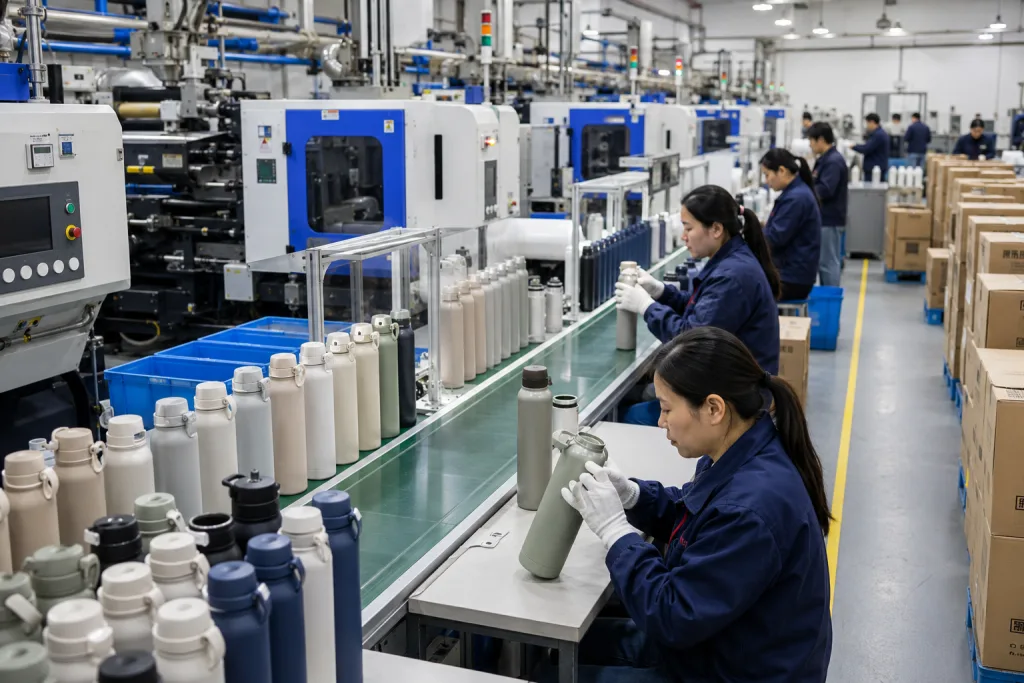
- BottleForge produces up to 450,000 drinkware units/month in Zhejiang with 25-35 day standard production after sample approval
- Use AQL 2.5/4.0, REACH/LFGB or FDA contact tests, and 1.2 m drop testing for serious distributor drinkware programs
A polypropylene thermal bottle looks simple on a quote sheet: capacity, color, logo, carton size, FOB price. Then QC pulled two 500 ml samples from the line, both marked “PP inner, thermal insulation.” One kept warm water acceptable for 2 hours; the other passed a 1.2 m school-bag drop test with only a scuffed cap. Small lines matter. For retail, promo, school, gym, or distributor orders, those specs decide if you get 3 complaints per 1,000 pcs or a buyer asking for debit notes.
As a Zhejiang drinkware factory team, we’ve seen buyers lose 12 days chasing a lower unit price, then spend 18 days fixing a loose cap seal. That is the wrong question to ask. A solid polypropylene thermal bottle supplier should confirm the resin grade and wall structure first, then lock the cap seal, logo method, AQL level, and export packing before sampling. We run calipers on the mouth ID in mm, weigh the cap on a 0.1 g scale, and check the PO for small mistakes like “matte black” typed as “mate black.” China production moves fast only when the spec sheet is nailed down.
Material line: PP is not enough
If a quotation says “PP bottle,” ask which PP grade is used on each part. Don’t accept the shortcut. As a polypropylene thermal bottle supplier, we run food-contact PP on the inner cup or liner, a separate PP grade on the outer shell, and a silicone sealing ring seated in a measured groove; QC checks that groove with a Mitutoyo digital caliper to 0.1 mm tolerance. Cheap canteen factories sometimes pair a PP body with recycled outer material. Fine, if the part is non-food contact and the market allows it. But it must be written on the spec sheet and PO. For Europe and North America, specify virgin food-grade PP for all food-contact surfaces.
The buyer impact shows up fast: oily odor after packing, white stress marks near the thread, dishwasher warping at the lip, color drift after molding. QC pulled 1 sample last year that smelled oily after 24 hours in a sealed carton; the buyer said, “Maybe production will be better.” Wrong question. A bottle that smells oily at sample stage will not smell cleaner after 10,000 units arrive in Hamburg or Los Angeles. We normally ask for FDA 21 CFR or EU 10/2011 food-contact confirmation, plus LFGB if selling into Germany. REACH still matters for external coatings, inks, printed straps, and soft-touch paint.
Check the temperature range. PP works for warm water and daily use, but it is not stainless vacuum insulation. If your retail copy says “keeps hot all day,” the math doesn't work, and returns will follow. A cleaner claim is often 2-4 hours of improved temperature retention, based on wall thickness, lid fit, and whether the liner has an air gap. For canteen custom projects, write the test method into the spec: starting water temperature, room temperature, measurement point, and time interval. We run this with a probe thermometer at the center point after 30, 60, 120, and 240 minutes, not by touching the shell and guessing.
A serious canteen supplier will not object. If a canteen vendor only answers “food grade, no problem,” push harder before paying for tooling or mass sampling. We’ve seen this go sideways over 1 vague PO line: “PP, blue, safe.” One buyer even typed “PP blue sage” on the PO, and the line matched the color chip instead of the approved sample.
Capacity, dimensions, and real fill volume
Capacity looks simple on the spec sheet. It isn’t. We’ve had 3 buyers dispute a 500 ml PP bottle because their lab filled it to the brim, while our QC measured safe fill 8 mm below the thread line with a 1,000 ml graduated cylinder. A 500 ml bottle can mean brim-full volume, safe fill volume, or the number printed on the gift box; those 3 numbers are not the same on the line. For customized drinkware, write usable fill volume as the liquid level below the thread or seal line. That is the number people drink from. On small PP bottles, safe fill is often 20-35 ml less than brim-full capacity.
Dimensions sell on the shelf. Freight decides the margin. Height, shoulder width, carton direction, and divider style set carton cube, pallet loading, courier cost, cup-holder fit, and whether your distributor makes money on single-piece e-commerce orders. We once changed only the shoulder radius on a 650 ml bottle, and the master carton moved from 0.086 CBM to 0.101 CBM after the packing line tested the E-flute divider. Same bottle. Worse cube. A 650 ml bottle with a wide shoulder may look stronger in a rendering, but it can add 12-18% master carton volume. If you are a canteen distributor or distributor drinkware buyer shipping 40HQ containers, not showroom samples, the math does not work.
Ask for measured data, not only CAD data. Get overall height with cap locked, body diameter at the widest point, mouth diameter checked by caliper, cap height, net weight, gross unit weight with packaging, and carton quantity with the divider installed. For Amazon-style or DTC programs, ask the supplier to mark the FNSKU label area on a flat panel and confirm drop-safe mailer dimensions after a 1.2 m corner drop. QC pulled the sample last month because the label zone was 3 mm too narrow for the buyer’s sticker roll. Small miss. Big delay. For school and sports channels, grip diameter matters more than a nice silhouette; 70-75 mm fits most hands better than an 82 mm bulky body.
For a custom canteen or customizable canteen line, capacity also needs to match your replacement lid plan. If the 500 ml and 750 ml versions share the same cap thread, your spare-parts shelf stays cleaner and warehouse staff pick fewer wrong lids during after-sales packing. We run this check with a thread gauge before mold sign-off, because one PO typo on “500 ml lid same as 750 ml” can turn into mixed cartons and angry after-sales emails. We’ve seen this go sideways. If each capacity has a different cap, you save USD 0.03 per unit on paper, then pay it back through service calls, replacement shipments, and slow-moving lid inventory.
Wall structure and insulation claim
“Thermal” is not a structure. For PP bottles, we quote four builds almost every week: single-wall PP, double-wall PP with a 3-6 mm air gap, double-wall PP with a foam insert, or PP with a separate inner cup. A polypropylene thermal bottle supplier should print the build on the quotation and on the sample label. If the PI only says “thermal bottle,” the price comparison is nearly useless. We saw this on a 5,000 pcs inquiry where two suppliers were USD 0.18 apart, but one quoted air-gap double wall and the other quoted a foam insert. QC caught it when the 0.01 mm caliper reading and the cut sample did not match the sample tag.
Single-wall PP is light and low-cost, so we run it for canteen promo orders where the bottle is a giveaway, often 3,000-5,000 pcs per color. Keep the claim modest. Double-wall PP gives a better grip and slows heat loss, but it is not vacuum insulated. Foam insert designs perform better in the 2-hour bench test, though they add one assembly station on the line and make recycling claims harder to defend. The buyer may ask for “eco thermal PP” on the artwork; push back early. For sustainable drinkware claims, check the rule in your selling market before the carton artwork is approved. We have seen mixed-material claims go sideways during retailer review after the foam ring showed up in a cut-open sample.
For buyer-side control, write a basic performance target into the spec sheet. Example: fill with 95°C water to 90% usable volume, close lid, place at 20°C ambient temperature, measure after 2 hours. For cold retention, use 4°C water and measure after 3 hours. The exact numbers depend on the mold and lid seal, but the test must be repeatable. We run this on pre-production samples with a probe thermometer, and QC keeps one signed sample in our Zhejiang QC room with the test time written on masking tape. Simple test. No debate later.
Wall thickness matters. PP outer walls around 1.8-2.5 mm are common for durable bottles; thinner walls cut cost but show sink marks near the handle base and feel weak in the hand. Cheap is visible. On the line, we check the handle root with a 0.01 mm digital caliper because that is where sink marks and stress whitening show first. If you sell through canteen distributors, complaints often start with “feels soft” before any crack or leak appears. A bottle can pass leak testing at the bench and still get rejected by a retail buyer during shelf review.
Do not let marketing copy outrun the test result. If you need 8-12 hour thermal performance, this is the wrong question to ask; the math does not work for normal PP thermal canteens. Source stainless vacuum bottles instead, and we would quote that line separately rather than dressing up a PP bottle claim. We had one PO typo last year that changed “2 hours” to “12 hours,” and the buyer flagged it before deposit. Good catch.
Lid, seal, and leak testing
The lid is where 7 out of 10 low-price quotes start to break down. The bottle body is simple to mold. A cap with steady sealing, clean threads, and no plastic burrs needs better steel, sharper EDM work, and tighter control at the injection machine. For canteen customized programs, put the lid material, gasket material, opening style, and spare-gasket packing method on the PO. No guessing. We run food-grade silicone for most sealing rings, usually 50-60 Shore A hardness, but a 0.2 mm change in groove depth can decide whether that gasket sits flat or rolls on the line.
Leak testing belongs in the spec sheet. Never assume it. Our standard check for PP thermal bottles is fill to usable volume, close the cap at normal hand torque, invert for 30 minutes, then shake 10 cycles. For sports or kids channels, we add a 1.2 m drop test onto plywood or concrete depending on the intended market. QC pulled one sample last season where the cap passed inversion but leaked after the third shake because the gasket had a 0.4 mm flash mark from the mold parting line. ASTM-style child-use expectations may apply when selling to children, mainly for sharp edges, small parts, and cap components.
Thread design changes how the buyer's customer feels the bottle. Two turns is enough. A cap requiring more than two full turns feels slow, and the buyer flagged this on a 20,000 pcs school canteen order because children could not close it consistently before lunch service. A cap with shallow thread engagement can leak after repeated use; we have seen it go sideways after a teacher washed samples in hot water at about 80 C and the fit loosened. Ask for cycle testing if the program is large: 1,000 open-close cycles on 3-5 samples is a practical benchmark. It will not catch every problem, but it exposes poor thread fit fast.
If you are comparing canteen manufacturers in China, ask whether leak testing is 100% or sample-based. This is the wrong question to leave until final inspection. For premium orders, 100% air-pressure or water inversion checks add labor but reduce claims; on our line that usually means one worker, one pressure jig, and packing output dropping from about 1,200 pcs to 850 pcs per shift. For a basic canteen promotional order at USD 1.00-1.30 FOB Ningbo, sample-based inspection may be acceptable if the design is mature and the last AQL 2.5 report had no cap leakage. For retail distributor canteen orders, I would not skip stronger lid QC.
Customization lines that change cost
Customization is where the quote sheet gets dirty. “Logo included” usually means one-color silk screen on one side, inside a 45 x 60 mm print box. It does not cover wrap print, heat transfer, molded logo, or 2,000 individual names. Ask the supplier to write the print area, color count, setup charge, sample charge, and artwork format for each drinkware line, not just “logo free” in a WhatsApp message. We run vector AI or PDF files at the prepress table on a calibrated monitor; a 300 px PNG pulled from a sales deck gives rough logo edges, and QC will pull the sample before packing.
For PP bottles, we run silk screen or pad print for simple marks, heat transfer for bigger artwork, in-mold label for retail orders above about 10,000 pcs, sticker label for short runs, and molded embossing when the tooling budget is already signed off. Laser engraving is the wrong process for PP. Full stop. Silk screen works for simple logos, often USD 0.05-0.12 per color depending on area and quantity. Heat transfer can carry gradients across a larger panel, but it adds USD 0.15-0.35 per unit and needs abrasion testing. We use 3M tape and a 500-cycle rub test on bigger supermarket orders because one buyer flagged logo peeling after a dishwasher claim, then sent photos with the batch carton still in frame.
Custom color is another cost driver. A stock-color customized canteen with logo may start at 1,000-2,000 units. A Pantone-matched body normally needs 3,000-5,000 units per SKU because resin mixing and color stability checks eat machine time. The wrong question is “can you match this color?” Ask how many shots the line needs before the PP shade holds steady under the light box. On one PP canteen run, QC checked the first 80 shots with a D65 light box before approving mass production, and the shift leader kept two borderline samples on the table for comparison. For a full canteen range with three capacities and four colors, the MOQ climbs fast if the SKU matrix is loose. That is 12 SKUs before spare lids, display cartons, or regional barcode labels enter the PO.
Packaging customization also changes price. A plain polybag is cheap. A color box may add USD 0.12-0.35 depending on paper weight and size. FSC paper, retail hang tags, barcode labels, and FNSKU labeling are manageable, but they belong on the first quote request. We have seen this go sideways when the buyer approved the bottle price, then added a 350 gsm matte box with spot UV and two FNSKU stickers after deposit. The math does not work. The packing line also slows down when workers scan two labels per unit instead of one, and that labor cost will show up somewhere. Canteen vendors often quote low first and add packaging costs later; do not reward that habit.
Quality, audits, and shipping terms
For B2B custom drinkware, the quality clause should name the inspection standard, not say “good quality.” On most PP thermal bottle orders we run AQL 2.5 for major defects and AQL 4.0 for minor defects. Critical defects are zero-acceptance: contamination, sharp edges, broken caps, or leakage past the agreed test time. Stop the line. Last month QC pulled a sample after a 30-minute inverted leak test because 3 caps showed slow seepage around the silicone ring. Packing stopped before the carton sealer. If your buyer manual requires AQL 1.5, put it on the RFQ before we quote. The math changes: extra inspection hours, more rejected cartons, and tighter pressure before vessel closing.
Factory documents matter when you sell to chains, schools, hospitals, or large distributors. BSCI usually answers social-compliance questions, ISO 9001 covers the quality system, Sedex supports ethical sourcing review, and retailer audits often check whether the workshop name on the wall matches the report. Not every canteen manufacturer holds every audit. Normal. What is not normal is using a trading-company certificate for a production site 40 km away. Ask for the factory name, address, certificate scope, and expiry date, then match them against the chop on the PI. We have seen this go sideways because one PO spelled the factory address as “Hangzou” and the buyer’s compliance team froze the booking for 2 days. BottleForge’s Hangzhou-area partner network in Zhejiang supports about 450,000 drinkware units/month across PP, stainless, glass, and tritan categories, with typical PP bottle lead time of 25-35 days after sample approval.
Testing should follow the destination market, not the supplier’s cheapest report folder. For Europe, REACH and EU food-contact testing are common on the PP body, lid, gasket, and printed area. For the United States, FDA food-contact compliance and California Proposition 65 review apply depending on resin, pigment, and decoration method. For kids’ bottles, CPSIA-related checks go into the file, especially when the buyer asks for age grading on the carton mark. Simple rule: test the parts that touch the mouth or liquid. QC pulled one blue cap sample in our lab because the color masterbatch code on the 25 kg material bag did not match the test report. A canteen suppliers list that cannot explain these terms is not ready for serious export programs.
Shipping terms need the same precision as the bottle spec. FOB Ningbo or FOB Shanghai is common from Zhejiang, China. EXW looks cheaper on the first quotation, but it leaves local trucking, customs declaration, and export handling on your desk. For a distributor growler or distributor canteen buyer consolidating several SKUs, ask for carton dimensions early so your forwarder can estimate CBM before the PI is signed. We ship PP bottles in 5-layer export cartons, and a 3 mm change in insert height can change pallet loading. It happens. A 20-foot container may hold roughly 70,000-95,000 PP bottles depending on capacity and packaging, so carton design hits landed cost directly. If you only compare unit price, this is the wrong question to ask.
Send your PP thermal bottle spec for review
We will check material, MOQ, logo process, testing, and FOB pricing before you lock the purchase order.
Frequently asked questions
What MOQ should I expect from a polypropylene thermal bottle supplier?
For stock shapes with a one-color logo, a practical MOQ is usually 1,000-2,000 units per design. If you need a Pantone-matched PP body, custom lid color, or retail color box, expect 3,000-5,000 units per SKU. New mold development is different; tooling can start around USD 3,000-8,000 for a simple PP bottle set and the first production run often needs 10,000 units or more. A canteen promotional order can sometimes be lower, but unit price and setup cost rise quickly.
How much does a customized PP thermal canteen cost?
For normal export orders, a customized canteen in PP may range from about USD 1.10 to USD 2.40 FOB Ningbo, depending on capacity, wall structure, lid complexity, logo method, and packaging. A single-wall promotional bottle with simple print sits near the low end. A double-wall 600-750 ml bottle with silicone seal, heat-transfer artwork, and color box moves toward the higher end. Testing, barcode labels, FNSKU work, and special cartons are usually quoted separately unless you ask for an all-in price.
Can PP thermal bottles really keep drinks hot?
Yes, but within limits. PP thermal bottles are not vacuum flasks. A double-wall PP bottle can slow heat loss for 2-4 hours under normal indoor conditions, depending on capacity, lid design, and wall gap. If you start with 95°C water at 20°C room temperature, you should request actual test data after 1, 2, and 3 hours. If your product promise needs 8 hours hot or 12 hours cold, choose stainless vacuum construction instead. A good canteen manufacturer will tell you this before production.
Which logo process is best for polypropylene bottles?
For simple brand marks, silk screen printing is usually the most cost-effective and stable choice, often adding USD 0.05-0.12 per color at normal quantities. Pad printing works for smaller curved areas. Heat transfer is better for full-color artwork, gradients, or larger designs, but it costs more and should pass tape, rub, and dishwasher-simulation checks if you claim durability. Molded embossing looks clean for a custom canteen, but it requires tooling and is not flexible for multiple brands.
How do I compare several canteen vendors fairly?
Send the same spec sheet to every canteen vendor: capacity by usable fill, PP grade, wall structure, lid type, silicone gasket, logo method, packaging, AQL level, testing standard, destination market, and Incoterm. Ask each supplier to quote FOB Ningbo or FOB Shanghai with lead time, MOQ, sample fee, and carton dimensions. Do not compare a stock-color bottle in polybag against a Pantone-matched bottle in color box. They are different products, even if both are called customized drinkware.