Key Takeaways
- A basic PP thermal bottle usually lands at USD 1.10-2.80 FOB China at 3,000-10,000 pcs
- New injection molds commonly add USD 1,500-6,000 and 18-35 days before mass production
- Standard logo and color orders can ship in 30-45 days after sample approval
- BottleForge Hangzhou capacity is about 450,000 plastic drinkware units/month with MOQ from 3,000 pcs
A polypropylene thermal bottle looks simple until you order 10,000 pcs and QC pulls the first molded cap off the line with a thread gauge in hand. Small choices move the unit price fast: PP resin grade with food-contact test reports, cap thread tolerance at 0.10 mm, foam insulation instead of an air-gap body, carton CBM, and a logo process that looked cheap in the first email but needs a 40 mm print area plus one extra fixture. That USD 0.20 gap is not magic. If you are comparing quotes from a polypropylene thermal bottle manufacturer in China, ask what is inside the number.
BottleForge Industrial runs custom drinkware projects from Hangzhou, Zhejiang, with Ningbo and Shanghai ports both workable for export. We quote distributors and retail brand owners every week; promo buyers push hardest on logo cost and carton packing because their math breaks at 3,000 pcs. Last Tuesday, a buyer flagged a PO typo on MOQ: 3,000 pcs was written as 30,000 pcs, and the whole price table changed. It happens. “What is your best price?” is the wrong question to ask. The better question is: “What price is realistic at my MOQ, and can we ship in 12 days or does this need 18 days?”
What You Are Actually Buying
For B2B sourcing, a polypropylene thermal bottle is usually a double-wall plastic canteen or flask made from food-contact PP, with PU foam or a plain air gap between the inner and outer walls. It is lighter and cheaper than stainless steel vacuum drinkware. Same category? No. On our line, a 600 ml PP double-wall bottle with a 3.2 mm wall gap normally keeps drinks warm for 2-4 hours, depending on the lid seal, wall gap, fill temperature, and bottle volume. We check it with a digital probe thermometer on the QC bench, not with a catalog slogan. If a canteen supplier promises 12 hours from a PP-only bottle, ask for the test method, water starting temperature, room temperature, and final temperature before you print that claim on packaging. We have seen this go sideways after a buyer flagged it during carton artwork approval.
The material spec matters. Food-grade PP for export should have FDA food-contact documentation for the US market and LFGB or relevant EU food-contact testing for Europe. If you choose a colored PP body, the pigment masterbatch also needs compliance paperwork, not only the base resin. Last month QC pulled a blue body sample because the color chip matched the approved Pantone, but the masterbatch file on the PO had one digit wrong. Small typo. Big delay. For kids or outdoor promotional programs, buyers may ask for BPA-free declarations, REACH SVHC screening, and EN 14350 or ASTM-related checks based on product design and age grading.
Cost confusion often starts with the word “thermal.” If the RFQ only says “PP thermal bottle,” this is the wrong question to ask. One canteen manufacturer may quote a double-wall insulated PP bottle, while another quotes a single-wall bottle with a thicker shell. A canteen customized with a flip straw lid costs more than a screw-cap model. A wide-mouth sports cap may need a silicone gasket and TPR grip, plus a PP hinge pin and a leak test at 30 kPa for 60 seconds. Each extra part adds mold maintenance, assembly time, and AQL inspection points. The math does not work if a buyer wants a 1,000 pcs MOQ, 4 lid parts, 3 body colors, and the same unit price as a plain screw-cap bottle. The line feels that pain first.
Before asking for price, define volume in ml, cap style with photos, insulation structure, logo method with print size, body color, packaging, and market compliance. Send a 2D drawing if you have one. Even a marked-up photo with target volume in ml and mouth diameter in mm saves 12 emails vs 18 emails of guessing. A good canteen factory in Zhejiang or another China manufacturing base should cost those items separately, not hide them behind one vague “custom canteen” quotation. We run clearer quotes when the buyer tells us the test market first, then the target shelf price. That beats fixing a carton spec after the deposit is paid.
FOB Unit Cost Drivers
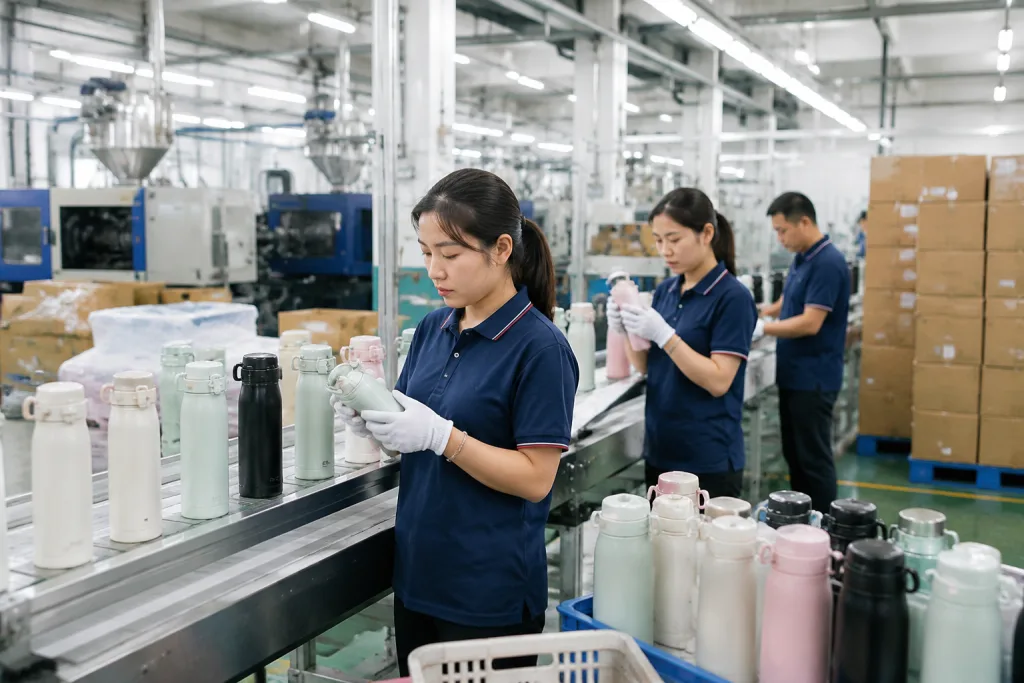
FOB pricing for polypropylene thermal bottles starts with the BOM sheet, not a quick guess on WeChat. We price PP resin grade and part weight first, then machine time, decoration, hand assembly, packing, scrap allowance, and the margin needed to keep the line booked for the week. For a 500-750 ml double-wall PP bottle, a normal FOB China range is USD 1.10-2.80 at 3,000-10,000 pcs. A basic promotional canteen can sit near the low end. Retail-ready costs more. Add color-matched lid parts, a silicone seal that actually passes leak testing, printed box, and barcode control, and the price can move above USD 2.50. Last month QC pulled a 750 ml sample from the line and found the silicone ring was 0.4 mm under spec; that single finding changed the lid cost and failed the 30-minute inverted leak test.
Material weight is the first lever. A 500 ml PP bottle may use 90-130 g of plastic. A thicker 900 ml outdoor canteen may use 160-230 g. When PP resin moves by USD 100 per metric ton, bottle cost shifts by around USD 0.01-0.03. Heavy bodies feel it first. Wall thickness also changes cycle time: a 1.2 mm wall molds faster than a 1.8 mm wall, but go too thin and the line starts seeing deformation and stress whitening around the threads after the torque test. Bad trade. On our Haitian injection machine, adding 0.6 mm wall thickness can push one cavity from a 28-second cycle to 34 seconds, so the math does not work if the buyer only writes “stronger plastic” on the RFQ without a target weight in grams.
Decoration is the second lever. One-color silkscreen on a straight body may add USD 0.06-0.12 per pc. Two-color printing can add USD 0.12-0.22. Heat transfer can be USD 0.20-0.45 based on print coverage and film waste. In-mold label looks clean for distributor drinkware programs above 10,000 pcs, but it needs tighter artwork control and a film supplier that holds registration within 0.5 mm. MOQ also goes up. Laser engraving is the wrong question to ask for PP unless the part uses special additives or a coated surface. We have seen this go sideways: the buyer approved a black logo PDF, then flagged the first print because the Pantone number on the PO was typed as 186C instead of 168C.
Packing gets ignored until the final proforma invoice. Bulk pack in a master carton may add USD 0.06-0.12. A white box adds USD 0.12-0.22. A color retail box with insert card, EAN label, and warning sheet may add USD 0.25-0.55. For a canteen distributor network, retail packaging can earn its place because stores need shelf barcode control and cleaner display. For a canteen promotional giveaway, bulk packing is usually smarter. We ship plenty this way: 48 pcs per master carton, 5-layer K=K carton, drop test at 76 cm. No buyer pays happily for a color box that gets thrown away at an event gate.
Freight changes landed cost, even though it is not part of FOB. A 750 ml PP thermal bottle is light but bulky. Carton loading efficiency can beat weight in the final cost sheet. Reducing carton height by 20 mm may save more money than arguing USD 0.03 on unit price. We checked one 40HQ loading plan last quarter with a tape measure on the packing table and changed the bottle nesting angle by 15 degrees; carton count went from 5,120 pcs to 5,760 pcs, which made the buyer stop pushing for another USD 0.02 discount.
MOQ Tiers That Make Sense
MOQ is not a penalty. It is the point where resin purge, color change, pad-print setup, and packing labor stop eating the margin. At BottleForge in Hangzhou, Zhejiang, we run existing PP thermal bottle molds from 3,000 pcs per shape; 1,000 pcs per color only works when the total order fits the injection line slot. For new tooling, 10,000 pcs is our floor before we talk about cutting steel. Last month, after a blue-to-white changeover, QC pulled 12 first-shot bottles and the purge bin still showed 6.8 kg of mixed PP scrap on the floor scale.
At 1,000 pcs, expect sample-order pricing, not production pricing. The line still purges resin, sets the injection machine, tunes the cap fit, prints trial logos, and checks cartons. Unit price usually lands 20-40% above a 5,000 pc order. We have seen canteen vendors accept 1,000 pcs to win the PO, then claw back cost through logo charges or loose QC. Looks cheaper. The math doesn't work. On one 1,000 pc run, our technician spent 42 minutes adjusting the cap thread because the go/no-go gauge caught a 0.3 mm tight fit.
At 3,000-5,000 pcs, a custom canteen order starts running clean on existing molds. You can choose standard PP colors, add a one-color logo, and use bulk packing or a basic color box without turning the job into a special project. This tier fits promotional distributors and school program buyers testing demand before they give up shelf space. We ship this size every month; one recent school order used 3,000 pcs packed in 15 kg cartons, and the buyer flagged the first carton mark because “navy” was typed as “nary” on the PO.
At 10,000-30,000 pcs, you have room to negotiate resin buying, dedicated machine time, custom masterbatch color, and packaging with inserts or retail barcodes. This is the right level for a distributor canteen line or a seasonal retail launch. If you need several lid colors and body colors, build the order matrix early. Five body colors with four lid colors create 20 SKUs. Every SKU needs its own label file, carton mark, and inspection sampling plan. We have seen this go sideways when a buyer approved 20 colorways but booked only 18 days before shipment; for that matrix, 12 days is normal production time, but approvals and AQL 2.5 checks pushed the safe window closer to 18 days.
Above 50,000 pcs, tooling amortization hurts less. You can consider a private shape, custom growler-style handle, unique cap, or branded measurement marks. Do not oversell performance here. A custom growler in PP does not behave like stainless steel, so do not claim cold or hot retention unless lab data backs it up. On our side, we check wall thickness with a digital caliper at the shoulder and base; if the PP wall drops below spec by 0.2 mm, the bottle can pass a quick visual check and still fail the 1.2 m drop test.
Tooling, Samples, and Approval Time
If we use an existing mold, pre-production samples are usually ready in 7-12 days after artwork and deposit land. We run the color masterbatch on the injection line, fix the logo screen, then QC checks lid fit, straw pull force with a push-pull gauge, and leakage with a 30-minute inverted test. Simple enough. A new bottle body or lid changes the calendar fast. A simple cap mold may cost USD 1,500-3,000. A new bottle body mold can be USD 3,000-6,000 or higher, depending on cavity count, matte or gloss texture, thread depth, and handle structure. Tooling lead time is usually 18-35 days, then another 5-10 days for T1 samples and correction after the mold shop measures the first shots with calipers, usually around the thread and sealing ring position. We have seen 0.3 mm at the seal turn a “nice sample” into a leaking bottle.
Color approval is the hidden delay buyers underestimate. Pantone 286 C on coated paper will not match a molded PP part. PP translucency, 2.0-2.5 mm wall thickness, and pebble texture all shift the color under the light box. We recommend approving a molded color chip or an actual sample part, not a digital rendering. Photos lie. One buyer flagged a blue as “too purple” after their marketing team checked photos on two different laptops; that single comment added 5 days. For Europe and North America, brand owners often need one internal marketing approval round, which adds 3-7 days, so we ask them to confirm the chip under D65 light before the line mixes the next 25 kg batch of PP resin.
Logo approval needs discipline. A straight cylindrical bottle is easy for silkscreen, but tapered bodies and textured surfaces shrink the safe print area. A 70 x 35 mm logo may print cleanly on one model and stretch near the curve on another. For customized drinkware, we ask for vector artwork in AI, PDF, or EPS format, plus exact logo size in millimeters. Send real files. JPG copied from a website is not artwork. If the product uses FNSKU, EAN, or retailer SKU labels, approve those files before packing materials are ordered; we have seen a PO typo in one EAN force 2,000 color boxes to be reprinted after the carton supplier had already finished the die-cutting plate.
Do not place mass production before the sample is signed off. This is the wrong place to gamble. A buyer may think it saves 7 days, but the math doesn't work if the line makes 10,000 unusable bottles because the color is off, the straw leaks, or the carton barcode is wrong. QC pulled the sample for a leak test before one shipment and found 3 lids out of 50 failed at the silicone plug. We stopped it there. Serious canteen suppliers will push you to approve a golden sample because it protects both sides and gives the inspector something real to compare during AQL 2.5 final inspection.
Production Calendar From Deposit
For an existing-mold polypropylene thermal bottle manufacturer, the normal export schedule is 30-45 days after deposit and sample approval. That covers 3,000-20,000 pcs with standard resin color, one-position logo, and regular OPP bag or bulk packing. Switch to retail cartons, Pantone-matched resin, or mixed-SKU carton packing, and the calendar should be 45-60 days. New tooling is another job: 60-90 days from CAD confirmation to shipment booking. Check the drawing first. Last month one buyer lost 6 days because the PO showed a 55 mm cap, while the approved drawing was 58 mm. Our mold room caught it on the vernier caliper check, not in email.
A workable calendar usually runs like this: artwork and technical confirmation, 2-4 days; sample production, 7-12 days; buyer approval, 3-7 days; material purchase and injection molding, 10-18 days; printing and assembly, 5-10 days; packing and final inspection, 2-4 days; vessel or truck booking, 3-7 days. We run the first PP pellets against a color card before molding. Then QC pulled the sample for gram weight, lid fit, and logo position with a 0.5 mm tolerance on placement. Peak season before summer and Q4 gifting stretches the line because print capacity gets booked and carton suppliers start pushing delivery dates. A 12-day print queue becoming 18 days is normal once 30,000 pcs promotional orders stack up.
BottleForge runs about 450,000 plastic drinkware units per month across PP bottles, sports bottles, and kids drinkware. Capacity matters. It still does not remove every bottleneck. A two-color logo can sit behind another customer’s 80,000 pcs order on the same pad-printing line if both jobs need fixture No. P-17. A special silicone gasket can be delayed if the sub-supplier misses Shore A hardness by 3 points and QC rejects the first bag. Freeze the bill of materials early. We have seen this go sideways when a buyer changed from white lid to translucent lid after deposit; the mold was free, but the resin purchase and assembly plan were already locked. The math does not work when the line has to stop for a color change nobody costed.
If you are a canteen vendor supplying events, leave at least 14 days between planned warehouse arrival and the event date. Ocean freight to the US West Coast may be around 18-25 days port to port, while inland delivery and customs can add another week. Europe shipments vary by port and service; Hamburg and Rotterdam do not behave the same in peak weeks, and our forwarder has flagged 5-7 days of swing during busy sailings. Air freight fixes a missed date, but this is the wrong question to ask for most promo jobs: USD 0.80-1.80 per bottle on bulky PP drinkware can wipe out the margin before the cartons leave Hangzhou. We ship 52x42x38 cm export cartons on these bottles, so chargeable weight hurts fast.
Quality Checks Buyers Should Specify
Polypropylene thermal bottles still need basic checks, and they need to run in the same order on the line every time. We reject leaks, cap threads that miss the first bite, plastic odor above the buyer’s limit, and export cartons crushed after a 5-layer stack test. Print adhesion needs a proper 3M 600 tape pull at 45°, not a thumb rub by the packing table. For B2B orders, put AQL in the PO instead of writing “check carefully.” A common standard is AQL 2.5 for major defects and 4.0 for minor defects, with critical defects set at 0. For kids’ bottles, food-contact and safety issues belong in critical defects; do not let a supplier downgrade them to minor because “only 3 pcs had smell.” QC pulled one sample last month with a 0.4 mm thread short-shot, and that was enough to make the cap feel loose.
Define the leak test in plain words. For screw-cap PP canteens, we fill water to the marked capacity, tighten the cap with a torque meter, invert the bottle, then lay it on its side for 30 minutes. Simple test. Clear result. For straw or flip lids, add a shake test or low-pressure test if the selling claim needs it; our usual bench check is 10 shakes over a white tray so small drips show up. Here is the pushback: calling every straw lid “leakproof” is the wrong question to ask unless the lid has a sealed vent and was tested that way. If you sell through distributor drinkware channels, write the claim carefully: “spill-resistant” and “leakproof” are not the same. The buyer flagged this on a Walmart-style spec sheet before, and the artwork had to be changed after mass production samples were already packed in 24 pcs cartons.
Thermal performance should be measured without sales drama. A basic double-wall PP bottle can be tested by filling it with 95°C water, closing the lid, and recording temperature after 2 and 4 hours at 20-25°C ambient. Same probe depth every time. On our bench, we mark the thermometer at 30 mm below the water surface so the reading is not guessed by the operator. Capacity and lid structure move the result a lot, especially on small 350 ml bottles with wide flip tops. If your packaging says “keeps drinks hot,” keep the claim modest unless you have a lab report. We have seen this go sideways when a buyer printed “6 hours hot” and the actual retained temperature at 4 hours was only warm, around 43°C on a checked sample.
For compliance, ask your canteen manufacturer for current test reports, not old generic paperwork from another mold. FDA, LFGB, REACH, California Prop 65 screening, and BPA-free declarations may all be relevant depending on market. A BSCI or ISO 9001 factory audit can support retailer onboarding, but it does not replace product testing. If you are buying from 3 canteen manufacturers in China, align the same test standards across all of them or your SKUs will not be comparable. Check the report model number against the PO before deposit release; we once saw “PP-750” typed as “PP-570,” and the buyer’s compliance team rejected the file before shipment booking.
How To Compare Supplier Quotes
If two canteen vendors are USD 0.30-0.50 apart, do not assume the cheaper one runs a smarter shop. Check the spec. We run the quote sheet line by line: capacity in ml, net bottle weight in grams, body structure, lid parts count, gasket material, logo size in mm, inner box spec, carton quantity, lab test cost, and Incoterm. Body structure means single-wall or double-wall, not “same as sample” written in a WhatsApp message. Small words cost money. FOB Ningbo and EXW Zhejiang are not the same after 180 km trucking, warehouse handling, and port charges. Last month a buyer sent a PO with “FOB Zhejiang” typed in the price column; our merchandiser caught it before finance booked the order. A quote with no packing details is not a quote.
Ask each canteen supplier to write the mold status in plain words: existing public mold, modified existing mold, or private tool with a tool number. Public molds cut tooling cost and can bring sampling down to 7 days instead of 18 days, but your shape can appear in another market with a different logo. Private molds cost more. They protect your distributor growler or customized canteen line. If the supplier says the mold is “exclusive,” ask who owns it, which rack it sits on, and what happens after 12 months without orders. We tag private tools with an aluminum plate, record the cavity number, and store the first-shot sample in the mold room. If a factory cannot answer that, the answer is not solid.
Check communication quality before you check the unit price twice. A strong canteen factory pushes back on unclear requirements before PP injection, not after the line is hot. They should ask if the bottle is for 95°C hot filling or cold filling, whether the cap needs a silicone seal, what EU recycling mark goes on the color box, and whether the outer carton must pass a 1.2 m drop test. Weak suppliers just say yes. Then QC pulled the sample and found the cap leaking at the gasket because nobody confirmed 0.8 mm compression. We have seen this go sideways.
For repeat programs, choose a partner that can handle standard and customizable drinkware without changing factories every season. Today you need a canteen promotional order at 5,000 pcs. Next season the buyer may add a customized growler, a sports cap variant with two-color PP injection, or a retailer-specific carton with a 13 kg max carton weight. The cheapest factory on one SKU is the wrong question to ask if the program has 6 SKUs and mixed packaging rules. The math does not work. A good polypropylene thermal bottle manufacturer gives you cost transparency first, then cuts waste from the design before we ship.
Get a costed PP thermal bottle quote
Send capacity, logo, MOQ, target market, and delivery date. We will return a realistic FOB quote and lead-time plan.
Frequently asked questions
What is the normal MOQ for a custom polypropylene thermal bottle?
For existing molds, 3,000 pcs is a practical MOQ for one bottle shape. Some factories in China will accept 1,000 pcs, but the unit price can be 20-40% higher because injection setup, color change, printing fixtures, and packing labor are spread over fewer units. For custom color PP, 5,000 pcs per color is more realistic. For a new private mold, plan 10,000 pcs or more for the first order so tooling cost and production risk make commercial sense.
How much should I budget for a PP thermal bottle FOB China?
A basic 500-750 ml double-wall PP thermal bottle usually costs USD 1.10-2.80 FOB China at 3,000-10,000 pcs. The low end assumes an existing mold, standard color, one-color logo, and bulk packing. Add USD 0.12-0.22 for a white box, USD 0.25-0.55 for a color retail box, and USD 0.12-0.22 for two-color printing. Complex lids with silicone seals, flip parts, or carry handles can add USD 0.15-0.50 per pc.
Can a polypropylene bottle really keep drinks hot?
Yes, but within limits. PP thermal bottles are normally double-wall air-gap or foam-insulated products, not stainless steel vacuum bottles. A realistic result is 2-4 hours of warmth, depending on water temperature, room temperature, lid design, and bottle volume. If you need 8-12 hour performance, you should consider stainless steel vacuum construction instead. For PP, ask the canteen manufacturer for a test using 95°C water and recorded temperatures at 2 and 4 hours.
How long does a customized canteen order take?
For an existing mold with standard decoration, expect 30-45 days after deposit and sample approval. Custom color, retail packaging, or multiple SKU assortments usually need 45-60 days. New tooling adds 18-35 days for mold making plus 5-10 days for first samples and corrections. If your delivery date is fixed for an event or retailer launch, add at least 14 days of buffer after the planned warehouse arrival.
What documents should a canteen distributor request?
At minimum, request a formal specification sheet, FDA or EU food-contact support, BPA-free declaration, REACH SVHC statement when selling in Europe, and a pre-shipment inspection report using AQL 2.5/4.0. If selling to major retailers, ask for BSCI or social audit status and ISO 9001 if available. For Amazon or marketplace sales, confirm FNSKU label placement, carton marks, suffocation warnings for polybags, and barcode readability before mass packing starts.