Key Takeaways
- Specify food-grade PP, wall thickness, sealing structure, and hot-fill limit before quoting 3,000 units or more
- A 0.15 mm wall thickness difference can decide whether a PP thermal bottle keeps shape after hot water testing
- Use AQL 2.5 for major defects and 4.0 for minor defects on drinkware bulk inspection
- Typical Zhejiang factory lead time is 25-35 days after sample approval for 5,000-20,000 units
Polypropylene thermal bottle bulk orders look neat on a quotation sheet: 500 ml capacity, Pantone color, one-side logo, 48 pcs carton, FOB Ningbo. The line tells the truth. Caps start leaking after 3 weeks, 0.8 mm walls go soft in the 95°C hot-fill test, and a 12 kg master carton can fail ISTA drop testing before your distributor receives stock.
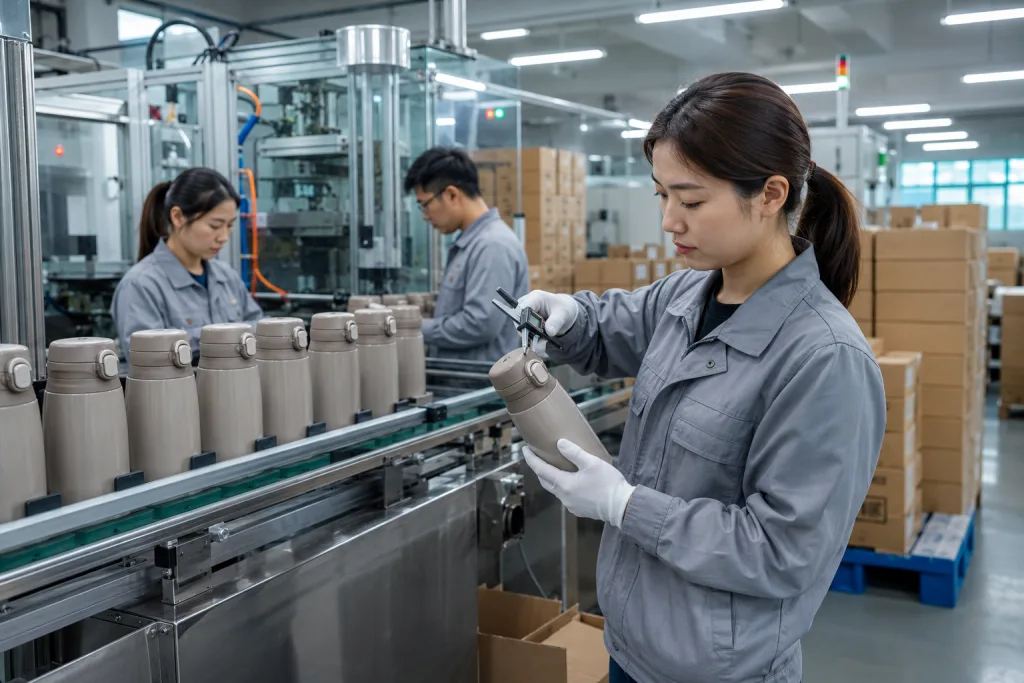
If you buy bulk drinkware from China for retail, promotion, outdoor, or institutional channels, lock the weak points before mass production. Our Zhejiang export team keeps seeing the same 6 problems in canteen wholesale, drinkware wholesale, and growler wholesale projects: PP resin written as “food grade” with no supplier code, insulation claims copied from a PPT instead of a 2-hour bench test, color signed off by eye with no Delta E limit, and no AQL plan tied to how the bottle will be used. We have seen this go sideways. QC pulled the sample with a thread gauge, the buyer flagged a loose cap thread, and the PO still said only “PP bottle, blue logo.”
The Resin Choice Gets Treated Too Casually
PP is not one fixed material by the time it reaches the molding shop. Same week, we run homopolymer PP for a stiff cap and random copolymer PP for a bottle body; recycled-content PP belongs on a non-food promo shell, not on a drinking surface. Different melt flow. Different shrinkage. For polypropylene thermal bottle bulk orders, the wrong resin shows up as plastic smell, weak drop-test results, or body ovality after hot water. QC pulled one 650 ml sample last season that measured 1.8 mm out of round at the mouth after the 85 C water check, and the line stopped for 3 hours while we traced the resin lot back to the 25 kg bags.
For tea, coffee, sports drinks, or warm water, specify virgin food-grade PP with a written material declaration. For Europe, your supplier should understand LFGB-style sensory requirements and EU 10/2011 food-contact migration testing. For North America, ask whether the material can support FDA food-contact documentation. A PI line saying "food grade material" is not enough. Too thin. We need the resin grade, the color masterbatch code, and the test plan on paper before the first 25 kg bag is fed into the hopper; last month one PO had the masterbatch code typed as MB-102 instead of MB-120, and the buyer flagged it before deposit.
The common failure is simple: a factory uses a cheaper PP mix to win a wholesale drinkware quote, then smell complaints arrive with the first container. We have seen this go sideways. A procurement manager saves USD 0.05 per unit and loses a full retail program when the buyer's store team opens 80 cartons and flags plastic odor. In Zhejiang, stable resin supply is not hard to arrange, but it must be written into the purchase order and checked at incoming material stage; our warehouse team checks the resin lot number against the PO before the line starts, using the bag label and the inbound inspection sheet.
- Spec the resin: virgin food-grade PP, no unauthorized recycled PP, named resin supplier, and the 25 kg resin bag label kept in the QC file for traceability.
- Spec the temperature: for example, 0-90 C water contact, with no deformation after 30 minutes at 85 C; we measure the mouth ID with a digital caliper before and after the test.
- Spec the odor test: closed bottle, 60 C water, 2 hours, no abnormal odor after cooling; QC keeps one sealed retained sample in the room cabinet for buyer review.
This matters whether the buyer calls it a bulk canteen, wholesale canteen, beer tumbler bulk item, or the best wholesale drink bottle for a promotion. The polymer has to match the use, not just the price target. If the buyer pushes for another USD 0.03 off by changing resin, the math doesn't work; we would rather adjust carton pack-out or MOQ than gamble on a resin swap that fails the 60 C odor jar.
Insulation Claims Drift Without Test Conditions
PP thermal bottles still get sold with soft copy like “keeps warm 6 hours.” By itself, that line is thin. Polypropylene is not vacuum stainless steel. Last year, a buyer stopped this exact wording on a 30,000 pcs school bottle PO during artwork sign-off. We had the carton proof on the light table, and the red pen went straight through the claim. Most PP thermal bottles depend on a double wall, a 3-5 mm foam insert, an air gap, or a liner shape, so the result sits in another bracket. Good bottle. Bad promise. The bottle can hit a sharp FOB price, but the math doesn't work if the supplier sells it like a 304 stainless vacuum flask.
Ask for the test method before you approve artwork. We run a bench test on the line sample: fill with 95 C water to rated capacity, close the cap with the production gasket, set it in a 20 C room, then record liquid temperature at 1, 2, 4, and 6 hours with a probe thermometer. For cold retention, repeat with 4 C water. Put the retention curve into the sample approval file, not only in a WeChat message. For 500 ml PP double-wall bottles, a fair warm-retention claim is usually 2-4 hours, depending on wall gap, lid contact area, and whether the gasket is 1.5 mm or 2.0 mm. QC pulled one sample at 6 hours and the water was already down to 41 C; the carton copy said 8 hours. If a factory claims 8-12 hours on a plastic bottle, ask for a third-party test report. Not a sales answer.
This issue shows up in drinkware bulk programs for supermarket shelf talkers, school bottles where parents complain fast, outdoor event kits with sponsor logos, and airline amenity packs where compliance reads every word. Marketing wants a thermal message. Fair enough. The wrong question is “can we print keeps warm?” The right question is “at what start temperature, room temperature, fill volume, and final temperature?” We’ve seen this go sideways when a distributor shipped 18,000 pcs with a bold heat claim, then got store-level complaints after the first weekend promotion. One buyer flagged the PO note too late; the Chinese line said “8H hot,” while the approved English artwork said “keeps warm.” Overclaiming brings returns and compliance trouble. No buyer likes that call.
For a polypropylene thermal bottle bulk project, define insulation by starting temperature, room temperature, fill volume, test duration, and acceptable final temperature.
The same discipline applies to beer tumbler wholesale bulk and beer growler bulk projects made from PP or mixed plastic components. If buyers expect stainless vacuum behavior from plastic construction, the project is already mis-specified. Say it early. We usually put the test curve beside the dieline approval, with the sample number, gasket version, and test room temperature written on the PDF. Then nobody tries to fix a performance problem with prettier artwork.
Lids Leak Because Tolerances Are Ignored
The cap is where a polypropylene thermal bottle order usually fails first. Not the body. Leakage comes from stacked tolerance errors: cap thread shrinkage at 0.15-0.25 mm, a gasket running 5 Shore A too hard, sink marks on the sealing face, loose hinge pins, or a spout plug that passes in the sample room and relaxes after one hot-water cycle. QC pulled 12 leaking pieces from a 500-piece pilot run last year. Every piece looked clean under the bench lamp, but the drip showed up after inversion.
Ask for dimensional drawings for the neck, thread, gasket groove, and drinking port. For injection-molded PP parts, shrinkage control is basic engineering, but the line still has to watch color masterbatch ratio, mold temperature, and cooling time on the injection machine. A 0.20 mm gap at the wrong sealing point can turn a passed sample into a leaking mass-production batch. We check with a Mitutoyo digital caliper and a thread go/no-go gauge before approving the mold trial. If the cap is already loose at T1, the math does not work.
For canteen bulk and canteen wholesale programs, define a leak test that matches real use. Our baseline is simple: fill to 95 percent capacity with room-temperature water, close the cap with normal hand torque, invert for 30 minutes, then shake 20 times horizontally and vertically. For hot water products, add a 70-85 C test and leave room for pressure buildup. If the bottle includes a straw, flip lid, or push button, test after 300 open-close cycles. One buyer flagged a "leak" after squeezing the bottle body like a sports bottle; that is the wrong test unless the product is sold for squeeze use.
Do not treat gaskets as generic accessories. Specify silicone or TPE grade, Shore A hardness, color, and whether the gasket is removable for cleaning. Ask whether spare gaskets are available; for institutional buyers or outdoor wholesale canteen orders, a 1 percent spare gasket pack cuts repeat emails from end users. We have seen this go sideways when a PO only said "black seal ring" and the supplier used a softer TPE that picked up tea odor after 7 days in our smell check jar.
This also matters for alcohol flask bulk and alcohol flask wholesale projects where caps are small and leakage complaints get expensive fast. If you buy alcohol flask in bulk for promotional use, confirm whether the plastic is suitable for intended liquid contact. High-proof alcohol needs a different compliance discussion than water or tea. We run separate material checks here, because a 10,000-piece promo order with the wrong cap liner is not a small repair job.
Wall Thickness Quietly Controls Durability
Roughly 70% of RFQs landing in our Hangzhou inbox only show capacity: 500 ml, 750 ml, or 1 L. Too thin. Wall thickness and rib design decide whether the bottle survives a drop, feels firm in the hand, keeps its shape near heat, and still stands flat after dishwasher-style exposure. For PP thermal bottles, we measure the outer wall, inner liner, base, shoulder, and thread area with a Mitutoyo thickness gauge; one clean 1.6 mm body reading does not tell us what the neck mold is doing after 8 hours on the line.
A workable commercial range for standard PP bottle bodies is roughly 1.2-2.0 mm wall thickness, depending on size and construction. Promo bottles sometimes run under 1.2 mm, but the math does not work if the buyer still expects low warping complaints. For larger bulk growler and wholesale growler items, the base and handle areas need extra reinforcement because filled weight climbs fast. A 1.5 L beer growler in bulk is not a scaled-up cup. QC pulled a sample on our line after the handle flexed 4 mm under load, with the digital caliper showing only 1.3 mm at the handle root; that is where repeat orders get damaged.
Drop testing belongs in the QC checklist, not buried in a side email. We run 1.0 meter drops onto concrete or a steel plate in 3 orientations: base first, side impact, then cap corner. For kids or outdoor canteen bulk orders, use 1.2 meters if the retail claim says rugged use. After drops, check leakage first, then cracks around the shoulder, lid opening force, and visible scuff marks under a bench lamp. The buyer flagged one batch for a hairline split at the cap thread that only showed after the third side drop.
Do not let the factory test empty bottles only. Filled-bottle drop tests match real use better because water weight hits the base and neck harder. For 10,000 units, our Zhejiang line would usually run first-article checks, patrol inspection every 2 hours, and final AQL inspection before carton sealing. That control is normal in China when the PO spells it out clearly, including fill volume, drop height, and pass/fail wording. We once had a buyer type “empty drop only” on the PO, then complain about filled drops later. That went sideways.
The same rule applies to beer growler wholesale bulk, beer tumbler in bulk, and larger drinkware wholesale assortments, but the target cannot be copied across SKUs. Capacity changes the stress profile. Your specification should change with it. A 750 ml bottle and a 1.5 L growler should not share the same base thickness target on the line, even if the Excel spec looks cleaner that way. We usually set the 1.5 L base 0.3-0.5 mm heavier after mold trial because the filled sample tells the truth fast.
Decoration Fails Before the Bottle Does
Logo trouble usually appears before leak trouble. We run 30-minute leak checks at the sink station, and a PP bottle still gets rejected if the logo scratches under a fingernail or the Pantone red prints orange. Last month QC pulled a sample where the print sat 4 mm too low and almost touched the mold parting line. Easy reject. PP is less forgiving than stainless steel because its surface energy is low. If the line skips flame treatment, corona treatment, primer, or the matched ink system, adhesion will fail before the bottle has a chance to prove itself.
For custom logo PP thermal bottles, fix the decoration method before sample mold trial. Silkscreen works for flat one-color logos on the body; we usually choose it when the artwork has clean edges and no shadow. Heat transfer is better for gradients, but the film edge must be checked after curing. In-mold label suits retail-facing panels where the shelf look matters and the label cannot lift at the corner. Pad print belongs on curved caps. Sticker label is for budget runs where the buyer accepts a shorter display life. Molded color insert is the right call when the color needs to be part of the plastic, not printed on top. Silkscreen is common and cost-effective for one or two colors, often adding about USD 0.03-0.12 per print depending on size and quantity. Heat transfer gives cleaner gradients, but we still run tape pull on the first 5 pcs after curing. In-mold labeling looks clean. Tooling and MOQ are higher, so the math does not work for a 3,000 pc trial order.
Use Pantone references, not phone screenshots. Screens lie. Set an acceptable color tolerance, for example Delta E under 2.0 for critical brand colors if measured, or approved production standard if visual. For retail bulk drinkware, request a signed golden sample and keep one at the factory and one with your buying office. We usually mark the factory sample with PO number, Pantone code, and approval date on the hang tag. One typo on a revised PO, such as 186C typed as 185C, can send the line chasing the wrong red for half a shift.
A basic adhesion check is 3M tape pull after 24 hours curing, then 50 rubs with a wet cloth and 50 rubs with a dry cloth. Use a white cotton cloth, not a dark rag from the packing bench. We have seen black fiber from a bench rag make a good print look dirty under the inspection lamp. For dishwasher-related claims, be careful. In our PP bottle orders, about 8 out of 10 decorated styles are hand-wash only unless the decoration system has passed repeated wash testing.
This is where wholesale drinkware projects lose 7 to 12 days. The buyer approves bottle shape but leaves logo size, placement, and Pantone confirmation until the pre-production sample stage. Then the supplier rushes samples, and the first batch becomes the real test. We have seen this go sideways: the bottle passed function, but the buyer flagged logo height during final inspection under AQL 2.5. The inspector measured it with a steel ruler against the approved sample photo, and the cartons were already stacked near the loading door. For polypropylene thermal bottle bulk orders, decoration belongs in the engineering spec, not in a late artwork email.
Cartons Fail in Export Reality
A bottle can pass factory inspection and still land at the buyer with dented caps if the export carton is underbuilt. PP bottles are light, so buyers often ask us to shave carton thickness to save freight weight. The math doesn't work. We have seen a 9 kg master carton leave the packing line clean, BOPP tape tight and corner seams square, then arrive with crushed shoulders after 18 days on the water and two warehouse transfers.
Put the carton spec inside the quotation: outer carton size in mm, bottles per carton, gross weight and net weight, 3-ply or 5-ply board, bursting strength, plus the exact inner packing method such as egg-crate divider or individual paper wrap. For Amazon FBA or distributor warehouse delivery, freeze the carton labels, FNSKU position, suffocation warning text, and master carton dimensions before production starts. QC should check the first packed carton with a 5 m tape measure and floor scale. A 15 kg carton is already awkward for hand loading. A carton with 25 mm of empty space on each side loses compression strength fast.
For standard export, 5-ply corrugated cartons are common. For larger wholesale growler, beer growler wholesale, or beer tumbler wholesale bulk orders, we run dividers or tighter inner packing so the bottles do not rub during the 220 km truck run to Ningbo. Glossy printed logos need individual polybags or paper wrap. Otherwise, after a shake test, QC often pulls a sample and finds hairline scuffs near the shoulder. If your market restricts plastic packaging, specify recyclable paper packing before the PO, then test whether the paper leaves marks on the coating after 24 hours in a stacked carton.
ISTA 1A or a simple drop test catches the obvious mistakes. Drop the master carton from 76 cm on one corner, three edges, and six faces, then open it and inspect the bottle, cap, handle, and retail box. We once had a carton pass the face drops but fail on the corner because the divider stopped 12 mm short of the cap. Small gap. Big claim. For high-value retail programs, third-party lab testing is worth paying for because one rejected pallet usually costs more than the test fee.
FOB Ningbo or FOB Shanghai pricing from Zhejiang and nearby China factories should include export cartons unless the quote says otherwise. If the cartons are not matched, the cheaper unit price is the wrong question to ask. Compare quotes only after the packing assumptions match: board grade, divider style, label work, and whether warehouse repacking is included. A USD 0.04 cheaper bottle can cost more after you add dividers, stronger cartons, relabeling, or warehouse repacking; we have seen buyers flag this only after the PO typo listed 3-ply instead of 5-ply.
QC Plans Must Match the Order
Final inspection cannot replace a signed spec sheet. It only proves whether the line followed what both sides approved. For polypropylene thermal bottle bulk orders, we run incoming resin check, first-article approval, line patrol inspection, and final AQL inspection as separate gates. The golden sample stays on the QC bench with a digital caliper, Pantone chip, full-water inversion leak test, and 3M tape test on the logo before mass packing starts. If QC waits until the last day, leakage or weak print adhesion may show up after 20,000 units are already sealed in export cartons. Too late. We had this on a blue PP bottle: the PO showed the approved Pantone, but the carton label still carried the old color code, and the buyer flagged it before release.
A practical AQL setup is 0 for critical defects, 2.5 for major defects, and 4.0 for minor defects. Critical defects include unsafe sharp edges, contamination, wrong material, and severe leakage during a full-bottle inversion test. Major defects include failed functional leak tests, capacity outside the signed tolerance, poor cap fit after torque checking, wrong logo, and a cracked body. Minor defects are small scuffs, color variation inside the approved range, or packing marks that do not affect sale. QC pulled the sample last month for a 0.8 mm burr on the drinking rim. That touches the mouth. The math doesn't work if a factory tries to hide that under minor defects.
MOQ depends on mold ownership, color, and decoration. Existing molds may run at 3,000 units per color, while custom colors often start at 5,000 units. New mold projects can need 8,000-20,000 units before the cost makes sense. At our Hangzhou-area partner facilities, monthly output for plastic and stainless drinkware combined can reach 300,000-500,000 units, but capacity means little if the artwork file or resin grade is still moving. We once held a 12-day production slot because the buyer sent CMYK logo art after approving a one-color silk screen. The line waited. That delay cost more than the sampling fee.
For mixed programs, separate specifications by product family. A beer tumbler wholesale order and an alcohol flask wholesale bulk order should not share one generic inspection checklist with a wholesale canteen order unless you accept loose control. Each item has its own liquid-contact risk, cap structure, packing test, and retail claim language. On the factory floor, we check a canteen strap pull with a simple kg load test; a flask needs tighter cap-thread checking and inner-surface inspection under a light box. We have seen this go sideways when one checklist said “check lid” for three products with different closure designs.
Before deposit, ask the supplier for a pre-production control sheet. It should list resin grade, color, capacity tolerance, wall thickness points, leak test, thermal test, logo method, packing method, carton mark, compliance documents, and shipment terms. That sheet prevents most avoidable failures because every checkpoint has an owner before PP samples are signed. We usually mark wall thickness in mm at the shoulder, body, and base, then attach the approved carton mark so nobody types “PP bottle” wrong on the shipping mark. It also makes your supplier easier to manage, whether you buy from Zhejiang, another China production base, or a trading company coordinating several factories.
Send your bottle spec before you request pricing
Share capacity, target market, logo method, MOQ, and test requirements. We will quote the real build, not a vague catalog version.
Frequently asked questions
What MOQ should I expect for polypropylene thermal bottle bulk orders?
For an existing mold and standard factory color, 3,000 units per SKU is a realistic starting point. Custom Pantone colors usually need 5,000 units because the factory must run dedicated resin and masterbatch. If you need a new mold, expect 8,000-20,000 units depending on size, cap structure, and whether you want exclusive tooling. Mixed-carton wholesale drinkware orders can sometimes combine colors, but do not assume a 500-unit color split unless the supplier confirms it in writing.
Is polypropylene suitable for hot drinks?
Yes, if the PP grade, structure, and test limits are specified correctly. Many food-grade PP bottles can handle warm or hot water, but you should define the contact temperature, such as 0-90 C, and run deformation and odor tests. Be careful with boiling water claims. A double-wall PP thermal bottle may reduce hand heat and retain warmth for 2-4 hours, but it is not the same as vacuum stainless steel. Ask for food-contact documentation for your target market before approving mass production.
How should I inspect a canteen wholesale or bulk canteen shipment?
Use an AQL plan with 0 critical defects, 2.5 major defects, and 4.0 minor defects. Check capacity, weight, wall thickness, cap torque, leakage, odor, color, logo adhesion, carton marks, and packing. For leak testing, fill bottles to 95 percent capacity, invert for 30 minutes, and shake 20 times. For outdoor canteen bulk items, add filled drop tests at 1.0-1.2 meters. Keep the approved golden sample at the inspection table so cosmetic and functional standards are not debated during final QC.
Can I use the same supplier for beer growler bulk and PP thermal bottles?
Sometimes, but check the factory’s real process capability. A supplier strong in PP injection molding may not be the best choice for stainless vacuum growlers, and the reverse is also true. Beer growler wholesale projects need stronger handle, cap, gasket, and carton testing because filled weight is high. If you need beer growler in bulk alongside polypropylene thermal bottle bulk, ask whether production is in-house or subcontracted. Subcontracting is not automatically bad, but QC responsibility must be clear.
What price range is realistic for wholesale drinkware in PP?
For standard PP thermal bottles, many FOB China prices fall around USD 1.20-3.80 depending on capacity, wall thickness, cap design, insulation structure, logo, and packing. A simple 500 ml promotional bottle may sit near the low end, while a double-wall 1 L bottle with better cap and retail packaging costs more. Alcohol flask wholesale or beer tumbler bulk items may price differently because liquid-contact requirements, decoration area, and packaging change the cost. Always compare quotes with the same resin, test, and carton requirements.