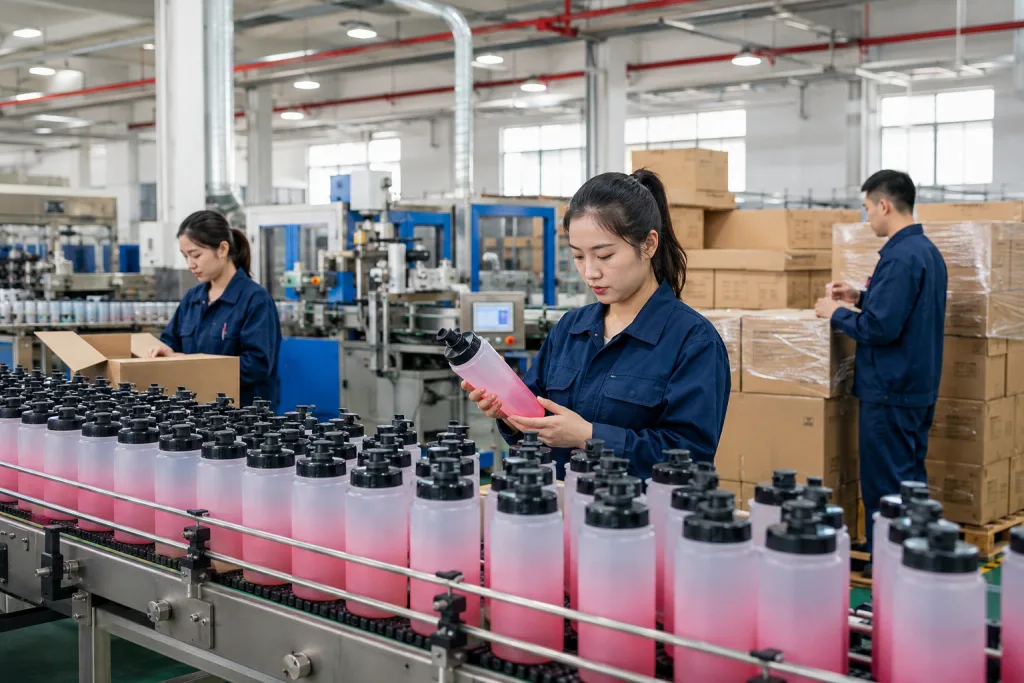
Key Takeaways
- For PP sport bottles, specify food-grade PP #5 with 1.2-1.8 mm body wall thickness depending on capacity
- A 3,000-piece MOQ per color is realistic for custom wholesale drinkware without pushing tooling cost too high
- Ask for 100% leak testing on push-pull caps and AQL 2.5/4.0 final inspection before shipment
- FOB China pricing usually changes more from cap structure and packaging than from the bottle body itself
A polypropylene sport bottle looks simple on a buying sheet: 650 ml, PMS color, one-color logo, 24 pcs per carton, FOB Ningbo price. The risk is one row lower. We run cap torque checks with a digital torque meter, then QC pulls samples again after warm-room testing; a cap that passes cold water can still seep at 45°C in a delivery van. Seen it happen. A body wall cut by 0.15 mm saves USD 0.03, but the math doesn't work if 2 cartons arrive with dented bottles and the refill order slips.
If you buy polypropylene sport bottle wholesale from China, read the spec sheet as a risk list, not a product description. At our Hangzhou, Zhejiang factory, standard MOQ is 3,000 pieces per color, normal lead time is 25-35 days after artwork approval, and output runs about 480,000 PP bottles per month. Small details decide the order. Last month a buyer flagged a PO typo: “PP lid” was typed as “PE lid.” We stopped the line before mold setup because that one letter changes fit, cost, and the leak-test result.
Start With Material Grade
The first spec line should never stop at “PP bottle.” Write it clearly: food-contact polypropylene, PP #5, virgin resin unless your QA team has signed off on recycled content. For North America and Europe, ask for FDA food-contact compliance, EU 10/2011, LFGB if your buyer needs it, and REACH for colorants. For children’s or school channels, CPSIA and ASTM checks depend on the label claim and sales market. We run this check before sampling, using the pigment file, resin COA, and the PO side by side. Last quarter QC rejected 3 color chips because the pigment file showed 186C, while the PO said 186U.
Polypropylene works for sport bottles because it is light, survives normal drops, and costs less than stainless steel. It will not shatter like glass. Fair trade. The weak points are heat deformation and scratching. Most PP sport bottles are fine for cold water, gym use, school packs, cycling events, and promotional drinkware bulk orders. They are not made for boiling water or rough dishwasher cycles unless the mold, resin, and cap gasket pass that use case. We have seen this go sideways: one buyer approved a gym bottle, then printed “dishwasher safe” on the hang tag without a 70°C wash test. Bad label. Bad claim.
For a 600-750 ml sport bottle, we usually recommend 1.2-1.5 mm average body wall thickness. For 1,000 ml models, 1.5-1.8 mm is safer, especially if the bottle ships as a bulk canteen for outdoor events. A cheap 0.9 mm body can look fine in a showroom sample but flex during printing, carton stacking, or drop testing. QC pulled the sample on one 20,000 pcs order after the screen-print jig left pressure marks near the grip panel. The caliper read 0.92 mm at the waist, not the 1.2 mm the buyer thought they were getting.
If you are comparing wholesale canteen, wholesale drinkware, or beer tumbler bulk projects, price by capacity is the wrong question to ask. Compare resin grade and wall thickness first, then check the cap material, gasket material, and test standards. That is where the cost sits. On our line, a 0.3 mm wall change can affect resin weight, cooling time, carton crush results, and the buyer’s landed cost more than a 50 ml capacity difference. The math does not work if the bottle passes the quote sheet but fails AQL 2.5 after printing.
Capacity Is Not Just Volume
Capacity sounds simple. It is not. Buyers still confuse brimful capacity with usable drinking capacity, and QC catches it with a 1,000 ml measuring jug more often than sales teams like to admit. A bottle marked 750 ml might take 780 ml at the rim, while the fill line sits at 720-740 ml once the cap, straw, silicone valve, or inner plug is fitted. For Europe and North America retail claims, write the test method on the spec sheet: brimful or usable fill, plus/minus 3% tolerance or tighter.
Common PP sport bottle sizes for wholesale programs are 500 ml, 600 ml, 650 ml, 750 ml, and 1,000 ml. Event giveaways usually land at 600-750 ml because one packed export carton stays around 14-16 kg, which keeps warehouse complaints down and still leaves room in the unit price. Fitness and outdoor brands often push 750 ml or 1,000 ml because the shelf value looks stronger. For canteen wholesale into school, camping, or corporate wellness channels, 600 ml is still the safer middle size. We have seen buyers reject 1,000 ml samples during review because they were too bulky for standard student backpack side pockets, even when the PO had a typo showing "100 ml" instead.
Shape changes the freight bill. A straight round 750 ml bottle may pack 50 pieces per export carton, while a curved grip body may drop to 36-40 pieces after the line allows for handle clearance and polybag space. That can shift sea freight cost by 8-15% even when the FOB price does not move. For distributors selling bulk drinkware, carton efficiency matters as much as product appearance. This is the wrong question to ask if the team only says, "Which mold looks better?" We have seen QC pull a packed carton and find 18 mm of wasted air on each side.
Ask your supplier for carton dimensions, gross weight, net weight, and CBM before approving the shape. We run this check in the sample room with a tape measure and carton scale before the PO is locked, because a bottle that saves USD 0.04 in molding cost but adds USD 0.06 in freight is bad math. If your program includes related categories such as growler wholesale, beer growler bulk, or alcohol flask bulk, keep capacity claims consistent across the line so the catalog does not look patched together by three different buyers.
Cap Design Decides Complaints
On our PP sport bottle orders, roughly 7 of 10 quality complaints start at the cap, not the bottle body. The cap spec needs the drinking style, thread type, gasket material, hinge strength, leak test method, and replacement policy written into the PO. A WeChat screenshot is not a spec. We check this first at pre-production, usually with the sample, caliper, and thread gauge on the table. A push-pull cap keeps cost down and buyers know it, but it leaks when the valve tolerance opens past about 0.20 mm on a tired mold; our gauge pin usually catches it before packing if the line checks every 2 hours. A flip-top cap looks better on shelf, but the hinge pin and locking button need cycle testing on the line. We run 500 opens as a basic floor check. A screw cap gives fewer surprises, though gym and school buyers often push back because kids drink slower and lose the cap.
For wholesale drinkware programs, we run assembled bottles upside down for 30 minutes after filling with room-temperature water. Simple test. For stronger projects, QC adds a 45°C warm-water leak test and a drop test from 1.0 meter onto plywood or concrete simulation, depending on the buyer requirement. If the bottle will be sold online, tighten the standard. One leaking unit in an e-commerce pack can wet 24 labels in the carton, soften the inner box, and turn into a bad review before your sales team sees the claim. We had a buyer flag a carton because the barcode label curled at one corner after a cap seeped during transit. The math is ugly: one bad cap can spoil a full inner pack.
Gasket material matters. Silicone holds shape better over repeated opening than low-grade rubber, but the math does not work if the buyer is chasing the lowest FOB by half a cent. TPE valves can pass, but we ask for food-contact certification and do an odor check after 24 hours in a sealed PE bag. QC pulled the sample once because the valve smelled like recycled shoe sole. That one failed fast. Do not accept a cap described only as "plastic cap." Specify PP shell, PE straw, TPE valve, or silicone gasket by component, then make the supplier write it on the sample label before approval.
For canteen bulk and drinkware wholesale buyers, cap color matching also needs attention. Body and cap are often molded in different materials, so Pantone matching may show a visible Delta E difference under the D65 light box. A realistic tolerance is Delta E 1.5-2.0 for critical colors, but confirm it before mass production and write the approved swatch code on the sample tag. Zhejiang factories can match color well, but resin batch, surface gloss, and wall thickness change the final look; a 1.2 mm cap wall and a 2.0 mm bottle shoulder will not reflect light the same way. We have seen this go sideways when a buyer approved the body only and flagged the cap after 8,000 pieces were packed.
Printing And Decoration Limits
PP gives printers trouble because its surface energy is low. If the logo has to survive carton rubbing, normal washing, and warehouse handling, the bottle body needs flame treatment, corona treatment, or primer before printing. We run a Dyne pen check at the print station; 38 dynes is our go/no-go line before ink goes on. Skip it, and the risk is real. A cheap silkscreen logo can pass first visual inspection under the light box, then start rubbing off after 3-4 weeks in customer hands.
Silkscreen is still the standard choice for one-color or two-color logos on sport bottles. At 3,000-10,000 pieces, the math works, and color coverage stays solid when the screen mesh, squeegee pressure, and curing time are set right. Heat transfer handles gradients and detailed artwork, but the decal edge can show on curved 750 ml bodies; the buyer flagged this on a matte black order last year after QC pulled 12 bottles from the packed cartons. In-mold labeling looks cleaner for large programs, but tooling and setup make sense above 20,000-30,000 pieces. Laser engraving is a weak fit for PP because the mark has low contrast unless the resin is mixed with marking additives.
A workable print spec should name the logo size in millimeters, Pantone colors, print position tolerance, adhesion test, and abrasion test. We use 3M tape pull testing after ink curing as a basic check, and QC pulls the sample only after 24 hours because fresh ink can lie. Short wait. Better read. For higher-value retail orders, buyers often ask for 50-cycle rub testing with a dry or wet cloth, and the line needs that requirement before mass printing starts. If the order is promotional wholesale drinkware or sports club packs, one-color silkscreen keeps cost predictable.
Decoration cost can beat the bottle cost. A plain 750 ml PP bottle may be FOB USD 0.58-0.85 depending on cap and weight. Add two-side printing, individual polybag, barcode sticker, and retail insert, and the added cost may be USD 0.12-0.28. We have seen this go sideways when a PO says “logo included” but the artwork file has two sides and 4 Pantone colors; one buyer even sent a revised AI file after the screens were already burned. Comparing drinkware bulk quotations without a complete decoration spec is the wrong question to ask.
Packaging, Cartons, And FBA
Packaging is where 3 good bottle specs can wreck a landed-cost sheet. For normal distributor orders, we run bulk packing first: bottles stacked in master cartons, with EPE or paper inner dividers only when the cap surface scratches in a 60 cm shake test. Retail orders need their own pack list. That means individual polybags with suffocation print, kraft boxes with the EAN barcode checked on our Honeywell scanner, or a hangtag tied under the neck ring with 180 mm cotton string. For Amazon FBA or similar warehouses, put FNSKU labels, carton weight limits, suffocation warnings, and drop-test packing method on the purchase order before we book carton board. Late changes cost real time. We had one PO last season where the buyer added FBA labels after carton printing, and the line lost 2 days relabeling 4,800 bottles by hand.
A common 750 ml PP sport bottle can pack 50 pieces per carton in bulk packing, with carton size around 58 x 40 x 48 cm and gross weight around 9-12 kg depending on wall thickness and cap. QC pulled a sample carton last month where the buyer asked for a color box after PP sample approval; the pack changed to 24 pieces per carton, and the CBM went up 32%. That is not a small change. The math does not work if nobody updates the freight sheet. A retail box may reduce packing to 24 or 36 pieces per carton and increase CBM by 20-40%. If you are shipping from China to Rotterdam, Hamburg, Los Angeles, or Vancouver, volume weight can hurt more than actual kg, and the forwarder will not care that the bottle itself is light.
Export cartons should use 5-ply corrugated board for heavier drinkware bulk shipments, especially if cartons sit on pallets in a forwarder warehouse for 45-90 days. For lightweight PP bottles, 175-200 lb test board is usually fine after we confirm stacking height, edge crush condition, and whether the carton bottom needs H-taping. We check this with a loaded carton on the floor scale, then stack 5 cartons high for a short compression read before sealing the sample with 48 mm tape. If the order mixes polypropylene sport bottles with bulk growler, beer growler wholesale bulk, beer tumbler wholesale bulk, or alcohol flask wholesale bulk SKUs, separate carton specifications by product weight. One carton spec for all SKUs is the wrong question to ask.
Ask for carton drop testing, carton markings, and pallet loading plans. We normally run a 1-corner, 3-edge, 6-face drop check before shipment for FBA-style packing, then photograph the crushed corners if the box fails. Do not let the factory decide shipping marks at the last minute. Your warehouse needs PO number, SKU, color, quantity, country of origin, and carton number clearly printed, and one typo in the PO number can stop receiving. We have seen a single missing digit on the side mark hold 86 cartons at inbound check. Zhejiang export teams know this routine, but we still need your exact template early, preferably before the carton knife mold is confirmed.
Price Lines And MOQ Reality
A proper quote for polypropylene sport bottle wholesale should break out the real cost drivers: bottle mold, PP resin gram weight, cap build, masterbatch color, logo print, inner bag or retail box, test request, and FOB/CIF term. One unit price hides the weak spot. We run wall-thickness checks with a digital caliper; if a 600 ml body drops from 1.15 mm to 0.92 mm, the price looks better but the bottle feels soft in hand. Bad trade. The buyer then flags squeeze marks after the first shipment, and nobody wants to argue over warehouse photos at 11 p.m.
For standard existing molds, our workable MOQ is 3,000 pieces per color and 5,000 pieces per custom color when Pantone matching is strict. A new private mold for a PP sport bottle usually starts around USD 3,000-8,000, with the quote moving by shape, cap complexity, and cavity count on the tooling drawing. Simple logo printing setup may cost USD 30-80 per color. Full custom packaging artwork proofing can add cost, especially when the barcode size or warning text is changed after the PO is signed. On the line, QC pulled one matte black sample last month because the cap and body were two Pantone steps apart under the D65 light box.
Typical FOB Ningbo or FOB Shanghai pricing for a 600-750 ml PP sport bottle can run from USD 0.55 to USD 1.10. The lower end usually means a simple cap, lighter body, bulk packing, and one-color print; the higher end often covers a flip-top cap with silicone gasket, thicker body, retail box, and tighter inspection. For 1,000 ml canteen bulk orders, expect higher resin cost and lower carton density; one 58 x 39 x 42 cm export carton may hold 48 pieces instead of 72. The math changes fast. We check carton loading with a tape measure before booking, because 2 cm extra carton height can push the pallet plan off.
Be careful when you compare this category against wholesale growler, beer growler wholesale, alcohol flask wholesale, or beer tumbler wholesale pricing. Those products often use stainless steel or glass, need different testing, and sit at a different retail shelf price. A PP sport bottle is a volume item. Your profit comes from repeat supply and clean branding with fewer complaints. Squeezing the final USD 0.02 is the wrong question to ask if it creates 3% leakage claims after delivery; we have seen one loose gasket batch turn a good reorder into a debit note, and the buyer flagged it during AQL 2.5 reinspection with water still inside the cap thread.
Inspection Before The Balance Payment
Do not wait until the container lands to learn the bottle mouth is 1.5 mm out of round, the cap color misses the approved Pantone, or the logo peels under a fingernail rub. That is too late. For wholesale drinkware orders, inspection belongs in the production schedule, beside the injection plan and packing date. We run three checkpoints with names on paper: pre-production sample approval with a signed seal sample, inline inspection at 20-30% completion, then final random inspection before balance payment. One buyer once asked us to "just ship first" because the vessel closing date was tight. Wrong call. QC found 17 oval mouths on the injection line that afternoon with a go/no-go mouth gauge.
Use AQL, not "good quality" written on a PO. For PP sport bottles, a common standard is AQL 2.5 for major defects and AQL 4.0 for minor defects. Critical defects should be zero. Major defects include leakage during inverted testing, broken caps after torque checking, wrong capacity against the marked ml line, wrong logo artwork, severe color mismatch, strong odor, and unsafe sharp edges around the mouth or handle. Minor defects include small flow marks, light scratches, or print position drift inside the approved tolerance, such as plus or minus 1 mm from the artwork file. We measure that with a 0.02 mm digital caliper and a printed logo gauge, not by eye under weak warehouse light.
For functional checks, write down the leak test quantity, cap torque range, drop test height, smell test method, print adhesion tape grade, and carton check items before the line starts. QC needs the rule early. If your buyer requires BSCI, ISO 9001, or social compliance documents, ask for them before paying a deposit. In our last 20 factory audits for PP bottle projects, two trading companies could show clean PDFs but could not arrange a live video walk-through of the injection workshop. We have seen this go sideways. We ask to see the injection machines, resin bag labels, and packing tables in one continuous call, with the phone camera close enough to read the PP grade sticker.
A good supplier will not be offended by inspection. We prefer it because it cuts the argument later. At our Zhejiang plant, mass production photos, packing videos, and random leak-test records are shared before shipment on repeat orders; QC pulled 80 samples from one 12,000 pcs lot last month and caught one carton with the wrong inner bag count, 48 bags packed against 50 on the packing spec. For first orders, a third-party inspection from SGS, Intertek, Bureau Veritas, or QIMA is worth the USD 250-350 fee. The math doesn't work if you save that fee and then sort 5,000 bottles in your own warehouse.
Send your PP sport bottle spec for checking
We will review material, cap, MOQ, printing, packing, and FOB cost before you place a production order.
Frequently asked questions
What MOQ should I expect for polypropylene sport bottle wholesale?
For existing molds, a realistic MOQ is 3,000 pieces per color for standard colors and 5,000 pieces per color for strict Pantone matching. Some China suppliers quote 1,000 pieces, but the unit price is usually higher and customization options are limited. If you need a private mold, expect 10,000 pieces or more for a sensible first run because tooling may cost USD 3,000-8,000. For mixed wholesale drinkware programs, we can sometimes combine colors or pack different SKUs in one shipment, but each color still needs stable molding and printing setup.
Is polypropylene safe for reusable sport bottles?
Food-grade polypropylene, marked PP #5, is widely used for reusable bottles, lunch boxes, and caps. For B2B sourcing, do not rely only on the recycling symbol. Ask for food-contact documentation such as FDA, EU 10/2011, LFGB if needed, and REACH compliance for pigments. Also specify intended use: cold water, warm drinks, dishwasher, or children’s use. A normal PP sport bottle is best for cold or room-temperature drinks. If you want boiling-water resistance or long heat retention, stainless steel is a better material than PP.
How much does a custom PP sport bottle cost FOB China?
For a standard 600-750 ml PP sport bottle, FOB Ningbo or Shanghai pricing often ranges from USD 0.55 to USD 1.10. The price depends on resin weight, cap design, gasket, print colors, packaging, and inspection level. A simple push-pull cap with bulk packing may stay below USD 0.75 at 5,000 pieces. A flip-top cap, silicone gasket, two-side logo, retail box, and barcode label can push the unit above USD 1.00. Always compare quotations using the same wall thickness, carton quantity, and test requirements.
Can I source sport bottles together with growlers, tumblers, and flasks?
Yes, but treat them as different product families. Polypropylene sport bottles, bulk growler products, beer tumbler in bulk, and alcohol flask in bulk use different materials, tooling, testing, and packing. PP bottles are usually high-volume, low-unit-price items. Growlers and beer tumblers may be stainless steel or glass, with different leak, insulation, and impact requirements. Combining them in one purchase order can reduce admin work and container cost, but each SKU needs its own spec sheet, AQL plan, carton design, and compliance file.
What defects should I check before shipping canteen wholesale orders?
Check leakage first. Fill samples, close caps, invert for 30 minutes, and add a warm-water test if the bottle may sit in hot transport conditions. Then check capacity, cap fit, gasket placement, odor, color, logo adhesion, scratches, sharp edges, and carton strength. Use AQL 2.5 for major defects and 4.0 for minor defects. For a 5,000-piece wholesale canteen order, third-party inspection usually costs around USD 250-350 in China. That is a small cost compared with receiving leaking bottles or cartons that collapse in your warehouse.