Key Takeaways
- A serious polypropylene sport bottle bulk RFQ should define PP grade, capacity tolerance, wall thickness, cap seal, and test standard before pricing.
- Typical MOQ for a custom-color PP sport bottle is 3,000-5,000 pcs, with 25-35 days production after sample approval.
- FOB China pricing can move 8-15% based on lid design, color masterbatch, carton strength, and logo method.
- For drinkware wholesale programs, AQL inspection, odor testing, and drop testing matter more than saving USD 0.03 per unit.
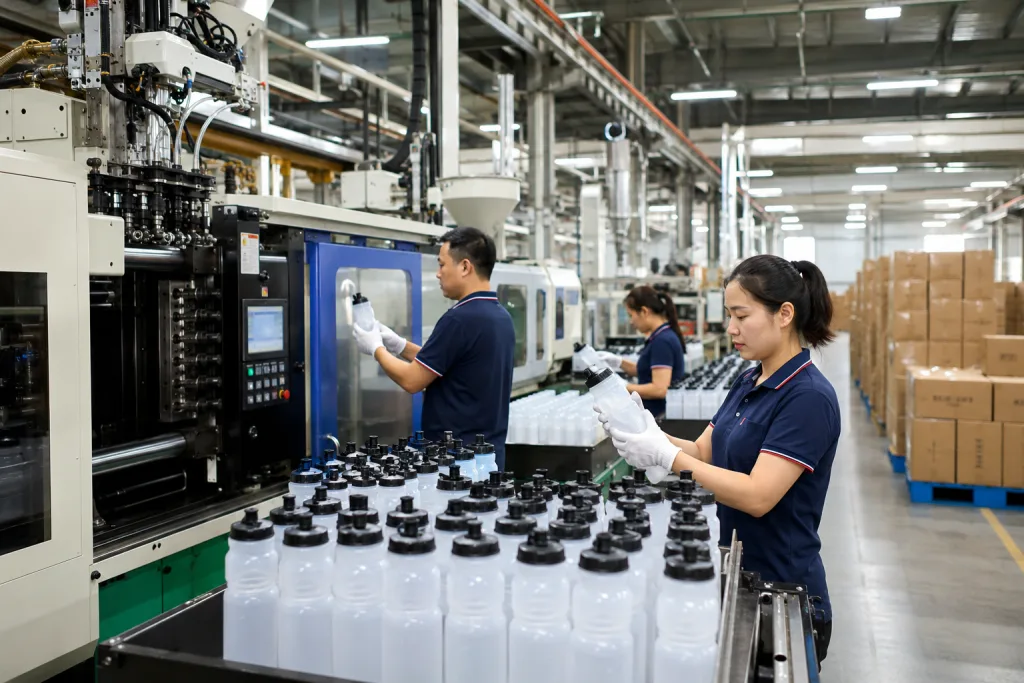
Buying polypropylene sport bottle bulk is rarely hard because of the bottle shape. It gets hard when a 0.2 mm wall-thickness change, a softer cap gasket, or a cheaper masterbatch moves the price, leakage rate, shelf life, and complaint rate. Same photo, different bottle. We run into this on the line: a 650 ml PP sports bottle can look almost identical across five quotes, while the resin grade, cap seal, wall thickness, and carton packing are all different; last month QC pulled the sample after 24 hours because 3 caps seeped at the silicone ring.
If you handle bulk drinkware for retail, fitness programs, schools, promotions, or distributor stock, a catalog photo is not enough. Read the spec sheet like a buyer, not like a consumer. From Hangzhou, Zhejiang, we saw 7 China sourcing projects this quarter lose 12 days vs 18 days on approval because the buyer signed off on the shape but missed the manufacturing details: PP grade, lid torque, 12 pcs/ctn packing, and drop-test height. Small miss. Big delay. The buyer flagged the color only after the pilot run, when the PO still had “mat blue” instead of “matte blue.” We’ve seen this go sideways.
Material line: PP is not one thing
The spec sheet should never stop at “PP.” For polypropylene sport bottle bulk orders, ask for food-contact polypropylene with a resin declaration, batch number, and supplier name printed on the bag label, not mixed recycled pellets from a no-name hopper. On our line, the resin bag label is checked against the BOM before drying at the injection machine, and QC pulled one sample last month because the PO typed “PP recycle” by mistake. Small typo. Big risk. PP sells well because it is light, takes drops better than brittle plastics, and costs less than Tritan or stainless steel. It survives gym bags and 5-layer export cartons without pushing carton weight into a bad freight bracket. “PP” alone is still a weak spec.
For Europe, confirm whether the material supports EU 10/2011 food-contact requirements and REACH screening for restricted substances. For North America, FDA food-contact compliance is the usual baseline. If the bottle is for children, CPSIA or ASTM-related checks depend on decoration, age grading, and sales channel. We ask buyers to confirm this before tooling. Changing a cap print after the silk-screen plate is made can burn 2 days and around USD 80 per color, and faster packing will not save that schedule. The line cannot fix a compliance miss with tape guns and extra workers.
The buyer impact is simple: unclear resin means higher risk. A quote that is USD 0.08 lower can turn expensive if the bottle smells after a 70°C hot-water test or shows color migration after 20 wash cycles. We normally recommend an incoming resin check and finished product odor evaluation for repeat drinkware bulk programs. Skip the lab every shipment if the program is stable. Do not skip traceability. The math does not work if the factory saves 3 cents on resin and your distributor rejects 5,000 pieces at AQL final inspection because QC opened the carton and caught a sour plastic smell.
PP has one weakness against higher-end copolyester: it can look softer and less premium, especially in transparent colors above 600 ml. If your brand claims “premium,” judging only by unit price is the wrong question to ask. If your channel needs a practical promotional bottle or school canteen bulk order, PP is usually the right cost-performance choice. In Zhejiang factories, PP injection and blow molding supply chains are mature, so we run 12-day repeat lead times more often than 18-day starts from unfamiliar material. The buyer flagged gloss once on a matte blue bottle; the mold temperature setting, not the resin grade, was the real problem.
Capacity, wall thickness, and hand feel
Capacity is where about 6 out of 10 wholesale drinkware projects start to drift. The buyer writes “750 ml bottle,” we check brimful capacity on the line with a 1,000 ml graduated cylinder, and the retail label expects usable fill. Same bottle. Different answer. For a PP sport bottle, state whether 650 ml, 750 ml, or 1,000 ml means normal drinking fill or full-to-rim capacity. On molded plastic drinkware, we run ±3% as the working tolerance unless the customer sends a tighter 2D drawing with marked fill height.
Wall thickness changes squeeze feel and shelf impression fast. For most polypropylene sports bottles, the body wall sits around 0.8-1.2 mm, depending on rib design, mold flow, and whether the line is fighting sink marks near the shoulder. QC pulled one 0.72 mm sample last year with a digital caliper; it passed leak testing but dented after carton compression at 11 kg. Thin wall can save 2-4 cents. The math doesn't work if the bottle feels cheap in the consumer’s hand. Thicker walls feel better in the grip, but they add resin weight and slow the injection cycle by a few seconds per shot.
If your buyer is comparing this product with a bulk canteen or wholesale canteen program, pin down the use case before quoting. PP sport bottles fit daily hydration, gyms, camps, and event giveaways, but that answer is too loose when the retail buyer expects outdoor gear styling. This is the wrong question to ask: “Can we use the same bottle?” Ask instead where it sits on the shelf and what the buyer will compare it against. A canteen wholesale product needs a wider shoulder or carry strap if the brief says hiking, and we’ve seen buyers flag a “sport bottle” profile as too soft-looking for outdoor retail after the first 12 sample sets arrived. A bulk growler or wholesale growler, especially for beer growler bulk demand, sits in another category because carbonation pressure, volume, and closure expectations change. Do not use one generic bottle spec for all of them.
For brand owners, we suggest locking the gram weight after golden sample approval. Example: 750 ml bottle body at 62 g ±3 g, cap at 18 g ±1 g. Put it on the PO. We once saw “62 g” typed as “52 g” in a buyer file, and QC caught it only because the approved sample was still on the inspection table beside the digital scale. Without gram control, you can receive a first order that feels sturdy and a second order that feels lighter because the supplier quietly reduced material to protect margin.
Lid system decides complaint rate
The lid drives most complaints in polypropylene sport bottle bulk orders. The bottle body usually clears drop, wall-thickness, and appearance checks. The cap gets blamed. On our line, QC pulled 32 samples last month after a buyer flagged wet cartons near the cap seam; 27 were lid-related. A proper spec sheet should name the cap material, thread type, gasket material, spout design, venting method, and state whether the lid is leakproof or only spill-resistant. Different promise. Different risk.
A screw cap with a silicone gasket costs less and holds well when the thread engagement is deep enough, say 3.5 turns instead of 2. Cheap lids fail right there. A flip-top cap with a push button looks stronger on a retail shelf, but it adds a spring, hinge pin, lock button, gasket, sometimes a straw, plus extra hands at assembly. Small parts slow the line; we saw one 5,000 pcs run lose almost 40 minutes because the hinge pin feeder kept jamming. For promotional drinkware wholesale, a basic pull spout is often enough if the MOQ price target is tight. For retail sports channels, we usually push buyers toward a locked flip lid because consumers throw bottles sideways into backpacks, and we have seen this go sideways after one loose hinge pin.
Leak testing belongs in the purchase order, not in a chat message. We run a simple factory test: fill the bottle to rated capacity, tighten the cap with a torque wrench, invert it for 30 minutes, then shake for 10-15 seconds. For higher-grade retail orders, request random sampling under AQL, such as AQL 1.5 for critical leakage and AQL 2.5 for major appearance defects. “No leaking” is weak wording. Better wording names the test, sample size, and rejection rule; we once had a PO typo saying “10 minutes inverted” while the buyer’s lab used 30 minutes, and the claim dragged on for 12 days vs 18 days of normal shipment release.
If your broader line includes beer tumbler wholesale, beer tumbler bulk, alcohol flask wholesale, or alcohol flask in bulk, do not copy those lid standards onto PP sport bottles. That is the wrong question to ask. Alcohol flask wholesale bulk products focus on metal sealing and taste transfer, often checked with a smell test after 24 hours. Beer growler wholesale bulk may involve pressure and insulation. PP sport bottle caps are judged by one ordinary but unforgiving action: the consumer puts it sideways in a bag for 12 minutes on a commute. If it leaks once, your brand gets blamed, not the factory in Hangzhou.
Color, logo, and surface reality
Color looks easy on a PDF. It gets ugly at the injection machine. For polypropylene, we run color with masterbatch and check the first barrel mix against a Pantone reference in the D65 light box. The buyer still needs to sign a molded color chip or a pre-production bottle, not just the artwork file, because PP texture and wall thickness can shift the shade by 1-2 tones. QC pulled a red chip last month that passed under D65, then looked dull on a 2.2 mm bottle wall. Paper red lies.
For logos, the steady options are silk screen printing and heat transfer. Silk screen fits one- or two-color logos on a smooth bottle panel, with screen tension and ink curing time written into the print sheet. Heat transfer gives cleaner graphics and gradients, but it adds cost and needs abrasion testing before we release the line. Pad printing works for small curved spots. In-mold labeling needs mold planning before tooling, while sticker labeling belongs on low-budget retail packs where the buyer accepts edge lift risk. Laser engraving is the wrong question to ask for most PP promo bottles; contrast is weak unless the resin has additives, and the math does not work. On the line, a 0.3 mm dust dot under a transfer film is enough for the buyer to flag it.
Buyer impact: your artwork method decides MOQ and defect rate. A one-color logo may work from 3,000 pcs. Full-wrap heat transfer makes more sense from 5,000-10,000 pcs because setup sheets and transfer wastage are higher. For a Hangzhou, Zhejiang production partner like BottleForge Industrial, a normal monthly capacity for PP sports bottles is about 300,000 units when molds and caps are already confirmed. That number means little if your artwork approval slips by 10 days. We have seen this go sideways: the PO said “logo black,” the AI file used rich black, and the approval loop burned 6 working days before printing even started.
Ask for tape test and rub test requirements before mass production. For 8 out of 10 promotional programs we ship, 3M tape pull after curing and 50 dry rub cycles are a fair baseline. If the bottle carries dishwasher claims, ask for a stricter validation plan: write the cycle count on the QC checklist, then lock detergent type and water temperature before the PP run starts. Do not guess. Last quarter, 14 complaint photos from one buyer were not about bottle cracks or lid leaks; the logo wore off before the campaign finished, and nobody cared that the PP body passed drop testing.
MOQ, price, and tooling math
For polypropylene sport bottle bulk sourcing in China, MOQ follows the customization, not the buyer’s target price. Stock mold with stock color and a one-position logo can start at 1,000-2,000 pcs, though the unit price often looks cleaner in Excel than it does beside the injection machine. For a custom color with logo, 3,000-5,000 pcs is more realistic because the line needs one resin color run, one logo setup, and a Pantone check under the D65 light box. New private mold usually means 10,000 pcs per first run plus tooling cost. We run stock molds for trial orders every week; asking for private tooling at 3,000 pcs is the wrong question to ask.
FOB Ningbo or FOB Shanghai pricing for a basic 650-750 ml PP sports bottle often sits around USD 0.55-1.35 per piece. The swing usually comes from cap complexity, bottle gram weight, logo process, and packing method, so ask which part changed before arguing over USD 0.03. A straw lid with silicone bite valve can add USD 0.08-0.18 before the buyer expects it, and a carry strap plus individual box changes both line labor and carton CBM. We have seen a 0.62 kg carton weight difference after switching from bulk pack to color box pack on the same 700 ml bottle. Separate the bottle cost from packing cost when you compare drinkware bulk quotes. Cartons and barcode labels are not free.
Tooling needs straight talk. A new bottle mold may cost several thousand dollars; a lid mold can cost more than buyers expect because it has hinge pins, silicone parts, and 6-10 small inserts the tool room checks with a digital caliper. If you only need 3,000 pcs for a market test, use an existing mold. Short run. Lower risk. If you expect 100,000 pcs per year and want a protected silhouette, private tooling is easier to defend because the cost spreads across repeat POs.
Do not let your supplier hide all details inside one unit price. Ask for a quote table with bottle body gram weight, cap part count, logo method with print area in mm, packaging spec, testing fee, and inland freight if applicable. QC pulled the sample last month because the PO said “single opp bag” while the artwork file showed a printed insert card; that typo added 6 days before shipment. This table lets you compare a sport bottle with related lines such as growler wholesale, growler bulk, wholesale canteen, beer tumbler in bulk, or alcohol flask bulk without mixing the cost logic. Different categories have different drivers. PP sport bottles are resin and cap driven; stainless growlers are driven by metal gauge, insulation structure, and surface finish.
Packaging, cartons, and shipping labels
Packaging is not decoration. It decides whether cartons arrive square, whether warehouse staff pick the right SKU, and whether the buyer sends chargeback photos on Monday morning. For B2B polypropylene sport bottle bulk shipments, we run one bottle in a 0.025 mm polybag, then pack 50 or 100 pcs per export carton on the packing line. Good for distributor stock. The wrong question is “what is the cheapest carton?” For e-commerce or retail replenishment, the carton has to pass barcode scanning, carton splitting at the 3PL bench, and 1.2 m handling drops without the corner seam opening.
If you sell through Amazon or a 3PL, lock the FNSKU label size, suffocation warning on polybags where required, master carton label layout, carton weight limit, and drop-test rule before we open the packing line. A carton above 18-20 kg is hard for warehouse handling and gets rejected by some customers; we had one buyer flag 21.6 kg gross weight on a 100 pcs bottle carton. It stalled release. For retail, you may need a color box with 300 gsm paper, a hangtag tied at the neck, UPC/EAN barcode printed at 100% scan size, and country-of-origin marking such as “Made in China.” Check the PO spelling too. One “Made in Chian” label typo cost 3 days.
Carton strength should match the shipping route. A thin K=K carton can look like overkill for light PP bottles, but sea freight stacking and humid air can crush weak cartons after 28 days on the water. We often specify 5-ply export cartons for wholesale drinkware orders moving by sea from Ningbo, with edge crush checked by the carton supplier before loading. If bottles are packed loose without dividers, caps need protection from rubbing. QC pulled the sample once after 30 minutes on the vibration table; the caps had ring scratches. Scratched caps make the whole shipment look second grade.
Sustainability matters, but the math has to work. Buyers ask for less plastic packaging, then complain about scuffed surfaces after the line packs 8,000 pcs into bulk cartons. We have seen this go sideways. If you want no individual polybag, test tissue wrap at 17 gsm, nested packing with 2 mm clearance between bottle walls, or a matte surface texture that hides small abrasion during truck transfer. We ship canteen bulk and drinkware wholesale programs with packing specs agreed before production, not guessed after the injection machines finish the last 12 cavities.
Inspection points before balance payment
Final inspection follows the spec sheet, not the sales photo. For PP sports bottles, we run it when at least 80% of the order is packed; QC pulled 5 sealed cartons off the line last week, weighed one carton at 12.6 kg on the platform scale, and checked the carton mark against the PO. Use AQL sampling. Check leak function with a 30-second inverted test, surface finish under a light box, cap assembly torque with a torque meter, odor after 2 hours closed, actual capacity in ml, logo position by ruler, barcode scan, and carton drop condition. Photo inspection is the wrong question to ask. You are accepting the supplier’s version of the shipment.
Critical defects include leakage after a 30-second inverted test, sharp edges around the mouth compared with the approved touch sample, blocked spouts, loose hinge parts, wrong material declaration, and foreign matter inside the bottle. Major defects include visible scratches over 10 mm, color deviation beyond the approved sample, logo registration off by more than 1.5 mm, cap mismatch, or a deformed bottle body that rocks on the stainless inspection table. Minor defects can include small flow marks or tiny color specks within an agreed limit, such as 2 specks under 0.5 mm on the back side. Write those limits before production. We have seen this go sideways when the buyer only wrote “acceptable quality” on the PO, then QC found 17 bottles with black dots near the shoulder.
Lead time needs checkpoints, not hope. A normal schedule is 5-7 days for sample preparation using an existing mold, 3-5 days for sample approval logistics inside China if fast, and 25-35 days for mass production after deposit and artwork confirmation. Peak season, custom color delays, or lab testing can add 7-14 days; we had one PP masterbatch lot approved in 12 days vs 18 days after the buyer accepted a 1 Delta E adjustment. Zhejiang supply chains move fast, but if the masterbatch supplier misses the color by 2 Delta E, the line waits. The math does not work if the buyer asks for 10,000 pcs packed by Friday while the color chip is still sitting on the spectrophotometer bench.
For mixed-category orders, separate the inspection criteria. Beer growler in bulk, beer growler wholesale, alcohol flask wholesale, and beer tumbler wholesale bulk products need their own checks: pressure test for growlers, lid fit gauge for tumblers, coating adhesion cross-cut, or metal thickness by caliper. Those do not belong on a PP bottle sheet. Your purchase order can combine items for freight efficiency, but your QC checklist should not be one generic page. A good supplier will accept that. A weak supplier will say, “Do not worry.” The buyer flagged that line to us once after finding a PO typo on “PP bottle 650 ml” written as “560 ml,” and he was right to worry a little.
Send your sport bottle spec sheet for review
We will check material, cap, MOQ, packaging, and FOB assumptions before you commit to production in China.
Frequently asked questions
What MOQ should I expect for polypropylene sport bottle bulk orders?
For an existing PP sport bottle mold with a simple one-color logo, expect 1,000-2,000 pcs as a workable trial MOQ, but pricing will be higher. For custom Pantone color plus logo, 3,000-5,000 pcs is the more realistic MOQ in China. If you need a new private mold, plan for 10,000 pcs or more on the first run, plus tooling cost. At BottleForge Industrial in Zhejiang, we usually quote the cleanest price from 5,000 pcs because resin purchasing, color setup, printing setup, and carton production become more efficient at that level.
Is polypropylene safe for sports bottles sold in Europe or North America?
Polypropylene can be safe for food-contact drinkware, but you need documentation and testing instead of a verbal claim. For Europe, ask for EU 10/2011 food-contact compliance and REACH screening where relevant. For North America, FDA food-contact compliance is normally required, and children’s products may need additional CPSIA or ASTM-related review. You should also test odor after warm water contact, because consumer complaints often start with smell, not regulation. For repeat wholesale drinkware programs, keep resin batch records and finished product test reports linked to each purchase order.
What is a reasonable FOB price for a 750 ml PP sport bottle?
A basic 650-750 ml PP sport bottle from China often ranges from about USD 0.55 to USD 1.35 FOB Ningbo or Shanghai. The low end usually means existing mold, simple cap, stock or simple custom color, and basic bulk packing. A flip lid, straw, carry strap, full-color heat transfer, retail color box, or heavier wall can move the price up by 8-30%. When comparing drinkware wholesale quotes, ask suppliers to break out bottle, cap, logo, packaging, testing, and inland freight. Otherwise, two quotes that look similar may not include the same deliverables.
How do I reduce leakage risk before mass production?
Start with the lid spec. Define gasket material, thread engagement, flip-lock structure, and whether the bottle is leakproof or only spill-resistant. Approve a golden sample and require leak testing during production and final inspection. A practical test is filling the bottle, tightening the cap, inverting for 30 minutes, then shaking for 10-15 seconds. For shipment inspection, use AQL 1.5 for critical leakage defects and AQL 2.5 for major appearance or assembly defects. Also check torque consistency, gasket seating, and hinge strength. Leakage is usually a cap design or assembly problem, not a bottle body problem.
Can I combine PP bottles with canteen, growler, or flask orders?
Yes, many importers combine polypropylene sport bottles with bulk canteen, wholesale growler, beer tumbler wholesale, or alcohol flask wholesale bulk orders to improve container utilization. But do not use one shared QC checklist. PP bottles need resin, odor, cap leakage, logo adhesion, and capacity checks. Stainless growlers and tumblers need wall thickness, welding, vacuum insulation where applicable, coating adhesion, and sometimes pressure-related checks. Packaging also differs because metal products scratch and dent differently from PP. Combining orders can save freight, but each item still needs its own spec sheet and inspection standard.