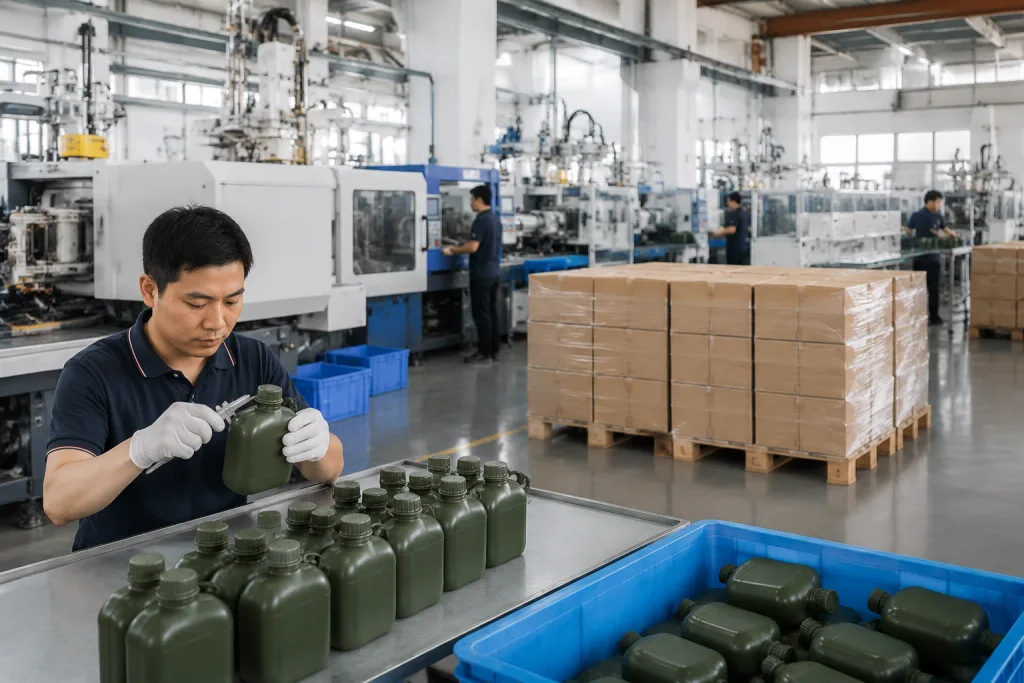
Key Takeaways
- Typical MOQ for polypropylene private label drinkware starts at 3,000-5,000 pcs per color for existing molds
- New mold projects usually need 25-35 days for tooling plus 30-45 days for mass production
- PP can reduce unit cost by 15-35% versus metal formats, but insulation and premium feel are weaker
- AQL 2.5/4.0 inspection should include leakage, odor, print adhesion, color tolerance, and carton drop checks
Polypropylene drinkware looks simple until we run your logo film, check the lid thread with a go/no-go gauge, book a vessel, and hand the retailer the food-contact file. For a polypropylene drinkware private label order, the hard part is not finding a canteen supplier. It is deciding what matters before the mold, Pantone color, carton mark, or test report locks in your cost. Last month QC pulled a 650 ml sample because the lid torque was 0.6 N·m short of our spec. Small miss. Big argument.
From our factory network in Zhejiang, China, we see the same 2 mistakes: buyers add plastic wall thickness where it does not change hand feel, then skip lid fit and the carton drop test. A 650 ml custom canteen for promotion is not the same project as a retail sports bottle or a distributor canteen program shipping 12,000 pcs per SKU. We run those on different assumptions. The line needs clear calls on material grade and mold route before steel cutting, and the decoration method must match the real artwork limit, whether that is a 42 mm print area, a curved logo, or a color block the buyer’s PO calls “navy” but the Pantone says 2965C. QC checkpoints matter too: AQL 2.5, thread gauge checks, and 1.2 m carton drop results. Asking only for the lowest FOB price is the wrong question to ask; we have seen that go sideways when the buyer flagged a 1 mm logo shift after packing.
Start With The Use Case
Before you ask a canteen factory for a quote, ask this first: where will this bottle sit for the next 12 months? On a classroom desk, inside a race pack, on a club shop rack, or facing out on a supermarket shelf. PP is a good resin for lightweight private-label drinkware, but it will not fix a messy brief. We run it for school bottles, sports event handouts, outdoor canteens, gym chain programs, and tight-FOB retail orders. It is the wrong pick for vacuum insulation, a heavy premium handfeel, or hot liquid above 90°C. Wrong material, wrong complaint. Last month QC pulled a PP sample after the lid warped 1.8 mm in a 95°C fill test; the buyer had written “hot tea bottle” on the PO, while the artwork brief only said “sports canteen.”
Start with capacity and use temperature. Common PP canteen sizes are 400 ml, 500 ml, 650 ml, 750 ml, and 1,000 ml, so choose the size against shelf height and user age, not just the mold list. A 500 ml bottle fits most retail shelves and school bags. A 750 ml customizable canteen usually sells better in sports and outdoor channels because the grip area still works with one hand after printing. For a custom growler or customizable growler, PP only makes sense for cold beverage, camping, or promo giveaways. If the buyer wants beer growler positioning, we move the quote to stainless steel or glass. No argument there. We run a 0.2 mm wall-thickness check at the shoulder on first samples with a digital thickness gauge, because cheap molds show sink marks there first.
Next, check the sales channel. A canteen promotional order can pass with a single-color body, one-color silk screen logo, and bulk polybag packing if the event team only needs 5,000 pcs for handout use. A distributor drinkware program is a different job: repeatable PMS color with ΔE kept under control, spare lids packed by SKU, scan-safe barcodes, master carton control, and packaging that survives mixed-pallet handling. If you sell to canteen distributors in Europe or North America, never quote only the cheapest FOB Ningbo price. The math doesn't work after 3% retail returns. Quote the version that still looks acceptable after warehouse handling: 5-layer export carton, 32 ECT or better, barcode position locked on the dieline, and a lid torque check before sealing the master carton.
At BottleForge Industrial in Hangzhou, Zhejiang, we ask buyers for a one-page product brief before sampling. Capacity. Lid type. Color count. Logo process. Write down the target FOB price, compliance market, carton quantity, and launch date too; do not hide them in a WeChat thread with 63 messages. That brief saves 7 days versus the normal 14-day email loop and stops the classic mistake: approving a nice-looking sample that cannot hit the real landed-cost target. We have seen this go sideways. One buyer approved a matte black 750 ml sample, then flagged the carton quantity after pilot packing because the PO typo said 48 pcs instead of 24 pcs per master carton.
Choose Existing Mold Or Tooling
Your mold choice shows up fast in two places: the PI unit price and the sample calendar. Design ownership comes later, usually when the buyer wants exclusivity. For most polypropylene drinkware private label orders, existing molds are the safer first run. We run the current bottle body, match your Pantone chip under a D65 light box, print or emboss the logo, then pack to your carton layout. For our standard PP canteen lines in China, MOQ is normally 3,000 pcs per color for simple private label and 5,000 pcs per color when the lid color, carton marks, and retail box all need matching. Sampling takes about 7-10 days after artwork approval. Last month QC pulled a PP body sample with a 0.4 mm logo shift, so we adjusted the pad-printing jig before sending approval photos.
New tooling is worth a serious talk when the silhouette, grip, cap style, or volume is part of the selling point. A customized canteen with a side grip that no one else sells, or a child-safe flip lid with your own lock shape, may need a new injection mold. Tooling for a basic bottle body can start around USD 2,000-5,000, while a more complex multi-part lid can push total tooling to USD 8,000-18,000. Tooling lead time is usually 25-35 days, then mass production needs another 30-45 days after pre-production sample approval. The mold shop cuts steel from a 2D drawing and 3D file, but the line still checks first shots with digital calipers at the thread, hinge pin, and sealing wall. No shortcut there.
Buyers miss the trade-off. A custom design gives you shelf difference, but tolerance risk moves onto your side. You must approve shrinkage, thread tolerance, lid torque, gasket compression, and cap fatigue, and each one needs a signed sample or test record before we release bulk production. PP shrinks more than some buyers expect, often around 1.0-2.5% depending on grade and mold conditions. A 0.2 mm miss around the thread can create leakage complaints across the full batch. We have seen this go sideways: the buyer loved a slimmer cap, then the torque test showed lids backing off after 20 open-close cycles.
If you are a canteen distributor testing a new category, start with existing molds and spend the money on color, decoration, and packaging. Better use of budget. If you are building a long-term brand range, tooling can make sense after the first 10,000-20,000 pcs prove demand. A good canteen manufacturer should be direct here. Not every private label project deserves a new mold. One buyer asked for new tooling before fixing the PO color typo, “Panton 286C”; this is the wrong question to ask when the first order is still unproven.
Material Grade Drives Compliance
Polypropylene works for canteens because it keeps the bottle light and the FOB price inside a range distributors can still sell. “PP” on a quotation is not enough. Ask the canteen supplier for the resin maker and grade code, then check both against the food-contact declaration and the color masterbatch approval for your market. We run this before production: QC reads the 25 kg resin bag label against the PO at the hopper, and if the grade code is blank or does not match, the line stops. No guessing. For Europe, buyers usually ask for EU 10/2011 food-contact testing, LFGB where relevant, REACH SVHC screening, and pigment heavy-metal documents with the actual color listed. For the United States, FDA food-contact compliance and CPSIA may apply if the bottle is sold for children.
Odor creates more fights than new buyers expect. The usual causes are recycled content, cheap color masterbatch, oily mold release, or cartons taped shut while the PP parts are still warm from the mold. Last season, one buyer flagged a “plastic smell” after QC pulled the sample 2 hours after packing; the same bottle passed after 24 hours of open-air cooling on the rack. For branded custom canteen programs, we run virgin food-grade PP for the body and cap, with a silicone gasket only where the seal design needs it. No recycled resin unless the compliance file is proven on paper. If you want recycled PP for a sustainability claim, check the resin source, allowed colors, and lab test scope before your sales team prints it in a catalog. We have seen this go sideways.
Wall thickness matters. A lot. Most PP bottles we quote sit around 1.2-2.0 mm wall thickness, depending on the shape, rib position, and shoulder design. A thinner wall saves resin and can cut cycle time by 1-2 seconds, but the bottle feels cheap and can fail carton compression after 6 stacked cartons in the warehouse. A thicker wall feels better in hand, but it adds resin cost and can leave sink marks when mold flow is uneven. On the line, we check the neck, shoulder, and base with a digital caliper, not by squeezing one sample at the desk. For a 650 ml customized drinkware bottle, a difference of 8-12 grams of resin can change FOB cost by several cents per unit. On a 50,000 pcs distributor growler or canteen program, the math gets painful fast.
Do not approve color from a screen. Use Pantone references, physical color chips, or signed color plaques. PP color matching shifts with pigment load and wall thickness, so the same masterbatch can look deeper at a 2.0 mm base than at a 1.2 mm side wall. We once received a PO with “Panton 286C” typed wrong, and the buyer only caught it after the first molded plaque was on the table. Wrong time to argue. A serious canteen vendor defines color tolerance before production with a D65 light box reading and a signed sample, not after your buyer rejects the shipment.
Decoration Is Not Just Artwork
For polypropylene, decoration is a cost and wear decision, not art dressing. We usually quote silk screen printing first, then compare heat transfer or IML after the lab checks the resin sheet and surface treatment. Silk screen is still the safe pick for canteen promo orders: one to three spot colors, logo width under 80 mm, low screen setup, and fast output on the semi-auto line. Simple wins. A one-color logo on an existing mold adds about USD 0.03-0.08 per piece depending on size, color count, and order quantity; last month QC pulled 20 pcs from a 5,000 pcs run and found one light edge on the white ink.
Heat transfer gives a larger print area and a stronger shelf look, but the cost changes once film plate charges and adhesion testing around curved bodies are added. IML looks sharp for high-volume private label programs. It also locks artwork earlier and usually needs higher MOQ, often 10,000 pcs per design in our quoting sheet. Seasonal artwork? Be careful. If graphics change every quarter, IML becomes a headache unless repeat volume is stable; we have seen this go sideways when a buyer approved the label file, then changed the barcode on the PO two days before mold trial.
Ask for an adhesion test, not just a photo. A practical test is 3M tape pull after 24 hours, plus 50 rubs with a damp cloth and mild detergent on the logo edge. For dishwasher claims, slow down. Around 7 out of 10 PP bottle bodies handle warm washing, but printed logos can fail before the bottle body, especially near a 6 mm radius shoulder. If your package says dishwasher safe, define the test cycle count and temperature. “Top-rack dishwasher safe” is not the same as industrial dishwashing, and the buyer flagged that wording on one EU carton because the lab report only covered 55°C home cycles.
Decoration also affects production yield. Large solid logos on curved bottles can show pinholes, stretch, or registration drift after the operator sets the jig pressure. A canteen customized with a wraparound print may need a tolerance zone of 1-2 mm. Zero variation is the wrong question to ask on a round PP body. If your brand guideline allows no movement at all, choose a flatter print panel or redesign the artwork; the factory can control ink viscosity with a Zahn cup and fixture position, but it cannot remove geometry from a round bottle.
For B2B buyers, the practical rule is simple: choose silk screen for low-risk logo orders, heat transfer for retail graphics with larger coverage, and molding or embossing only when your expected repeat order pays for tooling. We run the tooling payback sheet at the start, because a USD 1,200 emboss insert makes sense on 30,000 pcs but looks ugly on a 3,000 pcs trial order.
Price The Whole Program
A unit quote without the program details is a trap. Wrong question. A basic 500 ml PP bottle from a canteen manufacturer may quote around USD 0.55-0.95 FOB China with an existing mold, one-color body, and a 1-position logo from the pad-printing line. A heavier 750 ml customizable drinkware bottle with flip lid, silicone seal, heat transfer print, and color box can move into the USD 1.10-1.80 range. Use these as planning bands, not promises. Last March, PP resin moved twice in 7 days, and our 260-ton injection machine cost sheet changed before the buyer signed the PI. Resin price and exchange rate hit first. Then labor hours, packaging spec, and rejection rate finish the damage; QC once held 480 pcs because the lid flash measured 0.3 mm at the hinge.
Break the quote into bottle body; lid with hinge pin and drinking spout; gasket material with exact thickness; decoration setup; retail or bulk packaging; testing; inland trucking to port. You see the money fast. Retail color boxes can add USD 0.08-0.25 each, and QC pulled the sample last week because the box mouth was 1.5 mm too tight for smooth packing. Individual polybags cost little, but 6 of our European buyers now ask for paper sleeves or no plastic bag. Barcode labels and FNSKU labels for marketplace fulfillment add labor, especially when the buyer sends a PO with one digit missing in the SKU. Small typo, big delay. For an Amazon or 3PL-ready distributor drinkware program, packing details are not small stuff; they decide whether your warehouse receives cleanly or spends 2 days relabeling cartons.
FOB Ningbo or FOB Shanghai is normal for Zhejiang production. Ex Works looks cheaper on paper, but the math doesn't work if your team has to chase a local trucker, customs docs, and warehouse cutoff times from overseas. DDP is fine for a 300-carton trial order. For 20 ft or 40 ft container volumes, most experienced canteen distributors prefer FOB plus their own forwarder. A 40 ft HQ can often load about 24,000-38,000 PP bottles depending on bottle shape, carton size, and whether we run nested lids or assembled lids on the line. Carton optimization changes freight cost per unit. We have seen a 6 mm carton height change save 2 pallet positions on a Ningbo loading plan after the loading team checked it with a tape measure at 7:40 p.m.
Ask your canteen suppliers to quote at 3,000, 5,000, and 10,000 pcs, with the same lid, print area, carton spec, and test standard on all 3 lines. Injection molding economics improve with quantity, but the sharper savings usually come from packaging efficiency and spreading the print setup charge over more units; our pad-printing plate charge looks painful at 3,000 pcs and almost disappears at 10,000 pcs. We ship programs both ways. If a canteen vendor gives the same price at every quantity, the price is padded or the cost model is being hidden, and we've seen this go sideways when the buyer later asks for a color box upgrade. Last quarter, the buyer flagged a USD 0.04 jump after artwork approval because nobody priced the 2-sided print jig at quotation stage.
Set Quality Gates Early
Put PP private label drinkware quality gates on the PO before deposit, not after packing. On the Zhejiang lines we run, a normal PP canteen capacity is 200,000-350,000 units per month across 6-10 active molds, but that output means little if the inspector has no limit sample beside the calipers. Lock the signed golden sample, approved artwork, Pantone target, packaging spec with carton size in mm, and inspection checklist. Then apply AQL, commonly Critical 0, Major 2.5, Minor 4.0 for export drinkware. Here is the sharper question: who can reject the goods when the leak-test jig shows seepage?
Set checks for leakage at the lid seal, thread fit after 20 open-close turns, cap opening force measured in N, gasket placement, odor, lip flash, color against the Pantone chip, print adhesion after 3M tape pull, capacity, drop resistance, and carton condition. Small things fail. QC pulled one sample last season with 0.4 mm flash on the drinking lip, and the buyer flagged it before we reached the carton drop test. For children’s bottles, add bite-risk and small-parts review even when the design looks simple; a 6 mm loose plug can stop a shipment. For outdoor canteen customized projects, test strap strength and cap tether fatigue with 200 open-close cycles, not one desk check. We have seen this go sideways.
Pre-production samples are not optional when color, print, or lid function changes. Approve one sample for appearance and a second sample for function if the lid has a new gasket or thread pitch. During production, an inline check after the first 500-1,000 pcs can catch print position and leakage issues before the line packs 30 cartons wrong. Final random inspection should happen when at least 80% of goods are packed. On one PP bottle order, a 3 mm logo shift looked small at the pad-printing station, but it became a claim once 18,000 pcs were sealed in master cartons.
Do not accept “we inspected ourselves” as the only quality gate for a first order. Internal QC helps, but your purchase order should allow third-party or buyer inspection before shipment.
Compliance documents should match the actual material and color you ordered. A test report for a transparent PP sample from 2022 does not automatically cover a black bottle with a new masterbatch in 2026. The wrong question is “Do you have FDA or LFGB?” Ask which resin grade, color masterbatch code, and finished item the report covers. We check the resin grade, color masterbatch code, and FDA or LFGB file before mass production, because one typo on a PO, such as “PP lid” instead of “PP body,” can delay booking by 7-10 days. The math does not work when a lab report costs less than one rejected container.
Pick Suppliers By Behavior
China has at least 200 canteen vendors who will quote a PP bottle from one catalog photo. This is the wrong question to ask. Watch their behavior before you send the deposit. A solid canteen factory or canteen supplier sends 2D part drawings with wall thickness in mm, resin grade, MOQ by color, lead time by mold set, and inner-box/carton specs with dimensions in cm. A weak supplier sends one low price and a glossy picture. For private label, communication quality is production control; we run the line from the drawing, not from a sales promise scribbled in WeChat.
Ask whether the factory has BSCI, ISO 9001, or retailer audit experience if your channel requires it. A missing certificate is not always a deal breaker. We have seen good factories without one document beat certified factories on a difficult canteen shape with a tight lid thread. Audit readiness shows up in controlled drawings, clean batch records, and fast corrective action when QC pulled the sample and found a 0.3 mm flash on the lid thread using a digital caliper. For European and North American buyers, that matters when a retailer asks for traceability during peak season and the packing line has 18 cartons waiting for label rework.
Check whether the supplier understands distributor canteen programs. Distributors care first about reorder stability and replacement lids. After that, the real work is mixed color planning, carton markings that match the warehouse system, and lead times your sales team can quote without guessing. For repeat orders, we normally plan 30-40 days production after deposit and artwork confirmation for standard PP drinkware. Peak season before summer can add 7-15 days, especially when 6-8 canteen manufacturers are chasing the same injection molding machines. We have seen this go sideways when the PO said “blue lid” but the approved sample was Pantone 299C.
Private label buying is a sequence of decisions, not a hunt for the lowest spreadsheet number. Start with the product role and mold strategy. Then check material compliance, choose decoration based on actual use, price the carton and spare parts, and lock quality gates with AQL photos before mass production. The math does not work if the unit price looks good but the carton fails a 12 kg drop test or the barcode label is placed on the wrong panel. If a supplier helps you make those calls clearly, you are closer to a stable polypropylene drinkware private label program. If they dodge the details, the hidden cost lands as rejected cartons, late shipment, or customer complaints.
Send Your PP Canteen Brief For Review
Share capacity, target price, market, logo method, and delivery date. We will suggest a practical China production route before sampling.
Frequently asked questions
What is the normal MOQ for polypropylene drinkware private label orders?
For existing molds, a realistic MOQ is 3,000-5,000 pcs per color. Some canteen suppliers may quote 1,000 pcs, but the unit price, color control, and printing setup cost are usually poor at that level. For custom colors, 5,000 pcs is cleaner because resin and masterbatch mixing are easier to control. For new tooling, we usually recommend planning at least 10,000 pcs for the first production run, even if the mold technically can run less. Below that, the tooling cost per unit becomes hard to justify. If you need mixed colors, ask whether the MOQ is per color, per model, or per total order. This small wording difference changes your inventory plan.
Is polypropylene safe enough for European and North American drinkware?
Yes, virgin food-grade polypropylene is widely used for drinkware, caps, lunch boxes, and food containers. The issue is not PP itself; the issue is documentation and additives. For Europe, ask for EU 10/2011 food-contact testing, REACH SVHC information, and LFGB if your customer requires it. For the U.S., ask for FDA food-contact compliance and CPSIA when selling children’s products. Color masterbatch and silicone gaskets should be included in the compliance review. Do not rely on a generic test report for a different color or older material batch. If your customized canteen uses a dark pigment, glitter, soft-touch coating, or recycled PP claim, confirm the test plan before mass production.
How long does a custom canteen order take from China?
For an existing mold with logo printing, expect 7-10 days for sample preparation after artwork approval, then 30-40 days for mass production after deposit and signed sample. Add 3-7 days for final inspection, booking, and export paperwork. Sea freight to Europe or North America varies by port and season, but buyers often plan 30-45 days on water plus destination handling. New mold projects add about 25-35 days for tooling before production begins. If you need retail packaging, barcodes, FNSKU labeling, or multi-color heat transfer, add buffer. For summer outdoor promotions, place orders 90-120 days before the required delivery date.
Can PP drinkware be dishwasher safe?
The bottle body can often tolerate warm dishwasher cycles, but the full product claim depends on lid structure, gasket, print, and temperature. PP has a typical melting point around 160°C, but deformation and print damage can occur far below that under repeated washing, especially with high heat drying. If you want to claim dishwasher safe, define the test method: top rack, temperature, detergent, cycle count, and whether the logo must remain intact. Many buyers choose wording such as “hand wash recommended” for promotional canteens because it reduces complaint risk. For retail customized drinkware, run at least 10-20 wash cycles on decorated samples before approving packaging claims.
What should I compare when choosing canteen manufacturers?
Compare more than unit price. Ask each canteen manufacturer for resin grade, MOQ by color, lead time, printing method, sample cost, tooling ownership, packing details, compliance documents, and inspection terms. A serious quote should state FOB port, carton quantity, gross weight, and dimensions. Ask for photos or videos of injection molding, printing, and packing lines, not only showroom images. If your customer needs BSCI, ISO 9001, REACH, or food-contact reports, confirm before deposit. You should also test communication speed: late or vague answers during quotation usually become worse during production. A good canteen vendor will challenge unclear specifications instead of silently accepting impossible requirements.