Key Takeaways
- A practical MOQ for custom polypropylene drinkware bulk is usually 3,000-5,000 pcs per color and shape
- PP is light, tough, and cost-efficient, but it needs correct food-contact testing for the US or EU market
- Tooling, color matching, lid sealing, and carton drop tests affect final cost more than many buyers expect
- For new SKUs, approve samples, AQL limits, and packing specs before paying the 30% production deposit
Bulk PP drinkware looks simple until you ask for a firm quote. Our quoting desk still needs the resin grade, target wall thickness in mm, lid style, carton packing, color tolerance, test standard, and whether the cup will touch 80°C tea or 5% beer. Loose specs make the unit price look cheap. Risk does not disappear. It lands on your side, usually as a failed 1.2 m drop test, a warped rim on the cooling jig, or 18 days of rework after the line has already run.
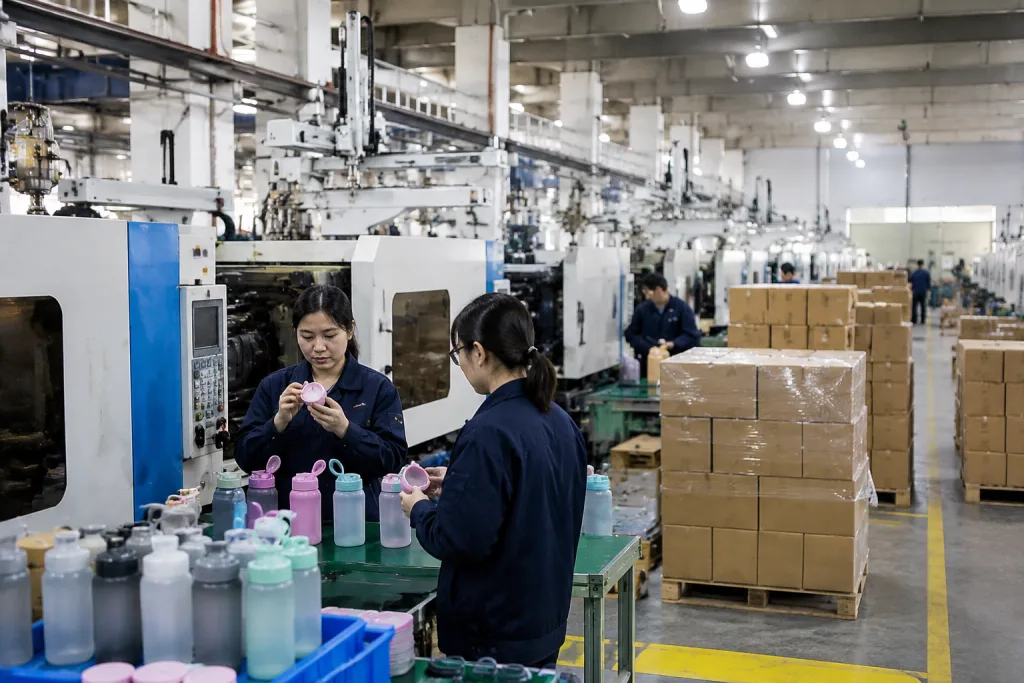
From our Zhejiang, China production base, we see at least 5 products sold as “PP drinkware”: school canteen cups for 160 g portion control, festival beer tumblers that stack 50 pcs per sleeve, promotional growlers, gym bottles with flip lids, and alcohol flasks that need tighter cap fit. They do not run on the same tooling. Comparing them by FOB price only is the wrong question to ask; the math does not work. Last month, QC pulled a 500 ml tumbler sample because the buyer’s PO said “red” but the approved Pantone chip was 186C, and the line had already mixed 25 kg of masterbatch. Sort out function, compliance, branding, and logistics before you ask 3 suppliers to quote.
Is polypropylene the right material?
Polypropylene, usually called PP, is a steady workhorse for drinkware bulk programs. On our line, a 500 ml PP sports bottle body runs around 48 to 65 g before the cap, so freight and carton weight are easier to control than stainless steel. Lighter carton. Fewer arguments. PP is lighter than stainless steel and less brittle than clear PS; it also takes repeated squeezing and drop tests better than cheap polystyrene. For canteen wholesale, school bottle projects, event beer tumbler bulk, and price-sensitive retail lines, PP is the sensible choice when the buyer is watching landed cost line by line. We run PP on multi-cavity injection molds, and QC still checks the parting line and rim flash with a 0.05 mm feeler gauge before packing.
PP is not magic. Standard PP is semi-opaque, so if the buyer wants glass-clear walls, we quote Tritan for reusable clear bottles or glass for premium shelf display. PP handles warm liquids, but we ask buyers to write the real use temperature on the RFQ. Is the bottle for room-temperature water at a stadium, 60°C tea, or dishwasher cleaning at 70°C? Those are not the same spec. Short question. Big cost impact. For polypropylene drinkware bulk, words like “heat resistant” cause trouble; we had one PO say “hot safe” with no temperature, and the buyer flagged deformation after a 70°C wash cycle in their test kitchen.
The main buyer question is simple: what job must the product do for the next 12 months? Starting with color chips or a cute cap shape is the wrong question to ask. If you are sourcing a bulk canteen for outdoor education, impact resistance and cap tether strength matter; we usually pull 10 samples and run a 1.2 m drop test on filled bottles. If you are sourcing beer tumbler wholesale bulk for festivals, stackability and rim comfort matter because staff may handle 3,000 cups per serving station, and one sharp lip will get reported fast. If you are asking for alcohol flask bulk or alcohol flask wholesale, chemical compatibility and local regulation matter more than shape, and the math doesn't work if the resin, printing ink, and gasket are not checked together.
- Good PP use cases: sports bottles with squeeze bodies, canteens with tethered caps, camping cups where carton weight must stay low, kids drinkware with rounded rims checked by hand, stadium tumblers stacked 50 pcs per sleeve, and promotional cups where MOQ and unit price drive the order.
- Riskier PP use cases: premium transparent bottles where buyers expect glass clarity, hot-fill applications above the agreed test temperature, high-end gift drinkware where the buyer wants a heavier hand feel, and products that need a metallic touch or cold stainless feel.
- Ask early: virgin PP or recycled-content PP, intended liquid with contact time, temperature range with a number in °C, dishwasher requirement by cycle setting, and target market for FDA, LFGB, or local compliance checks.
What should your RFQ include?
A weak RFQ says, “Please quote 10,000 PP bottles with logo.” A usable RFQ lets the factory price the same bottle your buyer expects to receive. Price alone is the wrong first question. Lock the spec first. On our desk in Hangzhou, we run the first check with 0.01 mm calipers, a 0.1 g scale, and the buyer’s cap sample before sales sends one number.
For polypropylene drinkware bulk, send the capacity, target weight, wall thickness, lid drawing with thread detail, gasket material, print method, carton packing, and destination compliance market. Wall thickness matters. A 500 ml PP bottle with 1.2 mm average wall thickness will not feel the same as one at 1.8 mm. QC can feel it by squeezing the shoulder area by hand. The cheaper body may pass a showroom photo, then crack after a 1.2 m carton drop or collect bad reviews because the sidewall feels thin. We pulled 12 samples from the line last quarter where the body weight was 6 g under spec; the quote looked clean, but the bottle felt cheap.
Before quoting from Zhejiang, we prefer to see a drawing or reference photo with main dimensions marked, capacity in ml or oz, tolerance in mm or %, Pantone color, logo file in AI or PDF, order quantity by color, packaging style, shipping term, destination port, and test requirement. Spell out the packing. Inner bag, color box, egg-crate divider, export carton, pallet height—each one changes the quote and the loading plan. If you need Amazon or other marketplace fulfillment, add FNSKU labeling, master carton weight limit, and carton dimensions. Last month the buyer flagged a PO typo, “Panton 186C” instead of “Pantone 186 C,” and that single space still cost us 2 days on color approval.
For first orders, we advise buyers to quote 5,000 pcs, 10,000 pcs, and 30,000 pcs. The price curve tells you whether the cost sits in resin weight, handwork on the line, or a tooling charge hiding in the first batch.
Do not hide the sales channel. A wholesale drinkware distributor may accept bulk inner bags. A supermarket private label team will ask for barcode position, shelf tray strength, and AQL 2.5 inspection photos before shipment. Different job. Same PP. If the item is a bulk growler or growler wholesale product, tell us whether it is for water, beer sampling, or decorative merchandising, because “growler” means a 1 L handled jug to one buyer and a small promo bottle to another. We have seen this go sideways: the buyer wanted a beer look, the gasket spec was only for cold water, and QC pulled the sample after the cap wept during a 30-minute inverted leak test.
How pricing really moves
PP drinkware pricing moves with resin cost, gram weight, cycle time, cavity count, decoration, defect allowance, and packing method. Most buyers chase the FOB unit price first. Wrong question. The invoice usually gets pushed up by the small parts: a two-color lid, 1.5 mm silicone gasket, individual kraft box, or four-color wraparound print can cost more than the bottle body. We see this on the line every month when the packing table has 6 workers waiting for printed sleeves while the injection machine has already finished the PP bodies. If the target shelf price is fixed, we should price the cap, print, and packing first, then decide whether the PP body needs 82 g or 96 g.
As a working reference, a simple 500-700 ml PP sports bottle in wholesale drinkware production may land around USD 0.65-1.40 FOB China at 10,000 pcs, based on body weight, cap parts, and decoration. A heavier canteen bulk design with strap, wide cap, and custom box may run USD 1.20-2.80. Beer tumbler wholesale products can sit lower if they stack cleanly and ship undecorated. Logo work changes the bill fast. Last month QC pulled a sample under the D65 light box because the blue was 1.8 Delta E off the approved chip. The buyer asked why undecorated stock was cheap but logo stock jumped by USD 0.11. Screen setup, ink loss, and 300 pcs of print trial scrap explained most of it.
MOQ is not just a sales tactic. Injection molding needs resin drying, color mixing, machine setup, first-article approval, and QC time. For custom colors, our normal MOQ is 3,000 pcs per color for simple PP cups and 5,000 pcs per color for custom bottles or canteens. New mold projects are different; tooling may take 25-35 days and cost from USD 3,000 to USD 18,000 depending on cavities and part complexity. We run PP on a 160T or 220T injection machine for these items, and a color change can burn 2-3 hours before the first acceptable piece drops into the bin. The math does not work for 800 pcs in three Pantone colors. The purge resin alone can fill two waste bins before the line is stable.
Ask suppliers to split the quote by product unit price, mold or tooling fee, sample fee, printing plate or screen fee, packaging upgrade, testing fee, and inland freight. Negotiation gets cleaner that way. If a supplier gives one blurred number for alcohol flask wholesale bulk or beer growler wholesale bulk, you cannot see what changes when quantity or packaging changes. We have seen this go sideways: a buyer approved USD 0.92, then flagged the PO typo after cartons changed from bulk pack to 1 pc white box. That one carton change added 0.018 CBM per 48 pcs, so the ocean freight line moved too.
- Cost reducer: use existing molds and standard caps, especially shared 63 mm or 70 mm thread sizes that we already run with matching gauges.
- Cost reducer: keep custom colors to 1-2 Pantone shades, then approve the color chip before mass mixing; do not approve from a phone photo.
- Cost increaser: leakproof lids with multiple components, such as flip button, spring, gasket, and inner plug, because assembly labor and leak testing both rise.
- Cost increaser: retail gift boxes instead of bulk master cartons, because paper weight, insert design, and carton CBM all rise; the packing table slows down first.
Which compliance tests matter?
Food-contact compliance is not optional. For Europe, we see EU 10/2011 plastic food-contact testing written on the PO, with LFGB sensory testing added for Germany and REACH screening requested when the retailer wants restricted-substance backup. For North America, FDA food-contact expectations apply; California Proposition 65 screening often appears when the shipment goes into a big-box or Amazon program. Kids products need their own file. CPSIA covers children’s product requirements, ASTM F963 comes up for toy-like claims, and child-safety checks depend on lid design, straw length, decoration, and the age grade printed on the carton. Last month QC pulled a 350 ml PP kids cup sample because the printed age mark on the carton said “3+” while the buyer’s artwork file said “6+”. That typo matters.
PP is common for food contact, but the lab tests the finished item, not the resin story on the material sheet. The risk often sits in the color masterbatch, pad-printing ink, silicone gasket, or sprayed coating, not in the clear PP body. A compliant PP bottle body does not make the printed lid compliant. Simple point. If you buy alcohol flask in bulk, beer growler in bulk, or beer tumbler in bulk, define alcohol contact time and washing method before tooling starts, then lock the warning text on the artwork. We have seen this go sideways when a buyer approved a lid for cold water, then used the same lid for 40% alcohol gift sets; the SGS report did not cover that use case.
Factory audits are separate from product tests. BSCI, Sedex, ISO 9001, and similar documents show management control, worker records, calibration logs, and line discipline, but they do not replace migration tests. Set the pre-production test plan before mass production. For a 30,000 pcs program, test raw material pellets or first production samples before the goods move to the port. Test early. The math does not work if a 40HQ is already on the water and the lab flags odor or overall migration; we once lost 12 days waiting for a re-test on a red masterbatch lot before releasing production.
Inspection should use AQL, not “check carefully.” A common setup is AQL 2.5 for major defects and 4.0 for minor defects, with critical defects not accepted. For PP drinkware, we treat sharp edges, leakage, contamination, blocked spouts, wrong material, and foreign odor as critical defects. On canteen wholesale and wholesale canteen orders, add strap pull strength and cap threading to the checklist; we normally run a 5 kg pull test on the strap and check cap fit with a go/no-go thread gauge. The buyer flagged it once after 800 pcs had caps that felt tight on the first turn. Catch it inline.
Branding, lids, and real usability
The decoration method has to match how long the cup will stay in use. Silk screen printing is still the lowest-cost clean option for a one-color logo; on our line, a 60 mm flat logo runs smoothly with a basic screen fixture and a locating pin. Heat transfer suits full-color artwork, but our operator checks film position every shift because the edge can creep 1-2 mm after the press warms up. In-mold labeling looks sharp when the order is large enough to keep molding stable. For a 1,000 pcs trial, setup waste eats the saving. Laser engraving is the wrong question to ask on most PP cups because the mark comes out pale unless the resin has marking additives.
For polypropylene drinkware bulk, the lid is where complaints start. Photos lie. A cheap cap can pass the first sample review, then leak after 20 open-close cycles on the test bench. We check thread engagement with calipers, gasket hardness with a Shore A tester, hinge thickness at the gate area, and spout diameter against the drawing. Venting gets tested with filled cups, not guessed from a CAD file. If you are developing a bulk canteen for children or outdoor use, ask for a 1.0-1.2 meter drop test on filled samples. QC pulled one sample last year where the body survived, but the flip hinge cracked at 0.9 meter. If you are buying beer tumbler wholesale bulk, ask for stacking tests and rim deformation checks after hot-water washing.
Logo placement also drives rejects. Printing across a curved ribbed body is harder than printing on a flat panel, and we have seen this go sideways when the target price is too tight. A 45 mm wide logo can usually hold position with a simple jig. A 110 mm wraparound mark needs wider tolerance, firmer cup support, and slower loading on the pad-print table. Pantone color matching on PP is possible, but approve color chips under D65 lighting if the brand color is strict. We had a buyer flag a blue PP cup because the approved chip matched in the office, then looked purple beside the retail shelf light. Normal production tolerance still applies. Plastic colors are not paper colors.
Packaging should match the sales channel. Distributor wholesale drinkware usually ships in bulk polybags and master cartons, often 48 pcs or 72 pcs per carton depending on cup volume. Retail canteen bulk programs may need hangtags, barcode stickers, 2-4 language instruction sheets, and carton marks that match the PO exactly. One wrong digit on a PO barcode can stop warehouse receiving; we had a carton held for 3 days over a swapped “8” and “B.” For e-commerce, keep master cartons under 15-18 kg when possible, and run a carton drop test from 76 cm if the packaging will face parcel handling. We ship parcel cartons with corner crush space, not just a tighter box.
How to qualify a China supplier
A solid China supplier should answer technical questions without getting defensive. Ask about PP grade, mold cavities, cycle time, gasket material, AQL, and lead time. If the reply is only “best price, good quality,” slow down. On our line, a normal answer reads like this: “8-cavity mold, 18-22 second cycle, silicone gasket, AQL 2.5 for appearance, 0.15 mm max flash at the rim.” That sounds plain, but it tells you the factory has the mold card and QC standard in front of them. Zhejiang has a strong drinkware supply chain. Still, buyers need to sort quote collectors from factories that control tooling, molding, assembly, and inspection.
Ask for production capacity in units per month, not factory size. This is the wrong question to ask first. A 12,000 m² building tells you less than the number of injection machines running PP cups this week, or whether the 260T machines are already booked for another buyer’s promo order. We run into this every March before summer programs. For example, BottleForge Industrial can support about 450,000-600,000 plastic and metal drinkware units per month across standard production lines, with typical PP custom lead time of 30-45 days after sample approval and deposit. For urgent repeat wholesale drinkware orders, we ship faster if resin and packaging are pre-booked; 18 days is possible on a repeat color, while a new carton print is still closer to 30 days.
Your supplier checklist should include business license, export history, audit documents, recent test reports, sample approval process, defect classification, packing photos, and shipment references with real BL dates. Ask for the BL date, not just a clean loading photo. For new molds, ask who owns the mold, where it is stored, how many shots it is rated for, and whether you can transfer it if the relationship ends. This is not rude. It is normal procurement control. We have seen this go sideways when a PO says “client owns mold,” but the mold tag on the rack has only the factory code and no buyer name. QC will not fix that dispute later.
For growler bulk, wholesale growler, alcohol flask wholesale, and beer growler wholesale projects, send your intended label claims before tooling starts. Claims like insulated, leakproof, dishwasher safe, BPA-free, freezer safe, and food grade need evidence tied to the same material lot and item number, not a test report borrowed from last year’s SKU. “BPA-free” is straightforward with PP because PP does not use BPA in normal drinkware production, but you still need supplier declarations and test documentation that match your shipment. The buyer flagged this once after QC pulled the sample and the carton printed “dishwasher safe,” while the approved spec only allowed hand wash below 60°C. The math doesn’t work if marketing copy changes after carton printing.
- Request golden samples signed by both sides.
- Confirm mass production cannot change resin or color masterbatch without approval.
- Book pre-shipment inspection when the order is 80-100% packed.
- Keep 1-2 cartons of retention samples for dispute control.
A buyer checklist before deposit
Before you pay the 30% deposit, put the commercial and technical details on the PO and the signed spec sheet. In our factory, 7 out of 10 polypropylene drinkware bulk disputes start with one missing line. The buyer assumes individual polybags. The supplier quoted bulk packing at 48 pcs per export carton. The buyer expects Pantone 186C. The molding room runs a close red because nobody signed the molded PP color chip under the D65 light box. We see this every month. Small gaps turn into chargebacks.
Use this checklist before deposit. Confirm the final product code and capacity; rim diameter in mm and height; unit weight in g and PP material grade; signed color chip and print artwork; packing method, pcs per carton, and barcode position; test standards and AQL level; shipment term, payment term, and lead time. QC should pull the pre-production sample against the signed spec sheet, not against a WhatsApp photo. It happens. If you are ordering beer growler wholesale bulk, beer tumbler bulk, alcohol flask bulk, or wholesale canteen products for a promotion with a fixed event date, write the latest shipping date and late-delivery remedy in the purchase order. We had one PO where “matte black lid” was typed as “mate black lid”; the buyer flagged it only after the first 2,000 pcs were packed. Do not leave this to email memory.
For logistics, choose FOB Ningbo or Shanghai, EXW, CIF, or DDP if your supplier offers it before the carton drawing is frozen. Zhejiang factories usually ship through Ningbo; from our Hangzhou line to Ningbo warehouse is about 180 km, and LCL handover is cleaner there than moving small cargo across provinces. Ask for estimated CBM, not only gross weight. A carton at 62 x 42 x 38 cm with only 7.5 kg looks harmless until the forwarder charges by volume weight. The math does not work if the cup is cheap but the cube is bad. We have had buyers flag this after booking, when the forwarder’s volume weight already killed the margin.
Keep your first order boring. Use an existing mold, 1 or 2 colors, a lid structure we already run, and packaging that passed a 1.2 m drop test with filled cartons. Fancy packaging can wait. After the product sells and return data is clean for 60 to 90 days, then pay for custom tooling or extra colorways. We have seen this go sideways when a buyer orders a new mold, metallic ink, and gift box on the first shipment, then asks why approval takes 18 days instead of 12 days. Good sourcing is not about chasing the cheapest drinkware wholesale quote in China. It is about catching the small details before they turn into rework, missed sailing dates, or expensive ocean freight problems.
Send your PP drinkware RFQ for review
Share capacity, quantity, artwork, and target market. We will return practical specs, MOQ, lead time, and FOB China pricing.
Frequently asked questions
What MOQ should I expect for polypropylene drinkware bulk?
For existing molds, a realistic MOQ is 3,000 pcs per color for simple PP cups or tumblers and 5,000 pcs per color for bottles, canteens, or multi-part lids. If you need a new Pantone color, the MOQ may rise because resin color mixing and machine setup create waste. For new tooling, many factories prefer 10,000 pcs or more for the first run. You can ask for 1,000 pcs, but the unit price may be 20-45% higher and color control may be less stable.
Is PP safe for hot drinks and alcohol?
PP is widely used for food-contact products, but you must define temperature and liquid type. For warm drinks up to around 60°C, many PP designs are suitable if the lid and gasket also pass testing. For boiling water, long hot-fill use, or dishwasher claims, test the finished product. For alcohol flask wholesale or beer growler bulk orders, tell the factory the alcohol percentage and contact time. Alcohol exposure may require additional migration or sensory testing, especially for EU buyers.
How long does a custom PP drinkware order take?
For existing molds, sample preparation usually takes 7-12 days after artwork and color confirmation. Mass production is typically 30-45 days after sample approval and 30% deposit. Add 5-10 days if third-party testing is required before shipment. New mold projects usually need 25-35 days for tooling, then sampling and production. If your delivery date is fixed for a festival, retail launch, or school season, build at least two weeks of buffer into the schedule.
What is the difference between bulk packing and retail packing?
Bulk packing usually means each item is protected by a polybag or paper wrap, then packed directly into master cartons, often 24-72 pcs per carton depending on size. Retail packing may include color box, hangtag, barcode, instruction sheet, warning label, and sometimes inner cartons. Retail packing can add USD 0.08-0.45 per unit and increase CBM. For wholesale drinkware distributors, bulk packing is cheaper. For supermarket or e-commerce channels, retail packing reduces repacking labor and labeling errors.
Can I combine canteens, tumblers, and growlers in one order?
Yes, but do not assume one MOQ covers every SKU. A canteen bulk item, beer tumbler wholesale item, and wholesale growler may use different molds, colors, lids, and production lines. MOQ is usually calculated by shape and color, not by total purchase order value. You can sometimes combine cartons in one LCL shipment or container to reduce freight cost. For a mixed program, ask for a production schedule by SKU and confirm that all items will be ready within the same shipping window.