Key Takeaways
- For PP bottles, realistic custom MOQ is usually 3,000-5,000 pcs per color for existing molds
- Food-grade PP should be confirmed with LFGB, FDA, or EU 10/2011 migration reports depending on market
- New mold development can add 25-45 days before mass production starts
- For promotional orders, printing and packing choices often change FOB cost by USD 0.08-0.35 per unit
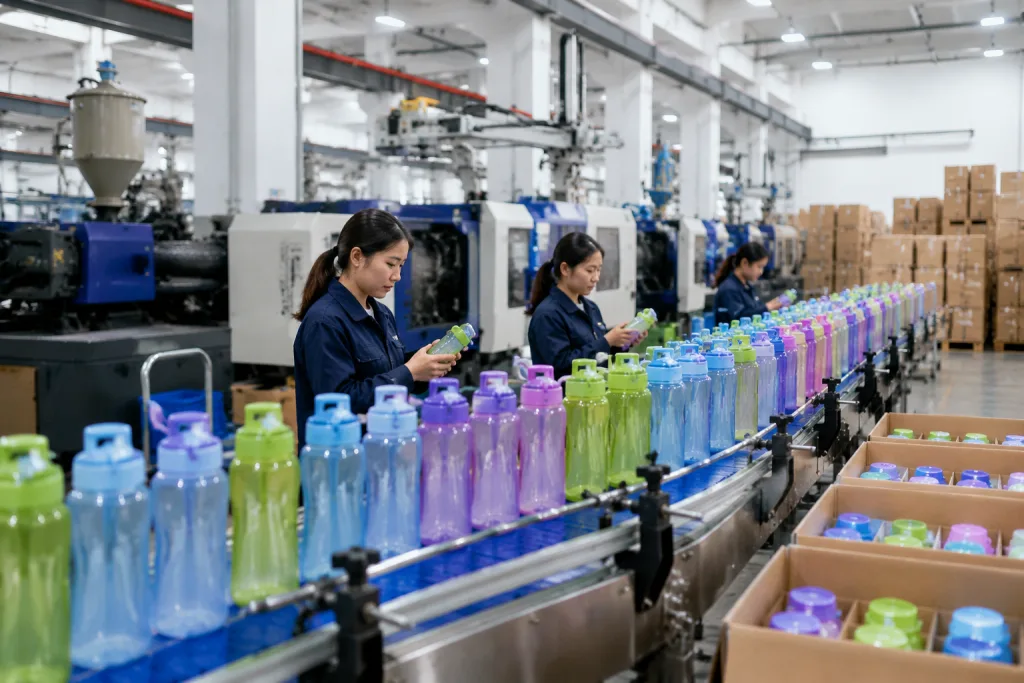
Choosing a polypropylene drink bottle manufacturer is not an FOB price check. It fixes the PP resin grade and cap thread first, then the small parts that cause claims: 1.5 mm gasket or 1.9 mm gasket, who owns the mold, silk-screen versus heat-transfer print, leak-test scope, inner bag spec, and 5-layer export carton strength. Here is the ugly question: who pays when 3% of bottles arrive with wet cartons? We have seen this go sideways. Last April, QC pulled a 650 ml sample from the line, filled it to 90%, inverted it for 30 minutes, and found slow seepage at the flip cap because the silicone ring was 0.4 mm too thin. Small part. Big claim. If you buy for retail shelves, school programs, promotion orders, or distributor drinkware lines, these details decide whether your margin survives.
From our factory network in Zhejiang, China, we see the same buyer trap in about 8 of every 10 RFQs: the first email asks for the lowest FOB price, then the buyer flags later that Pantone matching, 100% leak testing, or canteen customized packaging was not included. The math doesn't work after the PO is signed. Start cleaner. Lock four items before sampling: bottle use, decoration depth, target compliance market, and order economics. Put the MOQ and carton drop-test level into the sample request, not into a WhatsApp message three days later. On one recent PO, the artwork file had the school name misspelled by one letter; catching it before pad printing saved 12,000 bottles from becoming scrap.
Start With The Use Case
A polypropylene bottle for a school canteen program is not the same product as a bottle for outdoor retail, even if both are 600 ml and both look simple on a quotation sheet. Start with abuse, not the catalog photo. Will children knock it from a 90 cm desk onto concrete twice a week? Will a cyclist squeeze the body one-handed while riding? Will the stock sit for 6 months before a promotion, with export cartons stacked 7 layers high and a 13 kg carton on the bottom layer? Good questions. Those answers set the resin grade, wall thickness, cap hinge, gasket choice, and test plan. On the line, we run drop tests with water filled to the shoulder, not empty bodies for show. QC pulled the sample last month after the flip cap cracked at the hinge on the third 90 cm drop, and the caliper reading showed the hinge area was 0.6 mm thinner than the approved drawing.
Polypropylene, usually marked PP or material code 5, sells well because it is light, tough, and cheaper than stainless steel or Tritan-style copolyester. It also handles warm filling better than low-cost PE on school and promo jobs. For a basic 600-750 ml PP bottle, body weight often sits between 55 g and 95 g. A 55 g promotional bottle is fine for a 30-day campaign, especially at 5,000 pcs MOQ with one-color silk screen printing. Different job. The math doesn't work for a reusable retail line expected to survive 12-24 months of normal use; we would rather quote a 78 g body than spend September arguing about cracked bottoms after the first container ships. We have weighed this on a 0.1 g bench scale during trial shots, and 8-10 g saved in PP can disappear fast once the buyer asks for a stronger base ring.
For canteen custom projects, we ask buyers to put the product into one lane first: promotional giveaway, institutional supply, or branded retail, with the test standard written beside it. Promotional canteen orders chase unit price, fast logo printing, and cartons under 12 kg so the warehouse team does not hate the job. Institutional supply needs stronger caps, readable ml measurement marks at 100 ml spacing, and repeat orders that distributors can reorder without changing molds every season. Branded retail needs a cleaner surface finish, tighter color matching against the approved Pantone chip, barcode labels that scan on a Honeywell gun, and packaging that passes a 1.2 m carton drop. Small detail, big headache. We once had a PO typo showing “matte blue” while the approved sample was glossy blue, and the buyer flagged it only after pre-production photos. That is why we now tape the Pantone chip beside the first-off sample before the shift leader signs the QC sheet.
Be careful with vague terms like “BPA free” and “eco plastic.” They are not enough for procurement. Ask your canteen factory for resin grade, food-contact declaration, temperature range, and recycled PP status, including whether it touches food-contact surfaces. If recycled content is required, get written confirmation on percentage and food-contact suitability before sampling starts. In China, good factories can support this, but the line needs the instruction early so purchasing can lock the right resin lot and QC can record it on the incoming material sheet. Asking after mass production has started is the wrong question to ask; we have seen this go sideways when a buyer requested 30% recycled PP after the mold trial was already approved. By then, the injection machine settings, color masterbatch ratio, and first 2,000 pcs packing plan were already fixed.
Decide Existing Mold Or New Mold
The first call is straightforward: use a factory mold we already run, or pay for a new private mold. Existing molds cost less and move faster because the line already knows the PP shrink rate, cap fit, leak-test behavior, and carton count. New molds give you your own bottle shape and block other sellers from that silhouette, but you pay before one carton leaves Hangzhou: 2D/3D drawing check, steel cutting, T0 trial, adjustment, then approval sample. Ask the harder question. “Which one is cheaper?” is the wrong question to ask. Ask which option survives the first AQL 2.5 inspection, a barcode scan at the warehouse, and the buyer’s artwork revision that shifts the logo by 3 mm. QC pulled one sample last month because the cap sat 0.4 mm high after cooling. Small gap. Big argument.
For an existing 500 ml, 650 ml, or 750 ml PP sports bottle, a normal MOQ is 3,000-5,000 pcs per color. At BottleForge Industrial in Hangzhou, Zhejiang, our practical sampling time for an existing mold is 5-10 days, and mass production is commonly 25-35 days after sample approval and deposit. We run the first samples on the same injection machine used for bulk when the schedule allows, then QC checks cap torque with a torque meter and measures mouth ID with a digital caliper. If the mouth is out by 0.2 mm, the leak test tells on it. No hiding there. For a new bottle body and cap, the design, CNC, mold trial, adjustment, and pre-production sample stage can add 25-45 days. Mold cost for simple PP bottle tooling may start around USD 2,500-6,000, while complex caps, flip lids, or silicone seals raise the bill fast.
If you are a canteen distributor building a seasonal program, pick the existing mold. Do not get romantic about shape here. One buyer wanted a new 650 ml body for an 8,000 pcs back-to-school order; the math did not work after we added mold cost, 6-color carton printing, and 2 spare lid cavities. The buyer flagged the carton price before they flagged the bottle price. That happens often. If you are a brand owner protecting a shelf identity for three years, private tooling can make sense. Forecast discipline decides it. A USD 5,000 mold fee spread over 100,000 units adds only USD 0.05 per bottle. Spread over 8,000 units, it hurts.
Put mold ownership in the PO. We have seen this go sideways when a buyer wrote “private design” in an email, but the signed PO only said “PP bottle, blue lid,” with no exclusivity clause. One PO even had the color code typed as “BLU” while the approved sample label said “Blue 2935C”; nobody caught it until pre-production. The line was ready, but purchasing had to stop the color masterbatch release. Some canteen manufacturers quote “free mold” but keep full ownership and can sell the same design to other canteen vendors. That is fine for a short promotional run, not for a protected retail SKU. Your PO should say whether the mold is exclusive, whether annual maintenance is included, and what happens if you move the project to another factory in China.
Set The Customization Boundary
Customizable drinkware looks flexible until we price every change on the BOM. For PP bottles, we quote 4 levels in real orders: logo only, body color plus logo, tooling adjustment on parts such as cap or straw, then full private mold. A custom canteen with one-color silkscreen printing is a different job from a customized canteen with matched cap, body, straw, hangtag, retail box, and carton marks for 3 distributors. The line feels it by lunch. Last month QC pulled the sample because the PO said “matte blue,” but the approved sample was glossy Pantone 2925 C, and the packing table already had 12 cartons labeled.
Logo decoration on PP needs plain expectations. PP has lower surface energy, so ink adhesion is weaker than on stainless steel unless the bottle is flame-treated or corona-treated before printing. We run dyne pens on the surface before trial printing; below 38 dynes, the print risk goes up. For canteen promotional orders, one-color silkscreen is common because the setup is simple and the reject rate stays controlled. Multi-color screen printing works, but registration tolerance matters on curved bottles, especially around ribs or grip panels where 0.5 mm drift shows up fast under the inspection lamp. Heat transfer gives richer graphics, but confirm dishwasher resistance with a real 20-cycle wash test, not a nice catalog photo. Laser engraving is the wrong question to ask for most PP bottles. It will not give the clean contrast buyers expect on metal.
Color customization has its own rules. A canteen customizable bottle body in a Pantone color usually needs resin color masterbatch and a minimum per color. Below 3,000 pcs, we push buyers to stock colors because purging the injection machine can burn 18 kg of resin and 45 minutes before the next clean shot. For retail custom drinkware, request a color chip or molded color plaque, not just a phone photo under workshop lighting. Zhejiang has rainy weeks, LED lamps shift color, and phone cameras lie. Pantone C or U references help, but molded PP still looks different from paper; we check plaques beside the injection machine and write the batch number on the sample tag.
Packaging becomes a hidden cost faster than most buyers expect. A distributor canteen shipped in bulk polybags may be fine at USD 0.03-0.06 per unit packaging cost. A printed color box with 350 gsm paper, an instruction sheet, an FNSKU label, and a carton drop-test requirement can add USD 0.12-0.40 per unit. We have seen this go sideways when the buyer approved the bottle but forgot the Amazon label size until 8,000 cartons were waiting near the scale. Painful week. If you sell through Amazon FBA or national retailers, barcode placement, carton weight under 15 kg, and scannable labels are product specs, not afterthoughts. The math doesn’t work if packaging is added after the bottle price is locked.
Check Compliance Before Pricing
Check the food-contact files before you bargain the last USD 0.03. A cheap canteen quote is useless if the material report fails at the port, with your retailer, or in a school tender review. For Europe, buyers usually ask for EU 10/2011 overall migration and specific migration testing, plus LFGB for Germany or premium retail shelves. For North America, FDA food-contact confirmation is common, and 3 out of 10 US buyers we quote also ask for California Proposition 65 review. Kids’ bottles need closer control: CPSIA, ASTM, or choking hazard evaluation depends on the lid shape, straw diameter, and age grade printed on the carton. Last month QC pulled a 350ml kids bottle because the flip button measured 6.8 mm proud of the cap after drop testing with a Mitutoyo caliper. Price was not the problem.
PP is standard for food-contact drink bottles. The risk is in the full bill of materials. Color masterbatch, silicone seals, inks, coatings, and mold-release agent can change the test result. If your canteen customized design uses soft-touch coating or a bright pigment, test the final production setup, not only natural PP resin. We see this on live orders: a supplier shows a valid 2023 report for natural PP, then the buyer’s PO says neon orange body, black lid, and white pad print logo with a 38 mm print area. That is a different file. Different risk. The math does not work if approval is based on the wrong sample.
Factory audits matter when you supply retailers, schools, hospitals, or government programs. BSCI, Sedex, ISO 9001, or retailer-specific audits do not prove the bottle is leakproof, but they reduce social compliance risk and process drift. Our Zhejiang, China production partners run inline checks for injection temperature, shot weight, cap fit, visual defects, and leak testing; on the line, a 0.20 mm cap thread mismatch is enough to trigger carton-level complaints after the bottles sit through a 45°C warehouse test. A realistic AQL plan for finished goods might use General Inspection Level II with AQL 2.5 for major defects and 4.0 for minor defects, though some retailers demand tighter limits. We have seen this go sideways when the buyer approves color in the showroom but skips packed-goods inspection.
Do not accept “we have certificate” as the full answer. Ask for the report number, test lab, tested item description, date, and whether the report covers the same material, color, lid, gasket, and print method. Good canteen vendors send the file and explain the coverage. Weak ones send a blurry PDF for another product and hope nobody reads page two. One buyer flagged this after the PO had a typo: “PP lid” became “PC lid,” and the supplier still attached the old PP report. Check the paperwork before you argue over USD 0.03.
Build A Real Landed Cost
FOB unit price is only one line on our landed-cost sheet. For distributor drinkware, we price mold amortization by cavity count, 2-3 sample rounds, 0.03 mm inner bag spec, 5-layer export carton strength, PSI booking, ocean freight, duty, warehouse handling, returns allowance, and payment days. A bottle quoted at USD 0.62 FOB Ningbo can beat a USD 0.68 quote on the first screen, then lose money after QC pulled 32 crushed cartons from a 200-carton trial, the defect rate jumped to 4.8%, and the buyer had to switch 18 cartons to air because the approved sample left the line 12 days late. Ugly surprise.
For common existing-mold PP bottles from China, rough FOB ranges sit around USD 0.45-0.95 for 500-750 ml promotional styles, and USD 0.90-1.80 for heavier retail styles with better caps and packaging. These are not promises. PP resin price, RMB exchange rate, order quantity, and decoration method all move the quote; our costing clerk checks resin on the same day we issue the PI, not two weeks later. A canteen promotional order of 10,000 pcs with one-color silk print and bulk packing is not the same build as a customized drinkware line of 3,000 pcs per SKU with retail boxes and four Pantone colors. On the line, a 0.25 mm wall-thickness change can shift resin use by around 6-9 g per bottle and raise shrinkage risk near the shoulder.
Freight planning catches buyers. PP bottles are light but bulky, so we usually cube out the container before weight becomes the limit. A 750 ml bottle packed 100 pcs per export carton may use roughly 0.08-0.12 cbm per carton, based on shape and whether the cap ships assembled. That gap gets expensive fast when the buyer compares a round bottle with a flat-sided one on a 40HQ load plan. Better nesting or cap-off packing cuts volume, but the math does not work if your warehouse spends 6 extra seconds per piece re-capping and then finds scuffed threads during AQL 2.5 inspection.
If you are a canteen distributor, make vendors quote on the same basis: FOB Ningbo or Shanghai, same MOQ, same carton spec, same logo size, same testing requirement, and same payment terms. Then compare. If one canteen supplier is 18% cheaper, ask why before celebrating; this is the wrong place to chase the lowest line without checking the spec sheet. Sometimes the saving is real, such as better cycle time on a 4-cavity mold. We have also seen it go sideways: thinner wall, softer cap seal, skipped inspection, or a test report for a different SKU after the PO even had the color code typed as “Panton 286C.”
Sample Like You Mean It
Samples are not souvenirs. They are cheap insurance on a custom drinkware order. For a polypropylene bottle, we ask for three samples if the calendar gives us 7-10 days: a stock sample to check grip feel, mouth opening, cap thread fit, and one-hand drinking on the actual body shape; a pre-production sample in the approved Pantone color with the real logo process; a sealed golden sample the line can match during bulk. Sign it. Date it. Photograph it. Both sides should keep one sealed sample in a PE bag, with the PO number written on a white label. We have seen a PO list “PP blue” while the artwork file says PMS 2925C; QC pulled the sample before molding, or that mismatch would have gone into 8,000 pcs.
Test the sample in boring, practical ways. Fill it with water, close the cap, lay it sideways for 24 hours, shake it hard for 30 seconds, then leave it in a warm room at about 40°C. Drop it from 1 meter onto plywood or concrete if the product is meant for school or outdoor use. We run this on a marked drop board, not a clean showroom table. Put the printed area through a tape test or rub test; on our floor we use 3M tape and check whether the logo lifts at the edge after 10 pulls. If you require dishwasher suitability, define the cycle count, detergent type, and water temperature on the spec sheet. “Dishwasher safe” without a test condition is a marketing sentence, not an engineering requirement.
For a custom growler or customizable growler made from plastic, use the same sample rule, but be clear about pressure. PP bottles are not built like metal vacuum growlers, and carbonated liquids can create pressure inside the cap thread. If the bottle is for still water, say so on the spec sheet. If users will fill sports drinks, warm tea, or carbonated beverages, the cap gasket and venting path need review before tooling; we normally check thread engagement in mm with a digital caliper and record the reading on the sample card. Do not let a sales photo decide safety. We have seen this go sideways when a buyer approved a nice-looking flip cap, then flagged leakage after filling the sample with sparkling water overnight.
Our Hangzhou team recommends a pre-shipment inspection when the order is above USD 5,000 or when the product enters retail. Standard inspection points include quantity count, workmanship review, barcode scan, logo position tolerance, carton drop condition, leak test sampling, and AQL defect classification; if the buyer wants all seven checks, the inspection booking needs 2 working days before vessel closing. For logo position, we run a simple caliper check in mm against the approved artwork, because “looks centered” is the wrong question to ask when 12,000 bottles sit in export cartons. The buyer flagged a 3 mm logo drift on one batch last year, and the math does not work once cartons are sealed. With monthly capacity around 300,000-500,000 plastic drinkware units depending on season and mold mix, a factory can produce fast; inspection makes sure it produced the correct thing.
Choose Vendors By Control
The best canteen vendors are not always the smoothest talkers. They are the ones who control the dirty details: PP resin lot numbers tied to each carton, mold maintenance logged after 50,000 shots, cap seal tolerance checked at 0.30 mm, and ink adhesion tested with 3M tape before packing. Ask who runs injection molding. Ask who owns lid assembly. Then ask to see the leak-test station, not last season’s showroom photo. If every step is outsourced, the price may look clean on the PI, but we have seen this go sideways when QC pulled the sample and nobody could say which subcontractor printed the bad batch.
For a polypropylene drink bottle manufacturer, useful factory questions need numbers: how many injection machines are open for your mold, daily output for this cavity set, wall thickness tolerance, and where rejected parts sit before grinding. Ask for numbers. A real answer sounds like “8 injection machines, 12,000 pcs per day on this 650 ml bottle, wall tolerance plus or minus 0.20 mm, rejects in red bins beside Machine 6.” You do not need to become a process engineer. You do need specific answers. “No problem” is not a process, and we stop the line faster for mixed-color caps than for a buyer asking hard questions.
Communication speed matters too. A canteen factory in Zhejiang can have good machines and still create problems if the merchandiser misreads a packaging spec or confirms artwork Rev B when the buyer approved Rev C. For North American and European buyers, the time-zone gap costs 1 day per unclear email, and a missed carton mark can add 2 days at the packing line. Good vendors cut that loss with marked drawings, approval sheets, sample photos from the light box, and bilingual carton marks that match the PO exactly. We once had a buyer flag “matte black” typed as “mate black” on a carton label. Small typo. Big argument.
If you manage distributor growler or distributor canteen programs, build a supplier scorecard before the second PO. Track sample lead time in days, defect rate by AQL report, on-time shipment, document accuracy, and claim response with photos from the line. After 2 or 3 orders, the right canteen manufacturer becomes obvious. The cheapest quote is the wrong question to ask when your next PO has 6 colors, 2 logos, and a fixed vessel date out of Ningbo. The math does not work if saving USD 0.06 per bottle creates a 7-day delay, 1,200 pcs of rework, and 3 cartons held after final inspection.
Send Your PP Bottle Spec For A Factory Review
Share capacity, quantity, logo, market, and target price. We will check mold options, MOQ, compliance path, and realistic lead time.
Frequently asked questions
What MOQ should I expect from a polypropylene drink bottle manufacturer?
For existing molds, a realistic MOQ is usually 3,000-5,000 pcs per color for PP bottles. Some factories accept 1,000-2,000 pcs if you use stock colors and simple one-color printing, but the FOB price will be higher and color choice limited. For a canteen customized project with Pantone body color, matching lid, and retail box, plan around 5,000 pcs per SKU. New mold projects are different; even if the first run is 5,000 pcs, you should have a 30,000-100,000 pcs annual forecast to justify tooling cost and engineering time.
Is polypropylene safe for reusable drink bottles?
Food-grade PP is widely used for reusable drink bottles, lunch boxes, and caps, but safety depends on the exact resin, additives, pigment, gasket, and printing ink. For Europe, ask for EU 10/2011 migration testing and LFGB if your channel requires it. For the US, request FDA food-contact support and review Prop 65 if selling in California. Also define temperature use. Many PP bottles are fine for warm water, but boiling water, microwave use, or carbonated drinks may not be appropriate unless the design was tested for that condition.
Can I get a fully custom canteen shape without paying for a mold?
Usually, no. You can get a custom canteen look by using an existing mold with your color, logo, cap color, strap, and packaging. That is the economical route for most canteen promotional and distributor canteen orders. If you want a different body profile, grip texture, cap structure, or capacity that does not exist in the supplier’s catalog, a new injection mold is required. Simple tooling may cost USD 2,500-6,000, while more complex cap systems cost more. Expect 25-45 extra days before mass production.
Which logo method works best on PP drink bottles?
Silkscreen printing is the most common method for PP bottles because it is economical and works for simple logos. For better adhesion, the bottle surface should be treated before printing, often by flame or corona treatment. One-color printing is safest for curved bottles; multi-color printing needs tighter registration control. Heat transfer can create larger, more colorful graphics, but you should test rub resistance and dishwasher claims. For a 5,000-10,000 pcs order, logo method can change cost by roughly USD 0.03-0.20 per unit depending on size and colors.
How long does production and shipping take from China?
For existing PP bottle molds, sampling normally takes 5-10 days after artwork confirmation. Mass production is commonly 25-35 days after deposit and sample approval, assuming normal resin availability and no audit hold. Sea freight to Europe or North America often adds 25-45 days port to port, plus customs and inland trucking. A safe procurement calendar is 70-100 days from supplier confirmation to warehouse arrival. If you require new tooling, add 25-45 days for mold development, trial, adjustment, and pre-production sample approval.