Key Takeaways
- A realistic polypropylene bottle MOQ is 3,000-5,000 pieces per color for custom color and logo work
- For food-contact export, ask for resin data, LFGB or FDA migration testing, and REACH status before deposit
- A 0.8-1.2 mm wall is common for squeeze and canteen styles, but impact resistance depends on geometry
- FOB China pricing often changes by 8-15% when you alter cap structure, carton packing, or color masterbatch
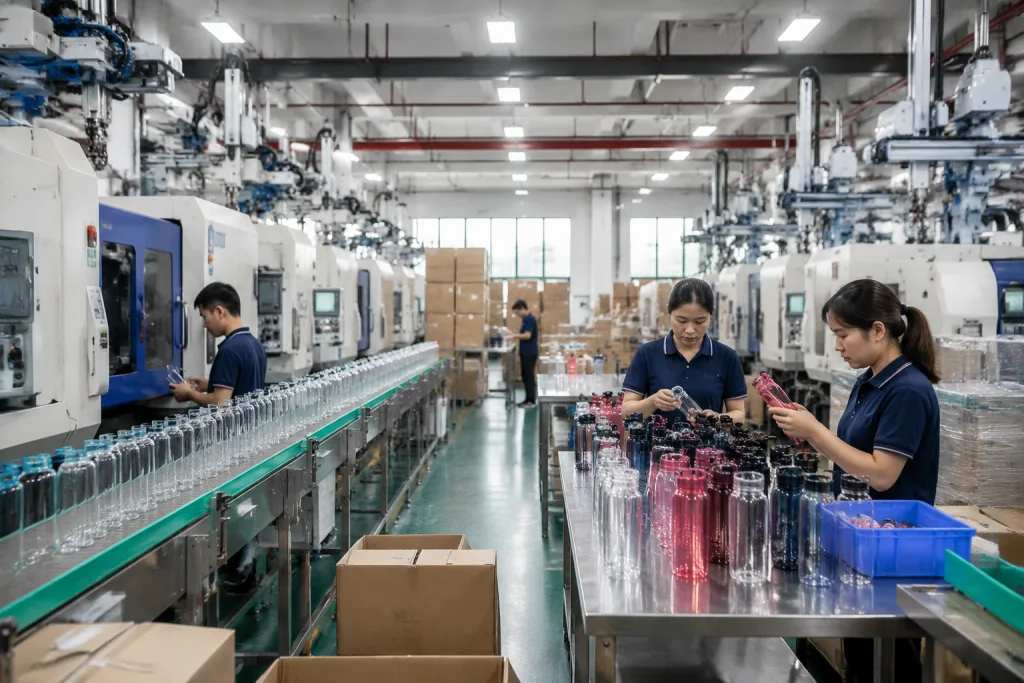
Polypropylene looks simple on a spec sheet: lightweight, low cost, food contact, decent heat resistance. On the line, it gets messy fast. A polypropylene bottle wholesale order lives or dies on PP grade, cap seal fit, wall thickness in mm, carton burst strength, molding odor, and color drift after the mold has run 20,000 cycles. QC pulled one 650 ml sample last month with a 0.35 mm thin spot near the shoulder. The CAD drawing passed, but the bottle failed our hand squeeze test at the inspection table.
If you buy bulk drinkware for retail, promotions, outdoor kits, or private label programs, finding a China supplier is not the hard part. Cheapest first? Wrong question. Ask whether the factory tracks resin batch records, cap torque, packing drop tests, and Pantone matching when the buyer flags a shade difference under D65 light. We run PP bottles from our Zhejiang production base starting at 3,000 pieces per color, with typical OEM lead time of 25-35 days after approved sample. One PO typo, “matte blue” instead of “mint blue,” once cost 4 days on the line.
What are you actually buying?
Before we quote polypropylene bottle wholesale, we first lock the real item: a single-wall sports bottle, a camping canteen, a shaker bottle, or a wide-mouth PP bottle shaped like a growler. Same resin. Different product. A flip cap with a silicone plug needs a separate tool insert and its own leak test, not the same check we run for a screw cap with a PE gasket. On our QC table, the inspector checks the cap gap with a 0.3 mm feeler gauge before the drop test starts.
PP sells because it is lighter than stainless steel and less brittle than clear AS or cheap PC. It also takes heat better than PET, so it can fit dishwasher-top-rack claims and warm-fill projects if the cap system is designed for that temperature. We run PP most often in 350 ml kids bottles, 500-750 ml sports bottles, 1 L outdoor canteens, and bulk promo drinkware where the buyer is trying to cut freight cost. For a 500 ml PP sports bottle, the finished body weight we quote is often 62-78 g before the cap and strap. That looks small on paper. Across a 10,000 pcs order, it changes the carton count and the sea-freight math.
Do not buy by product name alone. This is the wrong question to ask. A buyer might write “wholesale growler,” but if they mean carbonated beer storage, PP is usually the wrong material. We have seen samples swell 2.0 mm around the shoulder after pressure testing on the bench. If they want a 1.5 L camping water jug with a chunky growler look, PP can work. Alcohol flask wholesale requests need the same discipline: PP is fine for novelty flasks or event giveaways, but long-term alcohol contact needs tighter migration testing and often a different material.
A workable sourcing brief should state the capacity and tolerance, target retail price, liquid type, filling temperature range, dishwasher claim, cap construction, logo method, packaging format, and sales market. Spell out the claim. “Dishwasher safe” on a PO is not enough; last month QC pulled a sample after the buyer flagged cap warping at 70°C, and the PO still had “diswasher” typed in the item description. Europe and North America do not treat food-contact compliance casually. A Zhejiang factory can make the bottle, but we should not cut steel or start sampling until the spec is clear.
Checklist before asking for price
A request like “send me your best wholesale drink bottle” usually ends with a soft quote and 3 follow-up emails. Lock the specs in the first RFQ and the factory can price it the same day. Use this checklist before you ask for canteen wholesale, drinkware wholesale, or growler wholesale pricing; our sales desk checks these points against the mold card, the resin lot sticker, and the 0.01 g scale sample from the line.
- Capacity: 500 ml, 650 ml, 750 ml, 1 L, or custom volume. A 20 ml change can move the parting line or change the shoulder radius, so “around 700 ml” is not enough for tooling, carton cube, or freight calculation.
- Material: food-grade PP body, PP cap, silicone gasket, optional TPE grip. Ask for resin brand, batch lot, and material safety data sheet; “PP” alone will not pass our QC file review when the inspector matches the bag label to the production record.
- Wall thickness: 0.8 mm is common for light promotional bottles; 1.0-1.2 mm is safer for outdoor canteen bulk orders. We check it with a digital thickness gauge near the base and shoulder, not just on the straight wall, because thin corners show up first after cooling.
- Cap seal: screw cap, flip lid, push-pull nozzle, or tethered cap. Leakage risk usually sits in the cap, not the bottle body; QC pulled one sample last season for a 0.3 mm gasket gap after the buyer flagged seepage in a tilt test.
- Logo: one-color silkscreen, heat transfer, in-mold label, or molded logo. For PP, laser engraving is not our first pick because the mark can look pale on white and beige, especially under warehouse LED inspection lights.
- Packing: bulk polybag, color box, kraft box, PDQ tray, or Amazon FBA carton with FNSKU. Send the carton drop-test target and barcode position; a 2 mm FNSKU shift has caused buyer pushback before, and nobody wants to relabel 180 cartons by hand.
- Compliance: FDA 21 CFR for the U.S., LFGB for Germany, EU 10/2011, REACH, and California Proposition 65 if applicable. Tell us the sales market before pricing, since test cost and sample lead time change by destination, and the lab will not accept a vague “EU market” note on the request form.
For regular molds, our China quotation baseline is 3,000 pieces per color and 10,000 pieces for custom cap color. New private mold tooling can run from USD 3,000 to USD 12,000 depending on cavity count and cap complexity. Six colors at 1,000 pieces each looks tidy on a buyer’s PO, but this is the wrong way to chase unit price. The math doesn’t work. We run color purge on the injection machine, reset packing labels, check the PO artwork line by line, and pull AQL 2.5 samples six times; we’ve seen this push a 12-day production slot to 18 days.
Questions buyers ask about MOQ
MOQ is usually the first argument in a polypropylene bottle wholesale project. The buyer wants a low-risk channel test. The factory needs the injection press to run enough shots to cover mold loading, purge material, a color change, first-article approval, and carton setup. On our line, a 650T Haitian press burns 2-3 hours before QC signs the first bottle and the packing table starts polybagging. Both sides have a point. Asking for 300 pieces at 5,000-piece pricing is still the wrong question to ask.
For standard PP bottles, a workable MOQ is 3,000-5,000 pieces per SKU. If you take factory stock colors like white, black, translucent natural, or navy, a Zhejiang supplier can often run 1,000-2,000 pieces for logo-only work. Custom Pantone colors need more volume. Color masterbatch usually starts at a 25 kg minimum, and QC will not release mass production until the shade holds against the Pantone chip in the light box. We run this check under a D65 light source; after one lunch break, a small shade drift once sent 800 bottles to the hold area.
For wholesale canteen and canteen bulk programs, MOQ climbs when the cap has a strap, compass, carabiner, or multiple injected parts. A simple 1 L camping bottle is easy to slot into the schedule. A three-part cap with silicone seal and carrying handle can push MOQ to 5,000 pieces because the cap line, seal assembly bench, and leak test station each need setup time. For beer tumbler wholesale bulk or beer growler wholesale bulk projects, confirm whether PP is for cold water branding or actual beverage storage. We have seen this go sideways: the buyer wrote “beer growler” on the PO, but the artwork brief said event giveaway water bottles. The line was ready for sports bottles. The PO wording sent the sales file back for review.
Do not negotiate MOQ before you decide how many SKUs you need. Five colors, two lids, and three packaging versions create 30 combinations. That is where small orders become expensive.
If you need a test order, say so. A factory can run a pilot batch at a higher unit cost, then quote cleaner pricing at 10,000 or 20,000 pieces. BottleForge Industrial runs about 450,000 plastic and metal drinkware units per month across standard and OEM lines, and we ship with fewer surprises when the buyer shares a real ramp-up plan. A 1,000-piece launch with a 12-day sample approval window is one job; a repeat order moving to 20,000 pieces with 18 days for production is a different quote. The math changes fast.
How pricing really moves
FOB Ningbo or FOB Shanghai pricing for PP bottles is not resin plus labor. Resin price matters, but it sits on one line of the BOM. The real swing usually starts at the lid: hinge pin diameter in mm, silicone gasket grade, thread fit after cooling, print setup loss, carton compression strength, and the inspection level the buyer asks us to run. A plain 650 ml PP sports bottle may quote at USD 0.75-1.20 FOB China at 10,000 pieces. Add a leakproof flip lid with a silicone gasket, two-color print, individual kraft box, and a 5-layer export carton, and the same project can move to USD 1.35-1.90. We run these quotes from a BOM sheet, not from a “similar item” guess. Last month QC pulled the sample after a 0.4 mm lid-gap difference caused a slow leak in the tilt test.
For alcohol flask bulk or alcohol flask in bulk inquiries, shape drives the price. Flat flasks need tighter mold flow control than round bottles, because the melt front cools unevenly near the shoulders. A curved pocket flask shape looks cheap on a PDF, then the line starts fighting sink marks, warping, and cap alignment once the wall thickness drops below about 1.2 mm. Cheap mold first? Wrong question. Alcohol flask wholesale bulk buyers should budget for migration testing with ethanol simulants, not just water testing; we have seen a PO say “water bottle” while the artwork clearly said vodka flask, and the lab requirement changed the quote the same day.
Bulk growler and beer growler in bulk requests create a pricing problem buyers miss in the first round: volume. A 1.9 L container takes more resin and burns carton space fast, so fewer units fit in a 40 HQ container. The unit FOB price may look fine, but landed cost suffers when cubic meters become the shipping constraint instead of weight. Big air. Big cost. The same math hits beer tumbler bulk and beer tumbler in bulk orders with raised lids or side handles; our packing line often has to switch from 24 pcs per carton to 12 pcs per carton once the handle height fails the carton compression limit on the CT-400 tester.
Ask your supplier to show price breaks at 3,000, 5,000, 10,000, and 30,000 pieces. Ask what changes if you remove the color box or switch from four-color heat transfer to one-color silkscreen. A good China factory should explain a USD 0.08 change, not hide behind a revised total. We ship cleaner projects when the buyer challenges the cost line by line; if the supplier cannot show resin weight, gasket cost, print setup, carton CBM, and AQL 2.5 inspection time, the math does not work.
Compliance is not optional paperwork
For polypropylene bottle wholesale, compliance starts at the resin bag and finishes at the taped master carton. Food-contact PP needs traceable paperwork: resin grade, supplier name, lot number, and the COA matching the material loaded into the injection machine. We run lot labels against the molding record before mass production; one missing digit on a resin batch code once stopped a 6,000 pcs order before packing. It happens. If you sell into the EU, ask for EU 10/2011 migration limits, LFGB if Germany is involved, and REACH for restricted substances. For the U.S., FDA food-contact status is common, but chain stores often add California Proposition 65, CPSIA for kids products, or their own restricted substance list with 40 to 80 controlled items. On our floor, the material card sits beside the hopper, and QC checks it before the first 30-minute molding patrol.
Testing has to match the bottle. A kids 350 ml school bottle is not checked the same way as a 1 L outdoor wholesale canteen or a beer tumbler wholesale item. Typical lab tests include overall migration, heavy metals, odor, color fastness after 3M tape pull, dishwasher exposure at 70°C, and leakage after the bottle is inverted for 30 minutes. For children’s bottles, we check small parts with a choke tube, strap strength with a 5 kg pull, and bite-valve material if used. If the cap includes silicone, the silicone needs its own documentation. We have seen this go sideways when the bottle body passed FDA, but QC pulled the sample because the silicone seal had no matching report. The lab report looked clean. The BOM did not.
Quality control belongs in the purchase order. Put it in the PO, not in a WeChat message sent at 11:40 p.m. We usually recommend AQL Level II, with critical defects at 0, major defects at 2.5, and minor defects at 4.0 unless the retailer has stricter rules. Critical defects include sharp edges, contamination, wrong material, severe leakage, and blocked drinking spouts. Major defects include poor print adhesion after tape test, obvious color mismatch against the approved Pantone chip, weak cap fit, and carton shortage. The buyer flagged it once: the PO said “blue lid,” the approved sample was PMS 2925C, and the line packed PMS 299C for 12 cartons before the inspector caught it. That typo cost more than the inspection.
Factory audits still matter. BSCI, ISO 9001, or a retailer-specific audit does not guarantee perfect bottles, but it shows whether the factory controls incoming material, molding temperature records, metal detection, and final inspection. This is the wrong question to ask: “Do you have certificates?” Ask for the last 2 inspection reports, the resin trace sheet, and the carton drop-test record from a real order. A proper file should show carton size, gross weight, drop height, and the inspector’s stamp, not just a PDF named “test report final.” We had one audit file where the carton weight was listed as 9.6 kg on the report and 11.2 kg on the packing list; that mismatch is exactly why buyers ask twice. If a supplier in Zhejiang or elsewhere in China refuses to share basic test reports, resin information, or inspection standards before deposit, treat that as a sourcing risk, not a communication problem.
Samples, molds, and approval control
Sample approval is where roughly 3 in 10 drinkware projects start drifting. The buyer approves a hand-polished sales-room sample, then the mass production PP parts come off the injection line with lower gloss, softer thread bite, or a color that darkens after cooling. For PP injection bottles, sign off on a production-intent sample from the correct mold, with the same PP grade named on the BOM, the approved color masterbatch ratio, and the same printing or heat-transfer process we will run in bulk. If the sample is painted, pad-printed, or hand-assembled for the meeting, label it as a visual sample. Not a golden sample. We have seen this go sideways: QC pulled the pre-shipment sample, then the buyer compared the cap texture with a showroom piece under a D65 light box.
For existing molds, sampling takes 5-10 days when the color is standard. Custom Pantone matching takes 7-14 days because PP color shifts after cooling; our color room checks the chip after the part sits for 24 hours, not straight out of the mold at 58°C. For new molds, allow 25-45 days for tool making and first trial, then another 7-10 days for correction. If the product includes a threaded cap, gasket groove, carry handle, and measuring scale, expect at least one mold correction round, most often on thread fit or scale readability. The line does not forgive a 0.3 mm mismatch on a cap thread. We check that with a thread gauge before we let the sample leave Hangzhou.
Your approval package should lock down bottle weight in grams and wall thickness range in mm. It also needs capacity to fill line, cap torque feel, leak test method, logo position, color reference, carton drop-test requirement, and barcode placement. Make it measurable. “650 ml to fill line” beats “normal capacity.” “Logo 28 mm below shoulder seam” beats a screenshot with an arrow. For Amazon or marketplace distribution, confirm FNSKU label size and carton label format before production, not after packing. We once had a PO with the FNSKU typed one digit wrong, and the buyer caught it only after 42 cartons were labeled.
This matters across drinkware bulk categories. A budget sports bottle and a wholesale growler-style jug fail for the same boring reasons: loose cap fit, wrong color, bad label position. The golden sample is your contract in physical form. Keep two signed samples: one with you and one sealed at the factory. When production starts, QC can compare against the real part with a caliper, gram scale, and leak-test jig instead of arguing over photos on WeChat. This is the wrong place to save two days.
Logistics and launch planning
PP bottles are light. The container usually cubes out before it hits the weight limit. On our last 650 ml straight-wall PP bottle, packed one per polybag, the load plan showed 21,600 pieces in a 40 HQ after our packing team measured the master carton with a steel tape at 58 x 39 x 42 cm. A 650 ml bottle loads roughly 18,000-24,000 pieces in a 40 HQ container, depending on body shape and carton size. A 1 L canteen with handle loads far fewer because the handle leaves dead space inside the carton. Carton engineering matters more than some buyers expect. Retail boxes look good on shelf, but oversized boxes have added USD 0.10-0.25 per unit in freight equivalent when container space was tight and the forwarder billed by cube.
Normal lead time from our Zhejiang facility is 25-35 days after deposit and approved sample for existing molds. Add 7 days for complex packaging and 10-15 days if third-party lab testing must finish before shipment. Sea freight to the U.S. West Coast often takes 18-25 days port to port; to Northern Europe, 30-40 days is more realistic. Air freight works for samples and emergency replenishment. For low-cost wholesale drinkware, the math does not work. We once flew 18 cartons for a chain-store reset because the buyer flagged a late barcode change on the color box. The cartons arrived. Freight cost was higher than the bottle value, and nobody liked that invoice.
Plan your launch backward. If your retailer shelf date is September 1, production should finish by late June for Europe or mid-July for the U.S. West Coast, depending on customs clearance and inland trucking/warehouse receiving slots. For outdoor summer programs and back-to-school or festival promos, late artwork approval is the delay we see most often. The line can make bottles while the carton is pending, but packing stops if the color box dieline is still changing. Small typos matter. We had one PO with “matte black lid” typed as “mate black lid,” and QC pulled the sample before mass packing because the approved sample sheet did not match the artwork file.
When you compare suppliers, do not ask only for the lowest FOB. That is the wrong question to ask. Ask who owns the tooling, which resin grade is being purchased, how leak testing is run, who books final inspection, and who pays if cartons fail a drop test. We run 100% leak testing on screw-cap PP bottles with a pressure fixture on the line, and AQL 2.5 inspection still catches issues like flash on the thread or a weak handle hinge. Polypropylene stays cost-efficient when the project is specified tightly. It gets expensive when decisions stay open until production week; we have seen this go sideways when buyers approve Pantone color, logo position within 2 mm, and carton marks after the resin is already on the floor.
Send your PP bottle sourcing brief for review
Share capacity, target price, market, logo, and MOQ. We will reply with practical FOB options and sample timing from Zhejiang.
Frequently asked questions
What MOQ should I expect for polypropylene bottle wholesale?
For standard molds, expect 3,000-5,000 pieces per color for normal polypropylene bottle wholesale orders. Logo-only orders in stock colors can sometimes start at 1,000-2,000 pieces, but the unit price will be higher. Custom Pantone colors, custom caps, or retail packaging usually push MOQ upward because of resin color matching, setup loss, and packing line changes. If you need six colors, calculate MOQ by SKU, not by total order quantity. A 12,000-piece order split into six colors is very different from 12,000 pieces in one color.
Is PP safe for wholesale drinkware sold in Europe and North America?
Yes, food-grade PP can be safe for wholesale drinkware, but you need documentation and testing. For Europe, ask for EU 10/2011 migration testing and REACH status; LFGB is useful for Germany. For the U.S., ask for FDA food-contact information and confirm Proposition 65 if you sell in California. If the bottle has a silicone gasket, TPE grip, straw, or printed decoration near the mouth area, those components should be checked too. Do not accept a generic “food grade” claim without a material report or recent third-party lab result.
Can I use polypropylene for beer growler wholesale bulk projects?
It depends on the real use. If your beer growler wholesale bulk project is a promotional water jug or event container styled like a growler, PP may be suitable. If it is meant to store carbonated beer under pressure, PP is usually not our first recommendation. Carbonation, pressure retention, odor pickup, and alcohol migration require stricter testing. For beer growler bulk or beer tumbler wholesale products, define whether the product touches alcoholic beverage for minutes, hours, or days. That answer changes material choice, cap design, and compliance testing.
What lead time should I budget for a custom PP bottle?
For an existing mold with custom logo, budget 25-35 days for mass production after sample approval and deposit. Standard sampling takes 5-10 days; custom color samples take 7-14 days. If you need a new mold, add 25-45 days for tooling and first trial, plus time for mold correction. Lab testing can add another 7-15 days if the shipment cannot release before reports are complete. For retail launches, allow at least 90 days from artwork approval to warehouse arrival for sea freight into Europe.
How do I compare quotes for canteen wholesale or bulk drinkware?
Compare quotes line by line, not just FOB total. Confirm capacity, net bottle weight, wall thickness, resin grade, cap structure, gasket material, logo method, packing, carton size, inspection standard, and included test reports. A wholesale canteen at USD 1.10 may be cheaper because it has a thinner 0.75 mm wall, no silicone seal, and bulk carton packing. Another quote at USD 1.35 may include 1.1 mm wall thickness, individual box, and AQL inspection. For bulk drinkware, those details directly affect returns and landed cost.