Key Takeaways
- Food-grade PP bottle projects usually start at 3,000-5,000 pcs MOQ per color and 25-35 days lead time after sample approval
- Clarify PP resin grade, odor control, cap sealing, and temperature range before discussing logo price
- Silkscreen is cheaper for 1-2 colors, while in-mold labeling or heat transfer suits larger retail programs
- Use AQL 2.5/4.0 inspection, REACH or LFGB checks, and carton drop tests for European and North American orders
Polypropylene bottles look simple until you buy 20,000 pieces and ask us to print your customer’s logo on every one. One wrong resin grade, one cap short by 0.3 mm, or one artwork file with Pantone 186C typed as 168C can turn a safe custom drinkware order into rejected cartons and retailer chargebacks. QC pulled this exact sample last spring. The cap leaked at 45° tilt on the bench test.
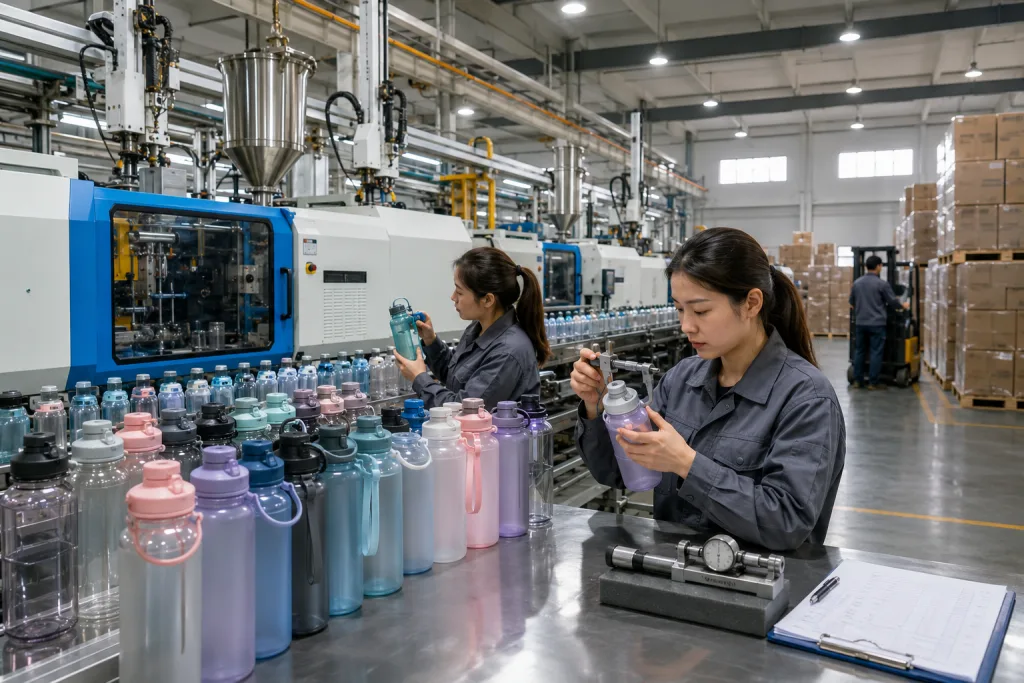
If you are comparing polypropylene bottle suppliers in China, “who is cheapest?” is the wrong question to ask. Ask whether the canteen manufacturer can hold food-contact PP to the FDA or LFGB target, control mold tolerance by mold number, print the logo within 1 mm of the signed sample position, pass the carton drop-test, and issue clean export paperwork without chasing the sales desk three times. From our Zhejiang factory, we run buyers through four checks first: resin grade against the material certificate, bottle structure against the mold file, branding method against real artwork limits, and inspection standard such as AQL 2.5. We have seen this go sideways. The math does not work if the unit price drops by USD 0.03 but the line loses 12 days reworking caps after the buyer flags a 0.3 mm mismatch with a digital caliper.
Start With The Use Case
A polypropylene bottle is not one fixed SKU. A school sports bottle gets thrown into a backpack. An outdoor canteen custom order sits in the sun and takes side impacts. A gym giveaway has to hit a tight landed cost, while a distributor canteen for military-style retail shelves needs shelf appearance and stronger cap feel. Start with the use case: where it sits, how often it drops, whether kids squeeze the body, how it gets washed, and whether it spends 6 hours in a hot car. We run 1.2 m drop checks on the cap corner with a steel height gauge because that is the failure point we see first on PP bottles. Ask use case before FOB Ningbo or Shanghai. Not after.
For most B2B buyers, the first split is between promotional volume and retail repeat sales. A canteen promotional project may accept a lighter body with 1.0-1.2 mm wall thickness, a simple flip cap, and one-color silkscreen because the target landed cost is tight, often USD 0.65-1.20 per piece for a 500-750 ml bottle depending on packaging. A retail customized canteen needs thicker walls, a stronger hinge tested on the line, Delta E color control under the light box, and cartons that still look clean after export handling. That can move FOB cost into the USD 1.30-2.80 range. The math does not work if the buyer asks for retail shelf quality at promo pricing; we have seen this go sideways when PSI found 14 cracked hinges in one AQL pull.
Capacity changes the mold and cost logic. A 350 ml kids bottle can be compact and easy to pack at 60-80 pcs per master carton, with a smaller cap torque setting on the line. A 1 L sports canteen needs more PP resin, larger cartons, and a stronger cap thread so it does not strip after 200 open-close cycles. If you want a custom growler or customizable growler made from plastic, check whether PP is the right material; 7 of 10 growler inquiries we see move to stainless steel or PETG because buyers expect higher rigidity and better gas-barrier performance. QC pulled one PP growler sample last quarter because the shoulder dented under thumb pressure, and the caliper still showed the wall was within drawing tolerance.
Good polypropylene bottle suppliers will ask about use case before they quote. If a canteen vendor only asks for quantity and logo file, they are pricing a generic shell, not building a reliable customized drinkware program. We also ask for packing method, target market, dishwasher claim, and cap artwork position because these details change tooling notes and the pre-production sample checklist. One PO even wrote “500 ml” while the artwork showed “750 ml,” and the buyer flagged it two days before mold text engraving.
Decide The PP Resin Specification
Polypropylene sells because it is light, cost-friendly, and handles more heat than PS or PETG in the same price band. Still, “PP” on a quote sheet is too loose. Ask the supplier to write the grade in full: virgin food-grade PP, random copolymer PP, impact copolymer PP, or recycled content with a separate file trail. For EU and North American food-contact drinkware, virgin food-grade PP is the normal baseline unless the brief clearly says recycled material and the compliance files match. On our line, QC checks the 25 kg resin bag label against the PO before material goes into the hopper; one buyer wrote “PP food grade” on the PO, while the artwork file said “recycled,” and that mismatch stopped sampling for 2 days.
A practical bottle wall thickness for sports and canteen customized models sits around 1.2-1.8 mm, depending on the body shape and grip area. Too thin, and the bottle dents or warps during hot water filling and carton stacking. Too thick, and the math doesn't work because you pay for resin that adds little value to the user. PP density is about 0.90 g/cm³, so a 0.2 mm wall increase shows up fast in a 50,000 pc order, especially when the buyer is already pushing for a 3% price cut. We run a digital thickness gauge at the shoulder and lower body, because those two spots usually show whether the mold flow is honest or just looks clean on the middle panel.
Temperature claims need discipline. Factory people throw around “heat resistant to 100°C” too easily. Ask what was tested: no deformation after 30 minutes, no leakage after filling, or only the resin softening point. For most PP sports bottles, we advise buyers to market them for cold and warm drinks, not boiling water, unless the full assembled bottle has passed testing. This is the wrong place to trust a catalog line. Dishwasher safety depends on the cap, gasket, ink, and label, not just the bottle body. We have seen this go sideways when a bottle body survived the test, but QC pulled the sample because the silicone gasket shrank 1.5 mm after the dishwasher cycle.
For Europe, ask for EU 10/2011 and LFGB where applicable. For North America, FDA food-contact resin documentation and California Proposition 65 review may be relevant. Distributors often ask for REACH, even when it is not the only rule that applies. A serious canteen factory in Zhejiang or elsewhere in China should provide resin declarations, migration test reports, and batch traceability, not a soft “food grade” promise. We ship with batch numbers tied to incoming resin lots; if the buyer flags a report during final approval, we can trace it back to the material lot instead of guessing from a blurry warehouse photo taken beside 25 kg resin bags.
Choose The Bottle Architecture
The body shape is only half the product. Most complaints we see on polypropylene bottles start at the cap system: leaking threads, weak flip hinges, loose silicone rings, or straws that miss the seat by 0.5 mm. Buyers often flag the render first. Wrong question. When you compare canteen manufacturers, ask for the 2D cap drawing with thread pitch marked, the torque check record from the electric torque tester, and a short water-test video showing upside-down testing for at least 30 minutes. A nice picture will not catch a gasket sitting 0.3 mm high after assembly.
A basic screw cap is still the safest low-cost structure. Fewer parts. Less labor. Fewer claims. A flip-top cap sells better on shelf, but we run hinge-cycle testing before the line opens; for a retail custom canteen, we normally test 3,000-5,000 open-close cycles on the hinge before approving mass production. Straw lids fit gym and kids’ products, yet they bring cleaning complaints and small-component control. For children’s bottles, you also need to check ASTM F963, small parts, and bite resistance based on market and age grading; QC once pulled a straw lid sample because the bite valve tore after 40 clamp pulls.
Gasket selection matters. Silicone is common because it bends well and stays stable, but the Shore hardness has to match the cap design. Too soft, and the gasket rolls during assembly. Too hard, and it will not seal when the bottle is slightly out of round. On mass production, a 0.2 mm tolerance issue can create a visible leakage rate, and we have seen 18 out of 200 pcs fail an upside-down water test because one cavity was drifting. That was not a “bad cap” problem; the caliper reading showed the cavity lip was off, and the line had already packed 6 cartons before QC pulled the sample.
Handle and strap choices are commercial choices too. A molded PP handle is durable, but it adds mold complexity and often one more slider in the tool. A nylon strap gives outdoor canteen customizable programs a cleaner retail look, but it adds colorfastness testing and sewing inspection; our QC team checks stitch spacing with a 1 mm ruler, not by eye. If you are a canteen distributor or distributor drinkware buyer, fewer moving parts means fewer after-sales claims. Simple sells. If your retail shelf needs a higher perceived value, a cap with a lock button, an integrated carry loop, and a dust cover that closes flush can justify the extra USD 0.15-0.45 per piece, but the math doesn't work if your MOQ is small and the carton damage rate is already under pressure.
Match Decoration To Order Size
Branding is where 6 out of 10 custom drinkware quotes start to drift. Two suppliers quote the same PP bottle body; one includes a logo that passes 3M tape pull plus 300-cycle rub testing, the other covers a small one-color mark on the flattest panel. We see this on POs every week. Last month QC pulled the sample and the buyer flagged a 2 mm logo shift against the approved artwork. Fair pushback. For a customized drinkware order, lock the logo size in mm, color count with Pantone codes, placement tolerance, and the exact durability test before you accept the price.
Silkscreen printing is still the workhorse for most polypropylene bottle suppliers. It fits one or two solid colors on a smooth area, and the setup cost stays predictable. A normal screen charge runs USD 30-60 per color per design, and the unit logo cost can drop to a few cents on a 5,000 pc run. Curvature is the headache. On the line, our screen master will reject artwork with fine gradients if the printable window is only 45 mm wide on a round PP body. Full-wrap designs look clean in the buyer’s PDF, then registration moves 1 mm during production and the seam becomes the argument.
Heat transfer gives richer artwork and stronger shelf impact for canteen promotional or retail programs. It costs more. The bottle surface also has to match the film, so we run adhesion checks before bulk printing with 3M tape and a cross-hatch cutter. Brand owners like the design freedom, but the math does not always work. In-mold labeling can look clean and durable, yet it only makes sense when volume is stable because label tooling, process control, and scrap risk are higher. For a 3,000 pc test order, it is overkill in most cases. For a 100,000 pc annual distributor canteen program, it can be efficient if the buyer repeats the same SKU for 3 seasons.
Laser engraving is common on stainless steel, not PP. Wrong material. Embossed or debossed logos require custom mold work, usually adding USD 800-3,000 depending on complexity. If you want a canteen customized body shape or a fully custom canteen mold, budget real time: 25-35 days for tooling is common before production sampling even starts. We had one PO typo list “deboss 0.8 cm” when the artwork needed 0.8 mm depth; that small mistake would have changed the mold insert and delayed shipment by 12 days.
Check Factory Capacity And Control
A supplier’s catalog is not capacity. Product photos won’t show whether line 2 is full, resin is short, or the lid station is fighting a stiff hinge pin. If you are buying for seasonal retail, school reopening, events, or FBA replenishment, ask for the weekly line load, not a soft promise. At BottleForge Industrial in Hangzhou, Zhejiang, our plastic and stainless drinkware lines together handle about 420,000 units per month, with typical PP bottle MOQ at 3,000 pcs per color and 5,000 pcs for new decorated retail configurations. Last August, QC pulled a 650 ml PP sports bottle from line 3 because the cap torque was 0.4 N·m under our spec on the torque tester. Good call. Capacity means nothing if the shift leader cannot stop the line.
Lead time depends on how many decisions are already fixed. For existing mold PP bottles with standard colors, a realistic schedule is 7-10 days for pre-production samples and 25-35 days for mass production after approval and deposit. New color matching adds a few days; we run two lab dips and one molded color chip before the buyer signs off. New cap tooling or body tooling can push the first shipment to 55-75 days. China export holidays also matter; orders placed too close to Lunar New Year often lose two to four weeks. The math doesn’t work if a retail buyer asks for new tooling, Pantone matching, barcode stickers, and delivery to Ningbo in 30 days. We had one buyer push back on this last January, then their own PO arrived with the color code typed as “Panton 286C,” so sample approval alone burned 6 extra days.
Ask where the supplier performs injection molding, blow molding if applicable, printing, assembly, and packing. Some canteen vendors trade finished goods from 3 or 4 small workshops. That setup is not automatically bad, but color control, AQL responsibility, and corrective action get harder once 4 bosses are involved. We’ve seen this go sideways: one PO had “navy lid” in the artwork file and “black lid” in the Excel packing list, and the subcontracted printer followed the wrong file. A more integrated canteen factory can lock resin batch, molding parameters, logo process, and packing method under one QC plan, with the same inspector checking the 0.2 mm print shift before cartons are sealed.
You should check audit status. BSCI, Sedex, ISO 9001, or customer-specific audits are useful signals, but none of them replace product inspection. For a canteen manufacturer in China, the best sign is still boring discipline: incoming resin checks, first-piece approval, hourly line inspection, leak testing, logo rub testing, and final carton inspection before the goods leave Zhejiang for Ningbo or Shanghai port. Simple works. On our floor, the inspector records resin lot numbers, weighs random bottles on a 0.1 g scale, then runs a leak test before the carton tape machine starts.
Build A Real Landed Cost
The lowest FOB price is the wrong question to ask first. PP bottles are light, but cartons eat container space fast. We shipped a 750 ml bottle at USD 1.05 FOB that looked fine on the PI, then landed cost jumped because the buyer insisted on one piece per color box and a 42 mm side handle. Bad math. The packing table could fit only 36 pcs per master carton, and freight per unit killed the distributor margin. The line packed two trial cartons with a tape measure on the bench before we saw the problem.
Ask for carton size in cm, gross weight in kg, net weight in kg, and pieces per carton before you compare quotations. Do not accept “standard export carton.” A 48 pcs master carton is easy for warehouse staff to lift, but 60 pcs can cut freight by 6-10% if the bottle body nests cleanly and the printed logo does not rub during a 1.2 m drop test. If you ship to Amazon or a 3PL, confirm FNSKU label position, carton weight cap, polybag suffocation warning text, and the drop-test standard before we print the carton mark. For retail chains, 6 pcs inner trays or PDQ trays with front-facing barcodes add USD 0.05-0.30 per unit, and the buyer will flag it if the EAN scans through the shrink film at the wrong angle. We run the scanner at the packing table before sealing the first master carton.
Payment terms change the real cost too. Most China factories we run with use 30% deposit and 70% before shipment for new buyers. For canteen distributors with 3 clean shipments and no chargebacks, terms can move to 30% deposit and 70% against copy B/L. If a canteen vendor quotes below market but asks for full payment before sampling, slow down. We have seen this go sideways. One PO on a PP sports bottle project typed the logo color as PMS 186C while the approved AI artwork said PMS 185C, and the print room caught it only because the technician checked the Pantone book at the pad-printing line.
Inspection budget is not waste. A third-party pre-shipment inspection in Zhejiang or nearby provinces costs USD 200-350 per man-day, cheaper than sorting 500 cartons at your destination warehouse. Use AQL 2.5 for major defects and 4.0 for minor defects as a normal starting point. Define critical defects with clear limits: leakage after inversion, wrong resin or material mark, unsafe sharp edges on the mouth or handle, barcode scan failure, and logo position outside the approved tolerance. For customized growler, customizable canteen, or high-visibility brand programs, lock the standard before production starts; QC pulled the sample after molding once and found a 0.6 mm burr on the mouth thread, too late to fix without reworking the mold insert.
Send Your PP Bottle Spec For A Practical Quote
Share capacity, logo file, target price, market, and delivery date. We will reply with MOQ, tooling, lead time, and compliance options.
Frequently asked questions
What MOQ should I expect from polypropylene bottle suppliers?
For existing mold polypropylene bottles, a practical MOQ is usually 3,000 pcs per color for plain stock colors and 5,000 pcs when you need Pantone color matching or logo printing. Some canteen suppliers will accept 1,000 pcs, but the unit price is often higher because setup, ink mixing, and line changeover are spread across fewer pieces. For a fully custom canteen mold, MOQ normally starts around 10,000-20,000 pcs, plus tooling cost. If you are testing a new distributor canteen program, start with an existing mold and custom logo first. After sales data proves demand, invest in body or cap tooling.
Are PP bottles safe for food-contact use in Europe and North America?
They can be safe if the resin, color masterbatch, gasket, ink, and packaging all meet the correct requirements. Do not accept “food grade” as a single-line answer. For Europe, ask for EU 10/2011 migration testing and LFGB if your customer requires German-market documentation. For North America, request FDA food-contact material support and review Proposition 65 exposure risk if selling into California. REACH may also be requested by larger canteen distributors. Test reports should match the material and color family you are buying. A report for clear PP from 2021 does not automatically cover a dark blue bottle with a new printed logo in 2026.
How long does a customized polypropylene bottle order take?
For an existing mold with a standard body color and one-color logo, plan on 7-10 days for sample preparation and 25-35 days for mass production after approval. Add 3-7 days if you need Pantone color matching and approval samples. New molds are slower: a cap or body tool may need 25-35 days for tooling, then another sample round before production. Sea freight from China to Europe or North America commonly adds 25-45 days depending on port and season. If your retail launch date is fixed, give your canteen manufacturer the required warehouse arrival date, not only the requested ship date.
Which decoration method is best for custom drinkware made from PP?
For most polypropylene custom drinkware programs, silkscreen printing is the best starting point because it is economical, fast, and reliable for simple logos. It suits 3,000-20,000 pc orders with one or two solid colors. Heat transfer is better when you need colorful artwork, full branding panels, or stronger retail shelf appeal. In-mold labeling can be very durable and clean, but it usually makes sense for stable high-volume programs, often 50,000 pcs or more annually. Embossed logos require tooling and are best for brands that will repeat the same canteen customized design for several seasons.
How do I compare two canteen vendors quoting different prices?
Normalize the quote before comparing. Ask both canteen vendors for resin type, bottle weight in grams, wall thickness target, cap structure, gasket material, logo method, carton packing, test standard, FOB port, sample cost, mold cost, and lead time. A bottle quoted at USD 0.95 may use thinner PP, no color box, and only a small one-color logo. Another at USD 1.25 may include thicker walls, heat transfer artwork, barcode labels, and AQL inspection support. Compare landed cost, not just FOB price. Also check whether the supplier is a real canteen factory or a trading office without control over molding and printing.