Key Takeaways
- Stock-shape polypropylene bottle promotional products usually start at 3,000 pcs per color, with FOB China unit prices around USD 0.78-1.65
- New lid or body tooling typically adds USD 2,500-8,000 and 15-30 days before bulk production
- Standard production for 5,000-20,000 pcs is often 20-35 days after sample approval and deposit
- Single-color silkscreen is usually the lowest-cost logo option, adding about USD 0.04-0.12 per unit at 5,000 pcs
You can buy a polypropylene promotional bottle for well under USD 2.00, but that price means nothing until the quote is broken out line by line. Lid type, logo process, carton spec, compliance testing, and even a simple insert card can move landed cost by 20% to 60%. We have seen buyers miss a 5 mm EVA insert or switch from one-color silk screen to wrap print, then the buyer flagged the gap when the PI came back higher. For procurement teams buying custom drinkware, this is the wrong question to ask. The hard part is not finding a canteen manufacturer in China; it is getting a quote that still holds when the line starts.
Buyers in Europe and North America usually ask the same shop-floor questions: What is the real MOQ? How many days for samples and mass production? When does a canteen customizable project need a mold, and when can you use stock tooling? At BottleForge Industrial in Zhejiang, China, we build around 600,000 units per month, and the answer sits in a few cost drivers that new buyers often miss. Sample lead time might be 3 days with stock tooling versus 12 days with a new logo fixture, and mass production can shift from 18 days to 30 days if QC pulled the sample and found lid torque out of spec.
What drives bottle cost fastest
For polypropylene bottle promotional products, the resin cost is only one line on the quote. Most buyers see PP and expect a low price. Sometimes that holds. The full unit cost comes from body weight, lid structure, decoration, packing, and compliance work. A 600 ml single-wall PP bottle with a simple flip-top usually runs 70-95 g on the scale at the line. Move to a 750 ml body with a carry loop, inner straw, silicone seal, and a color-matched lid, and you are at 110-145 g. That jump matters fast when resin pricing in China moves by USD 80-150 per ton. We have seen buyers focus on resin only; this is the wrong question to ask.
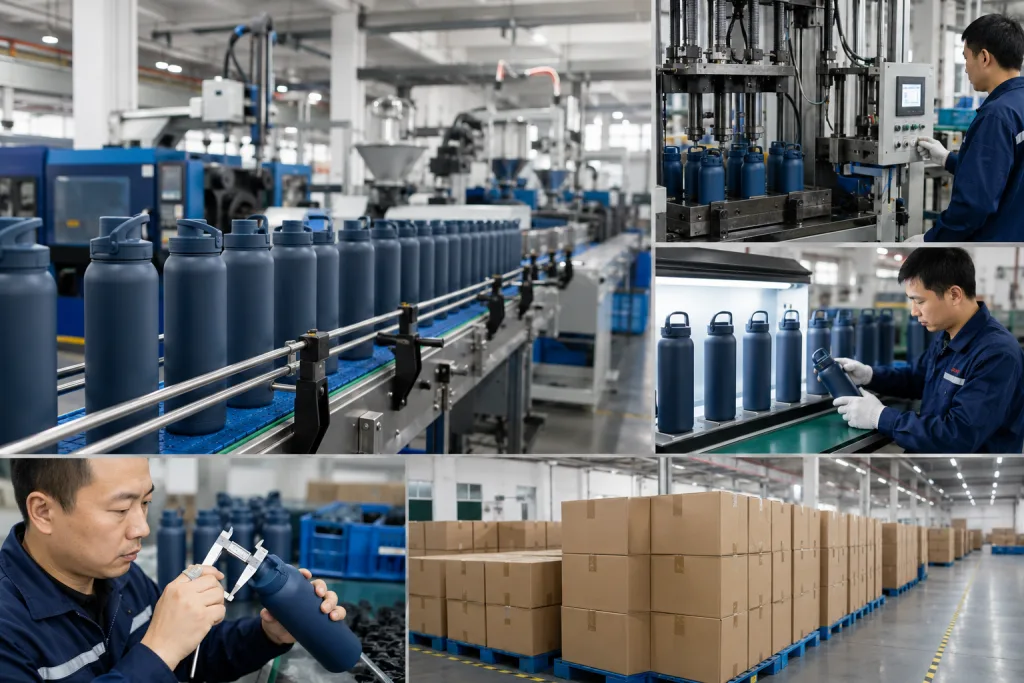
The next cost driver is tooling status. If your canteen custom program can run on an existing bottle and lid from a Zhejiang canteen factory, you skip mold cost and save 2-4 weeks. We ship those jobs faster because the line already has the cavity set and sample dimensions checked with a digital caliper. If you need a new grip panel, a different shoulder profile, or a patented closure style, plan for new tooling. For a stock body with a customized cap insert, tooling can be as low as USD 800-1,500. For a full customized canteen mold set, budget more realistically at USD 2,500-8,000.
Decoration moves cost fast too. Single-color silkscreen stays the standard for canteen promotional orders because it holds up for hand wash use and the setup cost stays low. Heat transfer and full-wrap IML can look sharper on the sample table, but scrap risk goes up and setup takes longer. QC pulled the sample on one 5,000-piece run where the wrap film drifted 1.5 mm at the seam, and the buyer flagged it right away. Packaging changes the math as well. A bulk-packed bottle in export carton is one job. An individually bagged bottle with barcode sticker, retail box, and pallet spec for Amazon FBA is another, and we have seen this go sideways when the PO missed the carton drop-test requirement.
- Body weight change: often shifts cost by USD 0.05-0.18 per unit
- Logo process change: usually USD 0.04-0.35 per unit
- Retail packaging: often adds USD 0.18-0.60 per unit
- Compliance testing allocation: commonly USD 300-1,200 per project
If you are talking to a canteen supplier or distributor drinkware partner and the quote is one clean number with no breakdown, ask for the line items. Do it early. We run into margin problems when freight carton spec, logo method, or test allocation gets buried in one line. The buyer may think the price is fixed, then the sample room finds a missing barcode size or a PO typo on lid color, and the delay starts there.
MOQ tiers that change the math
MOQ on PP bottles is never one flat number. It moves with bottle color, logo method, packing spec, and whether we run stock parts or open a custom color batch. A lot of canteen suppliers show 1,000 pcs online, but we’ve seen that turn out to be trial production, old stock packing, or a mixed-component deal. For normal OEM export orders, the workable starting point is usually 3,000 pcs per color on a stock bottle with basic print. This is the wrong question to ask, by the way. Ask what setup is included in that MOQ.
Here is what buyers should expect from a canteen manufacturer or canteen vendor working with standard export production:
- 1,000-2,000 pcs: workable on stock color items, but the unit cost stays high and decoration options stay tight. We usually see only simple silk screen on the line at this tier, and FOB price can land at USD 1.15-1.95.
- 3,000 pcs: common MOQ for stock molds with custom logo. This is where most export orders start to make sense, especially if QC pulled the sample and approved print position before mass run. FOB price often falls to USD 0.92-1.55.
- 5,000 pcs: a better tier for canteen customizable projects with Pantone color matching and stronger carton loading. On one 24-bottle master carton, the freight math usually looks cleaner here. FOB price often reaches USD 0.78-1.38.
- 10,000+ pcs: best range for customized drinkware programs with private packaging, extra testing, or multi-country distribution. At this level we ship full production lots, not patchwork batches, and FOB price can improve by another 5%-12%.
MOQ also changes by component. A custom canteen body color may be fine at 3,000 pcs, but a translucent custom lid color often needs 5,000 pcs because color consistency is harder to hold during injection molding. The buyer flagged this on a smoke-clear lid last season after a 0.5 shade shift between cavities. Silicone seals, straws, and hangtags can each carry their own minimums. We’ve seen this go sideways when one PO tries to split 4 lid colors across 3,000 pcs.
If you are buying as a canteen supplier, distributor canteen, or distributor growler business, ask whether the MOQ is per SKU, per color, or per shipment. They are not the same. We had one PO with a logo code typo, and the buyer assumed “3,000 pieces minimum” covered three logo versions in one body color. The factory meant 3,000 pcs per printed design. That gap costs time. Sometimes 12 days vs 18 days.
Price ranges by common configuration
Below are realistic FOB China ranges for standard polypropylene bottle promotional products made in Zhejiang, China. We use these as working numbers on the sales side, not exchange-board pricing. Budget first, then fine-tune. Final cost moves with PP resin, print coverage, and packing detail; a 5-layer export carton versus a plain bulk bag changes the number fast.
Typical stock-shape PP bottle pricing
- 500-600 ml screw lid, no straw, 1-color print, bulk pack: USD 0.78-1.10 at 5,000 pcs
- 600-700 ml flip-top lid, carry loop, 1-color print: USD 0.92-1.35 at 5,000 pcs
- 700-800 ml sports lid with straw, 2-color print: USD 1.10-1.65 at 5,000 pcs
- Retail box packed promotional bottle: add USD 0.18-0.45 per unit
- Color-matched PMS masterbatch: add around USD 80-150 per color batch, depending on run size
Buyers often line up a custom drinkware PP bottle against a custom growler or customizable growler in stainless steel. On entry price, PP usually wins by a wide margin, and we ship it faster too; for a 5,000-piece run, stock-shape PP is often 12 days versus 18 days on a basic stainless body. Premium feel is a different story. The buyer flagged this more than once for retail programs. That is why PP still runs well for schools, events, gyms, municipalities, and 10,000-piece campaign orders, while stainless fits higher-ticket shelves.
One more thing on tooling: mold ownership does not make production cheap. This is the wrong question to ask. A customized canteen on your private mold can still cost more per unit than a stock item if cycle time drops on the line. We have seen lids with undercuts and two sliders push output down enough to add 6%-15% in manufacturing cost, and the mold trial showed it on shot cycle right away. Good canteen manufacturers say this before tooling approval, not after the PO is stamped.
Compare quotes on the same basis: FOB Ningbo or Shanghai, same bottle weight, same print coverage, same AQL level, and same carton standard. QC pulled the sample on one project and found a 14 g weight gap against the approved bottle. Then the math doesn't work. A cheaper quote is often just a lighter bottle or a weaker carton.
Lead times from artwork to shipment
Lead time is where 8 out of 10 custom drinkware projects slip. Buyers hear “25 days production” and read it as the full job, but the line only counts bulk production after approvals are locked. Our project sheet breaks each step out because this is the wrong question to ask. The better question is: 25 days from which checkpoint? On the factory floor, even a simple logo position check gets measured off a steel ruler in mm before we release artwork.
- RFQ and technical confirmation: 1-3 days
- Artwork check and visual mockup: 1-2 days
- Pre-production sample from stock mold: 5-7 days
- New mold development: 15-30 days depending on complexity
- Sample approval revisions: 3-7 days
- Mass production: 20-35 days for 5,000-20,000 pcs
- Lab testing if required: 5-10 working days
- Booking and inland transfer to port: 3-7 days
If you need a canteen customized order before a campaign launch, the delay we see most is buyer-side approval. Last month, one PO lost 7 days because the logo owner had not signed off Pantone matching and the warning text was missing one line. QC pulled the sample, the buyer flagged it, and the job sat. For Europe, add review time for REACH documentation, food-contact declaration, and packaging compliance files; we have seen compliance teams hold those for 4 working days. For North America, if ASTM or California Proposition 65 screening is required, run it before mass production. We have seen this go sideways after 5,000 pcs were already packed.
A door-ready schedule for a stock-shape customizable drinkware order is usually 30-45 days from deposit and approved artwork. For a fully customized canteen from a new canteen factory tool, 45-70 days is the honest number. We run tighter than that only when the mold is simple and the sample gets signed back in 24 hours. Peak season in China, especially before summer promotion and before the National Day holiday, often adds 7-12 days. Booking is one reason. Another is that the injection line is already full, and changing over a polypropylene bottle body color still costs us half a shift.
Where buyers lose time and margin
The costliest problems in a PP bottle order are usually not big defects. They start with small spec misses, then stack up fast on the line. We have seen a cap thread pass a hand check on the sample table, then leak after a 1.2 m carton drop and 30 minutes upside down. We have also seen artwork approved from a flat PDF come out stretched on the bottle shoulder radius, and 0.03 mm polybags leave scuff marks after 18 days on the water. These are preventable, but only if the factory and buying team freeze the spec early. If not, the math doesn't work.
Here is where experienced canteen vendors save you time:
- They define bottle weight tolerance, typically plus or minus 3%-5%, and we check it on a digital scale every 2 hours during blow molding.
- They specify leak test method, for example inverted 30 minutes with no visible seepage, instead of saying "no leak" and leaving the line to guess.
- They define print adhesion requirement and washing expectations, usually with a tape test after curing and a sample wash count written on the PO.
- They agree on AQL, commonly 2.5 major and 4.0 minor for promotional drinkware, before QC pulled the sample and found the buyer and factory were using different defect standards.
- They confirm carton drop standard and pallet rules before production, including carton size, pallet height, and whether the warehouse allows overhang.
If you are working through canteen distributors or a distributor growler importer, ask who controls the final golden sample. This is the right question. That sample should include the color chip, logo placement by mm, barcode location, and the packaging stack-up from bottle to master carton. Last month a buyer flagged a PO typo where the barcode side was switched, left-facing instead of right-facing, and that one line would have cost a full rework. Without a locked golden sample, each party makes its own call and the Zhejiang production line ends up guessing.
Margin also disappears in freight inefficiency. PP bottles are light but bulky, and a 700 ml bottle can cube out a container before you hit the weight limit. We run load plans in CBM before mass production because 12 days vs 18 days in transit means nothing if you are shipping air. Small changes matter: a nested lid that saves 6 mm, a tighter carton headspace, or dropping an insert tray the buyer never asked for. We have seen loading improve by 8%-15% from those edits alone. If your canteen supplier is not talking about CBM, they are missing your real landed cost.
Compliance, quality, and factory checks
For Europe and North America, compliance is not end-stage paperwork. It needs to sit in the RFQ from day 1. For polypropylene bottles, we usually line up food-contact raw material declarations first, then check whether the market needs REACH, LFGB-related migration testing from a third-party lab, or a retailer's own protocol. If the order goes into kids or school channels, label copy and age grading can hold approval; the buyer flagged a 6 pt warning line on one PO because it missed the local language version.
From the factory side, ask your canteen manufacturer for the same proof you would ask from any export supplier in China: BSCI or Sedex social audit status, ISO-oriented quality procedures, incoming material inspection, and in-process leak testing records. We run leak checks with a 0.2 MPa air-pressure rig, and this is the wrong question to skip. AQL inspection should happen before the balance payment, not after the container is booked out and moving to port.
At BottleForge Industrial, our normal process is IQC on resin and masterbatch, first-article confirmation, in-line print adhesion checks, 100% visual review for obvious contamination, and final random inspection to AQL. QC pulled the sample every 2 hours on the line, then cross-checked logo adhesion with 3M tape. For a 5,000-piece canteen promotional run, that control level is usually enough. For larger retailer programs, buyers often add third-party final inspection at USD 250-350 per man-day. We've seen this go sideways when the color masterbatch lot shifts by even 0.5 Delta E and nobody catches it before packing.
If you need a canteen customized bottle for Amazon FBA or a major distributor drinkware account, add packaging checks early. FNSKU placement, suffocation warning format, carton label size, and outer carton weight limits matter because Amazon will bounce cartons over the limit, and the math doesn't work once relabeling starts. We ship with carton weight checked on a 30 kg floor scale, and one common target is keeping each master carton under 15 kg. A good canteen distributor plans this before the first sample, not when the shipment is booked.
Get a real PP bottle cost sheet
Send your target quantity, capacity, logo method, and delivery deadline. We will reply with MOQ, FOB pricing, tooling needs, and a workable production calendar.
Frequently asked questions
What is the normal MOQ for polypropylene bottle promotional products?
For a stock bottle shape with a custom logo, a practical MOQ is usually 3,000 pcs per color and per design. Some canteen manufacturers in China will quote 1,000 pcs, but that often means stock color goods, limited print options, or a higher unit price. At 5,000 pcs, you usually get better color control, stronger carton efficiency, and FOB pricing that is 8% to 18% lower than a 3,000-piece run. If you need a new mold for a customized canteen body or lid, the MOQ often rises to 5,000-10,000 pcs so the tooling and setup cost make sense. Always ask whether MOQ is per SKU, per color, or total shipment.
How much should I budget per unit for a custom PP promotional bottle?
For standard polypropylene bottle promotional products made on stock molds, budget roughly USD 0.78 to 1.65 FOB China depending on capacity, lid structure, print colors, and packaging. A simple 600 ml screw-lid bottle with one-color silkscreen and bulk packing can sit near the low end at 5,000 pcs. A 750 ml sports bottle with straw lid, carry loop, two-color print, and individual polybag is usually higher. Retail box packaging can add USD 0.18 to 0.45 per unit. New tooling is separate and commonly lands at USD 2,500 to 8,000 for a full body-and-lid project. If a quote looks unusually low, check bottle weight, wall thickness, and carton spec.
How long does production usually take from approval to shipment?
For a stock-shape custom drinkware order, the normal timeline is 5 to 7 days for a pre-production sample and 20 to 35 days for mass production after you approve the sample and pay the deposit. Add 3 to 7 days for port transfer and export booking. If you need new tooling, add 15 to 30 days before the sample stage. For Europe or North America programs needing lab testing, add another 5 to 10 working days. A realistic total for standard projects is 30 to 45 days. A fully canteen customized project is more often 45 to 70 days, especially in peak season in Zhejiang, China.
Do PP bottles need compliance testing for Europe and North America?
Usually yes, especially if the product contacts beverages and will be sold under your brand. For Europe, buyers commonly request food-contact declarations and may require REACH-related documentation or migration testing depending on customer policy. For North America, retailer requirements may include material screening and warning-label review. Testing cost is often USD 300 to 1,200 per project depending on scope and number of SKUs. If you are buying through canteen distributors or a canteen supplier, do not assume they already tested the exact color, lid, and print ink combination you plan to use. The final configured product matters more than the base resin alone.
Is polypropylene a good choice compared with stainless or Tritan for promo programs?
If your priority is low entry cost, fast production, and high-volume giveaway use, PP is a very practical choice. It is lighter than stainless, generally cheaper than Tritan, and suitable for many school, event, and municipal campaigns. The trade-off is perceived value: a stainless custom growler or travel bottle feels more premium and supports a higher retail price. PP promotional bottles often work best in the USD 1 to 2 FOB sourcing window, while stainless sits much higher. For B2B buyers, the decision is simple: use PP when the campaign needs volume, speed, and budget discipline; use premium materials when branding and resale margin matter more.