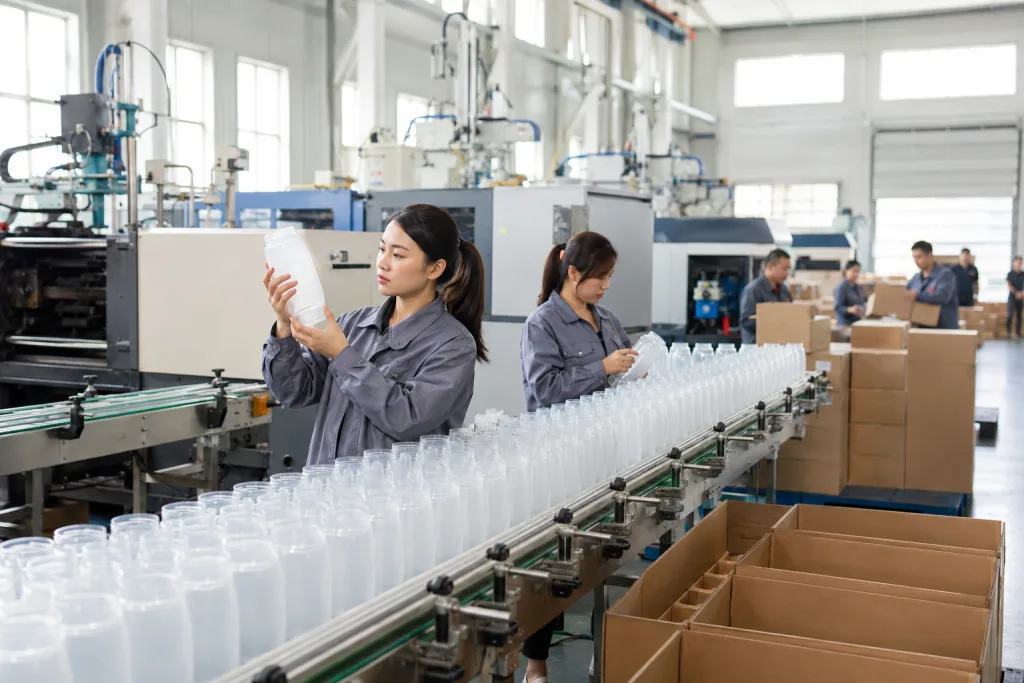
Key Takeaways
- A usable RFQ for polypropylene bottle online wholesale should lock 12 core items, including PP grade, capacity tolerance of ±3%, and AQL 2.5
- Typical MOQ for custom PP bottles is 3,000-5,000 pcs per color, with sample lead time of 7-10 days and mass production in 25-35 days
- Plain PP sports bottles often land at USD 0.85-1.60 FOB Zhejiang, while custom molds can add USD 2,500-8,000 depending on complexity
- Your bulk PO should state packing ratio, carton gross weight under 18 kg, labeling, test standard, and leakage criteria at 0.2 bar
You can buy a polypropylene bottle online wholesale from 20 suppliers before lunch. Easy part. The costly part shows up later: the resin is the wrong grade, lids leak at 0.03 MPa on the air test, the logo scratches off after 50 dishwasher cycles, carton counts do not match your WMS, or the quote looked low until tooling, testing, and duty got added back. We ship this every week. If you are buying bulk drinkware for retail, events, promotion, or Amazon, a 2 mm spec gap can turn into a return claim fast.
At BottleForge Industrial in Hangzhou, Zhejiang, we see the same pattern from new buyers in Europe and North America. Usually 8 out of 10 start by asking for a fast canteen wholesale quote, then the buyer flags the missing items: migration compliance, barcode position, drop test limits, and MOQ by color. Last month QC pulled the sample and found the PO had “1000pcs/ctn” typed instead of “100pcs/ctn.” This is the wrong question to ask at the start. China is efficient when your RFQ is tight, your PO line items are clean, and the line knows the spec from day one.
Start with a real RFQ
If you want clean pricing on polypropylene bottle online wholesale, start with a real RFQ. A screenshot and “Need best wholesale drink bottle, please quote” is not enough. We still send numbers when buyers do that, but the buyer flagged one case last month because 3 factories were quoting different specs without saying so. You cannot compare those offers side by side. A usable RFQ puts Zhejiang suppliers and the rest of China on the same page.
Your first RFQ should spell out the bottle type, target market, annual volume, and exact customization scope. Be specific. For a standard PP sports bottle or wholesale canteen, list capacity in ml or oz, target filled weight, body diameter, height, neck finish, lid style, and whether the bottle must fit standard cup holders or bike cages. On our line, the caliper check on body diameter is usually the first thing QC pulled the sample for, because 1.5 mm off can kill cup-holder fit. Polypropylene is not one material in practice; this is the wrong question to ask if you only say “PP bottle.” Ask for food-contact virgin PP, usually with the required declaration for EU REACH and framework food-contact compliance, or FDA-style declarations for North America if your customer asks for them.
- PO line item 1: Product name: PP sports bottle / canteen bulk order
- PO line item 2: Capacity: 650 ml nominal, tolerance ±3%
- PO line item 3: Material: virgin food-grade PP body, PP lid, food-grade silicone seal
- PO line item 4: Wall thickness: 1.8-2.2 mm target
- PO line item 5: Decoration: 1-color silkscreen, 1 position, 45 x 70 mm
- PO line item 6: Compliance: EU food-contact declaration, REACH SVHC statement
If you are also sourcing drinkware wholesale beyond PP, such as stainless items, bulk growler, wholesale growler, or beer tumbler bulk programs, keep those RFQs separate. We have seen this go sideways. Buyers often mix plastic bottles, alcohol flask bulk requests, and beer growler wholesale bulk in one email, then expect one clean quote sheet back. The math does not work because each product family runs on different tooling, test methods, and MOQs; a PP bottle body might start from a 3,000 pcs MOQ while a stainless growler program follows another setup. We ship faster when the RFQ is clean: 24-72 hours for a usable quote versus 5 days of back-and-forth on mixed requests.
Price the full landed structure
The lowest FOB price usually loses once you add tooling, testing, packaging, and defect risk. We have seen buyers chase a USD 0.04 saving, then lose it on one carton change and a failed drop test. For polypropylene bottle online wholesale, standard stock models from China are still the fastest route. On our line in Zhejiang, a plain 500-750 ml PP bottle with a simple screw lid usually lands around USD 0.85-1.60 FOB, depending on resin cost, bottle weight in grams, decoration method, and order size. Add a flip spout, carry loop, or two-color body, and the quote moves fast. This is the wrong question to ask if you only compare piece price.
Ask every supplier to split the quote line by line. If they cannot, you are guessing. You need unit price, printing charge, packaging upgrade, sampling fee, mold fee if any, carton dimensions, and loading quantity per 40HQ. QC pulled the sample on one project and found the inner tray added 12 mm height to each carton, which cut container loading hard. A bottle that is USD 0.06 cheaper can still cost more if the carton design wastes 12% of container space. That hits fast when you are buying drinkware bulk or canteen bulk for a promotion with a fixed landed budget.
What to request on the quotation sheet
- Unit price by 3 quantity breaks, such as 3,000 / 10,000 / 30,000 pcs
- MOQ per color and per logo; common custom MOQ is 3,000-5,000 pcs
- Sample cost and refund rule after bulk PO
- Tooling cost if you need a custom cap or body shape; often USD 2,500-8,000
- FOB Ningbo or Shanghai terms, plus optional EXW and DDP references
- Carton pack-out, net weight, gross weight, and container loading qty
If your range includes bulk drinkware in multiple categories, keep the costing logic aligned across items. The buyer flagged this on a mixed PO last year because the flask line used gift box costing and the tumbler line did not, so the math did not work. A beer tumbler wholesale bulk program, a growler bulk line, and alcohol flask wholesale bulk can each carry different testing charges and packaging cost, but your finance team still needs one landed-cost template that compares cleanly. Good suppliers in China know procurement signs off on total cost, not only piece price.
Lock the sample before artwork
Sampling is where sourcing either stays under control or slips fast. Lock the physical sample first. Do not approve artwork before that, unless you are only changing logo color on a proven stock item we already run. For polypropylene bottle online wholesale, ask for 2 sample stages: a plain construction sample first, then a pre-production sample with printing and final packaging. This saves rework. On our side, that usually means one sample off the bench in 3 days and a PPS after print setup in 7 to 10 days.
The construction sample should answer engineering questions, not just look decent in a photo. Check whether the thread engages smoothly, whether the cap over-torques and shows stress whitening, and whether the bottle stands flat after 24 hours at room temperature on a granite table. Check the mouth diameter too. We use a digital caliper for this, and a 2 mm change is enough for a buyer to flag drinking comfort. If it is a sports bottle, test one-hand opening and closing 50 times. If it is a canteen wholesale item for school or outdoor use, check whether the carry loop survives a 5 kg static load for 1 hour without deformation. This is the wrong question to skip, and we have seen this go sideways on loop hinges that looked fine on day one.
You are not buying a picture. You are buying a repeatable manufacturing result.
Branding on PP needs more attention. Surface energy is lower than stainless steel, so ink adhesion is where trouble starts, especially after the line packs the goods and cartons rub in transit. Ask what pre-treatment is used before silkscreen printing. Corona treatment is common; flame treatment shows up too. If the logo must survive dishwasher cycles, consider in-mold labeling or a dedicated adhesion test protocol. In one retail program, QC pulled the sample after a tape test passed but the logo still scratched after 12 wash cycles. A simple tape test plus 24-hour cure verification is not enough for retail programs. The math doesn't work if you save $0.03 on decoration and then eat a full reprint claim.
- PO line item 7: Pre-production sample approval required before mass production
- PO line item 8: Leak test: no leakage after inverted 2 hours and 0.2 bar internal pressure test
- PO line item 9: Drop test: packed sample passes 80 cm drop on 6 faces, 3 edges, 1 corner
- PO line item 10: Logo adhesion: cross-hatch or tape test standard to be defined
If you also source beer growler in bulk or alcohol flask wholesale projects, separate the sample criteria. PP bottles are not tested like stainless growlers, and buyers mix these standards up more often than they should. We ship both, so we see the confusion on POs—last month one buyer copied a 1.0 m drop spec from a flask order onto a PP kids bottle inquiry. The point is simple: approve the exact risk points for each item before you commit container space.
Write the bulk PO like quality insurance
Most disputes in China do not start with bad intent. They start with a short PO. If your purchase order says only “custom bottle, blue, 10,000 pcs,” the line has to guess too much. That is where claims start. A solid bulk PO is a commercial document and a quality agreement at the same time. It should be clear to your buyer, the supplier sales rep, the production manager, and the inspector on the floor in Zhejiang with a 0.02 mm caliper in hand.
At minimum, write the exact approved sample reference, artwork revision number, production lead time, and shipment window. Then write what counts as a defect. For PP bottles, we usually call out leakage, odor, unstable standing base, color mismatch, flash on the mouth area, logo offset, contamination marks, and carton errors. Be specific. QC pulled the sample too many times on jobs where “scratch acceptable” was never defined. State your inspection plan. A lot of buyers run AQL 2.5 for major defects and 4.0 for minor defects, but this is the wrong question to ask if your channel is not clear. Promo giveaway orders usually accept more cosmetic variance than a retail shelf program in Europe under D65 light box inspection.
- PO line item 11: Approved sample code and date
- PO line item 12: Inspection standard: ANSI/ASQ Z1.4, General Level II, AQL 2.5/4.0
- PO line item 13: Color tolerance: Pantone reference with visual match under D65 light
- PO line item 14: Packaging: 1 pc/polybag or egg-crate divider as specified
- PO line item 15: Carton limit: gross weight max 18 kg
- PO line item 16: Shipping marks, FNSKU, carton barcode, made-in-China marking
If you are combining SKUs such as wholesale drinkware, growler wholesale, and canteen bulk in one shipment, list each SKU separately with unit pack, carton ratio, and pallet rule. We ship into North America every month, and 3PL receiving teams will flag mixed details fast if carton labels and pallet rules do not match the PO. The math does not work on “saving” USD 0.03 on packing. We have seen this go sideways. One buyer flagged a PO typo where 24 pcs/ctn was written as 42 pcs/ctn, and a factory running 600,000 units per month still shipped the wrong carton count because the document was vague.
Audit compliance and factory discipline
Not every polypropylene bottle online wholesale order needs a full factory audit. Every order does need a compliance file. For Europe and North America, ask for the current business license, social audit status if relevant, and product compliance documents tied to the resin grade and the finished SKU. On our side, that usually means a PO file with the lid code, color code, and carton spec checked line by line. Depending on your channel, that may include REACH statements, food-contact declarations, LFGB-style testing references, California Proposition 65 statements where applicable, and ASTM or CPSIA checks for kids items.
Copy-paste test reports are where buyers get burned. We have seen this go sideways. A report for a random bottle from 2022 does not prove your current SKU, and QC pulled the sample on one order because the report said natural PP while the actual lid was black masterbatch with a matte print. The report should match the material family and, if possible, the final decorated product if the printing ink contacts users or may migrate indirectly. If you are sourcing a kids-focused wholesale canteen, ask tougher questions on bite resistance, small-part risk, and age grading. If you are buying growler bulk or beer growler wholesale for beverage programs, material suitability changes completely, so do not apply PP assumptions to those lines.
Factory discipline matters as much as paperwork. This is the right question to ask. Ask simple operational questions: is there incoming resin control by lot, are silicone seals checked by durometer range, and is cap torque controlled at assembly with a torque meter set in N.m. Ask about leak testing too. The line should tell you whether they run 100% in-line air-pressure leak checks or only final random inspection at AQL 2.5. A decent factory in Zhejiang should answer directly. BottleForge Industrial typically works on 25-35 day lead times after deposit and sample approval, but 25 days with weak process control is worse than 32 days with stable output.
- Ask whether the factory follows BSCI or similar social audit requirements if your retailer requires it
- Confirm whether packaging materials are subject to incoming inspection, down to carton burst strength and polybag thickness in mm
- Request production photos or a simple process flow if you are a new buyer in China
You do not need every certificate on earth. You need the right documents tied to the exact product, plus a factory habit of following written specs. We ship against approved drawings for a reason; one typo on a PO, like 500 ml changed to 550 ml, can wreck the whole run.
Manage production, inspection, and shipment
Once the PO is placed, some buyers go quiet until the balance payment. We have seen this go sideways. The safer way is to run 3 checkpoints: pre-production alignment, a mid-line update, and pre-shipment inspection. For polypropylene bottle online wholesale, ask for a dated production plan that shows resin purchase, molding, decoration, assembly, packing, and booking. Put the dates in a sheet. If one step slips by 4-5 days, you need that message early, not after the cartons are stacked. On our side, the line usually marks molding output by cavity and shift, and that gives you a cleaner read than a sales reply that just says "production started."
A practical process is simple. After deposit, the supplier sends color chips or molded swatches if needed, and we usually check them under a light box before sign-off. During mass production, ask for in-line photos from molding and printing, plus 1 short video from the assembly table if the bottle has a flip lid or straw part. Before the final 20% of units are packed, book a third-party inspection or your own QC review. Use the same defect definitions as the PO. Leakage and wrong artwork are major defects. Tiny color rubs inside the carton may be minor, depending on your channel. QC pulled the sample before from a 24-bottle carton where the logo sat 3 mm off-center, and the buyer flagged it even though the lid seal passed.
Shipment details that save trouble later
- Book FOB from Ningbo or Shanghai with a realistic ETD buffer of 5-7 days
- Require carton dimensions and gross weight before booking to avoid freight repricing
- For Amazon FBA, confirm FNSKU placement, suffocation warning text if polybags are used, and outer carton label format
- For EU retail, confirm pallet height, overhang limits, and EAN barcode readability
Product mix matters here. This is the wrong question to ask if the only question is unit price. A sourcing plan that combines drinkware wholesale, beer tumbler in bulk, wholesale growler, and alcohol flask in bulk can work, but each SKU needs its own inspection checklist and its own shipping marks. We ship mixed loads like this, and one carton mark error can stop customs release or warehouse receiving for the full lot. Last year a PO had "grower" typed instead of "growler" on one shipping mark file, and the warehouse kicked back 86 cartons for relabeling. China runs fast when the execution file is detailed. The math does not work when key points stay verbal.
Handle it this way and online wholesale sourcing becomes a control job, not a price chase. You are measuring dates, weights, print position, and pass rates, then correcting early before 1,200 cartons are on the floor.
Send your RFQ and get a spec-based quote
Share capacity, material, logo file, target market, and packaging needs. We will reply with MOQ, FOB pricing, sampling plan, and lead time.
Frequently asked questions
What MOQ should I expect for custom polypropylene bottle online wholesale orders?
For a stock PP bottle with one-color logo, a realistic MOQ is usually 3,000 to 5,000 pcs per colorway. Some factories in China will quote 1,000 pcs, but the unit price often jumps 12% to 25%, and color matching becomes less stable. If you need a new mold for the body or cap, the MOQ may start at 10,000 pcs, plus tooling of roughly USD 2,500 to 8,000. For plain undecorated bottles, lower MOQs are possible, but most procurement managers buy at least one full carton multiple and preferably a quantity that fills production efficiently. Ask whether MOQ is per SKU, per color, or per logo position before approving the quote.
How do I compare PP bottle pricing with stainless steel or growler products?
Compare by use case and total landed cost, not only by unit price. A polypropylene bottle may quote at USD 0.85 to 1.60 FOB Zhejiang for a standard 500-750 ml item, while insulated stainless products cost much more because of steel grade, vacuum process, and higher freight weight. Growler bulk, beer growler wholesale, or beer tumbler wholesale bulk programs also use different test standards and packaging. PP usually wins on low weight, lower mold cost on stock models, and lower freight. Stainless wins on heat retention and perceived value. If you also buy wholesale drinkware across categories, build one cost sheet that includes FOB, packaging, testing, duty, and damage rate.
Which quality tests matter most before I place a bulk PO?
For PP bottles, focus on tests that reflect how the item actually fails in the market. Start with leak testing: inverted 2 hours and a light pressure test around 0.2 bar. Then check odor, cap thread engagement, standing stability, and logo adhesion. If the bottle is for sports or school use, add carry-loop pull testing and a basic packed drop test from 80 cm. For retail programs in Europe or North America, ask for food-contact compliance documents and define your inspection plan, such as ANSI/ASQ Z1.4 General Level II with AQL 2.5 for major defects. If you approve only a visual sample and skip written pass/fail criteria, you are taking unnecessary risk.
How long does the sourcing process usually take from RFQ to shipment?
For a stock polypropylene bottle online wholesale project, expect about 1 to 3 days for an initial quote, 7 to 10 days for samples, and 25 to 35 days for bulk production after sample approval and deposit. If you need custom tooling, add roughly 20 to 35 days for mold making and first trial correction. Shipping time then depends on route: ocean freight to Europe or North America can add several weeks. The biggest delays usually come from artwork changes, unclear packaging requirements, or late compliance requests. If your PO includes barcodes, FNSKU labels, and carton specs from the start, the schedule is much easier to hold.
Can one supplier handle bottles, canteens, tumblers, and flask programs together?
Sometimes, but do not assume full category strength from one sample room. Many factories in Zhejiang and wider China are strongest in one or two product families. A supplier good at PP sports bottles and canteen wholesale may not be the best source for wholesale growler, beer tumbler bulk, or alcohol flask wholesale. Ask for category-specific production photos, monthly output, and testing capability. A useful check is whether they can quote different MOQs, lead times, and QC standards by category instead of giving one generic answer. If you need mixed drinkware bulk sourcing, one supplier can still work, but only if each SKU has separate specifications, sample approvals, and inspection rules.