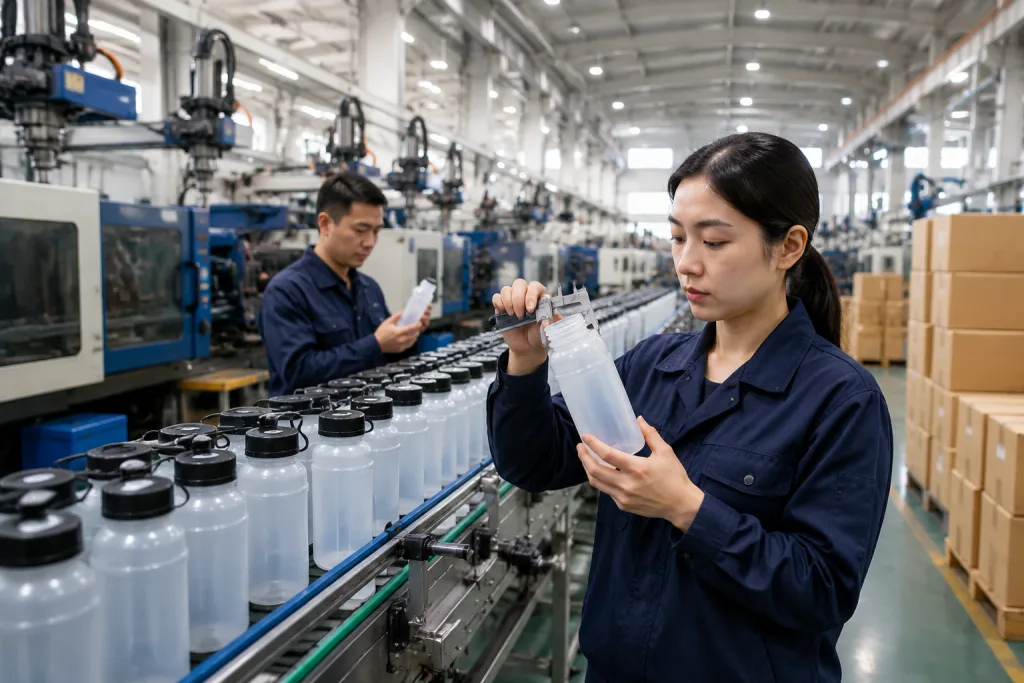
Key Takeaways
- Set measurable specs: leak test at 0.3 bar for 30 seconds, drop test from 1.2 m, and AQL 2.5 before shipment
- For custom drinkware in PP, expect MOQ from 3,000 units and FOB China pricing around USD 0.85-2.20 depending on mold, print, and lid complexity
- Color drift, sink marks, flash, and cap torque variation are the most common production failures with polypropylene bottle manufacturers
- Ask for REACH, LFGB or FDA test plans, BSCI status, and production lead time of 30-40 days before paying tooling or deposit
You rarely lose margin on a custom drinkware order from one big factory failure. It usually goes sideways through small misses that stack up: a cap leaks at 0.2 bar on the air-pressure tester, the Pantone shifts on a translucent wall, the handle cracks after a cold-drop test, or QC pulled the sample and found mixed lid torque in one carton. When you screen polypropylene bottle manufacturers, the cheapest quote is the wrong question to ask. The real job is writing a spec with less room for avoidable failure.
This gets tighter if you buy for Europe or North America, where REACH, LFGB, ASTM, labeling, and retailer QA all land on your desk. At BottleForge Industrial in Zhejiang, China, we build around 600,000 units per month with MOQs from 3,000 pieces, and most PP bottle programs run 30 to 40 days after sample approval. We run those orders on the line every week. The buyers with the fewest claims are not lucky; they send clear artwork, call out wall thickness in mm, and catch PO errors before we ship.
Where PP bottle projects usually fail
Polypropylene looks simple on paper because the resin is common, cheap, and tough. Buyers see a basic sports bottle or custom canteen and think the risk is low. We have seen the opposite on the line. PP gives you enough freedom in shape, hinge, and wall section that weak assumptions stay hidden until mass production starts. A concept sample can feel fine in hand, then fail in three ugly spots once a canteen factory runs 20,000 pieces in a hot Zhejiang week and the mold temp drifts 6 C.
The failure points are usually easy to spot if the factory knows what to check. Wall thickness is off balance by 0.4 mm, lids get dressed up for shelf look but miss sealing force, decoration is approved before anyone checks the mold parting line, and compliance gets raised after tooling steel is cut. This is the wrong question to ask: price first. If you are sourcing from polypropylene bottle manufacturers, ask whether the supplier brings up process windows, shrinkage rate, and QC checkpoints before you push them. If they do not, the math does not work.
- Material risk: virgin PP vs regrind content not declared clearly, and the buyer flagged odor after a 48-hour sealed-carton check.
- Molding risk: sink marks, short shots, flash, gate blush, warpage; we run a go/no-go gauge and QC pulled the sample at cavity No. 6 twice last month.
- Assembly risk: cap-to-neck mismatch, gasket fit, straw trimming, handle pin looseness; a 1.2 kg pull test will catch this fast.
- Decoration risk: poor ink adhesion, registration drift, laser haze on coated parts; on one PO, the logo sat 1.5 mm across the parting line and the buyer rejected the lot photo.
- Logistics risk: carton crush, odor pickup, barcode mismatch, mixed-color packing; we have seen one PO typed as BKUE instead of BLUE and the shipment mixed 600 pcs.
A serious canteen manufacturer or canteen supplier should turn these risks into a control plan with numbers on it. That means resin grade, cavity layout, in-line inspection frequency every 2 hours, torque range in N.m, and final AQL. If they only say they have done similar customized drinkware before, that is not enough. We have seen this go sideways. Similar is how you get returns, especially when the line is running fast and nobody wrote down the sealing limit.
Leakage starts at the neck finish
If your bottle leaks, buyers blame the lid first. On the line, we usually trace it back to the interface: neck finish tolerance, thread profile, gasket compression, or cap torque. A lot of factories can mold a clean-looking body. Fewer can hold neck repeatability within 0.15 mm across a 50,000-piece run, especially on an 8-cavity tool where cavity No. 3 and No. 7 never behave the same.
For a canteen customizable program, write the sealing system into the spec from day one. A snap lid needs one test plan. A screw cap or straw lid needs another, and this is the wrong question to ask only after the first pilot run. Ask your canteen vendor for the neck drawing with tolerances and the cap torque target. For standard PP sports bottles, a practical cap torque range is often 8 to 14 lbf·in, but it depends on thread size and gasket hardness; we check it with a torque tester every 2 hours. Silicone gaskets around Shore A 50 to 60 are common. If the supplier cannot tell you gasket material, durometer, and compression ratio, you are buying blind.
What to put on the spec sheet
- Leak test: 0.3 bar air pressure for 30 seconds, no visible leak.
- Inversion test: filled with 60°C water, inverted for 8 hours, no drip.
- Torque range: defined per lid type, recorded every 2 hours on line.
- Thread gauge check: first-off approval and every shift.
- Gasket verification: material declaration and incoming inspection.
For custom growler or customizable growler projects, pressure sensitivity is higher because buyers usually expect stronger thermal retention and a tighter closure. If your distributor growler line uses wide-mouth closures, ask for a neck-seal cross section before tooling; we have seen one 0.2 mm mismatch turn into a full mold correction. A small CAD review can save a full mold revision. Good polypropylene bottle manufacturers will also tell you whether body ovality after cooling may affect seal compression. QC pulled the sample on one run last year and found the ovality was 0.6 mm after ejection. That is the honesty you want, because we have seen this go sideways.
Most leak claims are not random. They come from tolerances that were never written down.
Bad molding hides in plain sight
PP molding defects do not jump out on a white sample under office light. Put the same bottle in translucent blue, add a 180 mm wrap logo, or mold a textured grip, and the line starts showing its mistakes fast. We usually see sink marks near ribs, weld lines around handle joins, flash at the cap line, and warpage that makes the bottle rock on a granite plate. Flip-top lid canteens add one more weak spot. If the gate position is off or melt flow is uneven, the hinge starts fatiguing early, and QC pulled the sample on this more than once.
Ask the canteen factory for the nominal wall thickness and every point where it changes. For a typical 600 to 750 ml PP bottle, a body wall around 1.8 to 2.5 mm is common. Too thin, and the panel sucks in or the bottle feels brittle in hand. Too thick, and cycle time goes from 28 seconds to 36 seconds, sink marks show up, and the resin math does not work. The ratio matters more than one headline number. This is the wrong question to ask if a supplier only says "2.0 mm" and cannot show where the section jumps near the shoulder or base ring.
If you are opening a new customized canteen mold with canteen suppliers, require first article samples from all cavities, not just the cleanest one from the tray. Multi-cavity tools hide problems. We have seen one bad cavity in an 8-cavity tool create 10% of total complaints because the vent depth was off by 0.03 mm and the buyer flagged random flash only after decoration. A capable canteen vendor should mark cavity numbers for traceability during pilot run, usually laser-marked or steel-stamped on the inner base.
- Flatness: base wobble limit, for example less than 1.5 mm on granite plate.
- Flash: no sharp flash over 0.2 mm at parting line.
- Sink: no visible sink at 50 cm under 800 lux unless approved by golden sample.
- Drop test: 1.2 m, filled, 3 drops on side/base, no crack or cap release.
At our Zhejiang operation, we normally run pilot production at 200 to 500 pieces before full release on new customizable drinkware. We ship slower for a day. That extra day is cheaper than remaking 5,000 printed bodies after silk screen because one cavity was running hot by 6 C. If a canteen manufacturer pushes straight to mass production without a cavity review, assume they are managing their schedule, not your risk. We have seen this go sideways.
Decoration failures cost more than resin
Most custom drinkware claims are cosmetic, not functional. The bottle still holds water. The trouble starts when the print scratches after 30 rubs, the logo shifts 1.5 mm off center, or the blue looks different under retail D65 light. Buyers miss this because decoration sits as a small line on the quote, sometimes USD 0.06 to 0.18 per unit on a 5,000 pcs PO. We have seen this go sideways. One bad print run can make 100% of the shipment dead stock.
For canteen promotional orders, pick decoration by use case, not by which sample looks best on the table. Silk screen works for 1 to 3 spot colors on straight cylindrical bodies, and we usually lock registration tolerance at +/-1.0 mm before the line starts. Heat transfer gives fuller graphics on custom canteen projects, but adhesion lives or dies on flame treatment, oven cure time, and operator control; QC pulled the sample once and found edge lifting after the 24-hour wait. Pad printing fits caps and small curved areas, though it scratches faster in daily handling. If you need dishwasher resistance, state the cycle count and detergent standard on the PO. Do not leave it open. This is the wrong question to ask: "Can you make it durable?" Ask for the test method.
Translucent PP is another trap. Pantone matching on translucent resin does not behave like opaque material, and a frosted blue canteen customizable bottle can shift lot to lot because wall thickness moves from 2.2 mm to 2.6 mm and the resin batch changes. The buyer flagged this on a reorder last year after two pallets looked darker under shelf lighting. Ask for a signed color limit sample and define the inspection light source, ideally D65. If retail consistency has to stay tight, opaque masterbatch is the safer call. The math does not work if you want translucent effect and exact visual repeat at the same time.
Minimum decoration controls
- Cross-hatch adhesion test: minimum 4B after 24-hour cure.
- Rub test: 50 dry rubs and 20 wet rubs, no major ink loss.
- Color tolerance: approved against Pantone under D65, signed sample held by both parties.
- Artwork position: logo centerline tolerance and rotation tolerance stated.
This matters across every channel. We ship for canteen distributor programs and distributor drinkware private label, and reorders usually fail for one reason: the first PO had no measurable decoration standard, sometimes not even the logo angle in degrees. One PO we saw said "navy blue" with no Pantone and spelled "centeen" in the remarks. Then the factory says the result is within normal range, and on paper they are not wrong. Without a signed standard, you have nothing solid to push back with.
Compliance gets messy when documents are vague
Buyers in Europe and North America often ask, "Is it food safe?" This is the wrong question to ask. A polypropylene bottle factory can answer yes from a resin declaration for PP raw material, while your retailer wants migration testing on the finished bottle with the actual print, gasket, and straw installed. We see this on the line all the time. QC pulled the sample once and the bottle body passed, but the printed logo area and silicone straw still had to go out for separate review. Those are different documents, and buyers mix them up.
For EU business, ask for REACH SVHC screening and food-contact testing based on intended use, such as cold water, juice, or 40C filling. Put the use case on the PO. We had one PO marked "bottle 700ML EU" with no drink type, and the buyer flagged it after sampling. For Germany, some buyers still ask for LFGB-style testing, even on a standard 650 ml sports bottle with a 2.5 mm wall. For the US, FDA food-contact position and ASTM checks depend on product category and age grading. If the program is for children, ask your canteen supplier about CPSIA-related parts and whether any non-PP soft components, like a TPE mouthpiece or silicone seal, bring phthalate questions. We ship cleaner paperwork when this is defined early.
Check social and system audits too, because major importers do. BSCI, Sedex, and ISO 9001 do not improve a bottle by themselves. They do show the factory is used to document control, revision logs, and batch files. That matters six months later when a retailer asks for traceability from carton code back to cavity number, shift record, and incoming material lot. We run into this after claims. The math doesn't work if the supplier saves one day on paperwork and loses 18 days chasing records later.
- Test the finished assembled bottle, not only the resin.
- Include decoration, seals, straws, and colorants in the compliance scope.
- State target market: EU, UK, US, Canada.
- Request batch coding or cavity/date traceability on carton or unit where practical.
A practical rule: do not release the bulk order based only on a previous report from another SKU. We've seen this go sideways. Customized canteen and customized growler projects change enough to break old assumptions, even if the shape looks close and the MOQ is still 3,000 pcs. A new ink system, a different masterbatch, or a blue silicone seal instead of clear can trigger a new test requirement. Good canteen distributors already ask for this. New buyers usually learn after a retailer chargeback or after inspection finds the approved report was for a straw lid with a 6 mm tube, not the current flip lid with a 7 mm tube.
Packing mistakes ruin landed cost
Packing mistakes stay quiet until the container lands. Then the buyer flagged crushed master cartons, scuffed bottle bodies, the wrong insert language, or an FNSKU label stuck across the logo area. We have seen this on the line after final QC passed, because QC pulled the sample from the bottle spec, not from pack-out. The bottle was fine. The pack-out control was not.
For custom drinkware going into retail, promo, or e-commerce, packaging needs the same level of control as the bottle itself. If you sell on Amazon or supply a distributor growler assortment, lock the unit pack, barcode position, carton drop standard, and mixed-pack rules before mass production. One buyer even typed "24 pcs/ctn" on the PO when they meant 12 pcs, and the freight math broke fast. Canteen distributors handling reorders usually care more about carton size consistency than people expect, because warehouse slotting is measured in mm and freight class hits landed cost right away.
Typical export cartons for PP bottles use 5-ply corrugate, but that spec alone is not enough. This is the wrong question to ask. A 5-ply carton at 585 x 395 x 420 mm and 13.2 kg gross needs a different board strength than a smaller 9.8 kg carton, so tie the board grade to size and weight. If packed cartons run above 12 kg, ask for burst or edge crush data and run carton drop tests at pack-out. We ship from Zhejiang, China, where sea freight means moisture, stacking pressure, and 18 days in transit instead of 12 on a cleaner route. Polybags cause another problem if the bottles go in before full cooling; we checked one lot with an IR thermometer and surface temp was still 38 C, which trapped odor inside the bag.
Do not leave these open
- Carton gross weight limit: often 10 to 12 kg for manual handling.
- Barcode type and placement: unit, inner, master carton.
- FNSKU or retailer label file approval before bulk print.
- Spare ratio: 0.5% to 1% extra for replacement if agreed.
- Packing inspection AQL: usually Major 2.5, Minor 4.0.
Reliable canteen vendors and canteen suppliers usually send a packing photo standard before production, often with 6-sided carton photos and ruler checks on label position. Ask for it early. If you approve the bottle and skip the cartons, you are only managing ex-factory quality. The buyer does not receive ex-factory quality. They receive delivered quality.
How to qualify the right factory
You do not need the biggest canteen manufacturer in China. You need the factory that fits your program. If your order is 5,000 plain bottles with one-color print, a 40-machine automated plant may treat it like filler between larger runs. If your program is 80,000 units across six SKUs, a small workshop with 6 injection presses will get stuck on mold changeover, operator shifts, and tool maintenance. We have seen this go sideways.
Start with hard questions. What is the MOQ by SKU and color? How many injection machines are running PP drinkware today? What is the normal lead time after sample approval? Can they handle custom logo, insert cards, and retail packaging in-house? At BottleForge Industrial in Zhejiang, typical MOQ is 3,000 units per design, sample lead time is 7 to 12 days, and repeat orders usually ship in 25 to 35 days depending on print and season. Ask what tonnage those PP bottles run on, too; on the line, a 320T press and a 16-cavity mold tell you more than a polished sales deck. Those are the numbers buyers can plan around.
Then audit how they think. A good canteen factory should walk you through incoming resin checks, in-process inspection every 2 hours, final AQL, and nonconformance handling. Ask whether they keep golden samples for color and assembly. Ask how they separate approved and rejected lots. Ask what percentage of orders require rework. QC pulled the sample last month on a lid thread that was out by 0.3 mm, and that kind of detail matters. This is the wrong question to ask if you only want the lowest price; you need to know how the factory reacts when the line finds a problem at 3:00 p.m.
- Factory fit: MOQ by design and color, mold ownership, daily output per machine, and whether they run silk print, heat transfer, or label application in-house.
- QA fit: AQL standard, leak test protocol, cavity traceability, and how the team marks mixed lots after inspection.
- Compliance fit: REACH/LFGB/FDA support, BSCI or similar audit status, plus which lab they use and how fast they can pull a retest sample.
- Commercial fit: FOB terms, deposit structure, spare policy, claim handling, and what happens when the buyer flagged a carton mark or a PO typo.
Whether you buy a custom growler, customizable canteen, or a broad distributor drinkware line, the best supplier usually points out failure points before you ask. That is not negative. That is production literacy. We ship smoother with factories that will tell you the handle pin can loosen, the color masterbatch can drift, or the retail box drop test failed at 76 cm. That separates a reliable canteen manufacturer from a quote machine.
Send your bottle spec for a failure-risk review
If you have a PP bottle RFQ, we will flag leak, molding, decoration, and packing risks before sampling so your first quote is closer to a shippable product.
Frequently asked questions
What MOQ should I expect from polypropylene bottle manufacturers?
For standard PP sports bottles or custom canteen programs, MOQ usually starts around 3,000 pieces per design and color from an established China factory. If you need a new mold, practical opening quantity is often 5,000 to 10,000 pieces to absorb tooling cost. Decoration changes also matter: one-color silk screen can stay near 3,000 units, while full-wrap heat transfer or retail gift box packing may push MOQ higher. If you are a canteen distributor testing a market, ask whether the factory allows mixed lid colors within one master style. That can reduce inventory risk without changing the total MOQ.
How do I compare quotes from different canteen manufacturers fairly?
Make the quote basis identical. Ask each supplier to price the same capacity, PP grade, wall thickness range, lid type, gasket material, logo process, packaging, and Incoterm, ideally FOB Ningbo or FOB Shanghai. Request separate lines for mold cost, print cost, unit pack, and test fees. A quote of USD 0.92 means little if one supplier uses a 1.6 mm wall and another uses 2.2 mm, or if one includes leak testing and the other does not. Also compare lead time, AQL standard, and claim policy. A cheap quote from China becomes expensive fast when rework, air freight, or retailer penalties appear.
Is polypropylene a good choice for custom drinkware compared with other materials?
For value-focused custom drinkware, PP is often the most practical choice. It is lightweight, impact resistant, and cost efficient, with FOB China unit prices commonly around USD 0.85 to 2.20 depending on size, lid, and decoration. It is not the best option if you need premium thermal performance or a heavy retail feel; then stainless steel may fit better. But for canteen promotional use, school bottles, gym bottles, and high-volume distributor canteen programs, PP works well if the closure and print are specified properly. The main trade-offs are lower heat retention, possible color variation in translucent parts, and higher sensitivity to cosmetic molding defects.
What quality tests should I require before shipment?
At minimum, require leak testing, drop testing, visual inspection, torque checks, and packing inspection under a written AQL plan. A common pre-shipment standard is AQL Major 2.5, Minor 4.0, though some retail programs ask for tighter control. For a typical customizable canteen, specify 0.3 bar leak test for 30 seconds, 1.2 meter filled drop test, logo adhesion testing, and carton verification against your pack spec. If the bottle includes a straw lid or carry handle, add functional cycling, for example 200 to 500 open-close cycles. Ask for production photos and test records by lot, not only a pass statement.
How long does a custom PP bottle project usually take?
If you use an existing mold, sample approval usually takes 7 to 12 days and mass production about 30 to 40 days after deposit and artwork confirmation. Repeat orders can be faster, often 25 to 35 days, depending on color count and season. A new mold adds roughly 20 to 35 days for tooling, first-off correction, and pilot run. Compliance testing can add another 7 to 15 days if you are waiting for finished-goods reports for EU or US markets. For buyers working with canteen suppliers in Zhejiang or other parts of China, the biggest time loss is usually delayed approvals, not machine time.