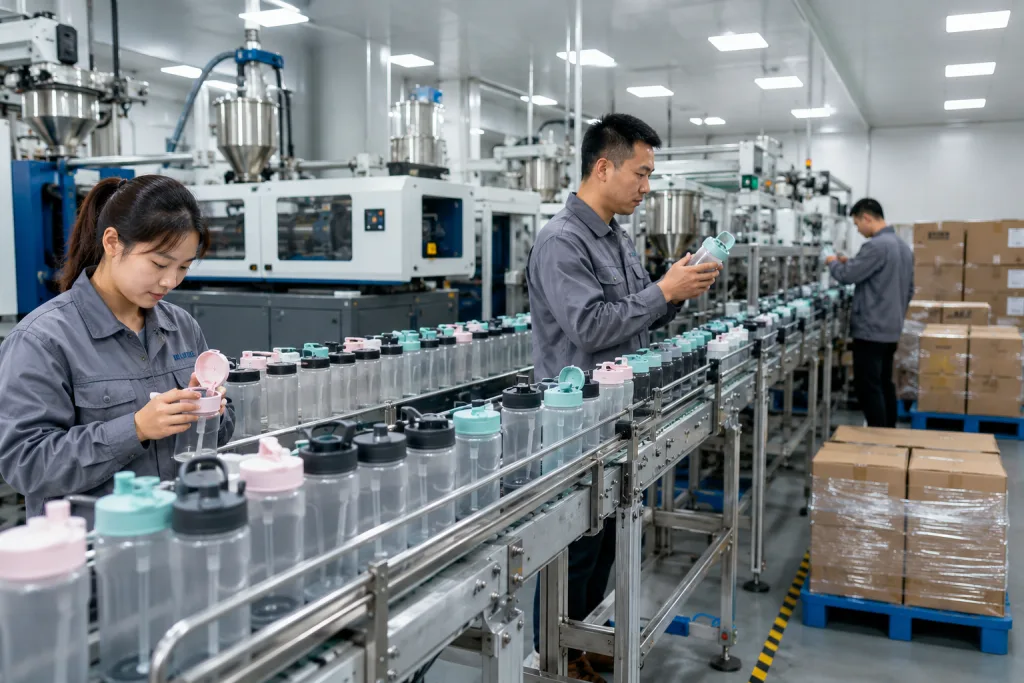
Key Takeaways
- For a 600 ml PP bottle, MOQ is usually 3,000-5,000 pcs per color, while a fully new mold starts closer to USD 3,500-8,000 and 25-35 days
- A workable FOB China target for a standard 600 ml polypropylene bottle customized project is often USD 0.78-1.45 depending on cap, print, and packing
- Ask for wall thickness and weight together: 1.8-2.5 mm and 68-95 g is common for promo-grade PP bottles
- Use AQL 2.5/4.0 final inspection and run leak, drop, odor, and print adhesion checks before balance payment
You send an RFQ for a polypropylene bottle customized project, and the offers look the same for one hour, then the gaps show up. One supplier quotes USD 0.92 FOB Ningbo, another says USD 1.28, and neither tells you the resin grade, wall thickness in mm, or print yield from the line. Then your buyer asks if the bottle meets EU food-contact requirements, if the cap still seals after 500 cycles, and if the logo survives dishwasher testing. This is where projects slip. We’ve seen it start with one missing note on a PO and end with QC pulled the sample because the lid torque was off.
Here is one real buyer case from Zhejiang, China: a 20,000-piece promotional sports bottle for a European distributor drinkware program. You need a practical spec, a realistic MOQ, a decoration plan, and QC checkpoints that a canteen supplier or canteen factory cannot talk around. This is the wrong question to ask if you only compare unit price. The better question is what you get at that price: material, leak standard, artwork method, and packing. If you are new to bottle buying, this section usually saves one round of remake, and on a 20,000-piece run, that matters.
The order starts with your brief
You’re the procurement manager for a European campaign order. On paper it looks easy: a polypropylene bottle customized with a one-color logo, 600 ml capacity, flip-top lid, BPA-free claim, and delivery in 45 days. Then the buyer starts mixing terms like custom canteen, canteen promotional, and customizable drinkware in the same email, sometimes with a typo on the PO. That is where projects drift. Your job is to turn loose sales language into a production brief a canteen manufacturer in Zhejiang can price without guessing.
Start with the hard numbers first. Write down usable capacity and brimful capacity. A bottle sold as 600 ml often checks at 620-640 ml brimful on the bench test. Add bottle height, max diameter, neck finish, target net weight, and whether it must fit a bike cage or a lunch bag pocket. For promo orders, weight tolerance of +/- 3 g is usually fine; we check that on the line with a digital scale before packing. Skip these points and two factories will quote two different molds, two resin weights, and two different prices, so the comparison is wrong from day one.
Next, define the actual use case. Cold-fill only? Top-rack dishwasher? Freezer safe? PP stands up to daily use, but it is not a vacuum bottle, and we’ve seen this go sideways when a buyer printed that claim on the insert card. If the bottle is for schools or kids, ask for compliance to relevant tests such as REACH for Europe and ASTM/CPSIA-related requirements where applicable in North America. If the project is for a canteen distributor or canteen vendors selling into outdoor retail, ask whether the cap hinge has cycle-life data and whether the carry loop is molded in one piece or assembled later. QC pulled a hinge sample last season that cracked before 2,000 flips; the buyer flagged it fast.
- Capacity: 600 ml usable, 630 ml brimful
- Body material: food-contact polypropylene, virgin resin
- Wall thickness: 2.0 mm nominal
- Decoration: 1-color silkscreen, 1 side, 45 x 80 mm
- Packing: individual polybag, 50 pcs/export carton
- Target lead time: 30 days after sample approval
At BottleForge Industrial, our normal MOQ for an existing PP sports bottle is 3,000 pcs per color, with output around 300,000 units per month across standard drinkware lines. Ask for those factory numbers early. This is the right question, not artwork first. We run sample scheduling off mold status and screen-print capacity, so if the supplier cannot confirm MOQ, monthly output, and whether they are quoting an existing tool or a new one, the math doesn’t work.
Choosing the bottle that will actually run
You’ve got three quotes from China. One supplier is offering an existing mold, one factory is tweaking the cap, and one is pushing a full custom tool. Start with order size. Rendering quality is the wrong question to ask.
For a 20,000-piece order, an existing bottle body with a custom lid color is usually where the math works. A full custom canteen shape looks good on screen, then tooling eats the margin. A new PP blow mold or injection/stretch blow setup for this category often lands between USD 3,500 and USD 8,000, depending on complexity and cavity count. Development time is typically 25-35 days before you even start mass production. On our side, the line also needs trial shots and cap fit checks before we release bulk.
What works better for most buyers is a proven body with changes on the visible parts. Body color by Pantone, cap color, logo print, carton branding. We ship plenty of programs this way because the risk is lower and the sample lead time is shorter, often 12 days vs 18 days for a new cap adjustment. If the customer insists on a custom growler or customized growler style, watch the wording. We’ve seen this go sideways. A growler format usually means larger capacity and often a different material expectation from the buyer. PP is fine for lightweight reusable bottles, but some markets won’t accept it for premium growler positioning, even if the PO typo says “same as sports bottle.”
What to lock before sampling
- Resin grade: virgin PP for food contact; ask for declaration and migration test support
- Weight: 68-95 g is common for a 600 ml promotional bottle
- Cap construction: screw cap, flip spout, straw lid, or push-pull
- Seal material: food-grade silicone or TPE gasket
- Surface finish: glossy, matte, frosted effect, or texture
A canteen supplier may quote lower by thinning the wall or changing the seal design. You won’t always catch that in a photo. Ask for a cross-section measurement or a cut sample if needed; QC pulled the sample on one 700 ml project and found a 0.18 mm wall drop from the approved piece. A 0.2 mm reduction in average wall thickness across 20,000 bottles materially changes resin cost and squeeze feel. If you sell to distributor canteen channels, consistency matters more than the last two cents.
Pricing the project without fooling yourself
Put numbers on the table early. For a standard 600 ml polypropylene bottle customized on an existing mold, the usual FOB China range is USD 0.78 to USD 1.45 per unit at 10,000-30,000 pcs. At the low end, you get a basic body, stock cap, one-color print, and simple polybag packing. At the high end, you are paying for custom color matching, a lid with more assembly steps on the line, wrap print, a retail box, and extra QC points. We run this type of bottle every month, and a 0.03 mm color shift on the print registration is enough for QC to pull the sample.
If a canteen suppliers quote looks cheap, check the holes in it. Is Pantone matching included, or will they add it later? Is there a screen charge of USD 30-60 per color? Will the carton pass Amazon FBA drop requirements if that is your channel? Are spare parts covered at 0.5% or 1% for replacement stock? This is the wrong question to ask: “Who is cheapest?” Ask what is missing. Last quarter, one buyer flagged a low quote and we found the vendor left out replacement lids and master carton marks from the PO.
For most B2B promo jobs, split the price into four buckets: unit cost, decoration, packing, and compliance/testing. If a quote blends them together, change requests get messy later.
A sample cost structure for 20,000 pcs might look like this:
- Unit bottle with cap: USD 0.86 FOB Ningbo
- 1-color silkscreen logo: USD 0.05
- Pantone body and cap color matching: included above MOQ, otherwise USD 80 setup
- Individual color label: USD 0.02
- Outer carton mark customization: USD 0.00-0.01
- Third-party final inspection: USD 280-350 per man-day in Zhejiang
If your customer is a canteen distributor in North America, get carton dimensions, gross weight, and pallet loading before PO release. Freight shifts the delivered cost more than buyers expect; on a 20,000 pcs shipment, a 2 kg jump in carton gross weight or 8 cm change in carton height can move pallet count and container loading. We have seen this go sideways. Also confirm the trade term. FOB Ningbo or FOB Shanghai is standard from Zhejiang and eastern China. If a supplier quotes EXW and you compare it against FOB, the math doesn't work.
Artwork, samples, and approval discipline
This is where decent projects lose 7 days. A buyer sends a 72 dpi logo, marketing swaps the tagline after layout signoff, then the canteen customizable request turns into a two-position print plus a QR code. We see it on the line all the time. PP bottles print well, but the decoration method has to match the bottle surface and how hard the end user will beat it up.
For promotional PP bottles, silkscreen is still the standard choice. It runs fast and the setup cost is manageable, but fine lines below 0.2 mm often break on curved walls, especially near the shoulder radius. QC pulled the sample on one school order last month for that exact reason. Heat transfer or IML gives you more color and cleaner gradients, though unit cost and setup time go up. If the request is customized drinkware for dishwasher-heavy institutional use, ask for an adhesion test, not a promise. On PP, flame treatment or primer is sometimes required before printing, and if the factory stays vague here, this is the wrong question to skip.
Use a simple three-step sample plan:
- Blank sample: confirm mold, fit, capacity, and hand feel in 3-5 days
- Pre-production sample: exact color and logo, usually 5-7 days after artwork approval
- Golden sample: signed reference kept by both you and the factory for QC
Ask the canteen manufacturer to measure color difference against your target if the body is molded in a custom Pantone. We usually check under a light box first, then compare side by side with the approved chip, because arguing over color on phone photos goes nowhere. Delta E standards vary by material and finish, but you need a visual standard under controlled light at minimum. For logo placement, put tolerances on the drawing, for example: centered within +/- 2 mm, print height +/- 1 mm, no pinholes visible at 50 cm. Put it in writing. We’ve seen this go sideways over a PO typo on logo size.
If your customer is a canteen vendor selling through retail and e-commerce, approve the barcode area and country-of-origin marking at the same time as artwork. One buyer flagged a barcode panel that sat too close to the bottle seam, and the scanner miss rate jumped during warehouse receiving. For shipments into Europe and North America, labeling mistakes cause avoidable delays and relabel fees. Factories in China that run customized canteen and customizable canteen orders every day usually ask these questions early. If they do not, the math doesn’t work in your favor.
Compliance and factory checks before deposit
Before you send the deposit, check two things as separate jobs: product compliance and factory capability. Buyers mix these up all the time. A bottle might pass one food-contact test once, then come out of a weak shop with poor process control. We have seen the reverse too: a polished factory profile, full audit deck, and the buyer flagged one basic gap—the exact PP bottle for their market had never been tested.
For Europe, ask for REACH and food-contact compliance support, plus migration testing where relevant on the complete article or on the food-contact components. For North America, ask for FDA-related food-contact declarations and any state-specific points tied to your sales channel. If the bottle is for children, add the proper chemical and mechanical checks. Do not stop at a generic BPA-free claim. BPA-free alone is not a compliance program. This is the wrong question to ask if the item will go into retail.
On the factory side, ask for current audit and system documents that change your risk on the line: BSCI or Sedex if your customer requires social compliance, ISO 9001 if quality system discipline matters, and a clear incoming, in-process, and final inspection flow. At BottleForge Industrial in Zhejiang, China, we normally issue a control plan before mass production starts, covering resin lot traceability, cap torque range, leak test frequency, and AQL final criteria. QC pulled the sample once on a 0.2 N·m torque drift, and that catch saved a full rework on 12,000 pcs.
Questions worth asking your canteen suppliers
- Do you use virgin PP only, or any regrind on food-contact parts?
- How is gasket hardness controlled, and what is the approved supplier list?
- What is the cap torque spec in N·m?
- What percentage of bottles get 100% leak testing versus sampling?
- Can you provide a migration test on the final assembled bottle, not just raw material declarations?
If a canteen manufacturers answer is vague, do not assume good intent. Put the answer in writing on the PI. We ship a lot of custom bottles, and most sourcing problems are not dramatic fraud. They are small assumptions left undocumented until cargo is ready. One PO typo on lid color code or one missing note on leak test standard is enough to send the whole order sideways.
Running production and catching defects early
Mass production starts after the deposit lands, the sample is signed off, and artwork is released. On a 20,000-piece order from Zhejiang, with existing tooling and one print color, lead time is 25-30 days. We run to that window if the PO is clean and the Pantone callout is not missing on page 2, which happens more than it should. Waiting until final inspection to find trouble is the wrong question to ask. You need two checks on the line: during production and final random inspection.
During production, inspect the first packed cartons once output hits 20-30%. QC pulled the sample from line 3 last month at 28% output and caught a cap-color mix-up before 6,000 bottles were sealed into master cartons. This stage catches color drift, print registration issues, cap mismatch, and packing mistakes before the lot is done. On PP bottles, we usually watch for short shots at thin features, flash around the cap line over 0.2 mm, sink marks, black specks, odor, weak hinge action, and bottles that do not stand flat on a steel table. If the order is canteen customized for a school or event, check the assortment ratio against the packing list carton by carton. Mixed-color shortages happen a lot, and the buyer flagged this on a 4-color school set where one blue SKU came up short by 96 pcs.
For final inspection, use a practical plan such as AQL 2.5 for major defects and 4.0 for minor defects. The math doesn't work if the factory and buyer are using different defect standards, so lock this before production. Major defects include leakage, incorrect logo, wrong color family, contamination, broken caps, and carton mislabeling that affects shipment. Minor defects include small print voids, light scuffs, or slight color variation within approved tolerance.
- Leak test: filled and inverted 30 minutes, then pressure or squeeze simulation if applicable
- Drop test: 3-5 drops from 80-100 cm depending on claim and pack style
- Odor check: no strong resin or ink smell after 24 hours closed
- Capacity check: verify on 5-10 samples per lot
- Print adhesion: cross-hatch or tape test after cure
If you buy as a distributor growler or distributor drinkware program, ask for spare stock for after-sales claims. A simple 0.5% overrun packed by color usually covers small shortages and saves an expensive air shipment. We ship this way for experienced canteen distributors and canteen supplier teams in China, often with one extra outer carton per color. It is standard practice, not a special favor.
Shipment release and what to improve next time
The cargo passes inspection. Good. Do not rush the balance payment until the document set is checked line by line. You should receive the commercial invoice, packing list, booking details, carton marks, test reports if agreed, and the approved inspection report. For Amazon or retail projects, add barcode files, FNSKU application instructions if relevant, and pallet requirements. We’ve seen shipments sit 6 days at the warehouse because the outer carton mark showed PO-1187 while the booking file showed P0-1187. Same goods, one wrong character. Most custom drinkware delays now happen at the warehouse handoff, not on the line.
Then check the numbers. Did the actual packed quantity match the PO? Was overproduction within your agreed tolerance, often +/- 5% for promotional molded products unless fixed by contract? Did the factory hit the lead time, such as 12 days vs 18 days, and did they update you before the slip? This is the wrong question to ask: “Were they late?” Ask why they were late, by how much, and whether they told you before QC pulled the sample. A canteen factory that slips 2 days but gives straight updates is easier to scale than a canteen vendors network that promises anything and confirms nothing.
For the next order, revise the spec sheet from what the shipment taught you. If the customer liked the bottle but the print scuffed after 20 dishwasher cycles, switch decoration method or reset the care instruction. If the cap leak rate was borderline, tighten torque control, for example 0.8-1.0 N·m on the capping check, or change gasket geometry after the line found a poor seal on one cavity. If the buyer starts asking for customizable growler or customized growler options, quote it as a new product family. Do not stretch a PP sports bottle past its job. We’ve seen this go sideways.
The practical win is simple: once you define the brief, sample correctly, control compliance, and inspect to AQL, a polypropylene bottle customized order becomes repeatable. That is what you want from a canteen manufacturer in Zhejiang or anywhere else in China: a process you trust on the next 20,000 pieces, not a polished sales pitch. We run repeat orders this way every month, and the math works.
Send your PP bottle spec for a real factory quote
Share capacity, target price, logo file, and deadline. We will review resin, decoration, MOQ, and QC points before you commit to production.
Frequently asked questions
What MOQ should I expect for a polypropylene bottle customized order?
For an existing bottle mold, most factories in China will quote 3,000 to 5,000 pcs per color for a PP sports bottle. If you need custom body color plus a custom cap color, the MOQ may stay the same, but mixed-color assortments can require 1,000 pcs per SKU within the total. For a full new mold, practical MOQ usually starts at 10,000 pcs because you need to amortize tooling that can cost USD 3,500 to 8,000. Decoration also matters. A one-color silkscreen logo is easy at lower MOQ; full-wrap transfer or retail gift box packing may push the break-even point higher.
How do I know if the quoted PP bottle is too light or too thin?
Ask for both net weight and nominal wall thickness on the drawing. For a 600 ml promotional PP bottle, 68 to 95 g is a normal range, with wall thickness around 1.8 to 2.5 mm depending on shape and grip details. If one quote is much cheaper, compare these numbers first. A bottle that is 10 g lighter across 20,000 pcs saves real resin cost, but it may feel soft, mark easily, or fail drop tests more often. Request a cut sample or caliper measurement at three points on the body. Weight tolerance of +/- 3 g is typical on this product category.
What tests should I require before shipment?
At minimum, require leak testing, capacity verification, odor check, print adhesion, and carton inspection. A practical final inspection standard is AQL 2.5 for major defects and 4.0 for minor defects. For leak testing, filled and inverted for 30 minutes is common, with additional squeeze or pressure simulation for sports caps. For print adhesion, use a tape or cross-hatch method after full curing. If your market is Europe, request REACH and food-contact support. For North America, confirm FDA-related food-contact declarations. If children are the target user, add the relevant mechanical and chemical requirements instead of relying on a BPA-free statement alone.
Is polypropylene the right material for a custom canteen project?
It depends on positioning. PP is a strong choice for lightweight, low-cost reusable bottles, school programs, events, and canteen promotional orders where FOB pricing around USD 0.78 to 1.45 matters. It is impact-resistant, practical, and easy to mold in color. It is not the right answer if your customer expects vacuum insulation, premium metal feel, or hot-retention performance. In those cases, stainless steel is usually the better fit. If you are supplying a canteen distributor or distributor drinkware account with value-driven volume, PP often makes sense. Just align care instructions and market claims with what the material actually does.
How long does the process take from RFQ to shipment?
For an existing mold project, plan about 3 to 5 days for blank samples, 5 to 7 days for a pre-production sample after artwork approval, and 25 to 30 days for mass production after deposit and sample sign-off. Final inspection and shipment booking add another 3 to 7 days depending on port schedule. So a realistic full cycle is around 35 to 45 days. A new mold adds 25 to 35 days for tooling and validation before production starts. Around major China holidays, especially before Lunar New Year, you should add buffer time because resin, packaging, and trucking capacity in Zhejiang can tighten quickly.