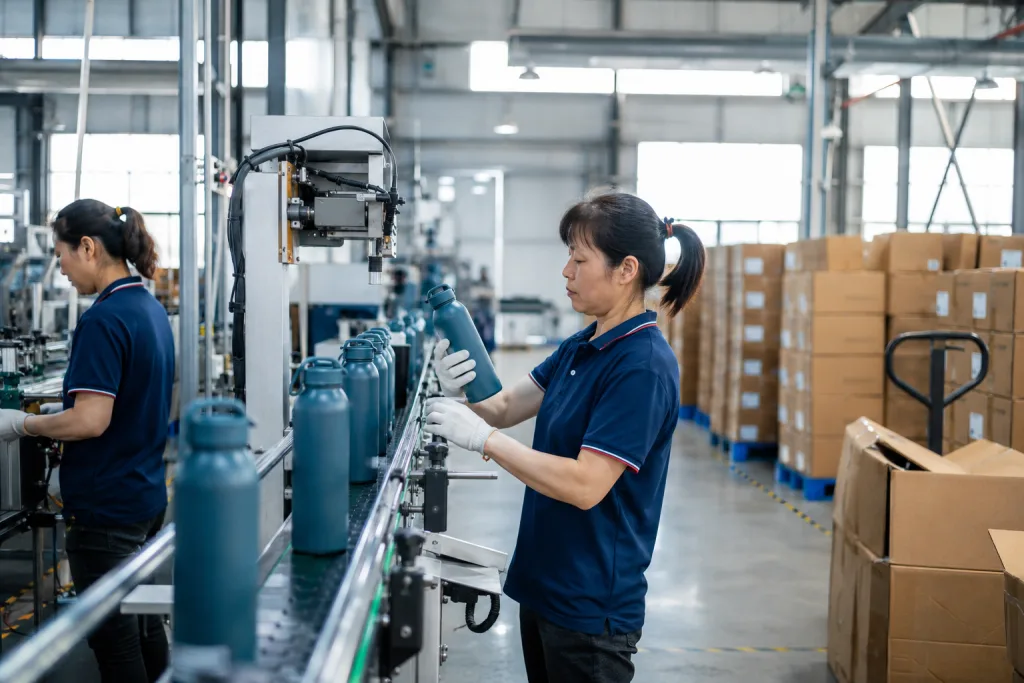
Key Takeaways
- For polypropylene bottle custom, include resin grade, bottle weight tolerance of ±3%, and leak test standard of 0/200 failures in your RFQ
- Typical MOQ from a Zhejiang canteen factory is 3,000-5,000 units per color, with sample lead time of 7-10 days and bulk lead time of 25-35 days
- Screen print on PP often needs adhesion testing after 24 hours; ask for cross-hatch or tape test and dishwasher limits in writing
- Use AQL 2.5/4.0, specify carton drop test from 76 cm, and put spare cap ratio of 0.5%-1.0% on the PO
You can buy a polypropylene bottle custom program cheap, fast, or with fewer claims after delivery. Pick two. For procurement teams in Europe and North America, the issue is not finding a canteen supplier in China. Zhejiang alone has 300+ canteen manufacturers on paper. The hard part is writing a clean RFQ, fixing the sample standard, and turning that into a PO the line can run without guesswork or a 0.3 mm drawing gap that starts an argument at sampling.
PP bottles look simple. They are not. Small omissions turn into expensive results: wrong resin grade, soft threads, cap leakage, logo rub-off, or carton dimensions that break pallet planning. We have seen QC pull a sample where the buyer flagged leakage at 50 kPa, and the root cause was a cap thread match nobody wrote into the PO. If you are buying custom drinkware, custom canteen, or a low-cost canteen promotional line, you need a sourcing process that moves from RFQ to sample to bulk with numbers on every line. This is the right question to ask.
Start with the RFQ details
Most polypropylene bottle custom projects fail before the first quote lands. We see the same RFQ every week: one reference photo, one target volume, and “please quote your best FOB price.” That is not enough. A serious canteen manufacturer or canteen supplier in China needs a technical RFQ, not a mood board. This is the wrong question to ask. If you want accurate pricing from canteen distributors, canteen vendors, or a direct canteen factory, spell out the parts that change cost and risk. On the line, a 0.3 mm wall change is not a small detail.
Your RFQ should list bottle capacity in ml and brimful capacity, bottle weight in grams, PP grade if required, wall thickness target, cap style, seal material, print method, packaging, testing standard, and destination market. For a 650 ml sports bottle, the difference between a 78 g body and a 92 g body changes resin cost fast. We run quotes both ways, and the gap is obvious. If the cap includes a TPR strap, a silicone ring, or a one-touch mechanism, quote comparisons are meaningless unless every canteen customizable option is frozen. Last month a buyer flagged a price gap, and the only difference was a flip-top spring they forgot to note on the PO.
Put these line items in the RFQ
- Product: 650 ml polypropylene bottle custom, food-contact grade PP body, PP cap, silicone sealing ring
- Color: Pantone match for body and cap, tolerance to approved sample
- Decoration: 1-color silkscreen, 1 side, print area 60 x 80 mm, adhesion requirement after 24 hours cure
- Packaging: polybag + egg-crate divider, 50 pcs/carton, export carton max 14 kg
- Compliance: REACH, LFGB or FDA as needed, BPA-free declaration
- Commercial terms: MOQ, tooling cost, sample fee, FOB Ningbo or Shanghai, production lead time
If you are a canteen distributor or distributor drinkware buyer serving retail chains, ask for carton dimensions and pallet load at RFQ stage. Do it early. That affects warehouse slotting, ocean freight, and Amazon prep later. We have seen this go sideways when the sample used a 53 x 53 x 41 cm carton and mass production shifted to 56 x 56 x 44 cm after the handle was revised. In Zhejiang, factories that produce 400,000 to 600,000 units per month can quote fast, but they still need exact inputs or they will pad the price to cover unknowns. QC pulled the sample once on a case like this, and the master carton missed the buyer’s pallet height limit by 18 mm.
Compare quotes without fooling yourself
Once the offers arrive, do not sort them by unit price alone. For polypropylene bottle custom, USD 1.18 FOB Ningbo can be a worse buy than USD 1.27 if the cheaper quote comes with a lighter body, thinner thread, a 15 mm smaller print area, or no spare gasket. We see this every month. A buyer compares one canteen custom offer from three canteen suppliers, assumes the specs match, then QC pulled the sample and found a 6 g weight gap between bottles that were supposed to be the same item.
Build a comparison sheet and lock the fields. Put each supplier on one line: unit price, MOQ, sample charge, mold cost, bottle weight, cap construction, seal material, print method, packing count, carton size, gross weight, lead time, and test documents. If one canteen vendor says 30 days and another says 18 days, ask what sits behind that number. Is the color masterbatch on the shelf or made to order? Do they run silk print on the line or send it out? Does your ship window land before or after Golden Week or Chinese New Year? In China, 12 days vs 18 days is normal if one factory already has resin and the other is waiting on material release.
Cheap quotations usually hide cost in three spots: underweight bodies, weak decoration, and vague packaging.
If you are sourcing custom growler, customizable growler, or customized growler lines next to PP bottles, split the comparison by material first. This is the wrong question to ask if you want one price logic for all of them. PP does not price like stainless steel or glass. Mold life is different. Drop-test risk is different. Carton loading is different. We ship PP in tighter pack density because the bottle wall rebounds; that math does not work the same way for glass. If you are a distributor canteen buyer building an entry-level custom drinkware range, use PP where low cost, light weight, and color flexibility matter more than thermal retention.
PO line items to define at quote approval:
- Approved ex-works or FOB port: Ningbo or Shanghai
- Currency: USD
- MOQ per SKU and per color
- Tooling ownership and storage terms
- Sample charge refund conditions after bulk order
- Price validity, usually 15-30 days if PP resin is volatile
This is where experienced canteen manufacturers show their value. They ask the annoying questions, and yes, that helps. We have seen POs with the color code typed wrong by one digit and outer carton marks copied from an old order. The buyer flagged it late, the line stopped, and the shipment slipped four days. A supplier that says yes to everything in two emails is usually guessing.
Lock the sample before the PO
Samples turn a rough sourcing idea into something the line can actually run. For polypropylene bottle custom, don’t sign off because it looks close enough on a desk. This is the wrong question to ask. Check it like a production master: dimensions, weight, fit, leakage, print position, odor, and surface finish. We usually put the caliper on 3 key points in mm and weigh the bottle on a 0.1 g bench scale. If the bottle is sold as a custom canteen for school, gym, or events, open and close the cap at least 50 cycles. If it has a carry loop or strap, hang 1.5 times filled weight for 1 hour and watch the joint, not just the strap itself.
Ask for two sample stages. First, a structure sample to lock mold, body shape, neck thread, and cap fit. Second, a pre-production sample with final color and decoration. We’ve seen this go sideways: the buyer approved a white blank, then the dark PP body came off the line and the logo ink lost opacity by one full pass, or the Pantone drifted under shop lighting. QC pulled the sample and the print position was 2 mm low. That is enough to trigger a claim on event orders.
Sample checklist
- Capacity: nominal and brimful volume
- Net weight: within agreed tolerance, usually ±3%
- Leak test: invert filled bottle for 2 hours, 0 leakage
- Drop test: filled bottle from 80 cm, no cracking if that is the claim standard
- Odor: no strong resin or print smell after 24 hours
- Print adhesion: tape test after full cure
- Thread engagement: smooth closing, no cross-threading
PO line items to add after sample approval:
- Approved sample date and sample code
- Color standard: Pantone number or physical swatch
- Artwork code, print location, print size, and orientation
- Leak test requirement: 0/200 defects at final inspection
- Reference photos attached to PO and signed by both parties
If you work with multiple canteen distributors or canteen manufacturers, keep a sample archive in your office. One approved sample, one sealed label, one PO copy. We ship repeats 6 months later all the time, and sometimes the buyer flagged a detail that never made it into the email trail, like a matte band near the shoulder or a cap logo rotated 15 degrees. Zhejiang factories move fast. Repeatability comes from a clear sample standard, not memory.
Write a purchase order people can build
A purchase order is not just a commercial document. On our side, it becomes the shop-floor instruction set that follows the order through resin purchase, molding, printing, packing, and QC. If your PO only says “650 ml customized drinkware, black cap, logo front,” the line has to guess. That is where cap shade variation starts, or the wrong silicone seal gets loaded, or the carton comes out at 14.2 kg when your warehouse cap was 13.5 kg.
PO discipline matters more if you buy from a canteen factory through a trader, or if you are a canteen distributor combining 4 to 8 SKUs in one shipment. Every assumption should sit as its own line item. We have seen this go sideways over one short note on a PO: “same as last order,” with no old revision attached.
What the PO should include
- SKU code: your internal item code and supplier item code
- Description: 650 ml customizable canteen, PP body, PP lid, silicone seal, carry loop
- Order quantity: for example 5,000 pcs navy, 5,000 pcs white
- Unit price: USD 1.24 FOB Ningbo
- Bottle weight: 85 g ±3 g; cap 24 g ±2 g
- Packing: 1 pc/polybag, 50 pcs/carton, carton size 64 x 38 x 42 cm, max GW 13.5 kg
- Marking: item label, barcode, made in China statement, carton shipping mark
- Inspection: AQL 2.5 major / 4.0 minor
- Spare parts: 0.5% extra caps and seals free of charge
- Delivery: ETD window, booking cut-off, late shipment penalty if agreed
For Amazon or retail-ready orders, add the FNSKU label position in mm from the base, the suffocation warning text if polybagged, and a carton barcode test requirement so the scanner reads on first pass. QC pulled a sample once where the FNSKU sat across the bottle curve and the buyer flagged it. For a canteen promotional campaign, confirm whether each bottle needs an individual color box or if bulk-packed event distribution is acceptable. This is the wrong question to leave until after sampling. Those two packing methods can change cost by USD 0.12 to USD 0.35 per unit.
If you also source custom growler or customized canteen lines from the same canteen manufacturer, do not combine unlike packaging assumptions. PP bottles pack tighter than steel vacuum items, so mixed container planning needs actual carton cube from the packing spec, not a sales estimate from memory. We run cube checks before booking because the math doesn’t work if one 5-ply carton spec gets copied onto both items.
Control production, testing, and compliance
After the PO is placed, your work is not done. We usually set 3 checkpoints on the line: pre-production, in-line, and final inspection. A solid canteen supplier should send a pre-production sheet that confirms resin grade, color masterbatch code, seal material, artwork file, and packing layout. If they stay silent, push for it. QC pulled one sample last month where the carton icon was missing and one 4-cavity mold was only releasing 3 bottles per cycle; both problems were cheap to fix before mass run.
For polypropylene bottle custom sold into Europe and North America, ask for the compliance documents that match the market you ship to. Typical requests are REACH SVHC declarations, LFGB or FDA food-contact testing, CPSIA points for kids' programs, and California Proposition 65 screening based on use and claims. If the bottle is sold as a kids bottle, ASTM-related use-and-abuse expectations matter more, even where the channel does not state them as a hard legal requirement. Be specific. "Send all tests" is the wrong question to ask. We have seen buyers spend $1,200 on reports they did not need, then miss the one migration item their retailer actually checked.
Factory controls worth confirming
- Incoming material lot traceability for PP resin and color masterbatch
- Seal ring hardness consistency, usually silicone Shore A range per supplier standard
- In-line leak test frequency, such as 1 piece every 100 or 200 units
- Print curing and adhesion verification
- Carton drop test from 76 cm on corner, edge, and face
At BottleForge Industrial in Hangzhou, Zhejiang, we prefer final inspection after at least 80% of goods are packed, not earlier. Before that point, the sample tells you too little because barcode labels, inner bags, and outer carton marks are still moving. For many PP bottle orders, lead time is 25-35 days after deposit and artwork approval, with MOQ starting at 3,000 pieces per color depending on the mold. We run that timing for a reason. A canteen vendor promising 15 days for a new printed order in peak season is usually squeezing something out of the process: ink curing, QC hold time, or packing. The math does not work.
If you use a third-party inspector, write the pass standard into the PO: AQL 2.5 major / 4.0 minor, no functional failures in leakage, no mixed colors in one carton, no missing barcode labels. Keep it blunt. One buyer flagged a shipment over a PO typo on the barcode suffix because the pass standard was never written down. Clear wording keeps arguments short.
Plan shipment and repeat orders early
The last expensive mistake in custom drinkware sourcing is leaving shipment to the end. With polypropylene bottle custom, freight cost often comes down to carton cube, not kg. We run load plans before deposit for this reason. If a 40HQ loads 95,000 bottles in bulk pack but only 62,000 in retail box, your landed cost moves more than the unit price. We have seen buyers push for USD 0.02 off, then lose far more because the retail box was 6 mm wider. Ask your canteen supplier for loading quantity per 20GP, 40GP, and 40HQ before you place the order.
For North America, 7 out of 10 distributor growler or distributor drinkware buyers also ask for Amazon readiness. That usually means outer carton labels, FNSKU, pallet height limits, and appointment-ready paperwork. QC pulled the sample carton more than once because the label sat across the tape seam and the buyer flagged it. For Europe, mixed-SKU pallets and EAN labeling usually matter more. A good canteen manufacturer in China should be able to run either system if you send the checklist early.
Before the balance payment, confirm these points
- Final inspection report with photos and quantities
- Packing list, invoice, and carton count match
- Barcode readability checked on unit and carton if required
- Booking details, cut-off date, and loading plan confirmed
- Spare parts and over/under shipment tolerance agreed, usually within ±5% only if stated
Then think one order ahead. Repeat orders should get simpler. Ask the factory to archive the approved color chips, print screens, and golden sample. On our side, we bag the golden sample, mark the date, and store it with the screen mesh note and cap torque record. Put the repeat-order tolerance on file: acceptable color variance, print position tolerance of for example ±2 mm, and whether substitute resin lots require your approval. This is where one-off promo jobs either settle into a program or go sideways.
China rewards buyers who document well. Zhejiang rewards buyers who reorder clearly. This is the wrong question to ask: how do I squeeze the last USD 0.03? The math does not work if the PO is loose and the line has to guess. We have seen a repeat order delayed 12 days because the PO said “grey lid” and the approved sample was actually Pantone Cool Gray 7 C. If you want a reliable canteen customizable supply chain, the best move is a precise RFQ, a hard sample standard, and a PO with little room for interpretation.
Send your PP bottle RFQ with real specs
We will review your polypropylene bottle custom brief, flag weak points, and quote MOQ, lead time, packing, and compliance options from Zhejiang production.
Frequently asked questions
What MOQ should I expect for a polypropylene bottle custom order?
For a standard existing mold, most China factories quote 3,000 to 5,000 pieces per color per SKU. If you need a special Pantone body, matching cap, and custom print, 5,000 pieces is more realistic because color setup and print waste need to be absorbed. A new mold can push the opening quantity higher, but for common 500-750 ml sports bottles, many Zhejiang suppliers can start around 3,000 pieces if packaging is simple. Ask whether the MOQ is per color, per lid style, or per total order. Some canteen manufacturers quote 3,000 total, then later require 1,000 per colorway. Put that on the PO before deposit.
Is polypropylene a good material for promotional and retail bottles?
Yes, if your target is lightweight, low-cost, non-vacuum drinkware. PP is widely used for event bottles, school bottles, gym bottles, and entry-level retail lines because it is durable, easy to mold in many colors, and usually costs less than Tritan or stainless steel. For a 600-700 ml bottle, FOB pricing in China can sit around USD 0.85 to USD 1.60 depending on weight, cap complexity, and decoration. The trade-off is that PP can scratch more easily than metal and does not give a premium thermal feel. If you need hot-and-cold retention, move to stainless vacuum. If you need cost-efficient canteen promotional volume, PP is a practical choice.
What tests should I require before bulk shipment?
At minimum, require leakage, print adhesion, basic drop resistance if claimed, and food-contact documentation for your market. A practical final standard is 0 leakage in a 2-hour inverted test, AQL 2.5 major / 4.0 minor, and print tape-test pass after full cure. For the carton, ask for a drop test from 76 cm on one corner, three edges, and six faces if the shipment faces parcel handling. If the bottle is for children, request extra use-and-abuse review and make sure the cap parts are appropriate for the age grade. Also ask for REACH or FDA/LFGB support from the canteen supplier, not just a generic BPA-free statement.
How long do samples and production usually take?
For an existing mold, a blank structure sample normally takes 3-7 days. A color and logo pre-production sample usually needs 7-10 days, especially if the factory must confirm Pantone and print adhesion on PP. Bulk production is commonly 25-35 days after deposit, approved artwork, and sample sign-off. If the order includes a new mold, add roughly 20-30 days for tooling and first trial, depending on complexity. Peak season in China can add another 7-10 days, especially before Chinese New Year or October holidays. If a canteen vendor promises a much shorter timeline, ask exactly what steps are being skipped or overlapped.
What is the safest way to manage color, logo, and packaging consistency on repeat orders?
Use a signed golden sample and convert everything into measurable tolerances. Keep the approved Pantone reference, bottle and cap weight, print size, print position tolerance such as ±2 mm, and exact packaging count on file. On repeat POs, reference the original sample code and attach photos of the unit pack and carton markings. Ask the factory to keep the print screen file, color chips, and carton artwork version number. For larger programs, request one sealed retention sample from each production lot. That is standard discipline for serious distributor drinkware and canteen distributor programs and it reduces arguments when a repeat order ships 6 or 12 months later.