Key Takeaways
- Typical MOQ for a polypropylene bottle custom pantone order is 3,000-5,000 pcs per SKU, while stock-color trial runs can start around 1,000 pcs
- Unit FOB China pricing usually lands at USD 0.68-1.85 depending on volume, bottle size, wall thickness, cap complexity, and print method
- Pantone master sample approval takes 3-7 days, production usually takes 20-35 days after deposit and artwork sign-off
- New mold development for a custom canteen body or cap commonly costs USD 2,500-9,000 with a 20-35 day tooling timeline
You already know a PP bottle is not a premium metal flask. That is why buyers reorder it. Polypropylene is light, tough, food-contact friendly, and priced for volume when we run retail programs, school packs, gym orders, event giveaways, and canteen promotions. The line suits jobs where 3,000 or 30,000 pieces need to land on budget. The friction starts later: exact Pantone matching, decoration limits, MOQ breaks, mold cost, and whether a 25-day lead time is real. We have seen this go sideways after a buyer flagged a cap shade shift of 1.5 Delta E on the first sample.
If you are sourcing from Zhejiang or elsewhere in China, the numbers matter more than the mood board. A polypropylene bottle custom pantone project moves fast only when you lock the material grade, cap style, color tolerance, artwork method, and carton spec early. At BottleForge Industrial in Hangzhou, Zhejiang, our output reaches 400,000 units per month across drinkware programs, and most PP bottle MOQs start at 3,000 to 5,000 units per colorway for efficient production. We ship smoother when the PO already shows bottle body Pantone, lid Pantone, print size in mm, and carton drop test standard. This is the wrong question to ask: "Can you match any blue?" Ask for the accepted tolerance first, because QC pulled the sample more than once over that point.
Where PP bottle pricing really moves
B2B buyers make this mistake all the time: they price PP bottles like one item. They are not the same build. A 500 ml straight-wall sports bottle with a one-color lid runs on a different cost sheet from a 750 ml canteen with carry loop, flip spout, inner straw, textured grip, and two-pass Pantone printing, and the line time shows it fast.
FOB China price for standard polypropylene bottles usually sits in these practical ranges:
- 300-500 ml simple bottle: USD 0.68-0.95 at 10,000 pcs
- 600-750 ml sports bottle: USD 0.88-1.35 at 10,000 pcs
- PP canteen customizable style with complex cap: USD 1.20-1.85 at 10,000 pcs
These numbers usually assume food-grade virgin PP, standard export cartons, and common decoration. Nothing mysterious here. The main cost moves are resin weight, cap assembly time, Pantone matching, print rejects, and packing labor. On our side, QC pulled the sample more than once just because the second print pass drifted 0.8 mm.
Wall thickness moves price more than buyers expect. On mass-market bottles, we usually run 1.8-2.2 mm. If your drop-test target is tighter or the bottle has deep curves, the mold engineer will push 2.3-2.8 mm after checking the caliper reading and sidewall stress points. That can add 8% to 18% to resin use. Cap design also changes yield on the line. A screw cap with a basic silicone ring is cheap. A push-button lid with lock and straw brings more parts, more QC checks, and more defects. We have seen this go sideways on a 12,000 pcs order where the buyer flagged weak spring return after assembly.
For a canteen manufacturer in China, production gets smoother when parts stay common across several SKUs. One bottle body with three cap colors and one print position is workable, and we ship that kind of program every month. If each SKU needs its own Pantone body, its own lid, its own insert card, and its own carton mark, labor climbs fast and changeover time stretches to 12 days vs 18 days across mixed runs. This is the wrong question to ask: "Can the factory do it?" Yes, usually. The better question is what it does to cost, lead time, and packing errors. We have even seen a PO typo on a carton mark force 6 outer carton versions to be reworked by hand before loading.
Pantone matching is not free
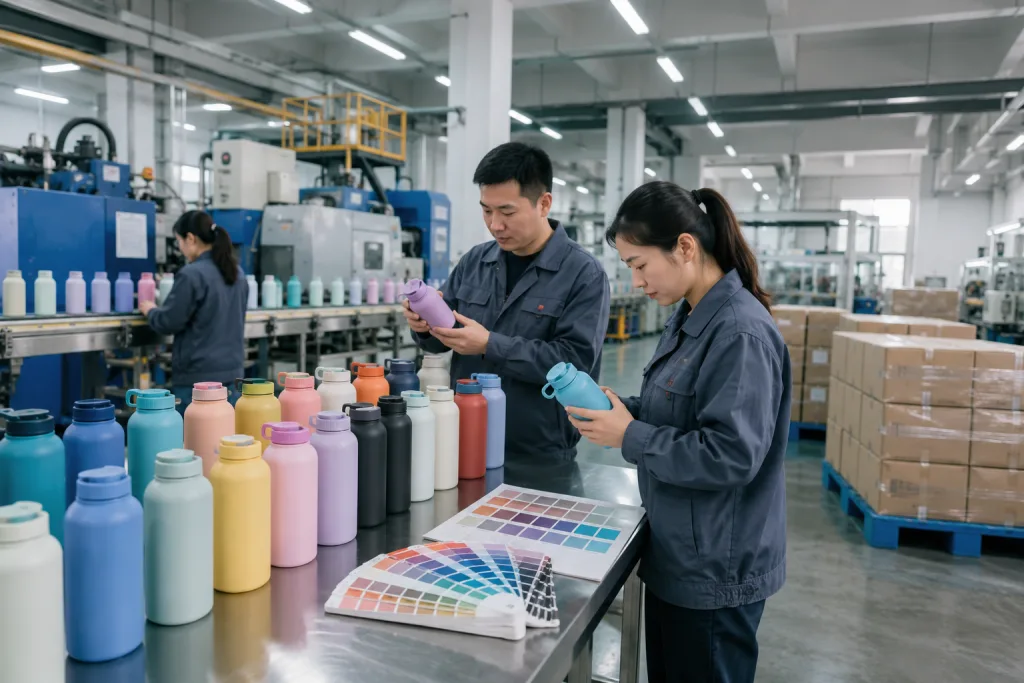
Buyers ask this on almost every PP project: why does a polypropylene bottle custom Pantone order cost more than a factory stock color? Short answer, PP color matching is a controlled production job, not a simple paint spray. We run the color through masterbatch into the raw material, and the final shade shifts with resin grade, bottle wall thickness, mold texture, and barrel temperature on the injection machine.
In Zhejiang and across China, most factories quote three color routes like this:
- Stock color: no extra charge or a low setup cost, usually pulled from 8-15 standard factory shades already running on the line
- Near-Pantone match: small masterbatch setup charge, often USD 80-150 per color, with one lab drawdown and a first molded sample for approval
- Strict Pantone approval: sample development plus controlled production checks, often USD 120-300 per colorway, with QC pulling the sample against the approved target before mass run
If you need the body and lid to match the same Pantone, tell the supplier if a visual match is enough or if you expect an instrument tolerance. This is the wrong question to skip. PP surfaces and PP/TPR mixed parts bounce light back in different ways, so the lid and body can read different even on the same target color. We have seen buyers flag a lid after assembly, then the delta came from texture, not pigment. Smart buyers approve under D65 light conditions and set a realistic tolerance from the start.
What usually affects Pantone accuracy
- Gloss versus matte mold finish, especially when cavity polish differs between SPI-B2 and a light texture
- Natural versus tinted base resin, because off-white resin shifts light colors fast
- Thick and thin wall transitions on the bottle body, such as 2.2 mm to 3.0 mm sections around grip areas
- Use of recycled content, if any; we have seen this go sideways above 15% on light tones
- Secondary overprint colors on top of the base bottle, where registration and ink opacity change what the eye sees
When you ask for exact Pantone on PP, ask what tolerance the factory will hold in mass production. “Can you match it?” is too loose.
For customized drinkware programs, we usually recommend a pre-production color chip plus 2-3 molded samples before final sign-off. That adds 3-5 days, but the math works better than remaking 5,000 bottles after QC finds color drift at final inspection. Put the approved Pantone reference into the contract, and spell out what happens if bulk goods fall outside the agreed tolerance. We ship cleaner projects that way. Serious canteen vendors and canteen factory teams are used to this level of detail.
MOQ tiers that change the math
MOQ is where first-time buyers misread the factory. We hear “Can you do 500 pcs?” every week, and this is the wrong question to ask. On PP bottles, we still run raw material prep, load the Pantone masterbatch, mount the mold, set the print station, and stage packing. A 25 kg bag of resin does not get cheaper because the PO is small.
Typical MOQ logic for a canteen customized or custom drinkware program looks like this:
- 1,000 pcs: possible on a stock mold, usually stock colors only, simple 1-color print, and the unit cost stays high because the line setup is spread over too few pieces
- 3,000 pcs: workable for custom Pantone on a stock mold, one decoration method, and this is usually the first level where the math starts to make sense
- 5,000 pcs: efficient level for body color + cap color + standard logo print, with better machine time use and cleaner carton planning on the packing table
- 10,000 pcs and above: strongest pricing position, better carton optimization, and easier variant splits because we can run colors in batches without stopping the line every hour
Here is what buyers usually see in practice on a 650 ml PP sports bottle with screw cap:
- 1,000 pcs: around USD 1.28-1.55
- 3,000 pcs: around USD 0.98-1.18
- 5,000 pcs: around USD 0.86-1.05
- 10,000 pcs: around USD 0.79-0.95
That is why experienced canteen distributors and distributor drinkware buyers consolidate colors or artwork. The buyer flagged it once on a PO that split 1,000 pcs across five Pantone variants, but we have seen this go sideways. In most cases, 5,000 pcs across two stronger colors beats five weak SKUs, and the unit savings cover the tighter assortment.
If you are a canteen distributor, canteen vendor, or distributor canteen buyer serving chain retail, ask the factory to quote MOQ by SKU and MOQ by order. Put it in writing. Some canteen manufacturers will allow mixed cap colors if the bottle body stays the same; others want full MOQ for each component color because cap resin, color change, and hopper cleaning still take time. We ship orders where QC pulled the sample and found the body color was right but the cap shade drifted one step from the approved chip.
For fully custom molds, MOQ usually starts higher. A new custom canteen body often begins at 5,000-10,000 pcs, and a new cap can need the same if there are 2 injection tools involved. Tool count matters. If the cap uses separate mold sets for the lid shell and inner fitment, the math does not work at 1,000 pcs.
Decoration cost by method and yield
Decoration is usually the second-biggest cost after the molded parts. For polypropylene bottle custom pantone orders, buyers often add a 1-color logo, 500ml measurement marks, or a full-wrap retail graphic. The right method comes down to order volume, artwork detail, and how hard the bottle gets used on the line or in the market.
Common decoration methods on PP bottles include:
- Silkscreen: USD 0.03-0.10 per color per position; best for simple logos
- Heat transfer: USD 0.08-0.22 per piece; useful for multi-color graphics
- IML or in-mold label: higher tooling and setup, good for high-volume full-wrap decoration
- Pad print: lower area coverage, suitable for smaller marks on caps
Silkscreen looks cheap on the quote sheet. That is where some buyers stop, and this is the wrong question to ask. On curved PP bottles with heavy taper, we have seen registration drift by 1.5-2.0mm at the shoulder, and the buyer flagged it right away on a centered logo. Heat transfer gives cleaner multi-color graphics, but if the bottle is going into school programs or outdoor channels, ask for adhesion and rub test standards up front. QC pulled the sample more than once for scratch marks after 50 rubs.
Useful QC checkpoints
- Color swatch approval before mass print
- Cross-hatch adhesion test on decorated samples
- Dishwasher warning if decoration is not high-heat safe
- AQL plan, commonly AQL 2.5 major / 4.0 minor
For canteen promotional projects, packaging changes the decoration math fast. Bulk pack in PE bags plus export cartons keeps the unit cost down and we ship faster because the line does not stop for folding inserts. If each bottle needs an individual color box, barcode sticker, and leaflet, add roughly USD 0.18-0.55 per unit depending on box size and print coverage. A 24-bottle master carton with FNSKU labels is straightforward, but we have seen this go sideways when the PO had the barcode suffix typed wrong.
Do not skip compliance language. If you sell into Europe or North America, your custom drinkware should be aligned with applicable REACH, LFGB or FDA food-contact expectations, and for kids-oriented formats, ASTM-related requirements may apply depending on the item and market claims. We run migration paperwork before shipment on sensitive programs, because the math does not work if 5,000 pieces are ready and the label claim is still unclear.
A realistic production calendar
Lead time gets stretched or squeezed for the wrong reasons in 7 out of 10 quotes we see. The clean way to plan is to break the job into approval gates. We run it this way on the line, and a PP bottle order from China becomes much easier to call.
For a stock mold polypropylene bottle custom pantone order, the typical timeline looks like this:
- Day 1-3: final quotation, artwork, Pantone references, and packing spec confirmed
- Day 4-7: prepayment received, color chip or digital mockup arranged
- Day 7-12: molded color samples and printed sample approval
- Day 13-32: mass production and inline QC
- Day 33-37: final inspection, carton sealing, and booking ready
That gives you a practical range of 20-35 production days after sample approval. In peak months, especially August to November, add 5-10 days because injection machines, silk screen slots, and carton supply all get tight at once. We have seen buyers push for the low end, then the cap liner arrives 4 days late and the math does not work. Zhejiang factories with stable injection capacity can hold the shorter side only when components and packaging land together.
For a totally new mold, timing changes:
- Tooling design and DFM: 3-5 days
- Mold making: 15-25 days for simple body tools, 20-35 days for complex cap systems
- T1/T2 sampling and adjustments: 7-12 days
- Mass production: another 20-35 days
So a new customizable canteen or customizable growler concept can easily take 45-75 days before cargo is ready. That is normal. We have seen this go sideways when a canteen supplier promises 18 days for new tooling and full production, then T1 comes out with a 0.3 mm thread mismatch and QC pulled the sample.
If your launch date is fixed, ask the canteen factory for a backward schedule including sample deadlines, deposit date, inspection date, and ETD. This is the right question to ask. A serious canteen manufacturer or canteen vendor in China should send that in one table, sometimes the same day, with the booking cutoff and even a note if the buyer flagged a PO typo on the carton mark.
Tooling, compliance, and hidden extras
The unit price on the quote is rarely the full landed cost. We see this every month. A solid buyer guide pulls in the charges that show up later, after sample approval, if nobody listed them on page one of the PI.
Tooling cost: A simple PP bottle body mold may cost USD 2,500-4,500. A cap mold with threads, inserts, and moving parts can be USD 3,000-6,000. If your custom growler or customized canteen includes a handle, lock, or multi-part spout, tooling can move beyond USD 9,000 total. Ask who owns the mold, where it sits, and whether maintenance is billed separately. We run into this on the floor: the buyer approves a 0.3 mm thread change, then finds out the mold shop logged it as paid rework. This is the wrong question to ask late.
Testing and compliance: If you require third-party testing for FDA, LFGB, REACH, or phthalates, budget roughly USD 250-800 per test package depending on the lab and scope. BSCI or ISO audit status does not replace product compliance. European buyers usually ask for both the factory audit file and the material declaration set. QC pulled the sample last quarter because the masterbatch shade matched Pantone under D65 light, then shifted under the lab cabinet, and the buyer flagged it before submission.
Inspection: A pre-shipment inspection by your own agency typically costs USD 250-400 per man-day in China. On a first order, spend it. Define AQL in the PO. For drinkware, AQL 2.5/4.0 is common, but premium retail buyers sometimes tighten visual standards to catch gate marks, logo blur, or a 1.5 mm scratch near the shoulder. We have seen this go sideways when the PO says "good quality" and nothing else.
Freight and carton efficiency: A bulky 750 ml bottle can ruin freight economics if carton count per CBM is poor. Ask for packed dimensions early. A small change in cap height or insert tray can improve container loading by 8% to 12%. Sometimes the math does not work: a nicer insert looks better in the sample box, but the ship cost jumps once the carton drops from 24 pcs to 20 pcs per master carton.
Payment terms: The default for many canteen suppliers in Zhejiang is 30% deposit and 70% balance before shipment. For repeat orders with established canteen distributors, terms can become more flexible, but do not assume that from the first PO. We ship plenty on this structure. A first-time buyer once sent a PO marked "70% after sailing" instead of "70% before shipment," and that typo stalled approval for 3 days.
Whether you buy a custom canteen, customized growler, or customizable drinkware line extension, pull every extra charge into the quotation before you approve samples. Do it early. Once the line starts, mold fixes, retests, and carton changes stop being small numbers.
How buyers keep projects on time
Most delays come from slow approvals, not the machine side. For a polypropylene bottle custom pantone order, send the canteen manufacturer the full pack on day 1. We see this every month. Pantone references, vector artwork, unit pack layout, carton marks, destination testing needs, and ship target should be locked before the line books resin; last week a buyer changed one carton mark after sampling because the PO showed "12pcs/ctn" instead of "24pcs/ctn."
A practical RFQ pack should include:
- Capacity, dimensions, and target weight tolerance
- PP grade requirement and whether recycled content is allowed
- Pantone code for body, cap, strap, and print
- Decoration size and method preference
- Packaging spec: bulk, white box, or color box
- Compliance market: EU, US, Canada, or mixed
- MOQ by SKU and total forecast for 90 days
If you are working with multiple canteen distributors or canteen vendors across North America and Europe, build one master specification, then change regional artwork only where law or language requires it. That keeps molds, color approvals, and QC standards aligned, and QC pulled the sample against one 0.3 mm logo position standard instead of three different files. Same account, same base spec. The same rule applies if you are adding a distributor growler or customized growler item under the account. This is the right question to ask early, because we've seen split specs go sideways.
From the factory side, ask for two things: an approval calendar and a risk list. The calendar shows whether artwork signoff is on day 3 or day 8, and that gap can mean 12 days vs 18 days on shipment. The risk list should call out if your Pantone needs extra color matching at the injection sample stage, if the cap assembly yield is running 96.8% on the line, or if your retail carton slows packing because the auto-taper jams on a tight inner fit. Good canteen suppliers and canteen factory teams in China speak plainly here. We run these checks before mass production because the math doesn't work if the buyer finds the issue after deposit.
If you are new to custom drinkware, do not chase the lowest piece price alone. Go after stable color, acceptable AQL, workable MOQ, and a lead time your team can hold. Last month the buyer flagged a cheaper quote that saved $0.03 per unit, but the strap pull test failed at 14 kg and the whole sample round slipped. That is how one-off canteen promotional orders die instead of turning into repeat programs.
Get a PP bottle quote with real numbers
Send your capacity, Pantone codes, MOQ target, and packaging spec. We will reply with FOB pricing, sample timing, and production lead time from Hangzhou, Zhejiang.
Frequently asked questions
What is the usual MOQ for a polypropylene bottle custom pantone order?
For a stock mold PP bottle, the practical MOQ is usually 3,000 to 5,000 pieces per SKU when you want custom Pantone color and standard logo decoration. Some China factories can do 1,000 pieces, but often only with stock components, limited print options, and a higher unit price. If you want separate Pantone body and cap colors, MOQ may apply to each component color, not just the final bottle SKU. For a fully new custom canteen or customized drinkware mold, expect 5,000 to 10,000 pieces minimum. Always ask for MOQ by SKU, by colorway, and by total PO, because canteen suppliers do not all calculate it the same way.
How accurate can Pantone matching be on polypropylene bottles?
It can be very good, but not unlimited. PP color is made through masterbatch blended into the resin, so final appearance depends on wall thickness, mold texture, gloss level, and processing temperature. A realistic commercial standard is visual approval against an agreed Pantone reference under controlled light, with small variation batch to batch. If body and lid use different materials or textures, a perfect match is harder even with the same Pantone target. Sample approval usually takes 3 to 7 days. If your brand team needs strict color control, ask for molded color samples, not just pellets or printed swatches, and define the approved tolerance before mass production starts.
What lead time should I expect from a Zhejiang, China factory?
For a stock mold order, expect roughly 20 to 35 days after deposit, artwork approval, and Pantone sample sign-off. If your order includes printed color boxes, multiple colorways, or a complex flip-top cap, add a few more days. During the August to November peak season in Zhejiang, it is safer to carry a 5 to 10 day buffer. For a totally new mold, add 20 to 35 days for tooling plus 7 to 12 days for trial samples and corrections. That means a complete new custom canteen project can take 45 to 75 days before the goods are ready to ship.
How much does custom tooling cost for a new PP bottle or cap?
A basic PP bottle body mold often starts around USD 2,500 and can reach USD 4,500 depending on cavity count and geometry. A new cap mold is commonly USD 3,000 to 6,000 because threads, seals, and moving parts add complexity. If you have a custom growler, handle, lock, or straw system, the combined tooling package can go beyond USD 9,000. Mold lead time is usually 20 to 35 days for standard projects. You should clarify mold ownership, storage location, maintenance responsibility, and whether your factory will reserve production capacity for that tool in future seasons.
Which extra costs do buyers forget when quoting custom drinkware?
The common misses are sample freight, color matching setup, third-party testing, barcode labeling, color box tooling, and inspection fees. Pantone setup can add USD 80 to 300 per colorway. Third-party compliance testing for FDA, LFGB, or REACH can cost USD 250 to 800 depending on scope. A pre-shipment inspection in China often runs USD 250 to 400 per man-day. Retail packaging can add USD 0.18 to 0.55 per bottle. If you sell through Amazon or chain retail, FNSKU labels, carton labeling, and pallet rules also need labor cost built in. Good canteen manufacturers will break these out before you place the order.