Key Takeaways
- Custom PP body color usually adds USD 0.03-0.12 per bottle, with MOQ commonly 3,000-10,000 units per color
- New color sampling takes 3-7 days; mass production for 5,000-20,000 units typically takes 20-35 days after approval
- For a 600-750ml bottle, FOB China pricing often lands at USD 0.68-1.45 depending on mold status, lid complexity, and print method
- Mixed-color orders lower inventory risk but often raise scrap by 2-5% and can extend packing time by 1-3 days
You can make a polypropylene bottle in almost any Pantone shade. The problem starts 45 days later, when the cartons land and the bottle in your hand is half a step off the approved chip, while the unit cost already ate your margin. We see first-time buyers lose 2 to 3 weeks here. Color on PP is not a paint call. It affects resin booking, MOQ, scrap on the line, sample approval speed, and sometimes the paperwork set for food-contact testing. On our floor, the color tech checks the first molded parts under a D65 light box before QC signs the sample.
If you source from Zhejiang or another China base, you will hear “any color is fine.” That is only half the answer. The right questions are what the match will cost, whether stock natural resin is enough, when masterbatch is the better route, and how printing, carton packing, and AQL inspection change the ship date. We have seen this go sideways over a 1 kg masterbatch minimum and even a PO typo on Pantone code. This section gives you the practical version before you place a PO with a canteen manufacturer or canteen supplier.
What custom color really changes
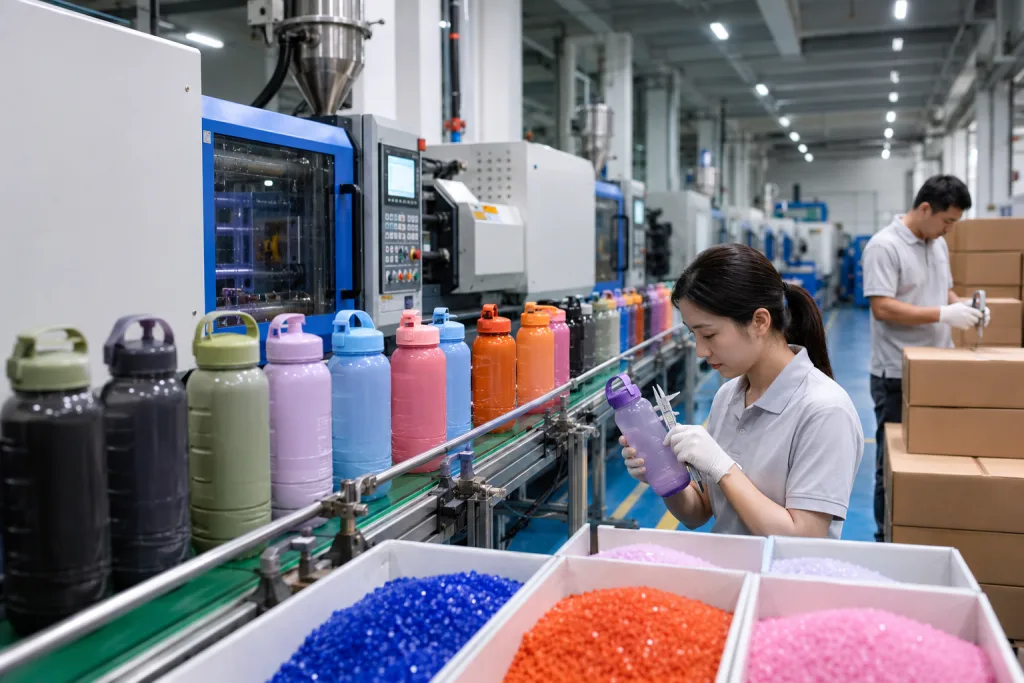
Ask for polypropylene bottle custom color, and you change more than the look. You change the setup on the line, from resin feeding to carton label checks. On PP, we run masterbatch into natural or base resin before injection or blow molding, usually at a set ratio on the hopper mixer. Simple on paper. On the factory floor, each color shifts MOQ, match tolerance, and scrap risk.
For a standard custom canteen or customized drinkware program, the cheapest route is still an existing bottle mold with an existing cap structure, then matching your color through a standard masterbatch formula. If your target is close to a factory formula already on file, added cost can stay around USD 0.03-0.05 per unit at 5,000 pieces. We ship jobs like this every month. If you want a tight Pantone match, especially bright orange, neon, very light beige, or the muted earthy tones buyers in Europe and North America keep sending over, the surcharge moves to USD 0.06-0.12. Reason is simple: extra sampling, more purge material, and higher pigment loading. Last month a buyer flagged a beige sample as “too pink” under store lighting after the lab sample looked fine in daylight.
PP does not read color the same way as stainless steel or Tritan. Surface finish matters. Wall thickness matters more. Cooling on the mold matters too. A bottle with 1.8-2.2mm wall thickness may look slightly darker at the shoulder and lighter at the grip panel under different light sources. We’ve seen QC pull the sample and check the same body under D65 and warm office light, and the difference is obvious. That is why experienced canteen manufacturers in China ask for approval on a physical pre-production sample, not just a Pantone code in an email. This is the wrong question to skip.
If you are a canteen distributor, distributor drinkware buyer, or promotional importer, do not start with “Can you do this color?” Any decent supplier will say yes first. Ask, “What MOQ, unit adder, and visual tolerance come with this color on PP?” That gets the commercial answer fast. It also avoids the usual problem later, where the buyer approved the chip but pushed back on a 10,000-piece MOQ or a ±1 shade visual tolerance after quoting their customer.
The cost stack buyers should expect
A PP bottle quote rarely moves on one item alone. The cost comes from a stack, and buyers should split it into six buckets before comparing suppliers. On our line, the same 700ml bottle can shift from 86g to 92g after a wall-thickness tweak of 0.3mm, and that changes resin cost fast.
- Base bottle: For a 600-750ml single-wall PP bottle using an existing mold, FOB Zhejiang, China is often USD 0.55-0.95 at 5,000-10,000 units.
- Cap assembly: A simple screw lid may add USD 0.10-0.18. A flip straw or carry loop cap can add USD 0.18-0.42.
- Custom color: Usually USD 0.03-0.12 depending on pigment and run size.
- Logo decoration: One-color silkscreen is commonly USD 0.03-0.06. Two-color print can reach USD 0.06-0.10. Laser is uncommon on PP. Heat transfer can run USD 0.08-0.18.
- Packaging: Bulk packed may be included. Individual polybag plus egg-crate divider can add USD 0.04-0.08. Color box often adds USD 0.12-0.35.
- Testing and compliance: REACH or food-contact testing may cost USD 250-900 per SKU depending on the lab scope.
If the project includes a new mold, price it separately. For a new PP body mold, you may see USD 3,500-12,000 depending on cavity count and bottle geometry. New caps can be another USD 2,000-8,000. We have seen buyers push for a fresh shape at 3,000 pcs MOQ, then stall after T1 samples because the handle felt weak at a 1.2m drop test. This is the wrong question to ask. The first question is not "Can you tool it?" but "Can this volume absorb tooling without killing margin?" Existing shapes are usually the safer launch path, and we've seen this go sideways when the PO forecast was typed as 50,000 instead of 5,000.
At BottleForge Industrial in Hangzhou, Zhejiang, we tell buyers to budget backward from landed margin, not forward from a wish list. If your target retail requires a FOB under USD 1.00, your custom growler or customizable canteen concept cannot carry every premium feature in the first PO. The math doesn't work. Pick the body color first, then choose either a complex lid or premium pack-out, not both. QC pulled the sample on one recent order because the color box spec added USD 0.22 and the flip lid added USD 0.31, which pushed the FOB past the buyer's cap before freight was even booked.
MOQ tiers and where pricing moves
MOQ is where 7 out of 10 price talks start to go sideways. A canteen factory can quote 1,000 pieces, yes. The wrong question is whether it is possible. The real question is whether the unit price, color match, and repeatability still work after the first run. For polypropylene bottle custom color, MOQ usually sits on two things: whether the bottle mold is already running and how many colors you split into one PO. On our line, QC pulled the first color chip at 3 mm wall thickness because thin PP parts show shade shift faster.
Typical commercial tiers
- 1,000-2,000 units: Usually workable only on stock colors, or you pay a setup surcharge that changes the math. Expect unit pricing 15-30% higher than the 5,000-piece level. We have seen buyers push for custom Pantone at 1,200 pcs, then flag the price after the masterbatch booking lands.
- 3,000-5,000 units: Common entry point for one custom body color with one logo. This tier fits a canteen promotional project or a pilot distributor canteen order. On the floor, one color, one print position, one carton mark keeps the line clean.
- 5,000-10,000 units: Best balance for stable color matching and competitive FOB pricing. This is where we usually run fewer stoppages, and hopper purge loss stays under control.
- 10,000+ units: This is where custom packaging, extra logo placements, or color family extensions start to pay back. At this level, a 44 x 44 x 50 cm export carton change or an insert revision no longer crushes the unit cost.
If you split 5,000 units into five colors, the factory may still take the order, but not at the same unit cost as one 5,000-piece color run. Every changeover adds line cleaning, hopper purge, sample check time, and packing work. In practice, mixed-color production can add USD 0.02-0.05 per bottle and 1-3 extra production days. We have seen 12 days become 15 days just from color swaps and carton relabeling. It also raises the risk of carton count mistakes, especially if outer boxes are assorted by SKU; last season, the buyer flagged one PO because the red/blue carton sticker code was typed wrong on 240 cartons.
For canteen distributors and canteen vendors serving smaller accounts, the smart move is usually 2-3 commercial colors in one PO, not 6-8 fashion shades. You keep the range sellable without turning the order into a scheduling mess. We ship this mix all the time. The same logic applies if you sell a customized growler or customizable growler line in plastic: more SKUs look good in the sales deck, but replenishment slows, safety stock rises, and the line spends more time changing labels than making bottles. We have seen this go sideways when a buyer asks for eight colors at 800 pcs each.
You do not buy MOQ once. You buy it again every reorder. Choose an MOQ structure you can repeat.
This matters even more in China sourcing because resin pricing, ocean freight, and peak-season vessel space can move faster than your sell-through plan. One week of delay changes the math. We have had PP resin move within 10 days, and a booking that was open on Monday was gone by Friday.
Lead time by stage, not promise
Break lead time into stages. “25 days” tells you nothing if artwork is still open, Pantone is not signed off, or the gift box dieline is still being changed. For a standard canteen custom project on an existing mold, this is the range we see from Zhejiang factories and the other main China drinkware clusters.
- Quotation and spec alignment: 1-3 days if you send capacity, dimensions, target price, print method, and packaging requirement. If the PO says “650ml approx” with no bottle height, we lose a day fast.
- Color match sample: 3-7 days for one body color and standard cap parts. We usually check the chip under a light box before QC pulled the sample.
- Pre-production sample with logo: 5-10 days after artwork confirmation. A 0.3 mm thin line in the logo often needs one screen adjustment.
- Mass production: 20-35 days for 5,000-20,000 units. The line runs, but packing labor and print curing time usually set the pace.
- Third-party inspection and booking: 3-7 days. AQL 2.5 is standard, and booking can slip if the forwarder misses the SI cutoff.
If you need a new mold, add 20-35 days for a simple bottle and 30-45 days if the cap assembly is new and includes moving parts. We have seen this go sideways on flip-top lids because hinge testing adds time. If your order lands before Chinese New Year or in the September-November peak, add another 7-15 days unless capacity is reserved in advance.
A factory with real volume should explain output by process, not give you one clean number. This is the wrong question to ask. One line might run 80,000-120,000 PP bottles per month on your style, but silk-screen, hand packing, and carton sorting usually choke first, not injection. In our Hangzhou plant, a 10,000-piece stock-mold order with custom color and one-color silkscreen is normally 25-30 days, MOQ 3,000 per color. That quote includes color approval and final AQL packing checks.
If a canteen supplier promises 12 days for a fresh custom color, custom box, and export carton mark update, ask which step they dropped. We ship rush orders, but 12 days vs 18 days usually comes down to one thing: sample approval was assumed or inspection was left out. Last month a buyer flagged a carton mark typo on the PO, and that alone cost 2 days for revised artwork. Fast is good. Undefined is expensive.
Hidden delays that hurt launches
Most launch delays do not start in molding. They start in “small” approvals that land late or change twice. If you are new to custom drinkware sourcing, watch these four areas first; on our line, these are the issues that turn a 12-day sample cycle into 18 days.
First, artwork files. A curved PP bottle has a fixed print window, and the screen fixture does not forgive guesswork. If you send a low-resolution logo or change the print width after the sample is made, you can lose 2-4 days fast. We usually mark the art area on the sample with 0.5mm tape before screen setup. For silkscreen, send vector artwork and state print width in millimeters. This is the right question to ask early, not after QC pulled the sample.
Second, color approval method. Screen color approval is not color approval. We have seen a Europe brand team approve on a monitor, then a North America warehouse compare the bottle under 6500K cool white tubes and reject the same lot. The factory had matched the sealed sample, but the buyer flagged it anyway. Physical sealed samples stop that argument. Last month one PO even had “dark navy” typed two ways on the color note, and that alone held approval for a day.
Third, packaging compliance. Retail pack details arrive late more often than bottle specs. Barcode labels, FNSKU placement, suffocation warning, carton drop requirements, and bilingual legal text all need layout signoff before we print inserts or outer marks. For Amazon FBA or mass retail, those points can hold shipment longer than the bottle. We ship plenty of plain bulk packs with no issue; retail packs are where projects go sideways. One common miss is FNSKU placed across a tuck-box seam, which the buyer then rejects after the first carton mockup.
Fourth, testing scope. If your buyer needs REACH, LFGB-related migration review through a chosen lab, or ASTM/CPSIA checks for a kids item, lock that scope before production starts. Retest from a last-minute accessory change is common, and the math does not work. Swap a silicone strap hardness or lid plug material after sampling, and you may add 7 days with nothing gained. We have seen a buyer change a straw color at the end, then learn the new masterbatch needed another migration review.
- AQL 2.5/4.0 is common for finished goods inspection.
- Leak testing should be defined by orientation and duration, for example 30 minutes upside down.
- Drop testing for packed product should specify height, usually 60-80cm depending on channel.
A serious canteen factory or canteen vendor asks these questions at quote stage, not after deposit. If they do not, you become the project manager by default, and that is usually where the delay starts.
How buyers control risk upfront
The cleanest purchase orders are specific. For a polypropylene bottle custom color project, lock the commercial spec before you argue over the last $0.02. We have seen this go sideways: a buyer cut price first, then changed the Pantone after sample approval, and the line lost 3 days waiting on a new masterbatch mix. This matters more with canteen manufacturers or canteen suppliers in China because we run fast once the plan is released to production.
Your PO should state bottle capacity tolerance, body color reference, cap color reference, logo method, logo position, packaging method, carton quantity, inspection level, and shipment term such as FOB Ningbo or FOB Shanghai. Be exact. If the bottle uses food-contact PP and a silicone seal, list both materials and call out seal hardness if you have it, such as 50 Shore A. If recycled content is requested, define the percentage and whether documentation is needed. One buyer wrote "eco material" on a PO and the line stopped for half a day because that is not a production instruction.
For procurement managers, a landed-cost matrix is the fastest way to compare canteen supplier offers. Put suppliers side by side on unit FOB, color surcharge with the actual Pantone count, sample fee, mold fee, packaging adder, compliance cost, lead time, payment term, and defect handling. QC pulled the sample on one project like this and the cheapest quote turned into the highest total after a $0.11 gift box adder, a $150 color matching fee, and no spare parts included. This is the wrong question to ask if you only look at FOB price.
Ask operational questions too:
- What is the standard MOQ by color and by logo?
- What is the normal color tolerance on PP parts?
- Can they support BSCI or equivalent social audit documentation if your channel requires it?
- Do they run incoming material traceability by batch?
- Can they provide spare caps or seals at 1-2% of order volume?
These are shop-floor questions, not theory. They tell you if the supplier can handle repeat orders without drama. Last month the buyer flagged a cap fit issue on a 0.3 mm thread variation, and the factory with batch traceability solved it in 1 day instead of 5. A canteen distributor or distributor growler buyer does not need a perfect factory. You need a predictable one. That keeps your replenishment calendar intact and your customer service team quiet.
Get a real PP bottle quote with timelines
Send your target capacity, Pantone, logo file, and quantity split. We will reply with MOQ, FOB pricing, sample timing, and realistic production days.
Frequently asked questions
What MOQ should I expect for polypropylene bottle custom color?
For an existing bottle mold, a realistic MOQ is usually 3,000 pieces per color, with 5,000 pieces giving better cost efficiency. Some canteen manufacturers in China will offer 1,000-2,000 pieces, but that often means using an existing stock color or paying a setup surcharge that adds 15-30% to unit cost. If you want two custom colors in one PO, many factories will ask for 2,000-3,000 pieces per color. For a new mold program, the commercial MOQ often starts at 5,000-10,000 units because the tooling cost has to be absorbed over the first run.
How much extra does a custom PP color usually cost?
On a standard 600-750ml bottle, custom color commonly adds USD 0.03-0.12 per unit FOB China. Dark basic shades like black, navy, or standard red are usually on the lower end. Light neutrals, trendy muted colors, and bright oranges or greens can cost more because they require tighter masterbatch control and more trial sampling. If your order is only 3,000 pieces, the color adder is often higher than on 10,000 pieces. If the cap, loop, and body all need separate matching, add another USD 0.01-0.04 depending on part count.
How long does a custom color bottle order take from approval to shipment?
If you use an existing mold, expect 3-7 days for color sampling, 5-10 days for a final pre-production sample with logo, and 20-35 days for mass production after approval. Add 3-7 days for final inspection and vessel booking. So a practical total is about 30-45 days from confirmed artwork and sample approval to FOB shipment. If you need a new mold, add 20-45 days depending on whether the cap assembly is simple or includes a straw, hinge, or carry handle. Peak season in Zhejiang and wider China can add another 7-15 days.
Can I mix several colors in one order without raising the price much?
You can mix colors, but the price usually does not stay flat. A 10,000-piece order in one color is more efficient than 10,000 pieces split into five colors. Each color change requires machine purge, sample checks, SKU separation, and more careful packing. In practice, mixed-color orders often add USD 0.02-0.05 per bottle and 1-3 extra production days. The best compromise for many canteen distributors is 2-3 commercial colors in one purchase order. That gives range variety without creating avoidable scrap, which can rise by roughly 2-5% on heavily split runs.
What should I confirm before placing a PO with a canteen factory?
Confirm the exact Pantone or approved physical color sample, bottle capacity, wall thickness range, lid construction, seal material, logo method, print size, individual packing, carton quantity, and inspection standard. For finished goods, AQL 2.5/4.0 is common. Also define compliance scope: REACH, food-contact testing, ASTM or CPSIA if the item is for children, and any retailer-specific packaging rules. On commercial terms, confirm MOQ per color, sample fee, tooling fee, FOB port, spare parts percentage, and production lead time. A detailed PO removes most of the disputes that first-time buyers experience with canteen suppliers.