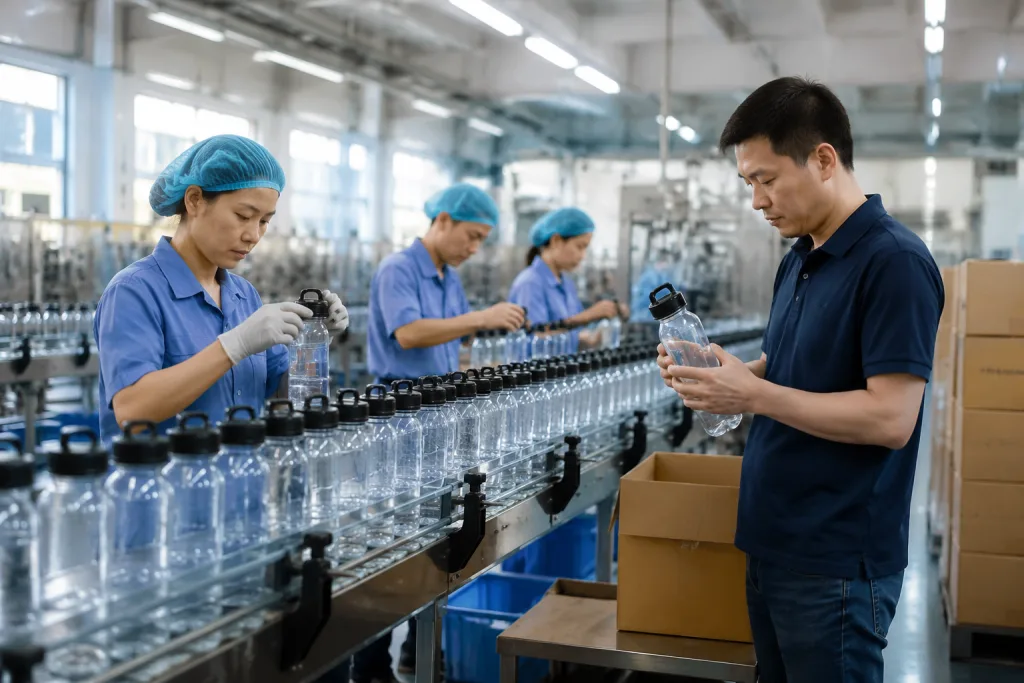
Key Takeaways
- For a 700ml custom PC bottle, typical FOB China pricing is USD 1.55-2.80 at 3,000-10,000 pcs depending on lid, print, and packaging
- Most canteen factory MOQs start at 1,000 pcs per color for stock molds, but fully new molds usually need 5,000 pcs to make the math reasonable
- Standard production lead time is 25-35 days after sample approval and deposit, while new mold projects usually need 45-70 days total
- Decoration, testing, and packaging can add 12%-35% to landed cost even when the base bottle price looks low
You can get a clean-looking sample of a polycarbonate bottle in 5 to 7 days. Easy part. The hard part is knowing what the production PO will cost, whether lead time is 12 days or 18 days, and where the risk sits before you sign off. We have seen buyers line up 3 quotes that looked the same on paper, then find one factory left out mold amortization, another priced only plain white boxes, and a third ran a wall thickness 0.3 mm lighter. QC pulled the sample and it looked fine. Bulk is where the math changes.
If you are sourcing polycarbonate water bottles custom for retail, events, gym chains, or a canteen distributor program, you need numbers you can budget against, not soft estimates. From Zhejiang, China, we run into the same pattern on the line: MOQ moves unit price, decoration pushes reject rate, and compliance testing adds 4 to 9 days to the schedule. This is the wrong question to ask if you only ask for the lowest FOB. A 3,000 pcs order with silk print, an insert card, and export carton drop test is not priced the same as a plain bottle order, even if the shape matches. Once you see the cost stack clearly, you can buy custom drinkware without paying for surprises.
Where the bottle cost really moves
For polycarbonate water bottles custom, the bottle body is just one line on the cost sheet. A proper quote from a canteen manufacturer should split out resin grade, bottle weight, lid construction, decoration, packaging, testing, and shipping term. We run quotes this way on the line because a 6g lid change or a 0.3mm wall change shows up fast in cost. If those items are not broken out, you are comparing guesses.
Use this as a working benchmark. For a 650ml to 750ml PC bottle with food-contact polycarbonate, body weight around 135g to 170g, and wall thickness of 2.0mm to 2.8mm, FOB China pricing from Zhejiang suppliers usually lands here:
- 1,000 pcs: USD 2.20-3.40 each
- 3,000 pcs: USD 1.75-2.60 each
- 10,000 pcs: USD 1.55-2.10 each
That spread is normal. Lid style is usually the first cost driver. A simple screw lid with PP cap and silicone ring may cost USD 0.18-0.30. A flip-top or one-hand lid can reach USD 0.45-0.85 because it adds parts, spring sets, mold cost, and hand assembly at the capping bench. Add a carry loop, tea infuser, shaker ball, or protective base, and the math changes again. We have seen buyers push back on USD 0.12, then approve a loop handle and move the total higher anyway.
Decoration is the second driver. One-color silkscreen may add USD 0.05-0.10 per unit. Two-color print can add USD 0.08-0.18. Full-wrap heat transfer or water transfer can add USD 0.20-0.45 and usually raises defect risk. QC pulled the sample on one run because the wrap registration drifted 1.5mm at the bottle seam. If you need a canteen promotional order with multiple SKUs and mixed artwork, setup loss pushes the real cost up even when the unit quote looks fine. This is the wrong question to ask if you only focus on the cheapest print price.
Low quotes usually hide one of three things: lighter bottle weight, lower decoration yield, or very basic packaging.
This is why experienced canteen suppliers in China ask for target retail channel, drop test standard, and artwork coverage before they lock price. A distributor drinkware program for mass retail is priced differently from a custom canteen run for events. We ship both, but the packout is not the same: one buyer flagged a plain white inner box at 24 ECT, while the retail order needed a stronger carton and insert after drop testing.
MOQ tiers and what they change
MOQ is not a factory trick. It is setup cost spread across the run. For stock molds, most canteen manufacturers in Zhejiang quote 1,000 pcs per color per size as the starting line, and we see that on POs every week. At 3,000 pcs, the math starts to work. At 5,000 to 10,000 pcs, resin purchase volume, screen-print setup, and carton fill rate get cleaner, so the unit price drops in a way buyers can actually feel.
Here is the practical effect of MOQ on a standard 700ml bottle with one-color logo and egg-crate packing:
- 1,000 pcs: good for testing a market, but unit cost stays high, and the line usually has limited carton assortment
- 3,000 pcs: the normal entry point for branded custom drinkware programs; this is where we run most first orders
- 5,000 pcs: lower piece price, and it gets easier to ask for spare lids or extra QC points like drop checks on packed cartons
- 10,000 pcs: a canteen supplier can often absorb minor setup cost or upgrade packaging value; we ship fuller containers and waste less space
If you want mixed colors, 6 out of 10 factories in China will still hold a total MOQ of 3,000 pcs but require 500 to 1,000 pcs per color. The buyer flagged this on one 4-color PO last month because each logo version split the run again. That matters for a customizable canteen line or a canteen customizable campaign where you want four colors and two logos. More split runs mean lower line efficiency, more changeover time, and a weaker price. Simple as that.
For a fully customized canteen or custom growler concept using a new body shape, treat MOQ differently. The actual commercial MOQ might be 5,000 pcs even if the tooling can technically produce fewer, and this is the wrong question to ask. The real question is where tooling amortization stops hurting the sell price. A new mold set for body and cap can cost USD 3,500-12,000 depending on cavity count and complexity, and we have seen cap thread tolerance fail at 0.3 mm on first trials. Spread that over 1,000 units and the math does not work.
An honest canteen vendor will tell you when a stock mold is the smarter call. We have seen this go sideways when a buyer insists on exclusive tooling for a 2,000-pc launch, then pushes back on the quoted price 3 days later. That stock-mold route is usually better for a canteen distributor, distributor canteen program, or distributor growler range that needs speed more than exclusive tooling.
Tooling, samples, and setup charges
New buyers fixate on unit price and miss the non-recurring cost. We’ve seen this go sideways. If you are buying polycarbonate water bottles custom from a canteen factory in China, ask for every setup charge before artwork approval, right down to the silkscreen mesh count and carton die-line fee on the PI.
Typical one-time or semi-fixed costs
- Existing mold sample with logo: USD 50-150 per design
- Pre-production sample with final packaging: USD 100-250
- Silkscreen screen setup: USD 20-50 per color per design
- Heat transfer setup: USD 80-200
- New mold deposit: USD 3,500-12,000
- Third-party lab test: USD 300-800 per SKU depending on REACH, LFGB, California Proposition 65, or ASTM requirements
For 7 out of 10 canteen customized projects, the better commercial route is a stock bottle with a custom lid color, custom print, and retail packaging. That is enough for shelf difference. We run these with a 3,000 pcs MOQ on common bodies, and the math usually works better than opening a fresh mold for one season.
Sample timing matters. A stock sample with a digital mockup usually takes 2 to 4 days, while a real logo sample needs 5 to 7 days on the line. Change the artwork position by 8 mm, ask for a Pantone match after approval, or swap the lid color, and part of the process starts again. QC pulled the sample before shipment more than once because the buyer flagged logo orientation after seeing photos. PDF-only approval is the wrong shortcut.
At BottleForge-scale output, a factory running around 600,000 units per month can turn standard samples fast, but approval discipline still controls the calendar. One loose comment from a brand team can burn 6 days versus 1 day for a clean sign-off. We ship plenty of rush programs, and this is the wrong question to ask: “Can you make it faster?” Ask who owns approval, who signs color, and who checks the barcode before the PO hits the line.
Ask whether tooling ownership is exclusive. Some canteen vendors in Zhejiang, China will credit back part of mold cost against future volume; some will not. Put it in writing on the PI, together with cavity count, material spec, and expected tool life. We have seen PO typos on 304 stainless projects and wrong cavity notes on plastic tools, so do not leave this to a WeChat message.
Lead times by order stage
Lead-time delays usually start at the handoff points, not at the molding press. For polycarbonate water bottles custom, we split the job by stage and put real dates on each one. On our floor, the first gap often shows up before production even starts: the buyer changes the logo position by 8 mm, or the PO says 5,000 pcs while the drawing says 3,000.
- Quotation and drawing confirmation: 1-3 days
- Stock sample preparation: 2-4 days
- Logo sample: 5-7 days
- New mold development: 18-30 days
- Pre-production sample approval: 3-5 days after molding trial
- Mass production: 25-35 days for 3,000-10,000 pcs
- Final inspection and booking: 3-7 days
So a stock-mold project usually moves from approved sample to FOB shipment in about 30-45 days. A new mold custom canteen or customized growler project is more like 45-70 days. Sometimes it runs past that. We have seen this go sideways when a lid uses 4 separate parts and the buyer flagged the thread feel after the second trial sample.
Printing and packaging are often the real bottleneck. A plain export carton moves fast. A color box with EVA insert, barcode sticker, polybag warning, and a 6-language instruction sheet takes longer because each item needs artwork check, print slot, and packing-line setup. Add Amazon FNSKU labels or assortment packing for a canteen distributor network, and the math doesn't work unless we rebalance the line and confirm carton drop-test size first.
Chinese New Year, summer bottle season, and pre-holiday vessel booking can stretch lead times by 7-15 days. Zhejiang factories are usually packed from May to August for hydration products. We run more night shifts in that window, but capacity is still tight. If you need August delivery in Europe or North America, lock production in June, not July. Last year one buyer pushed to book in July, and the sailing moved 12 days because the forwarder missed the cut-off.
A practical point: asking for “rush production” is the wrong question to ask. Ask which step can be compressed and what it will cost. Good canteen suppliers can sometimes pull 5 days out of the schedule, but that usually hits overtime cost, QC sampling windows, or carton procurement. QC pulled the sample at 2.5 AQL on one rushed order, and the rework alone ate back 3 of those 5 days.
Compliance and quality are schedule items
For B2B buyers, compliance is not a footnote. It sits in the cost sheet and the production calendar. Polycarbonate is still used widely for reusable bottles because it is tough, clear, and dimensionally stable, but the paperwork changes by market. We run into this early with sample approval, sometimes right down to a 28mm neck finish or a cap insert material the buyer forgot to list on the PO.
For Europe, buyers usually ask for REACH and LFGB-related food-contact declarations based on the full product build, not just the bottle body. For North America, California Proposition 65 screening is a common ask, and CPSIA or ASTM-related checks come up fast when the bottle is for kids. If you are sourcing a kids SKU, do not let a general canteen factory guess the standard set. Spell out the sales market, age grade, and packaging form. We have seen this go sideways after the buyer flagged a straw bite test issue on a 5,000-piece order.
On the quality side, a decent factory should have incoming QC, in-process checks, and final inspection. Ask for the actual routine. On our line, QC pulled the sample after injection and again after assembly, and the go/no-go gauge was sitting right beside the leak tester.
- AQL standard: commonly AQL 2.5 for major defects and 4.0 for minor defects
- Leak test rate: ideally 100% for assembled bottles
- Drop test: defined height such as 80cm to 120cm depending on packaging and market
- Dishwasher claim: only if verified by actual cycle testing
- Factory audit status: BSCI, Sedex, or ISO 9001 where relevant
Quality failures on clear PC bottles are easy to spot. Flow marks show up near the gate, black specks get trapped in the wall, gate whitening shows stress, and thread cracks often start after torque testing at 1.8 N.m. Print misregistration is another one. If you sell premium customized drinkware, this is the wrong question to ask: do buyers notice? Yes, they do, and they reject for it.
If a canteen supplier promises 20-day production on a decorated order but cannot explain AQL, leak testing, and final inspection timing, the quote is incomplete.
Good buyers in China sourcing do one more thing: they lock the test scope before deposit. That avoids the usual delay where the factory finishes the order, then waits 6 more days for the buyer to decide which lab protocol is needed. We ship faster when this is clear up front; one recent order moved in 12 days for lab booking instead of 18 days because the buyer confirmed the protocol before mass production.
How to quote like a buyer
The fastest way to get usable pricing from canteen manufacturers is to send a tight RFQ. Short and clear. If your inquiry is vague, 5 suppliers will quote 5 different bottles, and the comparison is dead on arrival. We see this on the line all the time: one buyer writes "sports bottle," another sends a 0.8 mm wall target, and only one of them gets numbers that hold up after sampling.
Your RFQ for polycarbonate water bottles custom should include these points:
- Capacity, for example 500ml, 700ml, or 1000ml
- Target bottle weight or wall thickness if durability matters
- Lid style: screw cap, flip lid, straw lid, or chug lid
- Logo method and print size
- Packaging: bulk, white box, color box, or PDQ display
- Quantity by color and by SKU
- Target market and required tests
- Trade term: FOB Ningbo, FOB Shanghai, or EXW Zhejiang
- Required ship date, not just order date
If you are a canteen distributor or distributor growler buyer, ask suppliers to quote three tiers at once: 1,000 pcs, 3,000 pcs, and 10,000 pcs. Ask for optional pricing on upgraded lids and gift box packaging in the same sheet. This is the right question to ask. It shows fast whether the math works for a canteen promotional program, a mid-market custom drinkware item, or a premium customizable drinkware line. We ship quotes like this every week, and buyers usually flag MOQ gaps on gift boxes first.
For stock mold projects, expect a clear quotation in 24 to 72 hours. That is normal. If the supplier needs 7 days to quote a standard bottle, it usually means internal confusion or slow costing approval. If a canteen factory sends a same-day price for a fully customized canteen body without asking for drawings, tread carefully. QC pulled the sample on one project last month, and the neck finish was off by 1.5 mm from the buyer's cap spec.
The buyers who get the best result from China are usually not the hardest negotiators. They write the clearest specs. Clear inputs cut change orders, cut rejects, and shorten production from 18 days to 12 days on repeat styles. That matters more than squeezing USD 0.03 off a bottle and then losing 10 days because the PO said "blue lid" while the artwork file was marked "navy."
Get a costed quote with realistic lead time
Send your capacity, lid style, artwork, quantity, and target market. We will quote MOQ tiers, testing scope, and FOB timing from Zhejiang, China.
Frequently asked questions
What is a realistic MOQ for polycarbonate water bottles custom?
For a stock mold bottle, 1,000 pcs per color is a normal starting MOQ in China. Many Zhejiang factories will quote 500 pcs for a repeat order, but first orders below 1,000 pcs usually carry a noticeable price penalty. If you need mixed colors, expect a total MOQ of 3,000 pcs with 500 to 1,000 pcs per color. For a new mold, the practical MOQ is usually 5,000 pcs because the tooling cost can run USD 3,500 to 12,000. Technically, a canteen manufacturer may produce fewer, but your amortized unit cost gets ugly fast. If you are testing a market, a stock body with custom print and packaging is usually the better commercial choice.
How much do custom polycarbonate bottles usually cost FOB China?
A standard 650ml to 750ml bottle with screw lid, one-color logo, and export carton packing typically costs USD 1.55 to 2.80 FOB China depending on quantity. At 1,000 pcs, you are more likely around USD 2.20 to 3.40. At 3,000 pcs, many buyers land near USD 1.75 to 2.60. At 10,000 pcs, efficient runs can get to USD 1.55 to 2.10. Flip lids, infusers, or gift boxes move the number up quickly. Testing, barcode labels, and retail packaging can add another USD 0.20 to 0.70 per unit. If a canteen supplier quotes far below that range, ask for bottle weight, wall thickness, and exact packing details before taking the price seriously.
How long does production take after sample approval?
For stock molds, most orders need 25 to 35 days after sample approval and deposit. Add 3 to 7 days for final inspection, booking, and export paperwork. If your order includes color box packaging, multilingual inserts, or Amazon FNSKU labeling, plan closer to 35 to 40 days. New mold projects usually need 18 to 30 days for tooling, then another 25 to 35 days for production, so a total of 45 to 70 days is more realistic. In Zhejiang and broader China supply chains, peak bottle season from May through August can stretch that by another 7 to 15 days. Buyers who fix artwork and packaging early usually protect the schedule better than buyers who chase a faster factory promise.
Are polycarbonate bottles suitable for Europe and North America?
They can be, but only if the material grade, additives, and test scope match your market. For Europe, buyers often request food-contact declarations and REACH-related documentation, plus LFGB-related testing where applicable. For North America, Proposition 65 screening is common, and kids programs may need ASTM or CPSIA-related checks depending on product design. The bottle body is only part of the picture. Lid plastic, silicone seals, inks, and coatings also matter. A serious canteen factory in China should state the resin grade and confirm what the quoted test cost covers. Budget roughly USD 300 to 800 per SKU for third-party lab work. If the product is for mass retail, lock the compliance protocol before production, not after.
What should I ask a canteen manufacturer before placing the PO?
Ask for five things in writing: bottle weight, wall thickness, leak-test method, AQL standard, and packaging spec. Then confirm MOQ by color, production lead time, and whether the quote is FOB Ningbo, FOB Shanghai, or EXW. You should also ask if artwork setup, mold charges, and third-party tests are included or separate. For clear PC bottles, request sample photos showing thread finish, print alignment, and base clarity. If you are buying for a canteen distributor or distributor drinkware program, ask about spare lids and defect replacement policy as well. A factory that can answer with numbers such as 2.3mm wall thickness, 100% leak test, and AQL 2.5/4.0 is usually operating in a more controlled way than one giving only general assurances.