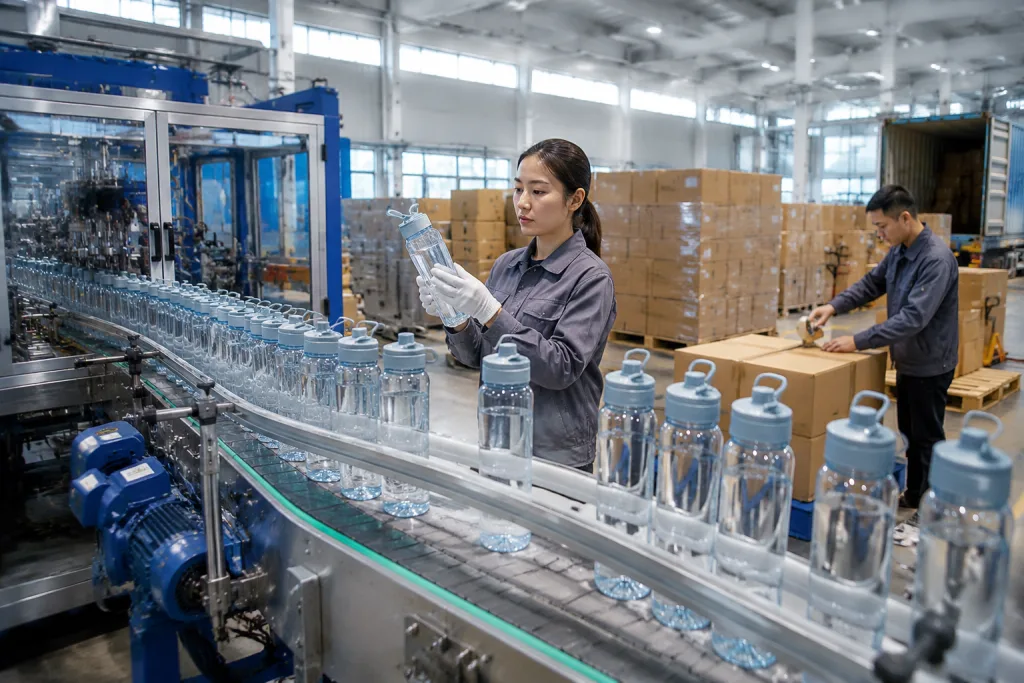
Key Takeaways
- A realistic MOQ for custom polycarbonate bottles is often 1,000 to 3,000 pcs per color, with 25 to 35 day production after sample approval
- Ask for resin grade, wall thickness, leak test standard, and AQL level before you compare FOB prices that may differ by USD 0.20 to 0.60 per unit
- For EU and North America, confirm REACH, LFGB or FDA contact compliance, plus drop and torque testing on every production lot
- A Zhejiang factory producing 300,000 to 500,000 units/month can usually support distributor drinkware programs better than a workshop chasing mixed small orders
You are not just buying a bottle. You are buying batch-to-batch consistency on resin grade, injection molding, lid torque, print adhesion, carton drop performance, and the REACH file that should already be on the desk. We have seen first POs go sideways at 5,000 to 10,000 pcs because the approved sample was clear, then the line shipped bottles with haze, gate marks, leaking caps, or missing declarations. QC pulled the sample, but the mass run was different. If you are speaking with a polycarbonate water bottle supplier, price is the wrong first question.
For B2B drinkware buyers in Europe and North America, the issue is straightforward: can this China factory ship repeatable quality at your target volume, lead time, and landed cost without forcing rework after arrival. We run into this on custom drinkware and custom canteen programs all the time, especially once orders move from 1,000-pc sampling to 20,000-pc production and the buyer flagged cap fit at 0.3 mm thread tolerance. The details decide the order. Miss them, and the math does not work for canteen distributors.
What are you really buying
With a polycarbonate water bottle supplier, you are not just buying the bottle body. You are buying resin grade, mold stability, cap fit, print method, carton setup, and line control. We have seen clean China quotes hide the real risk: a 0.75 mm sidewall that squeezes in transit, a seal that starts leaking after 3 weeks, or print that fails before 100 dishwasher cycles. On our line, QC pulled a sample last year where the neck finish was off by 0.3 mm, and the buyer flagged cap mismatch on arrival.
For most B2B programs, ask for this construction data before sampling starts. This is the right checkpoint. If a factory cannot answer these basics, the math does not work later at order stage.
- Material: virgin polycarbonate, not mixed regrind, with food-contact declaration
- Wall thickness: typically 0.8 to 1.5 mm depending on bottle size and shape
- Cap system: screw lid, flip lid, straw lid, or tethered sports cap
- Seal material: food-grade silicone, usually 50 to 60 Shore A
- Decoration: silkscreen, heat transfer, in-mold label, or laser mark on selected parts
- Packing: egg-crate, polybag, or individual white box based on your channel
If you run canteen promotional projects, gift programs, or private label retail, these details drive returns harder than most buyers expect. A school distributor ordering 10,000 canteens usually needs tougher drop resistance and simpler one-color print; outdoor retail may push for a tethered lid and thicker shoulder; e-commerce needs carton performance first, because parcel damage claims start fast. We ship all three types, and this is the wrong question to ask: "What is your cheapest bottle?" Ask which structure fits the channel. Last month one PO even had "straw kid" typed instead of "straw lid," and that small typo changed the cap spec discussion for two days.
A supplier who only talks about unit price is usually the one who leaves you to discover the quality problem after loading.
From Zhejiang, where a large share of China drinkware production sits, the gap in technical depth is wide. Some factories quote in 2 hours but cannot hold repeatability across 3 production runs. We have seen this go sideways. Ask for specifics: cavity count, bottle weight in grams, leak-test standard, and what the line does if torque drifts out of range. Serious canteen manufacturers answer with data. Traders answer with "no problem." On the factory floor, that difference shows up fast. A torque tester and an AQL table tell you more than a polished quotation.
How do you check supplier fit
Not every canteen supplier fits your channel. We’ve seen promo-heavy factories miss retail barcode control on a 40HQ run because the EAN position drifted 3 mm on the label file. A vendor built around domestic China volume often drags on EU document packs and test-file follow-up. Fit matters more than a polished sales deck. This is the wrong question to ask: “Are they professional?” Ask whether they run orders like yours every week.
Supplier checklist before sampling
- MOQ: 1,000 pcs for existing molds is workable; 3,000 pcs is common for custom color matching and printed sets
- Tooling lead time: 18 to 30 days for a new cap or bottle mold, depending on complexity
- Mass production lead time: 25 to 35 days in normal season, 35 to 50 days in peak season
- Capacity: ask for monthly output by category, not total factory output
- Audit status: BSCI, ISO 9001, and social compliance records where required
- Export experience: Europe and North America shipment ratio, not just total years in business
At BottleForge Industrial in Hangzhou, Zhejiang, a practical benchmark for stable export programs is 300,000 units per month with standard models and 1,000 pcs MOQ on selected items. Bigger is not always better. We care more about whether the line can hold schedule discipline from resin booking to pad printing and final AQL pull. On the floor, that means the planner is not reshuffling every PO after lunch and QC pulled the sample from the same lot that ships.
If you are buying for canteen distributors, distributor growler channels, or a distributor canteen program, ask whether the supplier has handled split shipments, mixed carton labels, and FNSKU application on live orders. Ask for one packing photo set. We ship these jobs with outer carton mark lists taped to each pallet, because buyers flag mixed-label mistakes fast. If you are sourcing canteen customizable items for a brand rollout, ask how they control Pantone variance across multiple production lots. A capable canteen factory should already work to a defined tolerance, usually within Delta E targets agreed before production, checked with a spectrophotometer instead of “eye match looks okay.”
Short version: pick the supplier that matches your operating model. A canteen distributor needs clean documents and repeat orders that ship the same way in June and November. A canteen promotional buyer needs fast sampling and logo placement that stays within a 2 mm print window. A custom growler buyer may need thicker walls and tighter cap torque control; we’ve seen this go sideways when the buyer pushed for lighter weight and then complained about leak rates. One factory rarely does all three well.
What specs should be on quote
A solid quotation should read like a mini spec sheet. If a supplier sends one line for a 700 ml bottle, you cannot compare it cleanly. We see this every month. One buyer flagged a price gap of USD 0.11, then QC pulled the sample and found the other factory had quoted a thinner body at 0.9 mm, not the agreed build. Change-order cost starts there.
Your RFQ and final quotation should lock down these points:
- Capacity and brimful volume: for example 650 ml nominal, 700 ml brimful
- Net weight: such as 128 g plus or minus 5 g
- Body wall thickness: for example 1.1 mm average
- Neck finish and thread spec: especially if you need cap interchangeability
- Color standard: Pantone code or approved physical chip
- Logo size and position: 1-color 1-position silkscreen, 60 x 80 mm
- Leak test: inverted 30 minutes, no leakage
- Drop test: packed and unpacked standard from agreed height
- Packing: 24 pcs per export carton, carton dimensions and gross weight
- Trade term: FOB Ningbo or FOB Shanghai, not just FOB China
With polycarbonate bottles, small spec changes move cost fast. This is the wrong question to ask if the buyer only wants the lowest unit price. The math doesn't work. A thicker wall can add USD 0.08 to 0.18 per unit, a more complex lid adds USD 0.20 to 0.45, and an individual box adds USD 0.12 to 0.30; on the line, even a 0.15 mm wall increase shows up in resin use and cycle time.
The same rule applies across related programs. A customized canteen for a campus store, a customizable growler for event merchandise, or a customized drinkware line for retail still needs the quote broken out the same way. We ship these every season. A reliable canteen manufacturer should separate base bottle cost, decoration cost, packing cost, and sample cost, and we have seen this go sideways when a PO only says "logo included" with no print size or no position mark.
If the project is large enough, ask the supplier to state scrap assumptions and replenishment terms in writing. For repeat custom drinkware orders, you should know if they hold 1% to 2% printed overrun or run exact quantity, because that changes shortage risk at final inspection and shipment booking. Last quarter, one buyer's PO had "2% spare" typed as "0.2% spare," and that small typo mattered once AQL 2.5 inspection started.
Which compliance papers actually matter
Compliance is where new buyers burn 2 to 3 weeks. They ask for “all certificates,” and the factory sends 18 PDFs, half unrelated to the bottle on the PO. Ask for papers tied to your market, resin, and actual use. That is the right filter. For a polycarbonate water bottle supplier shipping to Europe or North America, the paperwork should be current, model-linked, and easy for QC to trace back to the 1.2 mm body, lid, and seal set.
Start with food-contact compliance for the selling market. For the US, ask for FDA-related declarations. For Germany-focused programs, ask for LFGB test reports. For the EU, ask for REACH screening on SVHC items, and check whether California Proposition 65 matters for your distribution plan. If the bottle is aimed at kids, ASTM or CPSIA can come into scope fast. We have seen buyers miss this because the artwork looked playful and the buyer flagged it after sampling.
- Material declaration: food-contact statement for resin, colorant, and silicone seal, matched to the actual BOM and not a generic resin sheet
- Test report validity: recent report from recognized lab, not a 5-year-old scan pulled from an old folder on the line
- Factory system: ISO 9001 is useful, though not a product certificate; this is the wrong question to ask if you still do not have the bottle-specific report
- Social compliance: BSCI or equivalent if your brand policy requires it, especially when retailer onboarding asks for audit dates and factory address match
- Packaging compliance: carton and ink declarations where needed by retailer rules, including outer carton specs if you ship 24 pcs per master carton
Be direct with the supplier in China: a report for one bottle model does not cover every bottle. If the cap resin changes from PP to Tritan-like copolyester, or the seal formula changes, the paper needs an update. QC pulled the sample on one order here because the silicone shore hardness shifted and the old report no longer matched. Serious Zhejiang exporters will tell you that up front. Less disciplined canteen vendors just send the easiest attachment and hope no one checks.
Ask one more thing: was migration testing done on the finished product, or only on the raw material? Finished product testing is stronger because it reflects real assembly conditions, including ultrasonic welding, printing, and seal fit. If you sell through canteen distributors or large retailers, insist that the report sample matches the production BOM exactly. We ship against that rule for a reason. A PO typo on lid color is easy to fix; a mismatch between the tested sample and mass production is where the math doesn’t work, and we have seen this go sideways at customs and retail QA review.
How should quality control be handled
You do not need luxury-level inspection on every PO, but you do need a system that the line actually follows. On our side, that means inline checks every 2 hours, a final random inspection, and written defect limits posted at the packing table. No system, no control. Then QC starts with customer complaints, and we have seen that go sideways.
A practical export setup uses AQL sampling at final inspection. Most buyers we ship for work with AQL 2.5 for major defects and AQL 4.0 for minor defects. For drinkware, write the defect list before production starts, not after QC pulled the sample:
- Critical: leakage, sharp burr, odor, wrong material, missing compliance mark
- Major: cracked body, obvious print shift, cap cross-threading, wrong color
- Minor: small non-visible scratch, slight speck outside logo zone, carton scuff
Inspection has to cover more than surface finish. Ask for torque checks on screw caps with a torque tester, leak tests on assembled units, and carton drop checks after packing. For a 24-piece export carton, a common packed drop sequence is one corner, three edges, and six faces, adjusted to your customer standard. If the supplier has no agreed method, the result is argument by opinion, and this is the wrong question to ask after the goods are packed.
For custom drinkware and canteen customized programs, first article approval matters. Approve one golden sample with signed color, logo, and fit references, then hold mass production to that sample. We usually mark the approved print position on the sample with a 2 mm reference note because the buyer flagged this before on a school bottle order. This matters more on canteen promotional orders, where the logo is the product. A 2 mm print shift looks small under factory lights and turns into a rejected batch once the cartons are opened.
Good canteen manufacturers in Zhejiang usually allow inline photos, pre-shipment inspection by third party, and retention samples from each lot. Use all three if the PO is over USD 8,000 to 10,000. We normally keep 2 sealed retention samples per lot in the sample room for 12 months. Third-party final inspection at USD 250 to 400 is cheap insurance. The math does not work if you save that cost and then discount a bad shipment across your whole distributor drinkware network.
What can go wrong after approval
The risky part starts after sample approval. That is when the line runs 5,000 or 20,000 pcs, not 12 hand-finished samples. Mass production brings variation in resin batches, print registration, cap torque, and packing. We check this with a spectrophotometer, torque tester, and first-article signoff sheet. Most issues are predictable if you ask the plant-floor questions early.
Watch these four areas closely:
- Color drift: translucent or tinted polycarbonate can shift lot to lot if masterbatch ratio changes by even 0.2% to 0.5%
- Scratch sensitivity: glossy clear bodies need better inner carton protection than opaque bottles
- Cap leakage: seal compression and thread tolerance can change between tools or cavities
- Carton failure: long-distance shipping from China needs correct burst strength and pallet pattern
If you are building a custom canteen line or working as a canteen distributor, lock down replenishment terms before the first PO. Put it in writing. If 3% of goods arrive damaged, who covers it, and how fast? We have seen buyers flag this after arrival, then find the PO says "spare part" instead of "spare units." That typo costs time. A solid canteen supplier will state whether they issue credit on the next order, replace in the following batch, or hold 1% spare stock at the factory. This is the wrong question to ask late.
Shipping details need harder numbers. FOB Ningbo is common from Zhejiang, but the loading plan is what changes your landed cost. Ask for carton photos, pallet size like 1100 x 1100 mm if needed, and confirmed container quantities based on actual stacking. QC pulled the sample on one order where the carton looked fine, but the pallet overhang was 18 mm and the buyer flagged it. A bottle that looks cheap at USD 1.28 can lose on freight if carton density is weak. Reducing carton cube by 8% often saves more than cutting USD 0.03 off unit price. The math doesn't work any other way.
This applies across nearby categories too. A customizable canteen, customized growler, or customizable growler follows the same freight math and packing logic. We ship these on the same container plans, and the line sees the same weak points: divider crush, cap scuffing, and under-spec outer cartons at 5-layer instead of 7-layer. The suppliers worth keeping talk about those downstream costs early, because repeat business depends on your margin as much as their invoice. We've seen this go sideways.
Questions to settle before the PO
Before you place the order, turn the discussion into a checklist. We run this step before mass production because one missed line on the PO can cost 12 days, not 2, once molds, color chips, and carton marks are already on the line. Whether you buy from canteen vendors, canteen manufacturers, or a specialized polycarbonate water bottle supplier, the same final questions need clear answers.
- What is the exact MOQ by color, logo, and packing style?
- Is the quoted price based on virgin resin and approved wall thickness?
- What are the sample cost, sample lead time, and courier terms?
- Which compliance reports match this exact SKU and BOM?
- What AQL standard will be used at final inspection?
- What overrun or underrun percentage is allowed, such as plus or minus 5%?
- What is the production lead time after deposit and artwork approval?
- Are replacement parts like lids or straws available for repeat orders?
- What is the payment term: 30% deposit and 70% before shipment, or something else?
- What is the trade term and port: FOB Ningbo, FOB Shanghai, or EXW?
If the supplier answers these cleanly, you are likely dealing with a capable canteen factory. If replies turn vague, delayed, or contradictory, move on. QC pulled the sample on one order last month because the bottle body was 0.4 mm under the approved wall thickness, and the buyer flagged it only after the second photo set. This is the wrong question to ask too late. There are 20-plus canteen suppliers in Zhejiang we see in the market, but a smaller group can support long-term custom drinkware programs without wasting your team’s time.
For buyer types such as canteen distributors, distributor canteen accounts, and distributor growler programs, the lowest opening quote is usually not the right benchmark. We have seen this go sideways: a factory saves $0.06 per unit, then ships mixed lids, loose straws, and carton counts that do not match the packing list. The better supplier holds spec, documents the order, and repeats the same result 6 months later. That is what makes a supplier usable. If you are new to this category, buy against that standard.
Get a supplier review before your next bottle PO
Send your target spec, quantity, logo method, and market. We will check feasibility, MOQ, compliance, and lead time from Hangzhou, Zhejiang.
Frequently asked questions
What MOQ should I expect from a polycarbonate water bottle supplier?
For an existing bottle mold, a realistic MOQ is usually 1,000 pcs per color with one standard lid option. If you want a fully custom color, custom logo, and individual box packing, many factories in China will ask for 2,000 to 3,000 pcs. New mold projects are different. A new cap mold can start around USD 2,500 to 6,000, while a full bottle and cap tool can go much higher depending on cavity count and finish. If a supplier offers 200 pcs on a highly customized program, check the details carefully. It may be leftover stock with decoration only, not true customized drinkware production. For repeat orders, MOQs often become more flexible once the factory already holds your color standard, screens, and packing layout.
How long does production usually take after sample approval?
For standard models, plan 3 to 7 days for pre-production sample confirmation and 25 to 35 days for mass production after deposit, artwork approval, and sample sign-off. Peak season can push that to 40 or even 50 days, especially before summer or year-end promotions. If you need a new mold, add roughly 18 to 30 days for tooling and another few days for trial samples. Buyers often underestimate logo approval time. A canteen promotional order with multiple logos, multilingual packaging, and barcode files can lose a week before production even starts. Ask the supplier to give a dated critical path: sample, material purchase, molding, printing, assembly, inspection, and booking. That schedule tells you more than a verbal promise.
Which tests and certificates should I ask for on these bottles?
Ask for documents tied to your sales market and actual bill of materials. For Europe, REACH-related declarations and, where relevant, LFGB-oriented food-contact reports are common checkpoints. For the US, FDA food-contact declarations are usually expected. Beyond paperwork, request product tests that matter in real use: leak test, cap torque check, odor review, dishwasher performance if claimed, and packed drop test. If the product targets children, you may need ASTM or CPSIA-related review depending on the use case. Also verify that the reports match the actual bottle body resin, colorant, lid material, and silicone seal used in production. A generic report from another SKU is weak protection if customs, retailers, or your own QA team challenge the shipment later.
How do I compare suppliers when FOB prices are very different?
Line up the quote structure first. A bottle priced at USD 1.05 FOB Ningbo may look better than one at USD 1.32, but the cheaper offer may use thinner walls, a lower-grade cap, no individual polybag, and a basic 1-color logo instead of a larger print. Ask each canteen supplier for the same specification: capacity, wall thickness, bottle weight, cap type, seal material, logo process, carton pack, and test standard. Then compare. Also include hidden operating costs such as defect risk, carton cube, and lead time reliability. Saving USD 0.12 per unit means little if 4% of the goods leak or if the cartons waste container space. Buyers who compare only price usually end up paying the difference somewhere less visible.
Is Zhejiang a good place to source custom drinkware and canteens?
Yes, provided you screen the factory properly. Zhejiang is one of the stronger regions in China for drinkware and related plastic and metal consumer products, with mature supply chains for molding, printing, packaging, and export logistics. That reduces coordination time and usually helps lead time stability. You can often find canteen manufacturers, canteen vendors, and custom drinkware factories within the same regional network, which helps if your project includes accessories or multiple bottle styles. The tradeoff is that supplier quality varies a lot. Some are true export factories with ISO 9001 systems, AQL discipline, and monthly output above 300,000 units. Others are smaller trading setups with limited process control. Visit if the volume justifies it, or at minimum use video audits and third-party inspection.