Key Takeaways
- Set measurable specs early: wall thickness tolerance of ±0.15 mm and leak test at 0.3 bar for 30 seconds catch common bottle failures
- For most OEM programs, MOQ starts around 3,000-5,000 pcs per color, with 25-35 day lead time after sample approval and deposit
- Decoration failures are avoidable when you define adhesion testing, such as 3M tape cross-hatch after 24 hours curing and 500 rub cycles
- Ask for AQL 2.5 major / 4.0 minor, REACH and LFGB or FDA support, and carton drop testing from 76 cm before shipment
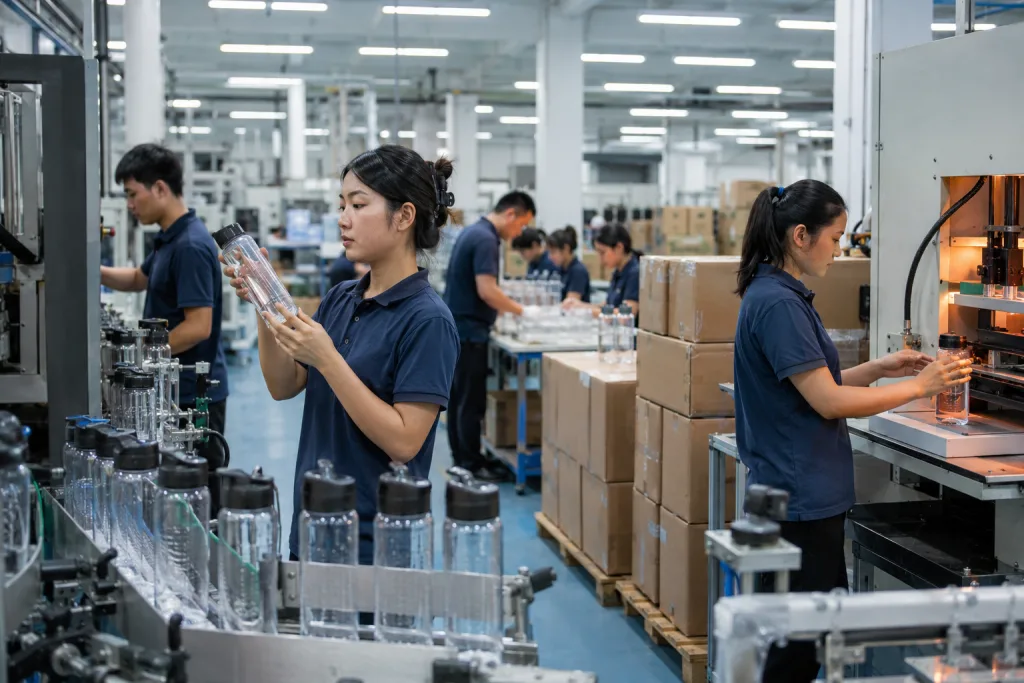
Most sourcing problems with plastic drinkware do not start with price. They start with loose specs, a hand-polished sample that looks better than the line output, and a factory saying yes before the file is locked. If you are buying from a polycarbonate water bottle manufacturer for retail, promotions, or private label, you are buying process control. Resin drying hours, mold-parting stability within 0.15 mm, leak testing, logo adhesion, carton drop results, and documents that pass in Europe and North America. This is the wrong question to ask: not “who is cheapest,” but “who can hold the spec after 20,000 pcs.”
In Zhejiang, we see the same pattern every season. A buyer asks for custom drinkware or a custom canteen, approves a clean pre-production sample, then mass production drifts. Lids crack. Logos rub off after 50 tape pulls. Color moves from the Pantone chip, or the outer carton fails after ocean transit. QC pulled the sample, but the line was running a different lid pin on day 3. We have seen this go sideways over one typo on a PO color code. The practical fix is not more emails. It is failure-mode planning before tooling, before PO approval, and before AQL inspection.
When the resin choice is wrong
The first failure mode is simple and expensive: the bottle body resin does not fit the job. Buyers search for a polycarbonate water bottle manufacturer for clear walls, good impact strength, and a premium look without the weight of stainless steel. That part is fair. Polycarbonate works on plenty of programs we run, especially sports bottles, office bottles, and some promo orders above 3,000 pcs. Still, don’t approve it by default because the sample looks glossy under showroom lights. We’ve seen a 1.2 mm wall sample pass first review, then crack at the gate after field use.
Your actual job is to define use conditions first. Cold-fill only, or occasional warm fill below 60°C? Gym retail, school channels, a canteen distributor network, or a canteen promotional campaign where unit cost matters more than service life? Those are different projects. Different channels fail in different ways, and this is the wrong question to skip. Retail buyers usually push on scratch marks and shelf look after 30 days. A distributor drinkware buyer wants batch-to-batch repeatability, same tint, same thread fit, same carton count. A canteen vendor may care more about 1,000 pcs MOQ and changing logos in 12 days instead of 18. Last season one buyer flagged a PO typo on lid color, but the bigger problem was the resin spec was missing.
What goes wrong if resin selection is loose?
- Stress cracking from aggressive cleaners, alcohol-based contents, or drop impact around gate areas.
- Yellowing or haze if UV stability is not specified.
- Odor complaints if resin grade, regrind ratio, or drying conditions are inconsistent.
- Compliance gaps if the supplier cannot support REACH, LFGB, FDA, or BPA-related declarations requested by your market.
Ask your canteen manufacturer or canteen factory to name the exact resin grade, the approved end use, and whether any regrind goes back into the line. For export orders from Zhejiang, China, we recommend stating 100% virgin food-contact grade resin unless you have already validated another method. That sentence saves arguments later. We dry resin by time and temperature, and QC pulled the sample once because moisture marks showed up before molding had stabilized. If your target market is Europe, ask for migration test reports on the finished article, not raw-material paperwork only. For customizable drinkware or customized drinkware used in corporate gifting, the risk is lower than children’s channels, but the file still needs to be clean.
A good factory should tell you where polycarbonate fits and where Tritan, PETG, or stainless steel is the safer commercial choice. We’ve seen this go sideways when every inquiry gets the same recommendation. That isn’t engineering. That’s quoting.
Thin walls, sink marks, warped bodies
The second failure mode is dimensional instability. A showroom sample can look straight. Then the line starts and you see oval mouths, rocking bases, sink marks near the grip area, and wall thickness drift that cuts impact strength. We usually trace it to rushed mold design, uneven cooling across cavities, or weight cutting before the part is stable. QC pulled one sample last month with a mouth out of round by 0.6 mm, and the buyer flagged it before packing.
If you are buying a customized canteen or customizable canteen for a value-driven program, the first push is often grams. Saving 8-12 g per bottle sounds small, but at 100,000 units it matters. The wrong question is “how light can you make it?” The better question is “what weight still runs clean at full speed?” We have seen factories shave resin first, then check mold flow later. That is how you get sink on the grip, warp at the base, and thread issues in the same lot.
What to specify
- Nominal bottle body wall thickness: typically 2.0-3.0 mm depending on capacity and geometry.
- Wall thickness tolerance: ±0.15 mm on critical zones.
- Neck finish tolerance and thread gauge standard.
- Base flatness requirement: no rocking on flat surface beyond 1.0 mm.
- Visual standard for sink marks, weld lines, and gate vestige.
Ask how the factory controls drying temperature, barrel temperature, and cycle time. Polycarbonate is moisture-sensitive. Bad drying shows up fast: splay, brittle drop performance, and surface defects. A serious canteen supplier logs settings by SKU and by cavity on the machine sheet. If the operator says “we use the usual setting,” that is a red flag. We run into this on night shift more than sales people like to admit.
A pre-production sample is not proof of process capability. It is proof that one sample was made correctly once.
For larger custom drinkware programs, request 20-30 pilot-run samples pulled from normal production conditions before approving packaging. Ask for parts from the start, middle, and end of the run, not 30 pieces picked from one carton. If the supplier in China says tooling is ready in 20 days, add another 5-7 days for pilot verification. That cost is low compared with sorting warped bottles in your warehouse. At BottleForge Industrial in Zhejiang, typical MOQ for a standard bottle with custom color and logo is 3,000 pcs, while a new mold project usually starts at 5,000 pcs and 35-45 days to first tooling samples. Those numbers are normal if the factory is being honest.
Leak claims usually start at the lid
Buyers usually blame the bottle body first. On the line, most claims start at the cap assembly: cross-threading, weak gasket compression, hinge fatigue, spout misfit, or a straw cut 3 mm short. We see this a lot in canteen custom programs because the buyer locks the bottle shape and logo area first, then picks the lid at the end.
If you buy from multiple canteen suppliers or canteen vendors, watch this setup. One factory sells a body from one tool set, then buys the lid from another partner, and the thread match is only checked on a hand sample. The sample passes a quick upside-down test for 30 seconds, then production drift shows up later as field leakage. For a canteen distributor or distributor canteen business, this gets messy fast. Returns come back mixed, QC pulled the sample, and root cause is hard to pin down. We’ve seen this go sideways.
Build the cap spec the same way you build the bottle spec. Call out material, gasket hardness, thread engagement, torque range, and leak standard. We run a thread gauge and a torque meter on first-off samples because this is the wrong question to ask after mass production starts. A practical QC protocol looks like this:
- 100% air leak test at 0.2-0.3 bar for 20-30 seconds, or 100% vacuum test depending on design.
- Torque control for screw caps, for example 8-12 lbf·in depending on thread size and gasket design.
- Drop test with filled bottle from 80-100 cm on key orientations.
- Hinge cycle test for flip lids: 2,000-5,000 cycles.
- Straw fit and bite-valve pull test where applicable.
Do not accept “leakproof” as a marketing word. Ask: leakproof under what test, for how long, and at what pressure? We had one buyer flag this after a PO typo changed “commuter bag test” to a basic bench leak check, and the standard was nowhere near the same. If the item is sold for commuting, you need a stronger standard than for a low-cost canteen promotional giveaway. If your order includes a custom growler or customizable growler line in the same container, keep the test plans separate. Cap systems that work for a wide-mouth growler often fail when copied onto slim portable bottles, and the math doesn't work if you try to share one lid across both.
Good factories in Zhejiang have in-line leak stations and keep test records by production date, shift, and line number. We ship with those records tied back to the lot code on the carton. If a supplier cannot show that, you are buying hope.
Decoration looks good, then fails fast
Plenty of B2B buyers leave logo approval to the last stage. That’s where margin leaks. The sample looks clean because one piece was packed by hand and nobody dragged it across a carton divider. Then the shipment lands, and the print gets scratched during packing, sea transit, or routine washing. The bottle still holds water. You still can’t sell it.
The common failures are familiar on the line: weak silkscreen adhesion, batch-to-batch color shift, uneven laser marks, and logo position drifting 2-3 mm on a curved body. We ship to brand owners, canteen vendors, and 20+ canteen distributors serving schools, gyms, and company accounts, and the buyer flags the same issue every time: the logo panel must stay clean and the color must repeat. “Looks right” is not a spec. This is the wrong question to ask. Ask how the process is controlled.
Questions worth asking
- Is the body surface treated before printing?
- What ink system is used, and is it suitable for polycarbonate?
- What curing time and temperature are used?
- What is the color tolerance against Pantone reference?
- How is logo position checked on curved surfaces?
For practical QC, ask for a cross-hatch adhesion test with tape after full cure, plus a rub test of 500 cycles with a defined cloth and load. QC pulled the sample last month on a white PC bottle because the ink passed visual check but failed after cure under tape. If you are ordering a customizable canteen for dishwasher exposure, say it early. We’ve seen this go sideways. Plenty of printed plastic bottles are not built for repeated dishwasher cycles even when the body itself survives.
The decoration method should fit the channel and price target. Silkscreen is the standard choice for 1-color and 2-color programs, and the math works on 5,000 pcs. Heat transfer suits fuller graphics, but registration and curing need tighter control on the line. Laser holds up well on selected coatings and parts, though it is not always the low-cost option buyers expect. If a factory prices all three methods the same, they are skipping details somewhere.
For a standard 5,000-piece OEM order from China, decoration can add USD 0.05-0.28 per unit depending on method, color count, and print area. That range is normal. We usually see simple 1-color silkscreen near the low end and large-area transfer near the high end. If your quote comes in far below that, expect trimmed print coverage, weaker adhesion, or add-ons after the PO — sometimes it’s a plate charge, sometimes a packing note nobody mentioned.
Compliance paperwork that does not travel
One common failure does not show up on the line. It shows up at customs, during a retail compliance check, or in a customer audit. The bottle itself may be fine, but the file set is old, incomplete, or linked to resin and color masterbatch instead of the finished SKU. We have seen buyers receive a clean-looking PDF pack, then find out QC pulled the sample and the lid ink, silicone gasket, and straw were never covered. That is usually how you tell a real canteen manufacturer from a trader forwarding whatever the upstream factory sent.
For Europe and North America, ask what documents the supplier can support for the exact SKU, not for a “similar item.” This is the right question. Depending on the design and sales channel, that usually means REACH declarations, LFGB or FDA food-contact support, Proposition 65 awareness, packaging material statements, and test reports from a recognized lab. If the bottle is sold to children, the requirement set gets tighter fast. If the item is part of a broader custom drinkware set with accessories, every contact part counts: gasket hardness, straw resin, mouthpiece, and the logo ink system if it sits in a contact zone. We had one PO where the buyer flagged a lid color change from Pantone Black C to warm gray, and that small change forced a fresh review because the colorant declaration no longer matched.
Check the factory system too. Ask to see how they run incoming inspection, not just what certificates hang in the meeting room. Useful signals include BSCI for social compliance expectations, ISO 9001 for quality system discipline, and a written incoming inspection plan with lot traceability back to the resin batch and silicone supplier. None of this guarantees perfect product. It cuts randomness. A factory in Zhejiang or elsewhere in China shipping 400,000-600,000 units per month should be able to show a process flow chart, defect records, and corrective-action logs in 10 minutes, not after three days of chasing paperwork. If they cannot pull that file, we have seen this go sideways.
- Ask for test reports dated within the last 12-24 months, depending on your internal policy.
- Confirm the report matches the actual structure and materials of your bottle.
- Check that colorants and logo processes are not omitted from declarations if relevant.
- Require carton markings, barcode standards, and country-of-origin labeling to be confirmed before mass production.
If you sell through Amazon or major retail, put FNSKU, outer carton label format, and pallet standard into the purchase spec from day one. This is not just chemistry. It is packaging execution. The math does not work if you save 3 days on approval and lose 18 days reworking labels after the buyer flagged a barcode issue at the warehouse. We ship plenty of distributor growler projects, and a launch can fail because the carton print says “Made in Chnia” or the pallet height misses the limit by 20 mm, even when the bottle itself is fine.
Packing and shipping break good bottles
The last big failure point starts after the bottle leaves the line. A good bottle gets damaged by tight pack density, weak dividers, overloaded cartons, or container loading that ignores actual transit stress. We see this most on low-price custom canteen programs where the packing cost gets cut first. On one 1,200-carton run, the buyer pushed for 6 more bottles per carton; QC later found neck rub marks on the top layer before loading.
The practical problem is simple. A clear polycarbonate bottle can pass factory QC and still land with scuffs, neck cracks, or body deformation from top-load pressure if the inner pack is wrong. Ocean freight from China to Europe or North America is rough, and a carton that looks fine in the warehouse can fail after 18 days at sea. Humidity, vibration, compression, repeated loading and unloading all show weak carton design fast. We ship enough of these to say it plainly: this is the wrong place to save $0.03 per unit.
Set shipping specs before approval:
- Carton burst strength appropriate to gross weight, often 5-ply export carton minimum.
- Drop test from 76 cm on corners, edges, and faces.
- Inner protection such as PE bag, tissue, divider, or egg-crate partition depending on finish sensitivity.
- Master carton gross weight ideally under 15-18 kg for easier handling.
- Pallet standard if shipping to 3PL or retail DC.
If you source from 2 or 3 canteen manufacturers or canteen vendors, ask for a packaging approval sheet with photos, dimensions, carton marks, and packing quantity, then freeze it against the PO. We have seen this go sideways when a supplier changed from 24 pcs to 30 pcs per master carton to make the freight math look better on paper. The buyer flagged breakage after arrival, and the carton size on the PO had one digit wrong.
Use pre-shipment inspection with AQL 2.5 major / 4.0 minor as a baseline, and put packaging checks on the checklist. For large orders, QC pulled the sample cartons from the top, middle, and bottom of the pallet stack, not just the easy outer row. That is how you catch compression risk early. Typical lead time for repeat bottle orders from Zhejiang is 20-30 days after deposit and artwork approval, but complex custom packaging usually needs 5-7 extra days because the line has to wait for inserts, labels, or a new carton die-cut sample. Fast shipping is fine. Shipping the wrong pack-out is not.
If a supplier talks only about FOB price and says nothing about pack-out risk, you are not talking to a factory engineer. You are talking to a quote sheet.
Send your bottle spec for a real feasibility check
We will review material, lid design, decoration, MOQ, and compliance risk before you place a PO, with practical feedback from our Zhejiang production team.
Frequently asked questions
What MOQ should I expect from a polycarbonate water bottle manufacturer?
For a standard existing model with custom color and one logo, a realistic MOQ is usually 3,000 pcs per color. If you want a new lid color plus retail box changes, many factories in China will still hold 3,000-5,000 pcs if the packaging is simple. A fully new mold is different: expect 5,000 pcs minimum and tooling development of 35-45 days before first samples. If a supplier offers 500 pcs on a fully customized canteen project, check whether they are mixing stock parts, outsourcing decoration, or planning to charge back hidden setup costs. Low MOQ is possible for stock colors, but not for every OEM detail at once.
Is polycarbonate still acceptable for Europe and North America?
It can be, but you need to verify market fit and compliance support carefully. Many buyers now prefer alternative copolyesters for some categories, while polycarbonate still remains viable in selected commercial applications because of clarity and toughness. The right question is not whether the material is fashionable; it is whether the finished bottle meets your customer expectation and documentation requirement. Ask for food-contact support relevant to your destination market, such as LFGB or FDA-related testing, plus REACH declarations where needed. Also confirm the bottle is intended for the actual use condition you will sell: cold fill, warm fill below a defined limit, hand wash only, or other stated use.
How do I compare a canteen supplier quote beyond unit price?
Break the quote into five blocks: bottle body, lid system, decoration, packaging, and compliance/testing. A bottle quoted at USD 1.35 FOB may actually be more expensive than one at USD 1.48 if the first quote excludes individual polybags, leak testing, logo setup, or stronger export cartons. Ask each canteen supplier for net weight, wall thickness, resin grade, gasket material, print method, packing quantity, carton size, and test standard. Then compare apples to apples. Also compare lead time honestly. A repeat order at 25 days from Zhejiang with stable QC is usually worth more than a shaky 18-day promise that creates claims after arrival.
What quality standard should I put in the PO for customized drinkware?
Use measurable criteria. At minimum, define material specification, approved color reference, logo placement tolerance, leak test method, appearance standard, packing method, carton marks, and inspection standard. Many buyers use AQL 2.5 for major defects and 4.0 for minor defects on final inspection. For bottle performance, specify 100% leak testing at 0.2-0.3 bar for 20-30 seconds, no sharp edges, no rocking above 1.0 mm, and no print failure after a cross-hatch tape test and a 500-cycle rub test. Add barcode and label approval if shipping to retail or FBA. If you leave these items out, the factory will fill the gap with its own assumptions.
Can one factory handle custom canteen, custom growler, and sports bottle programs together?
Sometimes, yes, but do not assume capability just because the catalog is wide. Many suppliers show a broad range while actually sourcing some categories from partner factories. That is not automatically bad, but you need transparency. Ask which products are made in-house, what monthly capacity is available, and whether the same QC team controls all categories. For example, a factory may be strong on plastic sports bottles at 500,000 units per month but only assemble growlers through outside partners. If you are a canteen distributor or distributor growler buyer building one mixed container, that matters for lead time, packaging consistency, and traceability when claims happen.