Key Takeaways
- For polycarbonate water bottle bulk, a realistic MOQ is 3,000-5,000 pcs per color, with 25-35 day lead time after sample approval.
- A 700ml PC bottle with PP lid and one-color print often lands at FOB Ningbo around USD 1.65-2.40 at 5,000 pcs, depending on wall thickness and packaging.
- Set QC limits before deposit: AQL 2.5 for major defects, 4.0 for minor, plus 100% leak test and drop test from 1.0-1.2 meters.
- Ask for REACH, LFGB or FDA contact compliance by component, not one generic report for all bulk drinkware SKUs.
You need polycarbonate water bottle bulk for a program launch, not a factory tour speech. China has no shortage of suppliers. Zhejiang alone gives you dozens to quote in one afternoon. The real job is freezing the spec before sampling turns into production errors: wrong resin grade, lid thread tolerance off by 0.3 mm, logo adhesion failing after 50 dishwasher cycles, cartons over the pallet height limit, or a bottle that passes leak test at 0.03 MPa but stalls on REACH paperwork.
A smart buyer treats bulk drinkware like an engineering order with a ship date. That sounds blunt because it is. At BottleForge Industrial in Hangzhou, Zhejiang, we usually run new buyers through one live PO from first RFQ to final AQL, and QC pulled the sample at each checkpoint. That is the practical way to source polycarbonate water bottle bulk, whether you also buy wholesale canteen lines, beer tumbler wholesale bulk, or growler bulk for the same catalog.
The PO starts with a real brief
A buyer from Germany sent us a short brief: polycarbonate water bottle bulk for a gym chain, 12,000 units, two colors, launch in 8 weeks. Sounds clean. It usually isn’t. The PO is still missing the points that set price, compliance, and scrap rate on the line. If those points stay open, the factory will make the call for you. We’ve seen this go sideways over a lid thread pitch and a logo position off by 3mm.
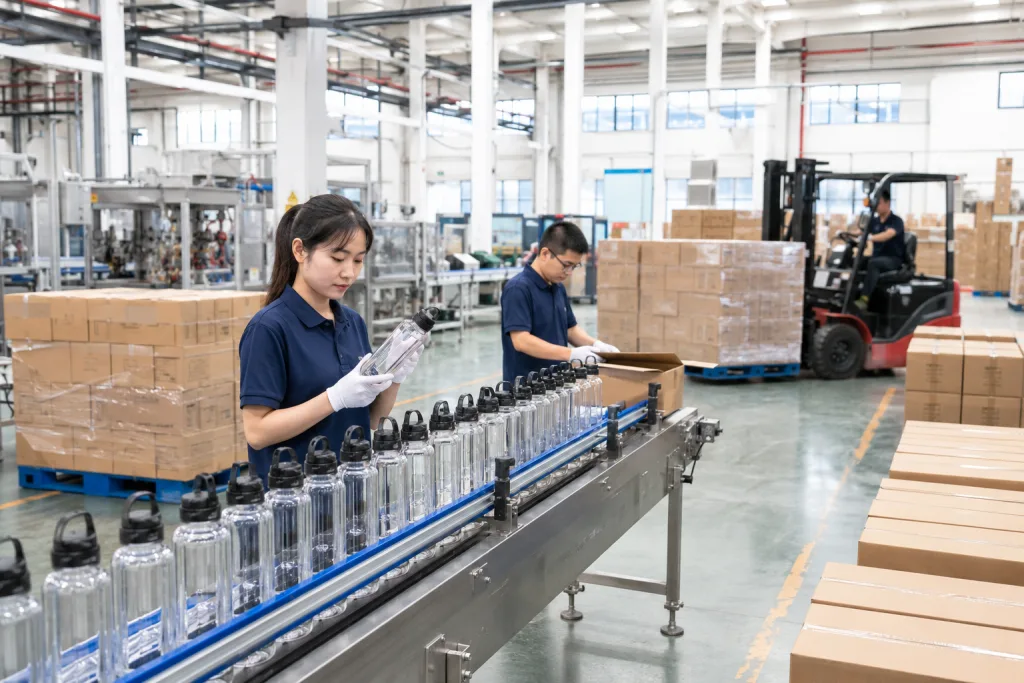
The first step is turning a sales idea into a production spec sheet. For this order, we lock in 700ml fill capacity, BPA-free virgin polycarbonate body, translucent smoke and clear blue colorways, PP screw lid, TPR carry loop, 63mm mouth diameter, body wall thickness 2.2mm nominal, unit weight 148g plus or minus 5g, one-color silk screen logo, and individual polybag with egg-crate divider in a 24-piece export carton. We also note carton gross weight must stay below 12kg because the buyer’s 3PL in the EU charges extra for handball cartons above that level. That detail matters. On our floor, QC pulled the sample once at 12.4kg after packing, and the math didn’t work until we changed the divider board grade.
- MOQ: 5,000 pcs per model, split into 2 colors
- Sample time: 7-10 days for pre-production sample
- Mass production: 30 days after deposit and artwork approval
- Factory capacity: 600,000 units/month across plastic and steel drinkware lines
If your assortment also includes canteen bulk, wholesale drinkware, or alcohol flask wholesale bulk, keep them in separate briefs. This is the right move. Buyers often cram 3 product categories into one RFQ, then ask for one target price and one ship date. We run PC bottles on one line and stainless on another; the tooling, leak test, and lead time are not the same. Last month a buyer flagged this after mixing a PC sports bottle with a wholesale growler in one PO, and even the carton mark had the wrong item code typed twice.
Where price really moves
Once the spec is locked, the price talk gets real. Buyers ask for the best wholesale drink bottle. That is the wrong question to ask. For polycarbonate, price moves on resin grade, wall thickness in mm, decoration method, pack-out, and how well we load the carton. For this 700ml bottle, a practical FOB Ningbo range at 5,000 pieces is USD 1.65-2.40. At 20,000 pieces, you may shave off 8-14%, mostly from better resin buying and less setup waste on the print line. We see this on the floor: once the screen is aligned and the first 300 pieces are stable, unit cost drops fast.
What changes the number?
- Resin: food-contact virgin PC costs more than mixed or recycled content. For export to Europe and North America, do not get clever here. QC pulled the sample more than once on off-grade resin because haze and odor showed up after hot-water testing.
- Weight: raising body weight from 148g to 170g can add USD 0.10-0.18 per piece. That sounds small until you run 20,000 pcs; the math doesn't work if your target retail stays flat.
- Decoration: one-color silkscreen is usually cheapest; heat transfer wrap or full-color print can add USD 0.12-0.35. A buyer flagged logo shift last month at 1.5mm, which was still visible on a clear bottle.
- Lid complexity: a basic screw cap is cheaper than a flip straw lid with more moving parts and seals. More parts, more leakage points. On the line, that means extra assembly time and another water-leak check.
- Packaging: color box can add USD 0.20-0.45 versus polybag and divider pack. We ship plenty of club-store orders this way because a color box looks good, but carton size jumps and container loading drops.
This matters when you compare categories. A bulk canteen in stainless steel, a beer growler in bulk, or a beer tumbler wholesale SKU may sit next to this bottle in your lineup, but the factory cost build is different. Stainless jobs bring in tooling depreciation, welding, vacuum testing, and coating. Polycarbonate does not. The same is true for growler wholesale and beer tumbler in bulk projects. We have seen buyers benchmark a single-wall PC sports bottle against a double-wall tumbler, then push for the same margin. It goes sideways fast.
The cheapest quote in Zhejiang is often cheap because some detail is missing. Ask what is excluded: testing, spare lids, barcode labeling, export carton marks, or mold maintenance. We once got a PO with the carton mark typo left unconfirmed, and reprinting 5,000 labels was not free.
Sampling is where failures appear early
The buyer approves the quote and pays for a pre-production sample. Good. This is where problems show up cheap. A sample review is not about whether the blue looks good on a white desk; it is about whether the bottle matches the process we run on the line and the goods you will receive in bulk. We have seen buyers sign off a clean-looking sample, then reject mass goods because the wall feel changed by 6g after cycle time was cut. That miss starts here.
For this order, we send three sample types: an existing-tooling reference, a color chip approval, and a logo print approval. If a new mold or modified neck finish is involved, add a fourth stage with T1 tooling samples. The buyer should ask for a simple sample checklist with measured data, not sales copy. We usually attach fill volume, weight, cap torque notes from the torque tester, and a photo of the neck gauge result in mm. This is the right question to ask.
What we check on the sample
- Capacity at brimful and practical fill line
- Net weight against target 148g +/- 5g
- Thread fit and torque feel on lid engagement
- Leak test: inverted 2 hours, then shaken 30 cycles
- Dishwasher statement, if any, matched to material and decoration limits
- Print adhesion by cross-hatch and tape pull
- Color match against Pantone under D65 light source
- Odor check after 24-hour water hold
This is also the stage where buyers ask if the same factory can supply drinkware bulk beyond the PC bottle. Usually yes, but assumptions cause trouble. A supplier that handles canteen wholesale or wholesale growler may subcontract part of the range, and we have seen this go sideways when the buyer thought one QC standard covered 12 SKUs from 3 workshops. That is the wrong question to ask. Ask which SKUs are made in-house, which come from partner lines, and who owns final QC. At BottleForge, we say it plainly when a beer growler wholesale bulk order or alcohol flask bulk program runs through a partner line instead of our core bottle line in Zhejiang. QC pulled the sample from the partner batch, not from our own injection line.
If the sample passes, freeze it. Put date, revision number, approved artwork, and carton spec into one PDF. Add one thing buyers often miss: the signed sample photo with PO number and revision, because we once saw a PO with the logo position typoed by 8mm and the file moved straight to production. That PDF should sit behind the purchase order and the production release.
Compliance paperwork should match the bottle
For Europe and North America, the paperwork needs to match the bottle, not sit beside it. Buyers ask for a “food grade test report” like one PDF clears the full SKU. It doesn’t. For polycarbonate water bottle bulk, compliance should tie back to each component in the BOM and the market you ship to. We’ve seen QC pull a sample and find the seal hardness changed from 60 Shore A to 50 Shore A while the old report stayed in the file.
For this gym-chain order going to the EU, we build one file around the actual build: PC body, PP lid, silicone or TPR seal, decoration inks, and outer packaging if the customer policy asks for it. That is how we run it on the line. Depending on destination, the buyer may ask for REACH, LFGB, or FDA-style food contact declarations. If the bottle is sold for kids, ASTM or CPSIA-related checks may matter too, based on the claim set and channel. Last season, one buyer flagged a PO typo where the lid resin was changed but the declaration still showed the old grade.
- Ask for: declaration of conformity by component and current test reports from a recognized lab
- Check dates: reports older than 2 years may not satisfy your retailer
- Match SKU: lid material and seal material on the report must match the actual BOM
- Factory audit: if your customer requires BSCI or ISO-style systems, confirm before deposit
This is where category mix-ups start costing time. A wholesale canteen, growler bulk, or beer tumbler bulk program may need different declarations because the structure changes, sometimes just from a single inner coating or cap assembly. The same issue shows up with alcohol flask wholesale and alcohol flask wholesale bulk; stainless bodies, coatings, and captive caps create different risk points than PC bottles. Build a compliance matrix if you run 12 SKUs. Chasing paperwork carton by carton is the wrong question to ask.
China factories see this request every week, but the request has to be precise. “Send your certificates” gets you a mixed folder and 18 files that do not match the shipment. “Send LFGB migration report for PC body, REACH SVHC statement for all components, and print ink declaration for SKU BF-PC700A revision 3” gets results. That wording saves days—12 days vs 18 days is common once the lab file, BOM, and artwork all line up.
Production control before cartons stack up
After sample approval and deposit, we book resin, match the color masterbatch, burn the printing screens, lock the assembly plan, and reserve cartons. This is where orders go clean or go sideways. We run 3 control points on jobs like this: a pre-production meeting, inline inspection on the line, and final random inspection before the cartons stack up.
For this 12,000-piece order, we pull a pre-production meeting with production, QC, and sales before the first hopper is loaded. The golden sample stays on the table. We check artwork position in mm, confirm the leak-test method, and verify carton marks, including EAN label placement. If the buyer sells online, we also add FNSKU labeling and confirm carton size against Amazon FBA limits. Last season, one buyer flagged a PO typo on the outer mark, so now we read back every line before printing starts.
QC plan used on this order
- Incoming material: resin lot check, color masterbatch confirmation, lid gasket inspection
- Inline QC: every 2 hours measure weight, thread fit, print position, and color consistency
- 100% testing: leak test on all finished units before packing
- Drop test: 1.0m, packed sample on edge, face, and corner
- Final inspection: AQL 2.5 major, 4.0 minor, ANSI/ASQ Z1.4 single sampling plan
Major defects on polycarbonate water bottle bulk are usually clear: leaking lids, cracked necks, deep scratches in the viewing area, wrong logo, or odor. Minor defects are tighter calls, so they need a written limit: slight print shift within the approved tolerance, a small black speck outside the main display face, or a carton mark smudge. QC pulled the sample once for a 1.5 mm logo shift that sales thought was fine; the buyer did not. If the supplier cannot define defects with photos and numbers, final inspection turns into an argument. That is the wrong question to leave until shipment week.
Lead time is usually 25-35 days in normal season from approved sample to shipment. Before summer and Christmas promotions, add 7 days. Zhejiang factories ship fast, but only after the spec is frozen and artwork stops changing halfway through molding. We have seen a 25-day plan slip to 32 days because the buyer changed the logo size after screen approval. The math doesn't work if the line keeps waiting for revised files.
Shipping math buyers often miss
After inspection, some buyers switch off. Too early. Shipping cost per unit is driven by pack-out, not only FOB. For this 700ml PC bottle, the export carton is 58 x 38 x 46 cm for 24 pieces. On our line, a tape measure and floor scale settle the argument fast. Around 6,000-6,500 units may fit a 40HQ depending on divider style and whether you use retail boxes. We have seen a 6 mm thicker divider cut container load by a few hundred bottles. The math doesn't work if you save a few cents on unit price and lose it back in freight.
Here is the practical checklist before balance payment:
- Confirm final carton dimensions and gross weight from actual packed cartons, not estimates
- Check pallet pattern if your warehouse requires Euro pallets or specific height limits
- Verify barcode readability and placement before sealing all cartons
- Confirm spare ratio for lids or seals, usually 0.3-0.5% free of charge on larger orders
- Match shipping marks to PO, destination DC, and carton count sequence
If you source mixed drinkware wholesale programs from China, this gets more sensitive. A compact PC bottle usually cubes well. A beer growler bulk item or beer tumbler wholesale bulk SKU often ships more empty space than product, and QC pulled one sample last month where the insert collapsed under top-load. A bulk growler range with swing-top lids also brings higher breakage risk and slower packing speed on the line. Buyers who compare FOB only usually miss this, then ask why landed cost is off by 9-15%.
For North America, buyers now ask for item labels, carton labels, and routing compliance at source. Fine. Put it on the PO. We had one case where the buyer flagged a missing suffix on the carton mark after 40% of the order was packed, and relabeling added 2-3 days plus labor. This is the wrong question to ask after packing starts. The factory is not being difficult. We already sealed the cartons.
What the buyer changes on the second order
After the first shipment, a good buyer does a fast post-mortem. In this case, the gym chain launch lands well, but the customer team sends back two clear notes: users want a wider carry loop, and the translucent smoke color sells 30% faster than blue. On the second order, the buyer raises smoke volume, cuts blue, and switches to a softer TPR loop while keeping the same lid structure. We see this a lot on the line. It is the right change because user feel improves, while the neck finish and bottle body tooling stay untouched, so you avoid a new mold bill and another 15-day validation round.
This is where sourcing gets simpler, and this is also where buyers make bad assumptions. Once a supplier has run one plastic bottle program cleanly, you can ask them to quote adjacent SKUs such as canteen bulk, wholesale drinkware, or a seasonal growler wholesale line. If you also want beer tumbler in bulk or beer growler wholesale, ask for a separate capability review. Do not assume all drinkware categories are equal. We have had buyers push back on this, then QC pulled the sample and found stainless weld polish that was fine for promo stock but not fine for retail shelves. Some China factories run injection and assembly well, with stable loop pull tests and lid fit, but stay average on vacuum stainless finishing. Better to know that before the catalog gets wider.
The point is simple: the first polycarbonate water bottle bulk order should build a control system you can repeat. Keep the BOM fixed, lock approved samples, track complaint rate, and ask your Zhejiang supplier for corrective action with numbers. If leak complaints are 0.18%, say 0.18%, not “a few issues.” This is the wrong question to soften. We have seen this go sideways when a PO note says “improve seal” and nobody defines whether the issue came from the silicone hardness, cap torque, or a 0.3 mm flash on the thread. Procurement managers protect margin by making launches boring. That is how we ship repeat orders without surprises.
Send your bottle spec and get a workable quote
Share capacity, target price, market, logo method, and quantity. We will review the BOM, MOQ, compliance path, and lead time before you place a risky PO.
Frequently asked questions
What is a normal MOQ for polycarbonate water bottle bulk orders?
For an existing mold, a normal MOQ is 3,000-5,000 pieces per model, often with a minimum of 1,000-2,500 pieces per color depending on resin color and decoration setup. If you need a custom body shape or a new lid mold, practical MOQ usually starts at 10,000 pieces to justify tooling and trial costs. For a straightforward 700ml bottle from China, many Zhejiang factories can combine two colors inside a 5,000-piece order, but custom packaging, retail gift box, or multiple logo versions may push the effective MOQ higher. Always ask whether MOQ is based on one SKU, one color, or one packaging configuration, because suppliers use those terms differently.
How much should I budget per unit for a bulk order?
A realistic FOB China price for a 600-750ml polycarbonate bottle is usually USD 1.50-2.50 at 5,000 pieces, assuming virgin BPA-free PC body, PP lid, one-color silkscreen logo, and standard export packing. Heavy-wall bodies, flip lids, color boxes, or full-wrap decoration can push the price to USD 2.80 or more. At 20,000 pieces, price may improve by 8-14%, but not if you keep changing artwork or split too many colors. Ask for a costed quote showing bottle, lid, decoration, and packaging separately. That makes it easier to compare options like bulk polybag pack versus color box without restarting the whole quotation.
What tests should I require before shipment?
At minimum, require 100% leak testing, final inspection to AQL 2.5 major and 4.0 minor, print adhesion test, color verification, and carton drop testing. For product compliance, ask for current material reports relevant to your market, such as REACH or LFGB-related documentation for EU programs. On functional testing, we recommend an inverted leak hold for 2 hours, shake test, and a packed-carton drop test from 1.0-1.2 meters. If the bottle has a strap or carry loop, add a pull test with a defined load, for example 5kg for 1 minute. Make sure the lab reports and QC checklist match the exact SKU revision, including lid and seal materials.
Is polycarbonate still acceptable for Europe and North America?
It can be, if you specify the right resin grade and support it with proper food-contact documentation for your target market. Buyers should ask for BPA-free virgin material declarations and component-level compliance paperwork, not generic marketing claims. Some retailers or brand policies still prefer Tritan, recycled PET, or stainless steel for image reasons, so commercial acceptability is not the same as legal acceptability. If your customer has internal sustainability or material restrictions, confirm them before sampling. We often see buyers approve a PC sample in China and then learn later that their European retail customer only accepts another material family. That mistake costs more than any lab test.
How long does production and shipping usually take?
For existing tooling, sample approval usually takes 7-10 days, and mass production takes about 25-35 days after deposit, artwork approval, and carton confirmation. In peak season, especially before summer promotions, add around 7 days. Ocean transit then depends on route, but many buyers should plan roughly 25-40 days on water plus clearance time. If you need FNSKU labels, retail inserts, or retailer-specific carton marks, include that in the timeline from day one. A supplier can move fast on molding and assembly, but last-minute labeling changes commonly delay shipment by 2-3 days because packed cartons need to be reopened and reworked.