Key Takeaways
- For real vacuum insulation, 18/8 stainless double-wall bodies are standard; MOQ often starts at 1,000-3,000 pcs per SKU.
- Typical custom thermos lead time is 7-12 days for pre-production samples and 30-45 days for mass production from Zhejiang, China.
- AQL 2.5/4.0 inspection, REACH testing, and coating adhesion checks reduce claim rates by 1-3% on bulk thermos programs.
- FOB unit pricing for a 500 ml customized thermos commonly runs about USD 3.20-6.80 depending on finish, lid tooling, and packing.
You searched for a polycarbonate vacuum flask manufacturer, but the first decision is simpler: should this project be stainless at all? We see 12 outdoor retailers and promo buyers out of 20 start with the same brief—durable flask, custom logo, gift-ready packaging, and a landed cost under USD 6.00 or USD 10.00 by channel. Then purchasing sends the real list: heat retention target, food-contact compliance, 1.2 m drop test, coating adhesion, and MOQ pressure from the sales side. This is the wrong question to ask too late. On our line, a logo position shift of 3 mm can already hold sampling for a day; material confusion holds it much longer.
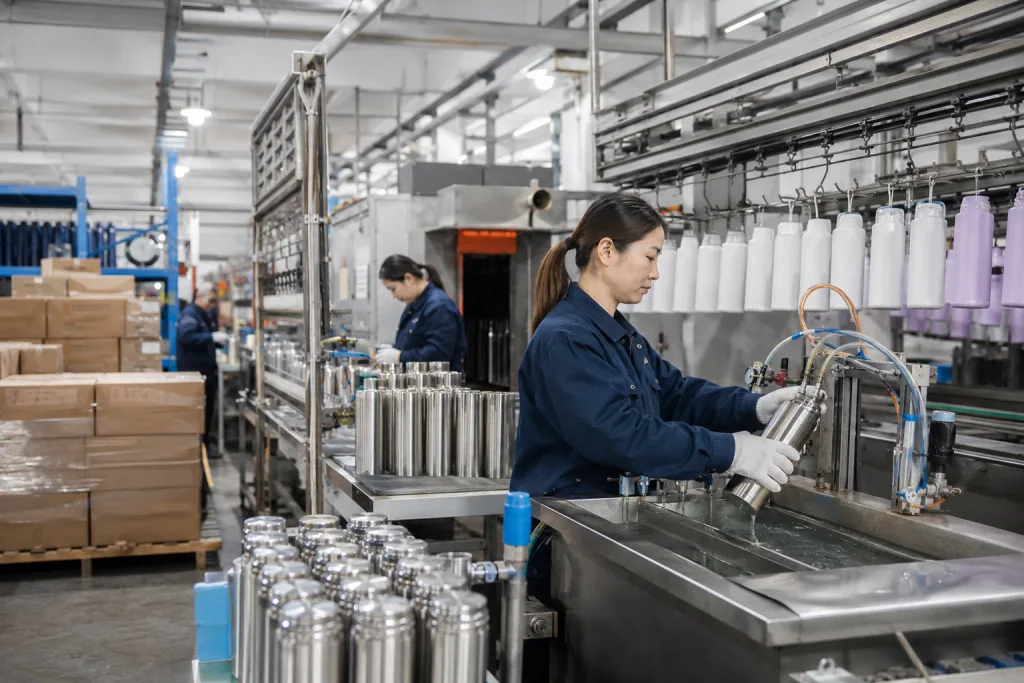
At BottleForge Industrial in Hangzhou, Zhejiang, China, we make stainless drinkware, not polycarbonate vacuum insulation bodies, so we’ll be direct. If you need actual vacuum performance, stainless is usually the practical route. We run 304 stainless vacuum bodies and ship them after vacuum and leak check; polycarbonate still fits for lightweight shells, clear parts, or lower-cost lids and accessories. We’ve seen this go sideways when a buyer flagged heat retention after approving a plastic-forward concept, and the sample schedule moved from 12 days to 18 days. Last month QC pulled the sample on a PO with the lid material typed wrong, and that single typo cost four days.
Start with the material question
Buyers ask for a polycarbonate vacuum flask manufacturer all the time, but that phrase usually mixes up two different products. First is a true vacuum flask: double-wall construction with vacuum pulled between the walls, often checked on the line after welding. Second is a drink container that uses polycarbonate only for parts like the lid, cup, clear outer shell, or small accessories. If you need 6-12 hour heat retention for retail outdoor use, the body is usually stainless steel, not polycarbonate. That part is simple.
We stay strict on this because a good thermos manufacturer should question the brief before sending a price. This is the right first step. Polycarbonate has its place, but it does not replace a 304 stainless vacuum body. We’ve had buyers ask for a clear vacuum flask, then pull back after seeing wall thickness and heat-loss limits on the sample report. For a bulk thermos program going to camping stores, ski shops, or corporate gifting, we usually run this structure:
- Inner and outer wall: SUS304, sometimes SUS316 for premium corrosion resistance
- Lid and stopper parts: PP, Tritan, silicone, sometimes polycarbonate depending on design and market requirements
- Seal system: food-grade silicone with leak testing
- Surface finish: powder coating, spray paint, PVD, or brushed steel
If your brief is weight first and cost second, and insulation is not critical, then a non-vacuum polycarbonate bottle may be the better fit. If your brief is outdoor retail, hot drinks, winter use, and gift packaging, a custom thermos based on stainless vacuum construction is the safer spec. We see this go sideways in Zhejiang: a buyer sends 10 RFQs, gets 10 fast prices, then finds out half the factories quoted the wrong structure. Last month one PO even said “PC vacuum body” when the target sample was 304 stainless with a PC cap. QC pulled the sample, and the mismatch showed up before tooling deposit. That saves money. Fast quotes on the wrong build do not.
Questions to settle before quoting
A usable quote needs more than capacity and logo art. If you are talking to thermos manufacturers or any supplier thermos source, lock the commercial and technical basics first. Otherwise each factory is quoting off its own assumptions, and the numbers will not line up. We see this on the line all the time: one buyer asks for a 500 ml bottle, but the drawing shows 71 mm OD while the cup holder limit on their market sample was 74 mm.
Checklist buyers should answer
- Capacity and size: 350 ml, 500 ml, 750 ml, or 1,000 ml. A 500 ml model can be 70-72 mm diameter or closer to 75 mm depending on insulation target.
- Use case: say where it sells and who uses it. Hiking retail, employee gift, school distribution, fuel-station promo, or a premium ecommerce bundle all need different specs. The buyer flagged this before on a PO because the gift-box version needed a cleaner neck weld than the promo version.
- Target FOB price: give the number early, for example USD 3.80, USD 5.20, or USD 7.50. This is not sensitive; this is the right question. If your target is USD 3.80 and your spec calls for a copper-coated vacuum body plus laser logo, the math does not work.
- MOQ tolerance: 1,000 pcs for stock color + one-color print, or 3,000 pcs for custom body color and molded lid. We run mixed orders every month, and MOQ changes fast once a custom mold base or color masterbatch gets involved.
- Decoration: silk screen, heat transfer, laser engraving, embossed badge, or full-wrap pattern. Each process hits cost and yield differently. QC pulled the sample last month because a full-wrap print was 1.5 mm off the seam line.
- Compliance market: EU REACH, LFGB, North America FDA-related food-contact expectations, California labeling needs, ASTM where applicable for components. Buyers skip this and then push for retest later. We have seen this go sideways after packaging was already printed.
- Packaging: white box, color box, PDQ tray, master carton drop test standard, barcode and FNSKU if needed. Put the carton details on the RFQ. One PO came in with FNSUK typed instead of FNSKU, and the buyer caught it only after the first label file was made.
At our Hangzhou facility, standard sample lead time is 7-10 days for stock-tool customizable thermos projects and 35-45 days for production after approval. We ship above 600,000 units per month across multiple drinkware lines, but that does not mean every factory thermos order moves fast. This is the wrong question to ask. The better question is what adds time: a matte powder coat in two Pantone colors, a custom stopper, and retail inserts can turn 35 days into 45-50 days. Ask your thermos vendor to spell out what the lead time includes. Tooling, sample courier time, packaging proofing, and lab tests need to be listed one by one. On our floor, the powder coat oven queue and stopper fit check with the go/no-go gauge are usually where the extra days show up.
A usable RFQ is not a mood board. It is a costed technical brief with a target channel, target price, and target compliance list.
How custom pricing actually moves
Buyers ask this every week: why does one manufacturer thermos quote land at USD 3.40 and another at USD 5.90 when both are sold as a 500 ml flask? The short answer is simple. They are not the same build. We see the gap come from steel weight, body thickness, surface finish, lid parts, pack-out, and reject risk on the line. Last month QC pulled the sample on a “same spec” project and the body weight was 268 g versus 312 g. That alone changed the cost and the feel in hand.
For a typical 500 ml stainless vacuum flask, use these FOB China ranges as a first check, not the final answer. This is the wrong question to ask if you skip the actual spec sheet.
- Entry promotional thermos: USD 3.20-4.10, stock lid, single-color print, white box, MOQ 3,000 pcs
- Mid-range customized thermos: USD 4.20-5.60, powder coat, leak-proof stopper, laser logo or two-color print, MOQ 2,000 pcs
- Premium outdoor thermos custom: USD 5.80-8.50, improved copper coating for insulation, textured finish, custom mold lid, color box, MOQ 1,000-2,000 pcs plus tooling
Steel weight moves price fast. Saving USD 0.15-0.30 per unit by lightening the body sounds good on paper, but we have seen this go sideways after drop tests and return claims. A 0.4-0.5 mm body is a common target for outdoor retail, depending on the shape and shoulder radius. We run micrometer checks at the neck and lower wall because some mills drift. One buyer pushed for a 22 g reduction on a hard-use SKU; six weeks later they flagged denting at the base.
Decoration changes the math too. A one-color silk print is low cost, but it can scuff after carton rub or rough handling in discount channels. Laser engraving sometimes comes in above print, sometimes below, depending on the curvature and fixture time on the laser station. If the job is a promotional thermos for event giveaway, keep it clean and cheap. If it needs shelf impact, budget for powder coat, a better color box, and pre-shipment inspection. On one recent PO, the buyer typed “mat black” instead of “matte black,” and we still had to confirm the coating code before the line started.
Good thermos suppliers should break the quote out line by line: unit cost, packaging surcharge, tooling, sample charge, and test fees. If everything is rolled into one number, cost-down talks get messy and the math does not work. We ship cleaner programs when these items are split early, especially once sample revisions start and the carton spec changes from a plain white box to a 5-panel color box.
Branding options that survive handling
The wrong logo process turns a decent flask into a complaint source. We see it on the line. Outdoor retailers usually ask for abrasion resistance after a 500-cycle rub test, while promo buyers push for 10-day shipment and low plate cost. Those are different jobs, so your customized thermos decoration needs to match the sales channel.
What usually works
- Silk screen: low setup cost, good for 1-2 colors, best on smooth bodies. We run this most often from 3,000 pcs up. Expect wear if the bottle rides in a metal cup holder or tool bag.
- Heat transfer: better for larger artwork or multi-color graphics. Surface prep decides the result. If the coating thickness drifts outside 60-80 microns, QC pulled the sample and adhesion started failing.
- Laser engraving: durable and clean on stainless or coated surfaces. Common for corporate thermos promotional programs because the mark stays sharp after handling, and the buyer flagged fewer logo rub-off claims.
- Pad print on lids: works for small top logos, usually 12-25 mm. Not for heavy abrasion zones. We have seen this go sideways when a buyer wants a sidewall effect on a curved PP lid.
- Embossed or molded logo: strongest long-term look for custom lid tooling. Upfront cost is higher, often one new mold insert, and the math doesn't work for a 1,000 pc trial order.
For a custom thermos program in the USD 4.50-6.00 band, powder coating plus laser logo is usually the best balance of durability and shelf feel. For low-cost thermos bulk event orders, stock color plus one-color screen print is the cleaner call. This is the wrong question to ask, but buyers still ask it: "Can I get premium decoration at promo pricing?" Usually no. We ship enough of these to know where cost gets cut next, and it is often the carton spec from 5-ply down to 3-ply or finish consistency at the rim.
If your design includes transparent parts, ask whether they are Tritan or polycarbonate, and ask why that resin was chosen. Buyers mix up those terms all the time. Last month one PO even typed "polycarbinate" on a lid approval sheet. Clarify resin grade, food-contact declarations, and market restrictions before approval, especially if the wall thickness is 2.0 mm and the part sees hot-fill use. Any experienced thermos factory or thermos supplier in China should send material data and compliance papers, not just a nice rendering.
Quality control buyers should insist on
If you are sourcing from China for North America or Europe, write quality control into the PO and artwork pack. Do not leave it as a polite expectation. A good distributor thermos program repeats because the acceptance standard is clear, down to AQL and test timing. We run into fewer disputes when buyers lock this before sampling, and QC pulled the sample against the signed limit sample instead of arguing after the carton is sealed.
Minimum controls worth asking for:
- AQL plan: commonly Major 2.5 / Minor 4.0 for final random inspection
- Vacuum retention test: for example 95°C fill, measured after 6 or 12 hours based on your target spec
- Leak test: inverted or pressure method on 100% of units where practical
- Coating adhesion: cross-hatch or tape test after curing
- Salt spray: if you sell coastal or outdoor use products and claim finish durability
- Drop test: packaged drop from set heights, usually 76-100 cm depending on carton standard
- Material compliance file: REACH, LFGB where required, and factory declarations for food-contact components
Ask your thermos distributor or sourcing team if they need third-party audits such as BSCI, ISO 9001 process control, or social compliance records. Then check the document dates and scope line by line. This is the wrong question to ask if you only ask, "Do you have the certificate?" We have seen buyers flag an audit that covered one workshop, while the lid supplier on the same PO was outside scope, and that 1.2 mm silicone seal caused the leak complaint.
Practical note: if the order is below 2,000 pcs, some buyers skip inspection to save USD 250-400. The math does not work on a customizable thermos with custom packaging. We ship projects where one retail carton typo or 3 leaking units in a 200-piece spot check can hold the whole launch, and the buyer flagged it after goods landed. One missed inspection fee is small; chargebacks, relabeling, and customer service hours cost more fast.
MOQ, lead time, and packaging trade-offs
MOQ is where ideas either get approved or die on the costing sheet. For a stock-body stainless bottle with a standard lid, one-color logo, and white box, 1,000 pcs per size is usually workable. If you move to a custom lid mold, Pantone-matched powder coat, and a full retail box, the starting point is often 3,000 pcs or higher. Sometimes we can split by color. Sometimes we can’t. The line still has to run, and a new lid mold is not free.
Here is the practical buying logic:
- Use stock tools first if you are testing a new channel. We’ve seen buyers spend on a new cap tool, then reorder only 600 pcs six months later. The math doesn’t work.
- Save custom mold budget for lids or handles that create visible brand difference. A body color change is easy; a new handle core in the mold is where buyers usually notice value.
- Do not over-customize the first PO unless your annual forecast supports it. If your forecast says 12,000 pcs a year, don’t build a project around a 3,000-pc trial with 4 SKUs and separate inserts.
Lead time depends on what your team actually approves. A digital mockup is not a pre-production sample. If you sign off artwork only, you are taking the risk on logo size, coating feel, and even lid fit; QC pulled one sample last month where the silicone ring was 0.8 mm off and the cap torque changed. For most thermos customized orders from Zhejiang, plan roughly:
- Artwork and quotation alignment: 2-5 days
- Pre-production sample: 7-12 days
- Sample courier and approval loop: 4-8 days
- Mass production: 30-45 days
- Peak season buffer before holiday periods in China: add 7-15 days
Packaging is where a cheap quote gets expensive fast. Outdoor retail usually needs stronger cartons and better shelf presentation than corporate gifting, and e-commerce has its own rules. If you sell online, ask for barcode position, carton size control, and FNSKU labeling if needed. We ship plenty of suppliers thermos programs where the buyer flagged outer cartons that were 12 mm over spec for automated receiving. That sounds small. It becomes a chargeback. A low unit price gets wiped out by oversized cartons, bad pallet stacking, or relabel work after arrival.
When stainless beats polycarbonate
If you started with the phrase polycarbonate vacuum flask manufacturer, you may still end up running a stainless program. We see that often. Not because stainless sounds upscale, but because it solves the sales problem better in 6 or 7 common channels, especially outdoor retail and gift sets where buyers compare weight, finish, and heat data side by side. On our line, QC pulled the sample after a 12-hour hold test and the stainless unit still met the claim cleanly.
Choose stainless vacuum flasks when you need:
- Hot and cold retention you can print on the box without getting buyer pushback after a 6-hour or 12-hour test
- A stronger premium feel for outdoor retail and gifting, where a 0.5 mm wall and powder coat usually sell better than clear plastic
- Lower odor retention risk after repeated use; we have seen tea and coffee smells stay in plastic lids longer
- Stronger perceived value at USD 4.00-8.00 FOB ranges; this is where the math often works for stainless
- More durable logo options for a thermos customized retail SKU, such as laser marking or screen print that holds up after carton rub tests
Choose polycarbonate or similar clear engineering plastics when you need:
- Transparent components or windows, where the buyer wants the liquid level visible
- Lower unit weight; on one 500 ml program, the buyer flagged a 180 g target and stainless could not hit it
- Lower mold cost for some accessory parts, especially simple caps or small inserts under MOQ 3,000 pcs
- Non-vacuum applications where thermal performance is not the main job of the product
For 8 out of 10 outdoor retailers and promo brands we quote, the better answer is a hybrid build: stainless body, engineered plastic lid parts, silicone seals, and packaging matched to the actual sales channel. We ship that structure every month. A torque tester on the cap and a leak test at the station will tell you fast where the weak point is. This is the wrong question to ask if the discussion stays stuck on one material only. A capable thermos manufacturer in China should push back when a concept looks good on paper but will fail on shelf, in transit, or after 3 months of use.
You do not need the biggest catalog. You need the right construction, a realistic MOQ, and a factory that will explain why one spec is safer than another. We have seen this go sideways over a 1 mm gasket change or even a typo on a PO for lid color. That is how a thermos supplier becomes a repeat partner instead of a one-order experiment.
Send your thermos RFQ and get a practical review
Share target price, market, MOQ, and artwork. We will tell you quickly whether stainless, hybrid construction, or a stock model makes the most commercial sense.
Frequently asked questions
Can a polycarbonate vacuum flask manufacturer make real insulated thermos bodies?
Usually not in the way buyers mean. Real vacuum insulation normally uses double-wall stainless steel with an evacuated gap. Polycarbonate may be used for cups, lids, windows, or outer design parts, but not as the main vacuum structure for standard 6-12 hour heat retention claims. If you need a retail-ready 500 ml flask for hot drinks, ask for SUS304 inner and outer walls, silicone seals, and a tested retention spec such as temperature drop measured after 6 or 12 hours. If your priority is light weight and transparent styling rather than thermal performance, then a non-vacuum plastic design may be suitable.
What MOQ should I expect for a custom thermos order?
For stock-tool stainless vacuum flasks with standard lids, MOQ is commonly 1,000-3,000 pcs per size or colorway. A simple logo print on a stock color can sometimes start at 1,000 pcs. If you want a custom lid mold, Pantone body color, retail color box, and special inserts, the practical MOQ often moves to 3,000 pcs or more. Tooling for a new lid can range from a few thousand USD upward depending on part complexity. If your forecast is uncertain, start with a stock model and invest in custom tooling after the first reorder.
How long does production take from China for bulk thermos projects?
A normal schedule is 7-12 days for pre-production samples and about 30-45 days for mass production after sample approval and deposit receipt. Add 4-8 days for courier transit and internal approvals, plus 7-15 days buffer during peak periods before major China holidays. If your order includes custom packaging, molded components, or outside lab testing, total calendar time can easily reach 50-60 days. Ask the factory to separate sample time, packaging proof time, production time, and booking time so you know where delays can happen.
What tests matter most for outdoor retail stainless thermos?
Start with leak testing and thermal retention, then add appearance and durability controls. A practical baseline is 100% leak check, AQL 2.5/4.0 final inspection, coating adhesion test, carton drop test, and documented food-contact compliance for all contact materials. For European business, REACH and sometimes LFGB-related expectations matter depending on your market and product claims. If the flask will be sold as rugged outdoor gear, consider salt spray and finish abrasion checks too. A third-party inspection costing a few hundred USD is usually cheaper than handling returns from one weak production run.
Which logo method is best for promotional thermos versus retail thermos?
For promotional thermos where cost and speed matter most, one-color silk screen on a stock body is usually the cheapest route. It works well for event giveaways and short campaigns, especially above 3,000 pcs. For retail thermos or premium corporate gifts, powder coating plus laser engraving is more durable and looks more permanent. Heat transfer can work when you need larger multicolor graphics, but surface prep and curing have to be controlled carefully. If the logo area will see hard abrasion, avoid over-promising durability on basic screen print just to save USD 0.10-0.20 per unit.