Key Takeaways
- A 500ml polycarbonate vacuum flask custom project usually starts at 1,000 pcs and lands around USD 3.20-6.80 FOB China depending on steel grade, lid structure, and decoration.
- New-tool projects typically add USD 1,500-4,500 in mold cost, while logo-only custom thermos orders can sample in 5-7 days without tooling.
- Mass production lead time is commonly 25-40 days after sample approval and deposit, with peak-season extension of 7-12 days in Zhejiang.
- AQL 2.5 inspection, REACH materials review, and 4-6 hour heat retention checks should be fixed before PO, not argued about after production.
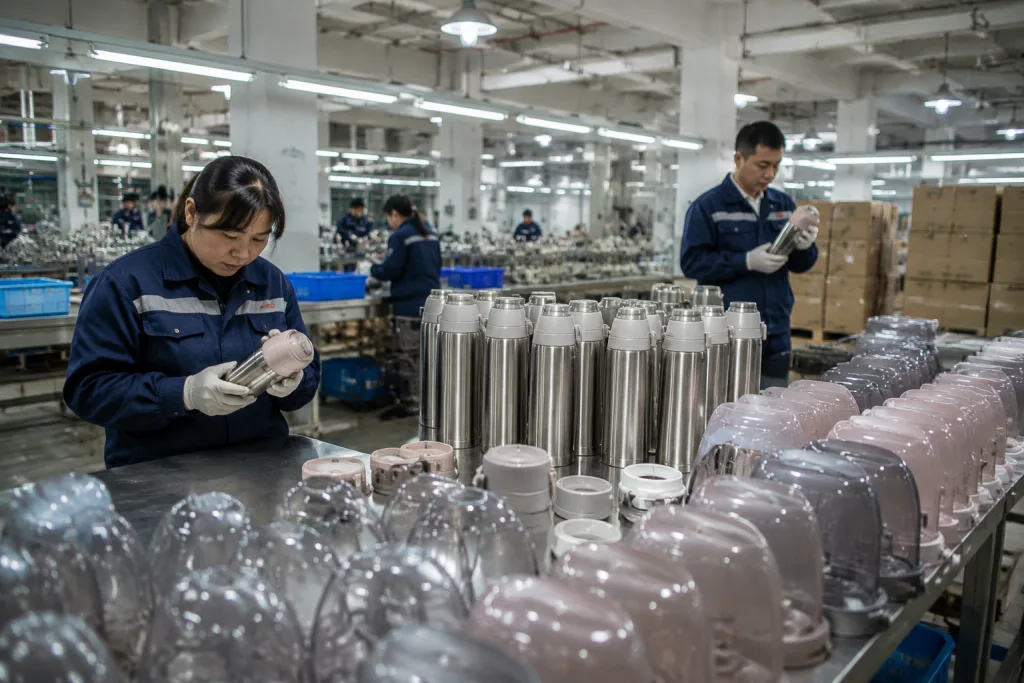
You are probably searching for polycarbonate vacuum flask custom because the sales side wants a tough outer shell, the buyer wants a clean logo, and the warehouse wants replenishment it can actually plan around. We see the same mistake on the line. Suppliers mix plastic bottle wording with stainless thermos production, then the quote misses the real build: 304 stainless inner, PC outer, vacuum process, and print adhesion after a 1 m drop test. The result is bad budgeting, late launch dates, and samples that look fine in photos but fail once QC pulled the sample and checked insulation, logo rub, and dent resistance.
For outdoor retailers and promo brands, the right questions are plain: what is the real unit cost, what sets the MOQ, and do you need 12 days or 18 days before cargo leaves China? This is the wrong question to ask if you only want catalog pricing. In Zhejiang, where a big share of China drinkware production runs, the answer comes from structure, decoration method, packaging spec, and testing points. A laser logo, a 0.4 mm stainless wall, or a buyer-flagged PO typo on carton marks can change the whole schedule fast.
What You Are Actually Buying
Let’s fix the first misunderstanding. In drinkware sourcing, polycarbonate vacuum flask custom usually means a stainless vacuum flask with one PC part, not a full polycarbonate insulated body. A true vacuum flask needs double-wall stainless with an evacuated gap between the walls. On our line, QC pulled the sample and cut-checks this structure before mass run. Polycarbonate is usually used on the outer accent, lid cap, clear window, handle piece, or cup part. If a supplier offers a fully polycarbonate vacuum body, read that quote carefully. PC itself is not the vacuum vessel.
For outdoor retail, the common build is 304 stainless inner and outer, 0.4mm to 0.5mm wall thickness, copper-coated vacuum layer, and a PC lid or outer cup. We run this spec every month. For promotional thermos programs, you may also see 201 stainless outside to cut cost by about USD 0.20-0.45 per unit on a 500ml item. Buyers ask for that all the time. It can fit a low-price campaign, but for distributor business the math doesn’t work, because dent resistance and corrosion margin are weaker, and we’ve seen the outer wall show rust spots after salt spray checks.
When you request quotations from a thermos manufacturer or thermos supplier in China, specify these points first:
- Capacity: 350ml, 500ml, 750ml, 1000ml
- Steel grade: 304/304 or 304/201
- Plastic resin: virgin polycarbonate, PP, Tritan, or ABS where applicable
- Heat retention target: for example 55C after 6 hours from 95C fill
- Decoration: silkscreen, laser, heat transfer, powder coating
- Packing: white box, color box, PDQ, master carton drop standard
If you do not lock these details, your factory thermos quote is not reliable. This is the wrong question to ask: “What is your best price?” Ask for the full build instead. In one week, we might send 6 quotes, and the cheapest one often assumes plain carton, no testing, 201 outer wall, and one-color print only. The buyer flagged this on a PO last month because the print spec said “2C logo” and the quotation was based on 1-color silkscreen. That is how a cheap number falls apart at purchase order stage.
Where the Unit Cost Moves
The fastest way to budget a thermos custom project is to split the cost into five blocks: body, lid set, finish, packaging, and compliance. On a standard 500ml vacuum flask, the stainless body is usually 45% to 55% of FOB value. Lid structure is often 15% to 22%. Decoration and coating can swing from 8% to 20%. That gap is real. We see buyers compare two bottles from photos, then the buyer flagged the quote because one was a simple logo item and the other had a retail-ready pack with a 0.4mm PC cup and extra assembly steps.
Main cost ranges for 500ml FOB China
- Plain brushed 304/304 flask with PP stopper: USD 3.20-3.80 at 3,000 pcs
- Powder-coated customized thermos with PC cup and silkscreen logo: USD 4.10-5.10 at 3,000 pcs
- Outdoor-style bulk thermos with carry handle, two molds in lid set, color box: USD 5.20-6.80 at 2,000 pcs
Polycarbonate parts add cost in two direct ways. Resin price is above standard PP or ABS, and transparent or glossy PC shows scratches faster during assembly. QC pulled the sample on one run last month because the cup edge had hairline marks after tray transfer. Rejection rate can climb by 1.5% to 3%. For a thermos factory running 300,000 units per month, that scrap goes straight back into the unit price. This is the wrong question to ask: “Why is PC only a small part but adds so much?” The math is in the reject rate, not just the raw resin.
Decoration moves cost more than buyers expect. A one-color silkscreen logo might add USD 0.06-0.12. Laser engraving adds around USD 0.10-0.18. Full-wrap heat transfer can add USD 0.28-0.55 depending on coverage and color count. Powder coating is usually USD 0.22-0.40. Soft-touch or textured finishes cost more and slow the line because we run a longer cure and check the surface with a cross-cut adhesion tester before packing.
Cheap quotations usually hide thinner steel, lower-grade outer material, or basic packaging.
If you buy thermos bulk for retail, spend the extra USD 0.12-0.25 on stronger inner partitions or EPE protection. We ship enough export cartons to know where claims start. On a 24-bottle master carton, a weak divider gets crushed fast during transfer out of Zhejiang through 2 or 3 hub warehouses. We have seen this go sideways, and the inspection finding is usually the same: dented shoulder, scratched cup, outer box still looks fine.
MOQ Tiers That Change Pricing
MOQ is not arbitrary. In a polycarbonate vacuum flask custom program, it follows resin and steel batching, coating line output, packaging print minimums, and assembly changeover time. We run different numbers for logo-only jobs, color changes, and structure changes because the factory risk is different. On the line, even a 0.3 mm lid fit issue can turn a clean quote into a claim case. This is the wrong question to ask if you only want the lowest starting quantity.
Typical MOQ tiers look like this:
- 500 pcs: possible for existing mold, one stock color, one logo, plain box. Unit cost is usually 12% to 20% higher than standard MOQ.
- 1,000 pcs: workable for customized thermos runs with standard body and custom packaging sticker or simple logo print.
- 2,000-3,000 pcs: best zone for cost-efficient custom thermos with powder coat, color box, and mixed carton pack.
- 5,000 pcs and above: where tool amortization, dedicated Pantone coating, and line efficiency start to help.
In about 7 out of 10 supplier thermos inquiries we see, the real blocker is not the flask MOQ. It is the packaging. A custom color box may require 2,000 pcs, while an instruction leaflet might need 3,000 pcs to keep print cost under control. We have seen buyers push for 1,000 sets, then the box factory quotes 28% higher because the die-cut setup is spread over too few units. So your thermos customized order can run at 1,000 pcs on the assembly side, but the packaging math pushes it to 2,000 pcs.
If you are a promotional brand, ask whether mixed colors are allowed under one SKU. This matters. Some thermos suppliers in China accept 500 pcs per color inside one 3,000 pc order. Others hold the line at 1,000 pcs per color because coating line cleaning and 35-minute curing cycles eat capacity. We have had a buyer flag this after the PO came in with “navy” typed twice and “red” missing once, and that kind of split order goes sideways fast. If you sell through thermos distributor channels or distributors thermos channels, color variety helps sell-through, but fragmented quantities cut landed margin.
At BottleForge scale, a practical MOQ for stainless thermos with custom print is often 1,000 pcs, while full new-structure development usually starts closer to 3,000 pcs. That is not sales talk. It is what keeps defect rate, packaging waste, and production changeover under control. QC pulled the sample on one 3,000 pc pilot run last month because the silk print position drifted 1.8 mm after fixture reset, and this is exactly why the math does not work at tiny volumes.
Tooling and Sample Budget Reality
Not every polycarbonate vacuum flask custom order needs tooling. If you pick an existing stainless body and only change color, logo, or packaging, we run from stock tooling and skip mold cost. Pre-production samples in that case usually cost USD 50-150 each plus courier, with 5-7 working days for logo and finish confirmation. On our side, QC pulls the sample after logo bake and checks position with a 0.5 mm scale card.
Tooling starts when you change the lid mechanism, outer cup geometry, handle shape, or decorative PC window. That is where the line changes, and this is the wrong question to ask: buyers ask only for mold price, but the bigger issue is whether the new part will run stable after T0 and T1 trials. For polycarbonate parts, we usually quote after reviewing draft angle and wall thickness on the 3D file. A 1.8 mm wall and weak snap-fit can go sideways fast. For polycarbonate components, injection mold cost usually falls in these ranges in China:
- Simple cap or trim mold: USD 1,500-2,500
- More complex lid set with threads and moving parts: USD 2,800-4,500
- Multi-cavity optimization after initial launch: quoted separately, often USD 3,000+
Be careful with suppliers thermos quotes that say “mold free” on a new structure. Usually the mold cost is buried in the unit price, or the factory keeps tooling ownership. We have seen buyers miss this on a PO where "own mold" was typed as "open mold," and the argument started 4 months later. If your annual forecast is 20,000-50,000 pcs, that may be acceptable. If you are building a long-term custom thermos program for outdoor retail, ask who owns the mold, where it is stored, and whether you get a mold number and maintenance record.
Testing samples also costs time. A proper manufacturer thermos process should include vacuum retention test, leak test, thread match, dishwasher warning review if applicable, coating adhesion cross-hatch check, and basic drop evaluation. We usually run a 12-hour heat retention check, a 1.0 m drop, and a thread fit review with the master gauge before sample release. For Europe and North America, you may also need REACH review, LFGB depending on market, or ASTM-related checks for kids-oriented items if the format overlaps with youth promotional use.
Sample approval is where many late launches begin. Buyers rush this step, then revise logo position, color, or inner stopper after approval. Each revision can add 3-5 days, and a new decorated sample often pushes mass production start back by a full week. The buyer flagged it last season on a matte black flask because the logo moved 6 mm left after final sign-off. Small change, big delay. We have seen this go sideways.
Lead Time From PO to Cargo
Lead time for a thermos customized order is not one number. It is a chain. We split it on the factory side into sample stage, material prep, production, packing, inspection, and booking. If a supplier says only “30 days,” ask what sits inside that number. This is the wrong question to skip. On our line, a 0.3 mm logo position change can push the sample back a day if the buyer flagged it after print proof.
A realistic timeline for existing-mold stainless thermos looks like this:
- Quotation and spec confirmation: 1-3 days
- Logo sample or color sample: 5-7 working days
- Sample approval and deposit receipt: 2-5 days depending on your side
- Material purchasing and production scheduling: 7-10 days
- Mass production and packing: 18-25 days
- AQL inspection and booking prep: 2-4 days
That usually lands at 25-40 days after final sample approval for most bulk thermos orders. New tooling adds 12-20 days for mold fabrication and trial. We have seen this go sideways on PC thread fit, where the first trial leaked at the cap seat and QC pulled the sample for correction before mass production.
Peak season changes the math. From August to November, when promo programs and holiday outdoor orders hit at the same time, Zhejiang factories often add 7-12 days. Before Chinese New Year, add buffer early, not at the last minute. We run into this every year. If your ship date is fixed, place the PO earlier instead of asking the line to compress every stage. Fast track usually means one of two things: overtime cost goes up, or process control gets loose. The math doesn't work any other way.
For Amazon or DTC replenishment, include labeling and outer carton work in the PO from day one. FNSKU labeling, carton marks, pallet rules, and appointment-ready packing can add 1-3 days. Small job, real delay. We ship cargo that gets held after production because one carton mark was missing or the PO had “pallet lable” typed instead of “pallet label,” and nobody corrected it before packing.
Quality Checks That Protect Margin
You do not make margin on a cheap flask that leaks, loses heat, or lands with scratches on the shell. In distributor thermos and thermos distributors channels, returns hit twice: replacement cost first, then the buyer starts questioning the next PO. We have seen this go sideways over one lid leak at 0.3 MPa. Write the quality terms into the PO before we run the line.
For a standard custom thermos order, fix these checkpoints in writing before mass production:
- AQL level: commonly Major 2.5, Minor 4.0
- Vacuum performance: for example 55C or above after 6 hours from 95C fill at room temperature
- Leak test: 100% line test
- Logo position tolerance: typically plus or minus 2mm
- Color tolerance: approved Pantone reference or signed sample
- Drop expectation: packaged drop test based on carton size and channel requirement
For PC parts, ask about stress cracking risk if the part is transparent or sees cleaning chemicals on the end market side. Polycarbonate looks sharp on shelf. It is less forgiving than standard PP if handling is sloppy. On our side, we separate parts in trays, control assembly torque with an electric screwdriver, and QC pulled the sample once for a 0.8 mm surface line near the spout. This is the right question to ask early, not after tooling sign-off.
Factory audits matter, but certificates alone do not tell you much. BSCI, ISO 9001, and social compliance reports help qualify a supplier thermos program, yet they do not replace product checks from the actual batch. Ask for inspection records, vacuum test logs, and coating adhesion results from the last 30 days. The buyer flagged this once on a PO that said "Matt Black" while the approved chip was closer to Pantone Black 7 C. A serious thermos factory in China should show production data from the line, not just framed paper on the wall.
If your project is for outdoor retailers, I would set a tighter cosmetic standard on visible cup and lid surfaces. The math does not work if you save a few cents and lose shelf appeal. Consumers will ignore a small carton rub mark after a 76 cm drop test, but they will reject a scratch on a premium flask the second they pick it up.
How Buyers Keep Projects On Schedule
Most delays on polycarbonate vacuum flask custom orders do not start in the steel shop. They start with missing buyer-side inputs: artwork still unapproved, Pantone confirmation arriving 3 days late, no clear carton drop standard, or packaging files changing after sampling. We run into this every month. Last week the buyer flagged a lid logo shift after the sample was signed, and the line had to stop while we checked the screen position with a 0.5 mm tolerance. If you want a stable lead time, send one complete brief and keep revisions under control.
A clean RFQ to thermos suppliers should include capacity, structure reference, material callout, target price, market destination, logo method, packaging dieline needs, and compliance expectations. Put the actual numbers in. A 500 ml body, PC outer, 304 stainless inner, FDA or LFGB target, 10,000 pcs MOQ, and a target ex-works range tell us more than two pages of vague notes. If you are speaking with multiple manufacturers thermos sources in China, keep the RFQ identical. Otherwise you are comparing different assumptions, and the price spread will mislead you. This is the wrong question to ask: "Who is cheapest?" Ask who quoted the same build.
For outdoor and promotional orders, the practical way to reduce risk is this:
- Use an existing vacuum body if launch timing matters
- Customize the lid, color, and packaging before redesigning the full structure
- Approve a golden sample and lock it to the PO
- Book inspection at 80% packed quantity, not after everything is already loaded
- Leave at least 10 days buffer before vessel cutoff
We have seen this go sideways. A buyer split a first order of 12,000 pcs across two thermos distributors and one thermos supplier factory, then found the lid thread feel was different by the third carton check. Usually no, do not split the first run. Your first order should stay with one supplier that can execute, hold color, and keep weld quality stable. QC pulled the sample on one job and found a 6 mm logo height mismatch between two sources because one PO had "matte black" typed as "metal black."
The blunt truth is that a customized thermos program succeeds when the specification is boringly clear. Good sourcing from Zhejiang or wider China is not about chasing the lowest number. The math does not work if you save $0.18 per piece and lose 12 days on rework before vessel cutoff. We ship repeat programs best when the product is fixed, the carton spec is fixed, and the approval path is fixed. Then you get the same product, on the promised date, at a margin you can repeat next season.
Get a real thermos quote with lead-time today
Send your capacity, decoration, packaging, and target ship date. We will return a practical MOQ, FOB range, and production timeline from Zhejiang, China.
Frequently asked questions
What is the normal MOQ for polycarbonate vacuum flask custom?
For an existing mold, the practical MOQ is usually 1,000 pcs for a simple logo project and 2,000-3,000 pcs for a fully customized thermos with powder coating and printed color box. Some thermos suppliers will accept 500 pcs, but expect the FOB price to rise by 12% to 20% and color options to be limited. If you need a new polycarbonate lid or cup mold, factories in China usually want at least 3,000 pcs to justify setup and tooling coordination. Packaging can also force the MOQ higher. A custom box often starts at 2,000 pcs, and instruction sheets can push the print minimum above your flask minimum. Always ask for MOQ by component, not just by finished product.
How much does a custom stainless thermos cost in bulk?
For a 500ml stainless vacuum flask with some polycarbonate parts, a realistic FOB China range is USD 3.20-3.80 for a plain 304/304 model at 3,000 pcs, USD 4.10-5.10 for powder coat plus logo, and USD 5.20-6.80 for a more retail-driven outdoor design with complex lid set and color box. Add roughly USD 0.06-0.12 for a one-color silkscreen logo, USD 0.10-0.18 for laser engraving, and USD 0.28-0.55 for wrap transfer print. New tooling for PC components usually costs USD 1,500-4,500. If a quote is far below these levels, check whether the factory assumed 201 outer steel, very basic packaging, or lower insulation performance.
How long does production take after sample approval?
For an existing body shape, most thermos manufacturer lead times are 25-40 days after final sample approval and deposit receipt. That usually includes 7-10 days for raw material and planning, 18-25 days for production and packing, and 2-4 days for inspection and booking prep. If your project needs a new polycarbonate lid mold, add around 12-20 days for tooling and trial samples. During peak season in Zhejiang, especially August through November, you should allow another 7-12 days. If you also need FNSKU labeling, retail inserts, or palletized packing for a distributor thermos program, add 1-3 days. The safe approach is to build a shipment buffer instead of scheduling against the shortest quoted lead time.
Is polycarbonate safe for vacuum flask components?
Polycarbonate is commonly used for caps, windows, cups, and structural trim, but it should not be confused with the vacuum vessel itself. The heat-holding function comes from double-wall stainless with a vacuum gap. For safety and compliance, ask your thermos supplier for material declarations and market-specific testing support such as REACH for Europe. Good factories in China also check odor, stress marks, thread fit, and leak performance during sample stage. Polycarbonate is strong and clear, but it can scratch more easily than PP and may stress-crack if the design or torque control is poor. For premium outdoor retail, many buyers use PC only where transparency or rigidity is needed, then keep the drinking-contact structure mainly in 304 stainless and food-grade PP or silicone.
What quality standard should I put on the PO?
Write the standard clearly. For most custom thermos orders, I would specify AQL Major 2.5 and Minor 4.0, 100% leak test, approved Pantone or signed color sample, and a heat-retention target such as 55C minimum after 6 hours from 95C fill at room temperature. Set logo position tolerance at plus or minus 2mm and define what counts as a cosmetic defect on visible cup and lid surfaces. If the item is for promotional thermos use with individual gifting, also define carton and inner box requirements because presentation defects create claims even when the flask works fine. Ask the factory for vacuum test records and inspection photos before final payment. Certificates like ISO 9001 or BSCI help, but they are not a substitute for product-level control.