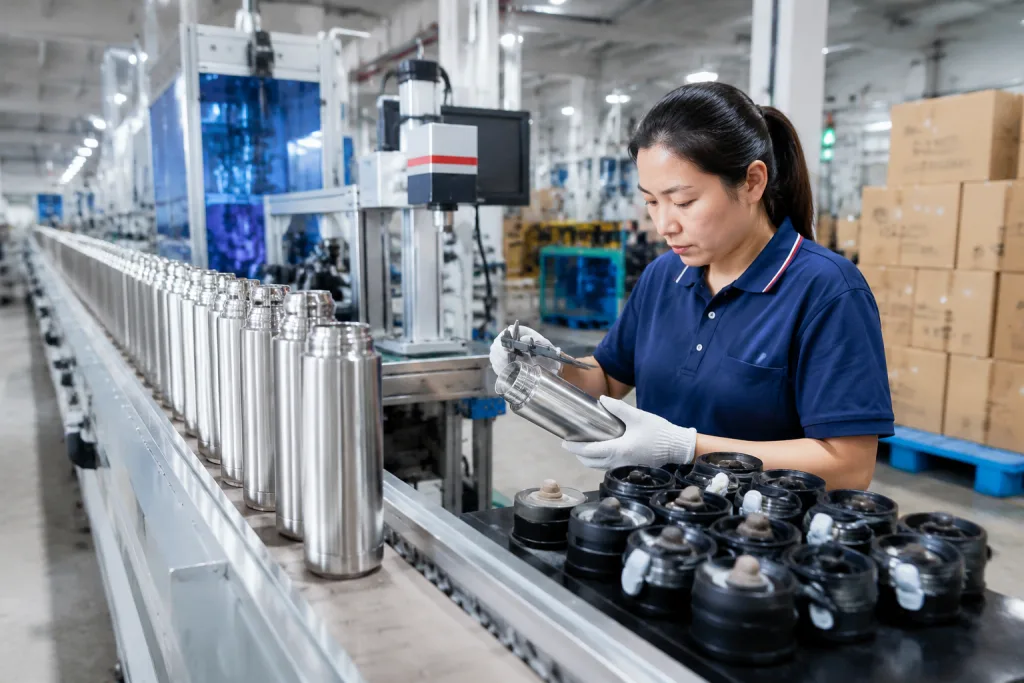
Key Takeaways
- A 500ml stainless vacuum flask usually lands at USD 3.20-5.80 FOB at 1,000-3,000 pcs, while mixed PC-component models can save 8-15% on tooling parts, not on the insulated body.
- For outdoor retail, 304 stainless inner and outer walls at 0.4-0.5mm with vacuum insulation outperform PC-heavy builds on heat retention by 6-12 hours.
- MOQ is commonly 500 pcs for stock colors and 1,000-3,000 pcs for fully custom thermos projects, with 25-45 day lead times from Zhejiang, China.
- Ask for REACH, LFGB or FDA test scope, AQL 2.5 inspection, and drop-leak testing at 0.8-1.0m before approving any thermos bulk order.
You search for polycarbonate vacuum flask bulk, and 6 out of 10 quotes that come back are not the same bottle. Some are full stainless vacuum flasks. Some use a polycarbonate outer shell, lid, or cup. That is standard on the China side, but it trips buyers up fast. We have seen POs marked "PC vacuum flask" while the drawing showed a 304 stainless inner with a PC cup, and the buyer flagged it only after sample approval. You are not comparing one product category. You are comparing different constructions, different compliance exposure, and a landed cost gap that can swing 18%.
If you sell to outdoor retail or run a promo program, FOB price is the wrong question to ask. A 2,000-unit giveaway bottle can pass because the target is simple and the budget is tight; that same item can fail on the shelf when the line used a 0.35 mm outer wall, the weight felt light in hand, and heat retention dropped short of the claim after 6 hours. In Zhejiang, we run into this every season. QC pulled the sample, checked the lid fit with a go/no-go gauge, and the issue was obvious. The right answer starts with the end user, not the quote sheet.
What buyers usually mean
When a buyer asks for polycarbonate vacuum flask bulk, we usually see 3 actual products behind that RFQ. One is a true stainless vacuum flask with PC parts like a lid window, cup, handle, or sleeve. Another is a double-wall plastic bottle with no vacuum at all; some trading companies still label it loosely, and this is the wrong question to ask if you need heat retention. The third is a stainless vacuum bottle packed with a transparent polycarbonate outer cup or accessory set for promo use. We see this mix-up on POs every month, sometimes with “vacum” typed on the spec sheet.
If you are buying for outdoor retail, focus on the first category. Full stop. The insulation still comes from the stainless body, not the PC trim. On the line, thermal result, dent resistance, and service life come from the steel shell, copper coating coverage, weld consistency, and vacuum hold rate. The plastic parts matter, but they do not decide whether the bottle holds 12 hours or 24 hours.
Start with the construction, not the photo
- Core body: 18/8 or 304 stainless steel, typically 0.4mm inner and 0.45-0.5mm outer wall
- Insulation: vacuum gap, often with inner copper coating to improve retention by around 10-15%
- Polycarbonate parts: lid window, outer cup, handle, shaker insert, or tea infuser housing
- Common sizes: 350ml, 500ml, 750ml, 1000ml
At our factory in Hangzhou, Zhejiang, about 8 out of 10 manufacturer thermos inquiries that mention polycarbonate still turn into stainless thermos programs because buyers need 12-24 hour thermal performance. If a supplier cannot state clearly which parts are PC and which are stainless, the quote is not ready. QC pulled the sample on one project last quarter and found the “PC cup” was actually AS plastic at 2.1mm wall thickness. That is how retail complaints start, and we have seen this go sideways.
For outdoor channels, buy the vacuum structure first and the plastic accessory second. For promotional channels, you can relax some performance targets if the price point is strict.
Spec table that actually matters
A clean comparison cuts 2 or 3 email rounds. Below is the spec logic we actually use to compare bulk thermos options for outdoor retail versus promo distribution, and it is the same conversation we have with buyers in Europe and North America buying out of Zhejiang. This is the right section to study first. On the line, the first thing we check is the sample weight on a digital scale before we talk about decoration.
- Body material: 304/18-8 stainless is the standard build. 316 inner wall usually adds USD 0.35-0.80 per unit on a 500ml flask, and we have seen buyers ask for 316 without a real corrosion-use case; this is the wrong question to ask if the product is for office gifting.
- PC content: lid and cup only is the safer setup. Large PC outer sections cut the premium feel and can crack in cold-drop testing; QC pulled the sample once with a hairline break after a 1.2m drop.
- Heat retention: 12 hours hot at 60C+ and 24 hours cold is realistic for a mid-grade 500ml vacuum bottle. Better builds reach 12 hours at 68-72C from 95C fill conditions, but the buyer needs to confirm the test method, fill volume, and room temperature first.
- Weight: a 500ml stainless vacuum flask usually runs 290-380g. Promo builds can go below 260g, and that usually means thinner steel; on our side, that often shows up as a softer body wall under caliper check.
- Leak standard: inverted 30 minutes with no leakage is the base requirement. Better suppliers also run pressure and shake testing, and we usually log the result after a 10-carton spot check.
- Finish: powder coating should be 45-65 microns, while spray paint is 20-30 microns. Logos are usually silkscreen or laser, and the buyer flagged color drift before when the Pantone target was approved from a photo instead of a chip.
- MOQ: 500 pcs for stock color, 1,000 pcs for custom color, and 3,000 pcs for new mold components. We ship plenty of 1,000 pc orders, but once the PO adds a new cup tool, the math doesn't work below mold MOQ.
For a custom thermos project, FOB pricing on a 500ml unit in China usually looks like this. These are workable numbers, not fantasy quote-sheet numbers, and they assume normal master carton packing rather than a heavy gift set at 12 kg per carton.
- Entry promotional thermos: USD 3.20-3.90 at 3,000 pcs
- Mid-grade outdoor retail bottle: USD 4.20-5.20 at 1,000-3,000 pcs
- Premium customized thermos with PC feature lid, gift box, and two-color print: USD 5.40-6.80 at 1,000 pcs
If a thermos supplier quotes far below that, check wall thickness, vacuum pass rate, and whether the lid resin is actually virgin polycarbonate or a lower-grade substitute. We have seen this go sideways. One buyer sent a PO with "PC lid" typed correctly, but the approved sample came back with lower-cost mixed resin and the hinge feel was loose after 200 openings. The cheapest quote often pushes cost into returns, weak packaging, or bad color matching between lots. Outdoor retail buyers care about repeat orders. A one-off promotional thermos has more room for compromise than a shelf item that needs the same look again 6 months later.
Use-case fit by sales channel
Not every flask sells the same way. Outdoor retailers and promotional brands buy for different reasons, so the right thermos bulk spec changes with the channel. We see this on the line all the time. One buyer asks for a 1.0m drop pass, another asks how big the logo panel is on a 500ml body.
Outdoor retail
Camping, hiking, hunting, and workwear buyers usually start with durability. That is the right question. A solid thermos manufacturer spec for this channel is 304 inner and outer, 0.4/0.5mm wall setup, vacuum insulation, powder coat, and a lid structure that survives drop tests. We run lid torque checks with a digital torque meter before packing. Polycarbonate fits better in functional parts like a clear cap window or a handle insert, not the main bottle body. A 750ml bottle with these specs normally sits around USD 5.60-7.20 FOB at 1,000 pcs.
For retail, target:
- 12 hours hot above 65C
- 24 hours cold below 10C
- 1.0m carton drop pass
- Dishwasher warning clearly stated if the finish cannot handle repeated machine cycles
Promotional brands
Campaign, gifting, and loyalty buyers usually push the other direction. They want lower landed cost, lighter weight, and a bigger branding area on the promotional thermos. A 500ml thermos custom order for promotion may accept 6-8 hour useful heat performance if the target unit cost is under USD 4.00 FOB. We have seen buyers flag a 20g weight increase on a gift program because freight math changed. In that case, a polycarbonate cup, display window, or color-accent lid adds shelf appeal without moving the vacuum body cost much.
This is also where distributor thermos and thermos distributor programs split from retail private label. Distributors usually want wider SKU flexibility, lower MOQ, and fast repeat decoration, but this is the wrong question to ask if the artwork changes every PO. We normally advise 3-5 stock body colors, then logos by silkscreen or laser engraving. QC pulled the sample on one repeat order last month because the PO said "sliver" instead of "silver," and that kind of typo slows approvals fast. This setup keeps lead time around 20-25 days instead of 35-45 days for full color development.
Short version: for shelves, buy performance. For campaigns, buy cost control and print area. Trying to make one flask do both usually gives you a middle-spec bottle, and we have seen this go sideways.
Where polycarbonate helps and fails
Polycarbonate works, but only where it earns its place. We run it for parts that need clarity, snap-fit accuracy, or button action, and the mold tolerance usually sits around +/-0.15 mm on these pieces. That is why it fits tea compartments, clear push-button tops, measuring lids, and outer cups. For a customizable thermos, PC adds function without forcing changes on the core vacuum line.
It has a limit. If a supplier pushes too much structure into polycarbonate, the flask starts to look cheaper and it ages badly after real use. We have seen buyers stay quiet at shipment, then come back after 6 months of UV exposure, drop tests from 1.2 m, or rough dishwasher-style washing. Stainless takes impact better. PC handles design detail better. This is the wrong question to ask if the team is only chasing appearance.
- Good use of PC: transparent cap insert, detachable cup, food-contact infuser housing with a clean-fit seal groove, push-button lid shell around the release set
- Risky use of PC: large structural outer body, hinge points taking torque above 3 N.m, thin clear handles, exposed glossy surfaces on hard-use bottles that show scratches fast
Compliance matters too. In Europe, you need to check REACH and the actual food-contact test scope, and in North America most buyers ask for FDA first. If the item sits anywhere near kids' use, ASTM can come up based on the decoration, strap, or accessory style; the buyer flagged this on one PO last year because the color box said "family bottle" instead of "outdoor flask." Ask the supplier thermos team which exact components were tested. A report for the stainless body does not cover the PC lid, silicone seal, paint, or print ink unless those parts are listed.
From our factory side in China, the reliable setup is simple: stainless where the product takes stress, polycarbonate where the user needs visibility or control. We ship this mix every month, and QC pulled the sample more than once where PC weight crept too high because the lid housing got overbuilt. That is why most serious factory thermos builds keep PC content under 20% of total product weight. Once the ratio climbs past that, ask what problem the design is solving. We have seen this go sideways. Sometimes it solves nothing except the mold maker's enthusiasm.
MOQ, tooling, and lead time
This is where new buyers lose margin fast. We see it on the line. They chase a lower unit price, then miss the setup cost, carton count, and decoration limit, and the math doesn't work once the full landed cost is on the sheet. For thermos customized orders, the right MOQ comes down to how far you step away from standard parts, and whether the mold base, spray color, or print position changes.
- Stock bottle + one-color logo: MOQ 500 pcs, lead time 15-25 days
- Custom body color + standard lid: MOQ 1,000 pcs, lead time 25-35 days
- New PC lid or cup mold: tooling USD 2,000-6,000, MOQ 3,000-5,000 pcs, lead time 35-45 days after sample approval
- Retail gift box packout: add USD 0.35-1.20 per set depending on insert and print coverage
At BottleForge-scale output, a practical capacity reference is 300,000 units per month across vacuum drinkware lines in Zhejiang, assuming standard models. On paper, that looks fine. In actual production, the bottleneck is usually decoration booking or packaging material arrival, not body forming. We run body stock first, then wait on the box. A thermos factory can have open welding capacity and still miss your ship window if the custom box artwork lands 4 days late or the buyer flagged a barcode size issue after the first proof.
For import planning, ask for these dates in writing. This is the right question to ask, not just "What is your lead time?" QC pulled the sample, approved it, and the schedule still moved because one PO had the sample date typed wrong by 2 days.
- pre-production sample approval date
- mass production start date
- mid-line inspection date
- final inspection date
- ex-factory date and FOB port date
If you buy thermos bulk for Amazon FBA or distributor replenishment, lock barcode placement, carton marks, and pallet rules before production starts. We have seen this go sideways. One common pushback is outer carton mark size, especially when the print file calls for 42 mm text and the warehouse spec says 32 mm. A flexible thermos vendor helps, but a disciplined one saves more money. Last-minute packaging edits in China are usually possible. They are rarely free.
QC points before you pay
A vacuum flask is simple on paper, but the failures are dull and expensive: slow heat loss, a cap that seeps, paint that peels at the shoulder. Most of this is preventable if the QC sheet is tight. We ship from Zhejiang every week, and we still ask our thermos suppliers and manufacturers thermos partners to confirm the same points on every PO, down to the 30-minute leak check and the torque reading on the cap.
- AQL: Use AQL 2.5 for major defects and 4.0 for minor defects as a starting point for finished goods.
- Vacuum test: sample hot-water retention after 6, 12, and 24 hours. Record fill temperature and ambient temperature.
- Leak test: inverted and sideways, 30 minutes minimum.
- Coating adhesion: cross-hatch tape test for painted or powder-coated surfaces.
- Drop test: 0.8m for unit, 1.0m for packed carton depending on market and bottle size.
- Odor check: especially on lid assemblies with PC and silicone.
- Thread fit: cap torque and cross-thread resistance.
For retail-oriented thermos manufacturers, I also check net weight tolerance within plus or minus 3%. QC pulled the sample once on a 500ml flask and saw 340g on the approved unit versus 305g on production. That gap is not random. It usually means the inner wall or outer wall changed by a few tenths of a millimeter, and we have seen this go sideways fast.
Ask for welding photos, vacuum pass-rate records, and packaging drop test records on new models. On our line, the vacuum pass-rate sheet usually shows batch data from 200 pieces, and the buyer flagged it once when one PO listed the wrong lid code. A serious customized thermos program should keep a golden sample approved for color, gloss, logo position, and lid fit. If you buy through thermos distributors or suppliers thermos channels instead of direct factory booking, this is the wrong question to skip: can they still give factory-level QC data? Without that, you are buying blind.
The best buyers do not chase the lowest quote. They ask for defect history before the first container ships, because the math does not work if you save $0.18 per unit and then eat a leak claim on 3,000 pieces.
Send your thermos spec for a real factory quote
Share capacity, target FOB, logo method, and market requirements. We will recommend the right stainless and polycarbonate construction with MOQ, lead time, and QC points.
Frequently asked questions
Can a polycarbonate vacuum flask bulk order be fully polycarbonate and still vacuum insulated?
Not in the way most buyers mean it. A true vacuum-insulated flask needs a sealed double-wall structure, and in commercial drinkware that is almost always stainless steel. When suppliers in China quote polycarbonate vacuum flask bulk, they usually mean a stainless vacuum body with polycarbonate lid, cup, window, or handle parts. If you need 12-24 hour temperature retention, specify 304 stainless inner and outer walls and then list which parts may be PC. A fully plastic body can be double-wall, but it is generally not a true vacuum flask for this category. If a quotation seems unclear, ask for a cross-section drawing, wall thickness, unit weight, and a 12-hour heat retention result from a 95C fill test.
What MOQ should I expect for a custom thermos with a polycarbonate lid?
For a standard bottle body with an existing PC lid mold, MOQ is commonly 500 pcs for stock colors and 1,000 pcs for custom color plus logo. If you want a new lid shape, push-button mechanism, or branded outer cup, MOQ usually moves to 3,000-5,000 pcs because the mold cost has to be spread across the order. Typical tooling for a new PC lid runs about USD 2,000-6,000 depending on part count and surface finish. For outdoor retailers, it often makes more sense to start with an existing mold and spend your budget on coating, packaging, and better QC. Promotional buyers are more willing to accept a standard lid if it keeps the FOB price under target.
Which is better for outdoor retail: stainless-only thermos or stainless plus polycarbonate parts?
For outdoor retail, stainless-first construction is usually better. A 500ml or 750ml bottle with 304 stainless inner and outer walls, 0.4-0.5mm thickness, and limited PC in the lid gives the best balance of heat retention, impact resistance, and premium feel. Polycarbonate adds value when it improves function, such as a clear lock indicator, tea filter housing, or measuring cup. It becomes a problem when it carries too much structure or sits on exposed impact zones. In our experience from Zhejiang production programs, stainless-led designs generate fewer returns in hard-use channels. If your customer is a camper, tradesperson, or field technician, keep PC content focused and functional rather than decorative.
What compliance documents should I ask for on a thermos bulk order?
Start with material declarations and product-specific test reports, not generic certificates. For Europe, ask for REACH compliance and food-contact testing relevant to the actual components: stainless body, PC lid parts, silicone seals, paint, and inks. For North America, FDA food-contact scope is common. If the product style or decoration makes it relevant, ask about LFGB, Proposition 65, or ASTM-related issues for accessory components. You should also request the factory's ISO and social compliance references such as BSCI if your program requires them. A useful document pack includes test report dates, sample photos, model number references, and factory name consistency. If the report does not match the exact lid or coating used in production, treat it as incomplete.
How long does production and shipping usually take from China?
For stock models with simple logo printing, production is typically 15-25 days after deposit and artwork approval. A more complete customized thermos order with custom color, gift box, and packaging adjustments usually takes 25-35 days. If you add new PC tooling or complex packout, expect 35-45 days after sample approval. Sea freight from China to major European or North American ports often adds 20-40 days depending on route and season. Build in extra time for final inspection, booking, and port congestion. If your item is going to FBA, lock carton size, FNSKU placement, and pallet requirements before production starts. The factory lead time is only part of the schedule.