Key Takeaways
- Decide the bottle architecture first: full stainless vacuum body or stainless body with polycarbonate lid parts; changing this late can add 12-18 days
- For most custom thermos programs, workable MOQ starts at 1,000 pcs per color, while laser logo trials can begin around 300-500 pcs
- A 500 ml 304 stainless double-wall thermos typically lands at USD 3.20-5.80 FOB Zhejiang, China depending on coating, lid complexity, and packaging
- Use AQL 2.5/4.0, REACH, LFGB or FDA, and drop/leak testing before mass shipment; defect prevention is cheaper than a 3% return rate
If you search for a polycarbonate vacuum bottle manufacturer, you are not buying one material by itself. You are deciding what your outdoor retail line or promotional thermos program should be made from, how it needs to perform, and what will pass compliance review in Europe and North America. This is where sourcing stalls. The factory talks monthly output and MOQ 3,000 pcs, while you still need a straight call on material, insulation, decoration, and risk. We’ve seen this go sideways.
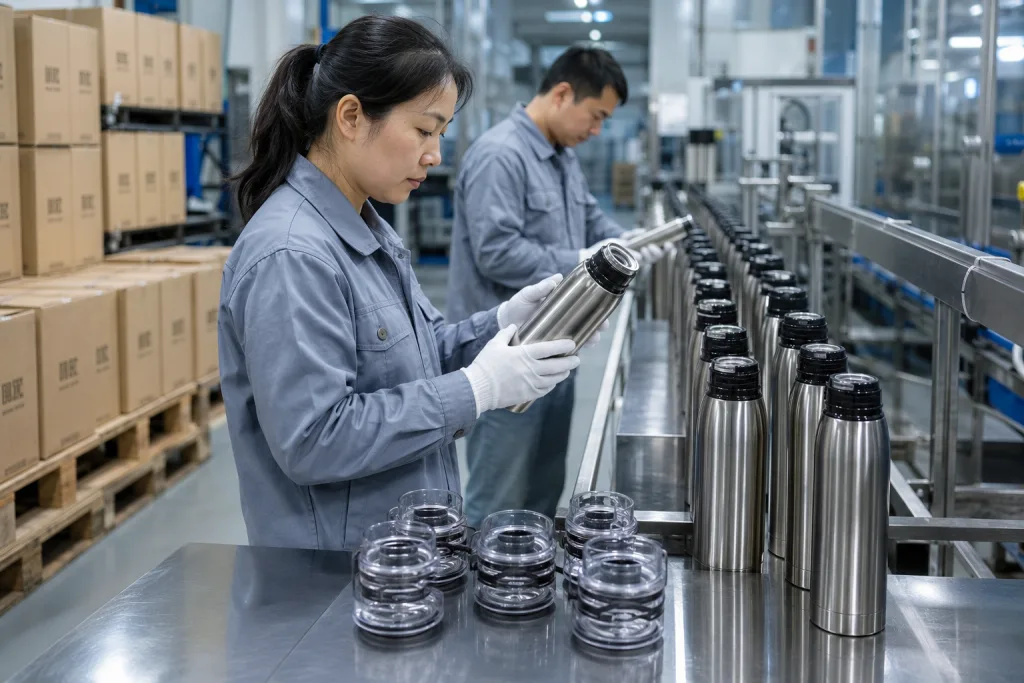
At BottleForge Industrial in Zhejiang, China, we see it every week on the line. A buyer starts with a bulk thermos brief, then finds out a custom thermos for hiking retail needs different lid torque, drop-test targets, and surface finish than a distributor thermos for corporate gifting. Stainless vacuum construction, polycarbonate parts, and lid engineering often sit in the same project, and QC pulled one sample last month because the PO typo said 0.5 mm instead of 0.8 mm for the outer wall. You need a buying framework first. A catalog dump is the wrong place to start.
Start with the four buying decisions
Most buyers start comparing thermos quotes too early. The first step is locking four decisions that drive cost, tooling, test scope, and delay risk. We see this on the line every month: a buyer asks for pricing on Monday, then changes the lid spec after the sample room already cut a 1.2 mm PC window insert.
- Decision 1: Bottle architecture. Decide the build first. Are you buying a full stainless vacuum flask, or a stainless body with a polycarbonate lid, straw cover, or viewing window? Outdoor retail buyers usually ask for 18/8 stainless contact surfaces and less plastic touching the drink path. Promo projects are looser if the target price is the main driver. We have had buyers push for a clear PC window, then flag odor risk after first sample. That is a common miss.
- Decision 2: Use case. Camping, commuting, school, and giveaways are not the same bottle with different logos. A 750 ml trail bottle needs better dent resistance, thicker base protection, and a lid shape you can open with gloves. A 500 ml office tumbler usually gives more weight to powder coat finish and front logo area. On one PO, the buyer typed 750 ml in the title and approved a 500 ml drawing. QC pulled the sample before mass production. Good catch.
- Decision 3: Compliance route. Set the market first, then the test list. Europe may require REACH review, LFGB on food-contact parts, and packaging checks. North America often needs FDA alignment, CPSIA attention for kids items, and retailer testing protocols. This is the wrong question to ask late, because one silicone straw tip can add days to lab timing if the line already booked production.
- Decision 4: Customization depth. A one-color silkscreen promo thermos and a full custom retail SKU sit miles apart on cost and schedule. Custom mold lid, pantone powder coat, barcode labeling, and retail gift box all add steps. The math doesn't work if you want new tooling at a low MOQ and still expect stock-model timing. We have seen this go sideways over a small detail, like a barcode label position shifting 8 mm and forcing carton artwork to be redone.
Lock those four points early, and supplier comparisons get clean fast. In our Zhejiang plant, standard stainless vacuum models usually run on a 35- to 45-day lead time after sample approval, with output around 300,000 units per month across stainless drinkware lines. If body shape or lid tooling changes after sampling, lead time often moves out by another 2 to 3 weeks. Sometimes it is 12 days vs 18 days just on packaging rework and fixture reset. We ship every week, and late changes are where the trouble starts.
You do not need the cheapest quote. You need the quote that still works after artwork, testing, carton drop, and final inspection.
Material choice is not just price
The phrase polycarbonate vacuum bottle manufacturer trips up buyers all the time. Vacuum insulation comes from a double-wall body, usually stainless steel. Polycarbonate shows up more often in lids, outer shells on older models, clear windows, or small accessory parts. For most outdoor and branded programs, the real decision is simple: use a stainless vacuum body, then control how much polycarbonate sits around it. We had one PO last season that called the full bottle “PC vacuum,” but the body spec was 304 stainless.
Here’s the trade-off in plain terms.
When stainless should lead
If you sell into outdoor retail, a stainless vacuum body is the safer commercial call. 18/8 stainless steel, often listed as SUS304, gives better heat retention, a stronger hand feel, and cleaner shelf positioning for reusable drinkware. A typical 500 ml double-wall stainless thermos with copper coating can hold heat for 8 to 12 hours and cold for 18 to 24 hours under normal test conditions. On the line, we usually spot-check vacuum performance with a temperature retention test before packing approval. Buyers ask about color first, but this is the wrong question to ask if the body material is still undecided.
When polycarbonate still matters
Polycarbonate still has a place in lids, lock covers, windows, and drinking mechanisms where impact resistance and transparency earn their cost. If you push too much of it into a product sold as an outdoor thermos, the buyer will start asking about scratch marks, odor pickup, and food-contact review. We’ve seen this go sideways on matte clear parts after a drop test. In Europe, buyers are stricter than they were five years ago, and QC pulled the sample more than once over cosmetic scuffing on the lid shell.
For a thermos customizable project, ask your suppliers thermos team for a component map: body material, liner material, lid housing, gasket, straw, paint system, and printing ink. Put it on one sheet. If they cannot send that, you are not dealing with a disciplined thermos factory. At BottleForge in China, we normally specify body wall thickness at 0.4 mm inner and 0.5 mm outer for standard models, with thicker options for larger 1,000 ml units where dent resistance matters more. We run thicker gauge on some 1,000 ml SKUs because the math doesn’t work if you save 0.03 kg of steel and then eat dent claims after shipping.
Match the thermos to your channel
Your sales channel should set the product spec before the artwork team touches color chips. We usually see three routes, and each one runs differently on the line.
Outdoor retail
Outdoor retail buyers need a custom stainless thermos that can survive actual use, not just look good in a meeting. The common ask is 304 stainless inside and outside, a leak-proof thread design, powder coating at 60 to 80 microns checked with a dry-film gauge, and a carton spec that holds up under e-commerce handling. Ask for heat-retention test data, salt spray results on painted parts, and drop testing from at least 80 to 100 cm with retail packaging. Buyers sometimes focus on color first; this is the wrong question to ask if the cap starts weeping after a backpack drop.
Promotional brands
A promotional thermos program usually comes down to landed cost and print consistency. Simple math. If the target is USD 3.50 FOB instead of USD 4.80, you may need a simpler stopper design and fewer custom parts. For these projects, thermos bulk and thermos promotional programs usually stay with standard molds, one- or two-color prints, and white-box packaging. We ship a lot of these with MOQ at 1,000 pcs per SKU, not 3,000+ after every lid, collar, and base color gets changed. Last season one buyer flagged a 1 mm logo shift on a silk-print sample, so QC pulled the sample board and reset the jig before mass production.
Distributor and importer programs
A distributor thermos or distributors thermos assortment has a different problem: too much SKU spread on the first PO. We have seen buyers ask for 4 capacities, 6 colors, and mixed carton allocations, then wonder why the launch drags. The math doesn't work. A good thermos vendor or thermos distributor support team should cut this down early. Too many first orders fail because buyers split 2,000 pcs across too many variants. In practice, a 2,000-piece launch works better as 2 sizes x 2 colors than 4 sizes x 5 colors. On packing, the line gets cleaner too; fewer carton marks, fewer pick errors, fewer cases where the buyer flagged a typo on the PO after labels were printed.
If you are sourcing from Zhejiang, China for North American replenishment, ask whether the factory can support FNSKU labeling, pallet pattern control, and barcode application at packing. We run these checks at carton-out, and they matter more than brochure language once you move from trial order to repeat purchase.
Customize only what adds margin
Custom work should earn its place. It needs to help you sell faster or lift margin, not sit on the quote sheet because a thermos manufacturer said the line can do it.
We usually break customization into four levels, and the cost jump between them is not small. On our side, the line setup for a logo-only run is nothing like opening a new mold trial with 6 sample pulls.
- Level 1: Logo only. Laser engraving or silkscreen on existing stock colors. MOQ can be as low as 300 to 500 pcs for some models. Tooling cost is usually zero. This is the cleanest place to start, and QC pulled the sample fast because there are fewer variables.
- Level 2: Color and packaging. Pantone-matched powder coat, hangtag, custom box. MOQ is commonly 1,000 pcs per color per size. Color cards need sign-off, and a 0.5 shade shift on powder coat is enough for the buyer to flag it.
- Level 3: Component color changes. Lid, handle, gasket, strap, body coordinated for a branded look. More sourcing control means more mismatch risk, usually 1,000 to 3,000 pcs. We have seen silicone gasket batches come in 1 mm off-tone against the lid, and that becomes the whole meeting.
- Level 4: New mold development. Unique cap, body silhouette, mechanism. Tooling can run from USD 2,500 for a simple lid insert to USD 12,000+ for a full body and cap system. This is where the math often breaks, because one cap revision can add 12 days vs 18 days across sampling and mold correction.
For a customized thermos or thermos customized project, ask one blunt question: will the added feature raise your sell-through rate by at least 10% or allow a retail price increase of USD 3 to 5? If not, keep the design simpler. Frankly, this is the right question; asking for “something special” is the wrong question. Outdoor buyers often overestimate how much consumers care about a unique lid shape and underestimate how much they care about leak performance. We ship repeat orders on leak-safe SKUs, not on fancy cap sketches, and the vacuum test tells the story in 30 minutes.
For promotional brands, the best value often comes from standard-mold custom-logo projects. A customizable thermos does not need to become a custom-tooling thermos. We tell buyers in Europe and North America the same thing: put the budget into surface finish, packaging, inspection. Skip gimmicks that add assembly risk. We have seen this go sideways over one small PO typo on a strap color, then 2,000 pcs had to be reworked by hand.
Price, MOQ, and lead time realities
You need a cost model before you negotiate. Without it, 6 supplier quotes on the same 500 ml bottle will look unrelated, and the math doesn't work.
Typical FOB Zhejiang, China pricing for stainless vacuum bottles looks roughly like this:
- 350 ml standard 304 stainless bottle: USD 2.80-4.20
- 500 ml powder-coated bottle with standard screw lid: USD 3.20-5.80
- 750 ml bottle with handle lid and color box: USD 4.60-7.50
- 1,000 ml large outdoor flask with cup cap: USD 5.80-9.20
What moves the number? Steel grade, copper coating, lid structure, paint system, packaging spec, and order quantity. This is the wrong question to ask if you only ask for “best price” on the bottle body. On the line, the lid often causes more trouble than the shell. We have seen a push-button lid with 6 plastic and silicone parts add USD 0.35 to 0.90 per unit, and QC pulled the sample once because the vent plug sat 0.6 mm off center.
MOQ needs a practical view. A thermos bulk order on a standard body may start at 1,000 pcs per color. Ask for custom packaging, spare parts, and 2 logo positions, and the workable MOQ usually moves to 2,000 or 3,000 pcs. New molds usually need 3,000 to 5,000 pcs to make financial sense in year one. We run into the same buyer pushback all the time: “Can you do 500 pcs with a new lid mold?” Usually no. Mold cost, trial shots, and carton minimums kill the margin before production even starts.
Lead times usually follow this pattern:
- Stock sample: 2-5 days
- Logo sample: 7-10 days
- Pre-production sample with custom color box: 10-15 days
- Mass production: 35-45 days after deposit and approval
If your thermos custom project ships before a holiday peak, add buffer. We ship plenty of orders where stainless purchase lead time jumps from 7 days to 12 days, and carton suppliers start asking for 1 extra week at the same time. The coating line gets packed fast. One missed approval can turn 35 days into 42. A serious manufacturer thermos partner will tell you this early, not promise 25 days and start apologizing later. We have seen this go sideways over one PO typo on carton size.
Compliance and inspection are where buyers win
A custom thermos can look sharp in the sample room and still fail after launch. We’ve seen this go sideways. Serious buyers set a control plan early, before the PO typo turns into a claim.
Documents to ask for
- Material declaration for body, lid, gasket, coating, ink, and straw parts, with the actual resin or steel grade listed instead of a one-line summary
- Food-contact test reports relevant to your market: FDA, LFGB, REACH screening where needed; QC pulled one sample last month because the lid ink report covered the wrong color code
- BSCI or social compliance audit if your customer requires it, especially if your chain store asks for the factory name and audit date on file
- ISO-based quality process overview and traceability format, down to lot code logic and carton label records from the line
Inspection points that matter
For stainless vacuum bottles, we recommend AQL 2.5 for major defects and 4.0 for minor defects unless your retailer requires stricter. Check vacuum retention, leakage, odor, logo adhesion, coating consistency, thread fit, base wobble, and inner cleanliness. For bottles with polycarbonate parts, inspect transparency, stress marks, hinge fatigue, and fit after heat exposure. This is the wrong question to ask: “Does it pass inspection?” Ask which defect photos the supplier already has and what they sorted out before booking inspection.
Drop testing matters more than 7 out of 10 buyers expect on the first order. A bottle can pass leak testing on day one and still fail after one corner drop because the lid lock shifts 0.8 mm or a gasket seat distorts. If you sell through e-commerce or outdoor chains, do an assembled drop test with retail box from 1 meter, plus a transit carton test. We ship to both channels, and the buyer flagged cracked hinge pins after the first warehouse handling test.
At our Zhejiang facility in China, we vacuum-test 100% of insulated bodies before assembly and run random finished-product leak tests during packing. We run a digital vacuum gauge on the line, then do spot checks after capping. That does not replace a third-party inspection, but it cuts preventable failures. If a thermos supplier resists third-party inspection before shipment, treat that as a warning sign. The math doesn't work. The cheapest order becomes expensive fast when return rates move above 2%.
How to shortlist the right factory
Before you get on calls with thermos manufacturers, score them on 5 practical checkpoints. Skip the sales pitch. We’ve seen buyers lose 3 weeks because nobody asked for the drawing tolerance on a 0.5 mm lid liner.
- Technical clarity. Can they explain stainless grades, vacuum process, coating thickness, and lid material choices in plain terms? Ask for numbers. A solid factory will tell you if the inner wall is 304 stainless, what powder coat range they run in microns, and why the line rejected a cap after torque testing.
- Quotation transparency. Do they break out unit price, tooling, sample charge, packaging, and test cost? This is the right question to ask. We ship quotes where carton upgrade, logo plate mold, and drop-test fee sit on separate lines, because the math does not work if everything is buried inside one FOB price.
- Customization discipline. Can they tell you which parts are standard, which need new tooling, and what MOQ applies to each? Get specific. A standard bottle body might start at 1,000 pcs, while a new stopper mold can push MOQ to 3,000 pcs, and the buyer flagged it later only because the first PO missed that detail.
- Operational fit. Can they handle your shipment terms, barcode labeling, carton marks, and mixed-SKU packing? Ask how the packing line runs. If they cannot manage Amazon FNSKU labels at 38 x 25 mm or mixed 12-pack cartons without repacking errors, the order will drag at shipment stage.
- Quality behavior. Do they discuss AQL, corrective action, and inspection records, or only talk about low price? QC pulled the sample should mean something. A factory worth shortlisting will show AQL, leak-test records, and one real corrective action report instead of repeating that quality is stable.
If you are comparing a polycarbonate vacuum bottle manufacturer with a stainless-focused thermos factory, do not ask one plant to cover a process it does not run well. We’ve seen this go sideways. Some suppliers are good at molded plastic parts and basic assembly, with 8-cavity injection tools and fast cap output. Others are built for stainless deep drawing, vacuum sealing, and powder coating, where the line checks weld points and vacuum hold before packing. The better choice for your brand is often a supplier thermos partner that does both jobs cleanly, not the one showing the widest catalog.
For outdoor retail and branded promotional business, our blunt advice is simple: choose the factory that makes your repeat order boring. That matters. Boring means the same Pantone match within approved range, the same seal result after 24-hour leak testing, the same packing spec, and the same paperwork with no PO typo on the carton mark. We run repeat orders every month, and that is what turns a first thermos manufacturer order into a stable SKU in your assortment, whether you buy bulk thermos for stores, custom thermos for campaigns, or thermos custom programs for distributors.
Need a practical thermos sourcing plan?
Send your target size, quantity, market, and decoration needs. We will suggest the right stainless and polycarbonate configuration, MOQ, FOB pricing, and lead time.
Frequently asked questions
Can a polycarbonate vacuum bottle manufacturer also make stainless thermos products?
Sometimes, but you should verify where the factory is actually strong. Vacuum insulation is usually a stainless steel process involving deep drawing, welding, vacuuming, and often copper coating. Polycarbonate is more relevant for lids, windows, and accessory parts. Ask whether the factory makes insulated bodies in-house or outsources them. Request photos or video of body forming, vacuum testing, and coating lines. A capable supplier should state monthly capacity, such as 200,000 to 300,000 stainless units, plus MOQ by model. If they mainly discuss injection molding and avoid insulated-body details, they may be a plastics specialist rather than a true stainless thermos manufacturer.
What MOQ should I expect for a custom thermos order?
For a standard stainless vacuum bottle with custom logo, MOQ is often 500 to 1,000 pcs per size or color. If you want pantone powder coating, custom box, and multiple lid colors, practical MOQ is usually 1,000 to 3,000 pcs. A fully customized thermos with new tooling can require 3,000 to 5,000 pcs to justify mold cost. Sample timing also matters: stock samples in 2 to 5 days, logo samples in 7 to 10 days, and pre-production samples in 10 to 15 days. If a factory offers an extremely low MOQ but adds many exceptions later, the quote is not really low MOQ.
How much does a bulk thermos order usually cost FOB China?
A fair FOB China range for stainless insulated bottles is roughly USD 2.80 to 9.20 depending on size and complexity. A 500 ml 304 stainless double-wall bottle with powder coat often lands between USD 3.20 and 5.80 FOB Zhejiang, China. Add about USD 0.15 to 0.40 for a custom color box, and more if the lid has a locking spout, handle, or straw assembly. Tooling for custom lids can start near USD 2,500 and go above USD 10,000. Always ask for the quote broken into bottle, packaging, tooling, and test cost so you can compare suppliers cleanly.
Which tests matter most for outdoor retail thermos programs?
For outdoor retail, focus on leak testing, vacuum performance, coating adhesion, odor, drop resistance, and food-contact compliance. A good baseline is 100% vacuum testing on bare bodies plus random finished leak tests during packing. For compliance, buyers commonly request FDA or LFGB food-contact reports, plus REACH screening for Europe. For quality control, AQL 2.5 major and 4.0 minor is common unless your retailer sets a tighter standard. Add a 1-meter packaged drop test and thread-cycle testing on lids. These checks cost far less than dealing with a 2% to 3% field failure rate after launch.
Should I develop a new mold or stay with a standard bottle shape?
If you are launching a new line, standard molds are usually the smarter choice unless your projected annual volume is strong. A new mold can cost from USD 2,500 for a simple lid insert to USD 12,000 or more for a full body-and-cap system. You also add 15 to 30 days for development, revisions, and validation. For most promotional brands and many outdoor importers, better margin comes from standard bodies with custom coating, engraving, and packaging. Consider new tooling only if it improves retail pricing by several dollars or helps you win a protected account with meaningful annual volume.