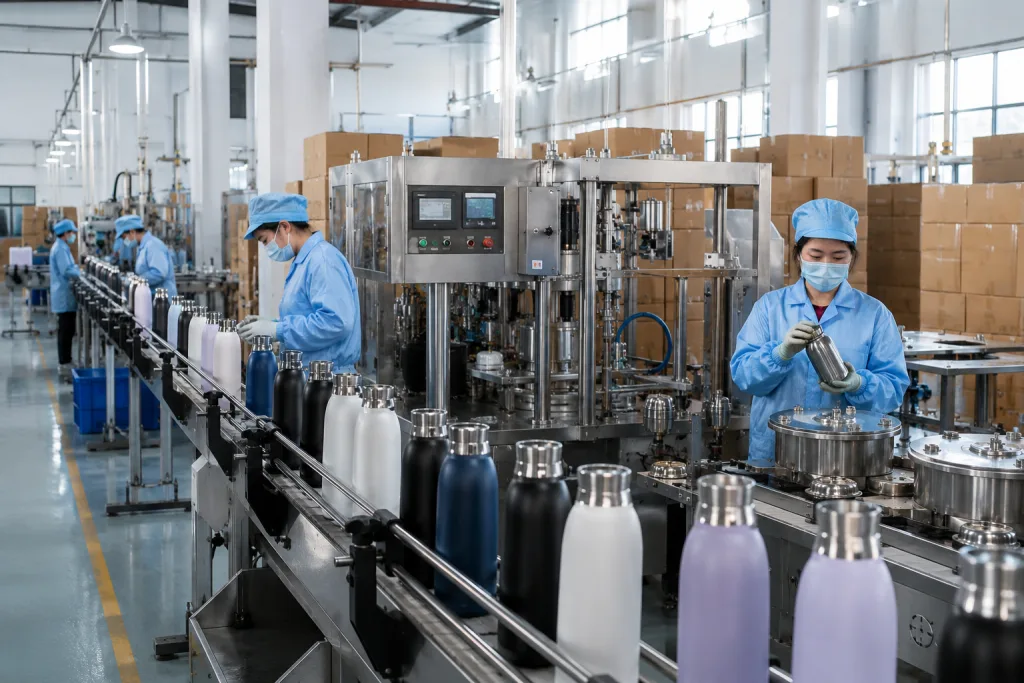
Key Takeaways
- If you need true heat retention, specify a 304 stainless vacuum liner; polycarbonate alone is not a vacuum structure, and typical MOQ starts at 1,000-3,000 units.
- For custom thermos branding, silk screen usually costs about USD 0.08-0.18 per color, while laser marking is often USD 0.15-0.35 depending on position and area.
- Standard lead time from Zhejiang, China is commonly 7-12 days for pre-production samples and 25-40 days for bulk after sample approval and deposit.
- AQL 2.5 for major defects, REACH screening, and drop/leak testing at 1.0-1.2 meters should be locked before you place thermos bulk orders.
You may be searching for polycarbonate vacuum bottle bulk because a retailer, club, event organizer, or promo buyer wants a bottle that looks premium, takes abuse, and still fits the target FOB price. Here’s the mismatch. A true vacuum bottle needs double walls and a sealed vacuum gap; polycarbonate is usually used for a single-wall body, lid, or outer shell, while the vacuum liner is usually stainless steel. On our line, QC pulled a sample last month where the buyer wrote “PC vacuum body” on the PO, but the cut section showed a 0.4 mm 304 inner and outer wall with only the cap in PC.
Your sourcing brief is not wrong. The wrong question is asking for quotes before the structure is defined. If you buy from Zhejiang, China without locking the material stack, print method, compliance scope, and carton plan first, sampling drags to 18 days vs 12 days, pricing comes back all over the board, and the product misses the sales channel. BottleForge Industrial in Hangzhou, Zhejiang ships up to 400,000 units/month, and most avoidable delays start in these first decisions, not on the production floor. We’ve seen this go sideways over a 1-carton drop test spec and even a typo on the PO that changed “polycarbonate lid” to “polycarbonate bottle.”
Start with the material stack
The first call is not color, logo, or capacity. It is the build. Buyers ask for a polycarbonate vacuum bottle bulk program, but on the line that usually means one of these: full stainless vacuum, stainless vacuum with polycarbonate components, or single-wall polycarbonate bottle. Those are different products with different heat hold, compliance risk, and cost. We’ve seen this go sideways when a PO says “vacuum bottle” and the sample on the bench is single-wall.
If you need 6-12 hour thermal hold for coffee, soup, or winter outdoor use, specify a 18/8 or SUS304 stainless inner and outer wall with vacuum insulation. Typical inner wall thickness is 0.30-0.40 mm and outer wall 0.45-0.50 mm. We check this with an ultrasonic thickness gauge before mass production. If the brief calls for a clear window, color shell, or impact-resistant cap, use polycarbonate in the lid, handle, tea filter, or outer decorative parts. That is the practical route for a custom thermos that still runs like a vacuum flask.
If your channel is promotional, not outdoor retail, a cheaper single-wall body sold as a bottle may fit. The math doesn’t work if you expect thermos performance from that build. Polycarbonate fits here because it is light and easy to mold, but the wording on the PO and carton label has to be exact. Last season a buyer flagged “vacuum mug” printed on a single-wall export carton, and QC pulled the sample before shipment.
- Outdoor retail: go with stainless vacuum, 500-750 ml, powder coat or a spray finish that passes tape test on the line.
- Promotional thermos orders: use simpler lid tooling and cut print positions if you need to hold budget; at 3,000 pcs MOQ, extra screens add up fast.
- Distributor thermos programs: start from proven molds, not fresh tooling, unless annual volume is above 10,000-20,000 units per SKU. We ship faster that way—12 days for sampling instead of 18 days on a new mold cycle.
Ask your thermos supplier one blunt question: “Which parts are stainless, which parts are polycarbonate, and where is the vacuum cavity?” If the answer is vague, stop there.
In Zhejiang factories, this early clarification saves time and bad quotes. This is the wrong question to ask later. Once factories quote different wall builds, lid structures, and finish specs, you are no longer comparing like for like. We see this at RFQ stage all the time, sometimes from 4 suppliers on the same inquiry sheet.
Choose your channel before the bottle
The second decision is channel fit. A bulk thermos for an outdoor chain store is a different item from a promotional thermos for a campaign, and neither fits a thermos distributor replenishment order. We see buyers combine these targets on one RFQ, then wonder why the cost is off by USD 0.60 per piece or why the sample feels overbuilt. That is the wrong question to ask. Start with where the bottle will sell.
For outdoor retail, buyers usually care about heat retention, dent resistance, leak control, and color consistency from PO to PO. A 500 ml or 750 ml vacuum bottle with screw cap, food-grade PP contact parts, silicone seal, and powder-coated body is the safe base run on the line. We normally check the powder coat against a Pantone chip under a light box before mass production, because the buyer flagged a navy shift once between two POs. Retail packs matter. Ask for 3A or 5A corrugated gift box options, and confirm barcode placement before artwork release.
For promotional brands, decoration area and delivered price drive the deal. A 350 ml or 500 ml bottle from an existing mold, with one-color silk screen and a standard egg-crate master carton, usually wins. In real pricing, a stock 500 ml stainless vacuum bottle from China may land around USD 2.60-4.80 FOB Ningbo or Shanghai depending on steel grade, coating, and lid complexity. Add special packaging, and the number moves fast. We had one PO where a simple insert card turned into a 12 mm taller carton, which changed the master carton count and pushed freight up more than the print cost.
For distributors thermos business, the hidden issue is assortment discipline. If you resell under multiple logos and colorways, keep to one or two bottle bodies and change the decoration only. That keeps MOQ workable and warehouse picks cleaner. Many thermos factories in Zhejiang will quote 1,000 units total with 250 units per color for standard bodies, while fully customized tooling usually starts at 3,000-5,000 units. We have seen this go sideways when a buyer wants 8 colors on 3 shapes, then finds out half the stock sits for 90 days.
Practical trade-offs
- Retail shelf appeal vs landed cost: metallic lid inserts, carry handles, and premium cartons look good, but they add USD 0.20-0.80. QC pulled the sample once because the handle pin scratched the lid during the drop test.
- SKU variety vs MOQ pressure: more colors mean split cartons, lower packing efficiency, and slower replenishment. The math does not work if each color only takes 120 units.
- Fast launch vs unique design: existing mold programs save 20-35 days and avoid tooling risk. On custom bodies, we usually wait for final drawing approval down to 0.5 mm before we cut steel.
A good thermos vendor asks where you sell, how you pack, and what your repeat order looks like before quoting. If they do not, you are getting a generic factory thermos price, not a sourcing plan you can ship.
Lock branding methods early
The third decision is customization, and buyers throw around terms like customized thermos, thermos custom, and customizable thermos as if they mean the same thing. They do not. On our side, we quote body color, logo method, packaging, and structural changes as separate cost lines. If you mix them together, the quote drifts fast. Last month a buyer flagged a PO typo that listed “matte black body” but attached a gloss-black mockup, and the sample had to be repainted.
Body color is usually the lowest-cost change if the bottle runs on a stock Pantone-like paint system. For powder coat, exact matching shifts with texture and gloss, so approve a sprayed sample under daylight and office light, not just a phone photo. We check color with a spray panel and keep a 100 x 150 mm control plate at the line. Logo goes on after that. For most thermos customized orders, the practical choices are silk screen, heat transfer, laser engraving, digital print, or embossed mold detail. This is the wrong question to ask first, by the way. First ask how the bottle will be used.
- Silk screen: best for simple logos; usually USD 0.08-0.18 per color per position at volume.
- Laser engraving: durable and clean; usually USD 0.15-0.35, depending on area and fixture.
- Heat transfer: good for wraps and multi-color artwork; higher setup and more QC attention.
- Embossed tooling: premium look, but new mold cost can run USD 1,500-5,000 or more.
For outdoor retail, laser on powder coat is often the safer long-term choice because it holds up better against scuffing than some screen inks. We have seen screen logos rub at the shoulder after 300-cycle carton vibration tests, while laser stayed clean. For promotional use, one-color silk screen usually gives the lowest unit cost. If you sell on marketplaces or into chain stores, do not miss FNSKU, EAN, or retailer barcode labels. Small item, real cost. We ship relabel jobs every season because the buyer missed a 45 x 25 mm barcode placement note.
The same logic applies to packs. A manufacturer thermos quote based on plain white boxes tells you nothing if your customer expects a branded gift box with insert card and safety sheet. We have seen this go sideways. A box insert adds little on paper, then the master carton drops from 24 pcs to 18 pcs because of height, and freight math changes. In China, sample approval on decoration usually takes 7-12 days; mass production follows in 25-40 days for standard orders. If your launch date is fixed, push the artwork dieline and print approval first. Waiting to finalize every small detail sounds safe, but it often turns into 12 days vs 18 days on packing approval.
Good thermos manufacturers do not just ask for a logo file. They ask for line weight, pantone references, adhesion expectations, scratch standard, and carton mark format. QC pulled one sample last week because the thinnest stroke was under 0.15 mm and filled in during screen exposure. That is the level of detail that saves a bulk order.
Test what matters, not everything
The fourth decision is quality scope. New buyers usually miss in one of two ways: they test too little and get claims 45 days later, or they write a lab list so long the cost goes up and the risk barely moves. For a thermos bulk order, test the failure points and compliance items that matter in your market. This is the right question. Testing everything is not.
For Europe, start with REACH screening on the relevant materials and ask for food-contact declarations for stainless steel, PP, silicone, and any coatings in contact or indirect contact positions. For North America, the usual asks are FDA-style food-contact expectations, CPSIA if the item is sold to children, and ASTM-related testing where the category or use calls for it. If you are buying a kids line, change the matrix. We have seen buyers copy an adult bottle checklist onto a kids SKU, then QC pulled the sample and flagged a handle gap at 1.8 mm that was fine for adults but not for a children’s item.
On workmanship, set the inspection standard before deposit. A common commercial benchmark is AQL 2.5 major / 4.0 minor for final random inspection. Write down what counts as major: leakage, wrong logo, unstable base, coating peel, vacuum failure, odor, sharp edge. Then define cosmetic acceptance clearly, such as 30 cm under normal light. If you skip this, the line will argue with the inspector about what “small scratch” means, and that wastes a day.
Minimum factory test pack
- Vacuum retention check: for example, hot fill at 95°C, then record temperature after 6 and 12 hours.
- Leak test: inverted or pressure method for 30 minutes.
- Drop test: filled bottle from 1.0-1.2 m depending on pack style and channel.
- Coating adhesion and abrasion check.
- Dishwasher warning verification if product is hand-wash only.
If the bottle includes polycarbonate parts, ask about cracking resistance around thread areas and handles. Those are the stress points we watch on repeat-use items. We have seen this go sideways after 3,000 twist cycles on the torque jig, especially where the thread root is thin. Serious suppliers thermos in Zhejiang usually already have test records for stock models, so ask to see them. A reliable thermos factory should also be fine with third-party inspection before shipment and should understand BSCI or social compliance requests if you supply major retailers.
The point is not paperwork. The point is fewer claims, fewer returns, and no awkward call from your customer six weeks after delivery because 12 out of 500 bottles started leaking from the lid seat.
Read quotes like an importer
Once construction, channel, decoration, and test scope are fixed, the quote starts to mean something. This is where buyers lose margin. They line up one FOB price and skip the assumptions behind it. A proper supplier thermos quotation should spell out capacity, material grades, wall thickness, finish, logo method, packing, MOQ, sample cost, lead time, and trade term. If wall thickness is missing, ask for the mm. We see too many sheets that just say “stainless steel” and nothing else.
For example, two thermos supplier quotes may both say “500 ml vacuum bottle,” but one uses SUS201 outer wall and the other SUS304 inside and outside; one includes powder coat, the other standard spray paint; one includes individual polybag and white box, the other only bulk carton. That gap is not random. It is the product. QC pulled the sample once on a similar job and found the spray finish scratched after a simple carton rub test, while the powder coat version passed. The buyer flagged the price difference first. They stopped asking after they saw the sample.
In export practice from Zhejiang, China, the common terms are FOB Ningbo or FOB Shanghai. If you buy small volume and need easier freight handling, ask for EXW only if your forwarder can collect smoothly; otherwise the savings disappear in local pickup fees, warehouse loading, and paperwork delays. We ship this every week. For stock factory thermos items, MOQ is commonly 1,000 units, sometimes 500 for neutral stock, while custom color plus logo usually starts around 1,000-3,000 units. Buyers ask if 300 pcs is possible on custom color; this is the wrong question to ask unless you accept a stock lid, stock body, and simple one-color print.
- Sample fee: often refundable after order, especially for standard mold with simple logo. On the line, a laser logo sample is usually faster than a new silk-screen plate.
- Tooling fee: should be separated, not hidden in unit cost. If a stopper part needs a new mold insert, list it out.
- Spare parts: ask for extra lids or seals at 1-2% if your program is long term. Seals are cheap; air shipping replacements later is not.
- Carton data: request GW, NW, carton size, and units/carton before booking freight. We’ve seen a PO move late because the buyer assumed 24 pcs/carton and production packed 20.
If you are an outdoor retailer, ask for pallet loading efficiency and carton drop-test standard. If you are a promotional buyer, ask how mixed-logo or mixed-color runs change MOQ and packing count. If you are building a manufacturers thermos sourcing shortlist, compare only factories that answer these line items clearly. The cheapest quote with blanks usually turns expensive after sample revisions, carton changes, and one missed note on the PO.
When to customize and when not to
Not every project should turn into full thermos customizable development. Buyers ask for a new body shape fast, then the line starts quoting new tooling, 18 days instead of 12 days, and extra QC points on the vacuum weld. In drinkware, structural changes often add avoidable mold cost, lead time, and defect risk. We’ve seen this go sideways. The better launch usually starts from a proven bottle platform and changes the parts the customer actually sees.
If your annual volume is under 5,000 units per SKU, stay on an existing mold unless the customer is funding exclusivity on the PO. Change the color, surface finish, logo position, strap webbing, lid accent, or packaging insert. QC pulled the sample last month on a 500ml stock body with a new Pantone lid and retail sleeve, and the buyer flagged it as "custom enough" without touching the tube diameter. A good customized thermos does not need a new shell if the shelf impact is already there. For promotional thermos campaigns, speed usually beats patented geometry.
Go to structural changes only when one of these conditions is true:
- You have forecast volume above 20,000 units per design.
- You need a feature not available on stock molds, such as a special pour mechanism or nesting cup system.
- You require protected design details for a long-term retail program.
Even then, ask your thermos manufacturers about semi-custom routes first. A new lid tool on an existing body can deliver 80% of the visual difference at 30% of the development cost, and this is the right question to ask first. We run this route often: one lid mold, one silicone seal revision, thread check on the gauge, then pilot samples. A lid tool is manageable. A full bottle redraw with vacuum structure validation is slower and the math doesn't work for small runs.
At BottleForge Industrial in Hangzhou, Zhejiang, 7 out of 10 buyers come in asking for a “manufacturer thermos exclusive model” and leave with a stock vacuum body, custom lid color, laser mark, and retail-ready box. Last quarter one buyer’s PO even misspelled “exclusive” as “excluisve,” but the sourcing decision was still correct. That is not a compromise. It is good sourcing discipline.
The best thermos distributors and retail buyers are not the ones who customize the most. They know which details move sales, which ones raise cost by $0.38 to $1.10 per unit, and which ones no end customer notices once the bottle is on shelf. We ship cleaner programs that way.
Send your bottle spec, get a workable sourcing plan
Share capacity, market, logo method, and target quantity. We will recommend the right stainless-plus-polycarbonate structure, MOQ, compliance path, and FOB quote.
Frequently asked questions
Can a polycarbonate bottle be a true vacuum bottle?
Not by itself. A true vacuum bottle needs two walls with a sealed vacuum gap, and that structure is normally made with stainless steel. Polycarbonate is commonly used for lids, outer shells, windows, handles, or filters, but not as the primary vacuum chamber. If you need hot or cold retention beyond a few hours, specify SUS304 stainless vacuum construction and then add polycarbonate only where it helps appearance or function. For most bulk thermos programs, the safest specification is 304 inner wall, PP or polycarbonate lid components, silicone gasket, and a leak test on every lot. If a supplier quotes “polycarbonate vacuum bottle” without explaining the stainless liner, ask for a section drawing and material list before sampling.
What MOQ should I expect for custom thermos orders?
For standard existing molds from China, neutral stock can sometimes start at 500 units, but most custom thermos orders with body color and logo begin around 1,000 units. If you need multiple colors, a common split is 250-500 units per color depending on finish. New tooling usually pushes MOQ to 3,000-5,000 units, and some complex structures need 10,000 units to make the cost sensible. If you are an outdoor retailer testing a new SKU, ask your thermos manufacturer for a stock body with custom packaging and decoration first. That keeps the MOQ realistic and cuts development time by roughly 20-35 days compared with a fully new mold.
How long does production take for thermos bulk orders?
For a standard bottle body with custom logo, plan about 7-12 days for pre-production samples after artwork confirmation. Bulk production is typically 25-40 days after sample approval and deposit, assuming normal season and standard packaging. If you add new tooling, special coatings, or retail gift boxes, you can easily add 10-20 more days. Peak season before holiday promotions can stretch schedules further, especially when print approvals are slow. Buyers in Europe and North America should also allow time for final inspection and freight booking. The practical way to shorten the schedule is to use an existing mold, approve packaging artwork early, and avoid changing logo size or carton configuration after production starts.
Which tests are essential for outdoor retail and promotional programs?
The essentials are leak testing, vacuum retention, drop resistance, cosmetic inspection, and food-contact compliance. For commercial orders, many importers use AQL 2.5 for major defects and 4.0 for minor defects at final inspection. For outdoor retail, add stronger focus on abrasion resistance, handle strength, and drop performance at 1.0-1.2 meters. For Europe, request REACH-related material screening and declarations for relevant food-contact parts. For North America, align with your channel’s FDA-style food-contact expectations and any category-specific requirements. If the bottle has polycarbonate parts, ask for stress-crack checks around threads and hinge points. You do not need every lab test ever offered, but you do need the tests tied to the claims on your packaging.
What information should I send to get an accurate quote from a thermos factory?
Send six things: capacity, target market, material preference, decoration method, packaging requirement, and target quantity. A useful RFQ would read like this: 500 ml stainless vacuum bottle, SUS304 inner, powder coat navy body, one-color white silk screen logo, individual white box, 3,000 units, for EU retail. If you want a polycarbonate component, say exactly where: lid, handle, clear window, or filter. Also specify whether you need FOB Shanghai, FOB Ningbo, or another term. Add any compliance needs such as REACH, barcode labels, or BSCI-related factory documentation. With that level of detail, serious thermos suppliers can usually give you a meaningful quote within 24-72 hours instead of a vague price range.