Key Takeaways
- A workable MOQ for custom Tritan bottles is usually 1,000 to 3,000 pcs per color, while fully new molds often start around USD 2,500 to 8,000 plus 25 to 40 days
- Tritan is usually the safer choice for food-contact consumer bottles, while classic polycarbonate needs more careful market and compliance review in Europe and North America
- For China production, normal lead time is 30 to 45 days after sample approval, with repeat orders often shipping in 20 to 30 days
- Use AQL 2.5 for major defects, verify REACH and LFGB or FDA files, and define leak test, drop test, and logo adhesion standards before PO
You can buy a bottle that looks fine in a catalog and still land the wrong SKU for your market. We see this on the line every month with polycarbonate tritan bottle wholesale projects. A buyer asks for "clear plastic sports bottles," then 3 suppliers quote different resins, flip-top versus screw lid, and 0.6 mm versus 0.8 mm wall thickness. QC pulled the sample, filled it, tipped it 45 degrees, and the first one leaked. Then the logo scratched after a tape test, or the compliance file for Europe was missing pages.
If you buy for retail, promo, gym, outdoor, or private label, get the spec tighter before you ask for price. From Zhejiang, we ship this category every month, and the pattern is boring: vague RFQs drag sampling from 12 days to 18 days, mix quality levels, and create claims you did not need to have. This is the wrong question to ask: "What's your best price?" Ask what resin grade, lid structure, bottle weight, and test standard the quote is based on. The fix is simple. Put bottle types side by side, match them to the sales channel, and lock the key numbers before production starts.
Start With The Real Material
Buyers often type polycarbonate tritan bottle wholesale as one search term. On the factory side, that creates trouble fast because polycarbonate and Tritan are different materials, and if you mix them in one RFQ, the quotes you get are not apples to apples. We see this weekly. One buyer sends a 700 ml sketch with no resin callout, the line prices Tritan TX1001, another supplier prices legacy PC, and the gap looks like margin when it is actually material.
For retail-facing custom water bottles, we usually run Tritan copolyester, not old polycarbonate. The reason is simple: Europe and North America expect BPA-free wording and cleaner food-contact positioning, and your compliance team will ask fewer questions. Tritan gives clear appearance, solid impact performance, and dishwasher tolerance on a lot of designs if the wall is around 0.8 to 1.0 mm and the lid parts are matched correctly. Polycarbonate is still tough and clear, but the buyer flagged it more than once on consumer programs, especially for supermarket shelves. For industrial use, team sports, or non-retail projects, some buyers still ask for it. For mainstream drinkware wholesale, Tritan is the cleaner call. This is the right question to ask first.
What to lock before asking for price
- Resin: Tritan TX1001 or equivalent food-contact grade, or clearly specified polycarbonate grade
- Capacity: 500 ml, 650 ml, 750 ml, or 1,000 ml. Do not just say “standard bottle.”
- Wall thickness: usually 0.7 to 1.2 mm for blow-molded bodies, depending on shape and drop target
- Lid type: screw cap, flip straw, spout, chug lid, or carry loop
- Decoration: 1-color silk screen, heat transfer, wrap print, or laser on metal trim parts
You are not buying a bottle shape alone. You are buying a resin, a mold tolerance, a lid system, and a compliance package.
From Zhejiang, China, a factory may quote USD 1.10 and USD 2.40 for what looks like the same 700 ml bottle. The math does not work if you compare shape only. In most cases, the gap comes from resin grade, cap structure, packaging spec, and testing scope. QC pulled the sample on one project last month and found the cheaper version used a lighter cap with a thinner hinge pin, plus a plain PE bag instead of a color box. Same silhouette, different bottle. We have seen this go sideways when the PO only says “700 ml clear sports bottle” and misses the resin and lid code.
Head To Head Spec Table
If you need an apples-to-apples comparison, lock the spec table before you start talking price. We run this first for 7 out of 10 new RFQs because the buyer often mixes Tritan, polycarbonate, and steel on one sheet, then the line loses 2 days quoting the wrong format.
- Tritan bottle, 700 ml: body 0.8 to 1.0 mm, weight 135 to 180 g, custom MOQ 1,000 pcs, FOB China around USD 1.35 to 2.20 with basic lid
- Polycarbonate bottle, 700 ml: body 0.9 to 1.1 mm, weight 150 to 190 g, custom MOQ 1,000 pcs, FOB China around USD 1.20 to 2.00 depending on resin source
- Stainless canteen, 750 ml single wall: 0.4 mm body, weight 170 to 230 g, MOQ 1,000 pcs, FOB around USD 1.80 to 3.10
- Vacuum bottle, 750 ml: inner 0.304 mm and outer 0.45 mm typical, weight 280 to 420 g, MOQ 500 to 1,000 pcs, FOB around USD 3.20 to 6.50
- Growler, 1.9 L stainless: MOQ 500 pcs, FOB around USD 6.50 to 11.00 depending on coating and lid
Why put bulk canteen, bulk growler, and related items into a Tritan sourcing discussion? Because procurement teams do this all the time. They start with one bottle brief, then after sample review and carton math, the buyer flags that the real use is office hydration, beer takeaway, or 12-hour cold hold. If your customer wants cold retention over 12 hours, Tritan is the wrong material. If they want light weight, transparency, and a sub-USD 2.00 landed manufacturing target, stainless is the wrong place to start. This is the wrong question to ask if the team is only debating resin before they confirm use case.
For a factory in Hangzhou, Zhejiang with capacity around 300,000 units per month across plastic and steel drinkware, the practical question is not whether we can make all of them. We ship both. The real issue is whether your channel margin covers the material, cap structure, and packaging cost after drop test requirements and master carton limits. Last month QC pulled the sample on a 750 ml vacuum bottle because the PO said "indvidual box" instead of "individual box," and the buyer had actually approved no retail box at all. Spec discipline saves money. We've seen this go sideways.
Use Case Fit Beats Catalog Variety
Plenty of buyers still shop by catalog count. We’ve seen RFQs asking for 400 SKUs, then the usable range drops to 12 once margin, channel, and compliance are on the table. That is the wrong question to ask. For wholesale drinkware, start with the selling scene first, then match the bottle. On our sample rack, the caliper check is usually fine; the mismatch is the use case.
Good fit for Tritan bottles: gyms, schools, outdoor accessories, wellness brands, company merch, and mid-price retail where shelf clarity sells. Tritan also fits projects that need measurement marks, infusion inserts, or fruit strainers, since the line can hold those details without moving to a heavier material. A common setup we ship is 650 ml to 850 ml with a 0.5 mm logo line check before mass production.
Less ideal fit for Tritan bottles: beer packaging, thermal use, or premium gifting where hand feel and insulation drive perceived value. We’ve seen this go sideways. One buyer flagged a Tritan bottle as “too light” for a gift set after PPS approval, even though dimensions were correct. That is where beer growler wholesale, beer tumbler bulk, or stainless canteen wholesale usually makes more sense.
Quick use-case matching
- Promo or event bottle: 500 to 700 ml Tritan, 1-color silk screen, individual polybag, target FOB USD 1.20 to 1.80; MOQ often starts at 3,000 pcs on the line
- Sport retail bottle: 700 to 1,000 ml Tritan with carry loop and molded logo, target FOB USD 1.80 to 2.80; buyers often ask for drop-test feedback before they place the PO
- Outdoor canteen bulk order: single-wall stainless if dent resistance matters more than transparency; we run this option when wall thickness and field use matter more than shelf look
- Beer growler in bulk: stainless vacuum or single wall, usually 1.2 L to 1.9 L, not Tritan; QC pulled the sample and weight balance was the first check
- Alcohol flask wholesale bulk: stainless hip flask, usually 6 oz to 8 oz, completely different line and compliance profile; one PO even came in with “flash” typed instead of “flask,” so yes, details matter
The point is simple. Your buyer may search best wholesale drink bottle, drinkware bulk, or wholesale growler, but the sourcing call should follow real use, carton loading, and how the product sells at retail. Good factories in China will push back if the brief and the material do not match. You want that. Last month, one carton drop test at 76 cm told the full story before production started.
Cost Drivers Buyers Usually Miss
The body resin is one line on the cost sheet. The bigger cost swings usually sit in the lid set and pack-out. A plain screw cap can cost USD 0.18 to 0.35. A push-button lid with internal straw, spring, and safety lock can cost USD 0.55 to 1.10. On a bottle with FOB cost of USD 1.60, that matters. We run lid assemblies on the line with a go/no-go gauge for thread fit, and this is the wrong question to ask if you only compare bottle body weight.
Logo process changes the math fast. For drinkware wholesale programs, 1-color silk screen is still the cleanest cost option at scale. Typical cost adder is USD 0.05 to 0.12 per print position at 3,000 pcs. Heat transfer wrap graphics may add USD 0.18 to 0.45. Special rubber paint, UV finish, or metallic trim can raise defect risk and slow output. QC pulled the sample last month on a metallic band job because the edge scratch showed up after a 24-hour tape test.
Packaging is where buyers get surprised. For retail, a white box plus barcode label is often enough. For Amazon FBA, you may need drop-tested mailer packs, suffocation warning, FNSKU label placement, and carton marks exactly per routing guide. That can add USD 0.20 to 0.60 per unit depending on board grade and insert structure. We have seen this go sideways over a 3 mm insert change, or one PO typo in the carton mark that the buyer flagged before shipment.
- Sample lead time: 5 to 10 days for existing model with logo, 15 to 25 days if cap color or tooling changes
- Mass production: 30 to 45 days after deposit and sample approval
- Typical payment: 30% deposit, 70% against inspection or copy B/L
- New mold cost: around USD 2,500 to 8,000 for body or cap depending on complexity
If you compare canteen bulk, growler bulk, or alcohol flask bulk projects, the same rule still holds. The visible vessel is not the full product cost. Closures and pack-out usually decide whether your margin survives. We ship projects where the bottle body looked fine on paper, then the buyer pushed for a custom closure and the math did not work.
Compliance Files Before Production
If a supplier says "no problem, food grade" and stops there, keep asking. That line means nothing without the file behind it. For Europe and North America, ask for the compliance file before you place the PO, not after production is finished and the cartons are taped. We have seen buyers wait until day 18, then the lab report shows the wrong lid material code on page 2. That gets expensive fast.
- EU market: ask for REACH, LFGB where relevant, and testing on finished product or a representative material set; QC pulled the sample from the same resin lot, not a random old file
- US market: ask for FDA food-contact declaration and any required state-level chemical disclosure support; the buyer flagged missing California paperwork on a 5,000 pcs order last year
- Kids' use: if sold for children, review CPSIA and applicable ASTM elements based on the straw, handle, small parts, and stated age grade
- Social and system audits: BSCI, Sedex, or ISO 9001 can matter if your retail customer requires them; this is the wrong question to ask too late
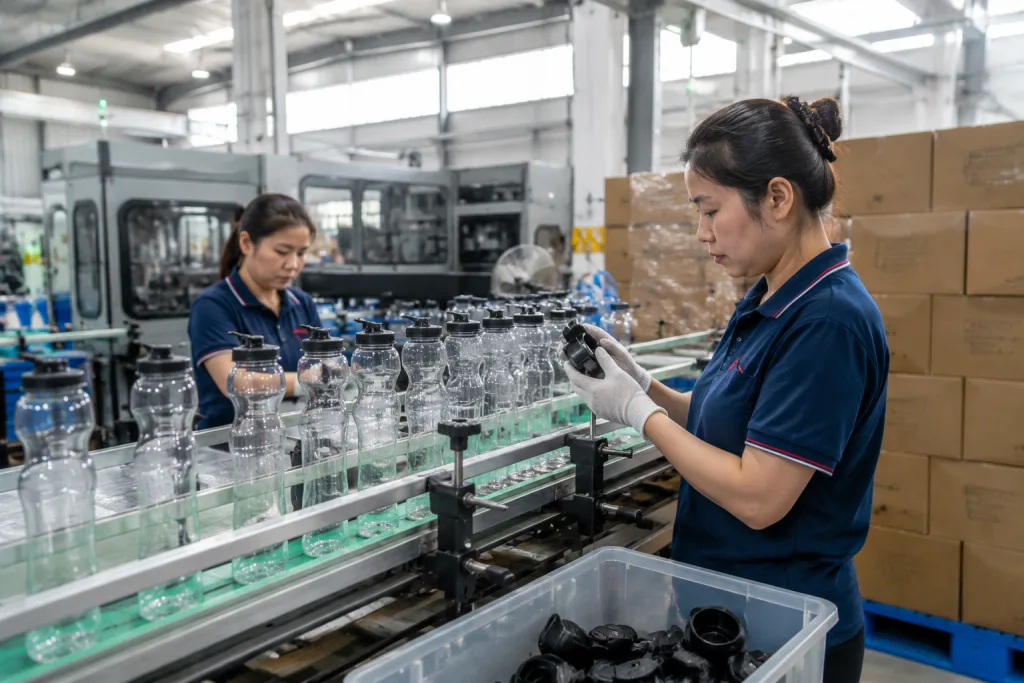
Also define inspection standard in the PO. We usually recommend AQL 2.5 major / 4.0 minor for general drinkware, plus a separate functional checklist for leak testing. Write it down. If the PO says only "inspect before shipment," the math does not work. For a 700 ml Tritan bottle, we run checks with a go/no-go gauge, torque check on the cap, and a signed QC sheet at the line:
- 100% leak test after filling and inversion for 30 seconds
- Drop test from 1.0 meter with empty bottle, 3 orientations
- Logo adhesion test by tape pull after 24-hour cure
- Dishwasher or hot-water resistance only if specifically claimed in your sales copy
Zhejiang factories that export every week will know these requirements. The gap is in documentation. One factory ships with a clean file set in 12 days; another sends loose screenshots and a verbal promise after 18 days. We have seen this go sideways when the importer of record asks for evidence and the PO even has a typo on the bottle SKU. A verbal promise from China will not help you then.
How To Place A Cleaner RFQ
The fastest way to get useful quotes is to cut the guesswork. If the buyer sends "please quote wholesale canteen and bottle," we usually send back a generic range and 2 or 3 follow-up questions, which adds a day fast. A clean RFQ gets you a real offer in 24 to 72 hours, sometimes same day if the drawing, logo file, and packing spec are already clear.
For polycarbonate tritan bottle wholesale, put these points in your RFQ:
- Target capacity in ml and preferred dimensions
- Resin preference: Tritan only, or polycarbonate acceptable
- Lid style with reference photos
- Expected order quantity: 1,000, 3,000, 5,000, or 10,000 pcs
- Decoration method and number of colors
- Target market: EU, US, Canada, or mixed
- Packaging requirement: bulk pack, white box, color box, or e-commerce pack
- Trade term: FOB Ningbo, FOB Shanghai, or DDP if you really need it
If you are cross-shopping related programs like wholesale canteen, beer tumbler wholesale bulk, or alcohol flask in bulk, split them into separate RFQ lines. We have seen this go sideways. A Tritan sports bottle, a stainless beer tumbler, and a hip flask do not run on the same line, do not use the same tooling, and do not share the same QC points; even carton drop test standards and lid torque checks can differ. Last month a buyer mixed 4 SKUs on one PO and even typed the flask capacity wrong, 8 oz instead of 6 oz, which delayed the quote revision.
A practical supplier should also tell you what not to do. This is the wrong question to ask: "Can you make a 1,000 ml Tritan bottle with a narrow waist, soft-touch coating, auto-flip lid, and the same landed price as a plain bottle?" The math doesn't work. If we run that spec, the neck area usually needs a thicker wall, around 0.6 mm more in the grip zone, and QC pulled the sample before because the hinge life failed early. A straight answer with tradeoffs is a good sign. Honest sourcing from Zhejiang, China means locking a spec the factory can ship repeatedly without ugly surprises at inspection.
Send your bottle spec and get a workable quote
Share capacity, lid style, target market, and quantity. We will review material fit, MOQ, compliance points, and FOB pricing from Hangzhou, Zhejiang.
Frequently asked questions
Should I choose Tritan or polycarbonate for a retail water bottle program?
For most retail programs, choose Tritan unless you have a specific reason to use polycarbonate. Tritan is widely accepted for BPA-free positioning, has strong clarity, and is easier to explain to distributors in Europe and North America. On a 650 to 750 ml bottle, FOB China pricing is often only USD 0.10 to 0.30 higher than comparable polycarbonate, which is usually a small premium compared with the risk of buyer hesitation. If your MOQ is 2,000 pcs and you are selling through sports, school, or lifestyle channels, Tritan is normally the safer commercial choice. Polycarbonate may still be considered for industrial or non-retail applications, but you should review market acceptance and compliance paperwork more carefully before committing.
What MOQ is realistic for custom polycarbonate Tritan bottle wholesale orders?
For existing bottle molds, a realistic MOQ is 1,000 pcs per size and usually per color. Some factories in China will quote 500 pcs, but the price tends to rise sharply because setup, printing, and carton utilization are inefficient. For a more custom program with special cap color, insert, or packaging, 2,000 to 3,000 pcs is healthier. If you need a completely new mold, expect tooling cost around USD 2,500 to 8,000 and a first production MOQ closer to 3,000 to 5,000 pcs. If your order includes several items like canteen wholesale, growler wholesale, and bottle SKUs, ask whether the supplier can combine production under one shipment, but do not assume the MOQ pools across different product families.
How do I compare quotes when one supplier is much cheaper?
Start by normalizing the quotation line by line. Ask each supplier to break out resin type, bottle weight, lid structure, decoration, unit pack, master carton quantity, and testing included. A quote that is USD 0.35 cheaper may use lighter bottle weight, recycled-looking off-grade resin, thinner print, or no leak-test control. On a 700 ml Tritan bottle, a body weight difference of 25 g is meaningful. So is the difference between a USD 0.22 screw cap and a USD 0.78 push-button lid. Also compare trade terms. FOB Ningbo is not the same as EXW. For reliable drinkware bulk sourcing from Zhejiang or elsewhere in China, the cheapest quote is often just the least complete one.
What tests and documents should I require before shipment?
At minimum, ask for material declaration, food-contact compliance support for your market, and a finished-goods inspection report. For EU-oriented sales, request REACH and LFGB-related documentation where applicable. For the US, request FDA food-contact support. On the QC side, define AQL 2.5 major and 4.0 minor, plus 100% leak testing. For bottles with printed logos, require tape adhesion testing after 24 hours of curing. For structural reliability, ask for a 1.0 meter empty-bottle drop test in 3 orientations. If the item is sold to children, review whether CPSIA or ASTM-related requirements apply based on the design. The right documents should be ready before the goods leave China, not assembled after a complaint.
Can one supplier handle bottles, growlers, tumblers, and alcohol flasks together?
Sometimes yes, but you should check whether the supplier is an actual integrated factory or a trading company coordinating multiple workshops. A manufacturer with both plastic and stainless lines may cover Tritan bottles, sports bottles, tumblers, and some growler styles under one QA system. Alcohol flasks, especially mirror-polish or wrapped models, may still come from a separate line. Ask direct questions: monthly capacity, in-house processes, which items use subcontractors, and whether final inspection is centralized. A useful metric is whether they can state something concrete, such as 300,000 units per month total capacity, 7 to 10 days for pre-production samples, and 30 to 45 days for mass production. That level of detail usually tells you they actually control the process.