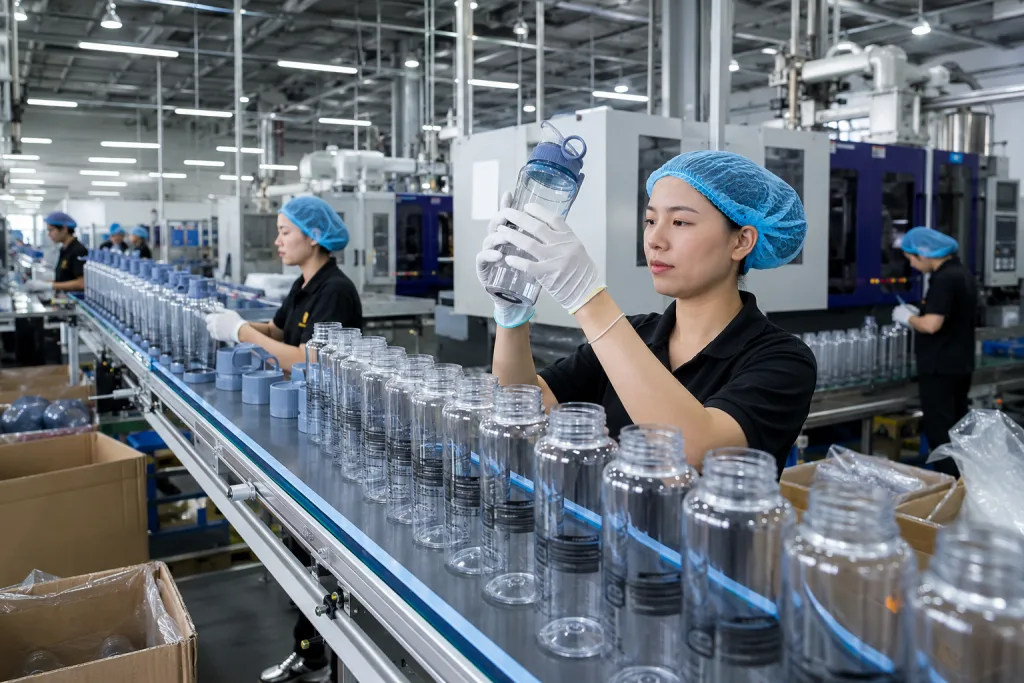
Key Takeaways
- Lock resin, color, wall thickness, and test standard before tooling; changing from 2.2 mm to 1.8 mm can cut impact margin fast
- For new molds, budget 20-30 days tooling plus 30-45 days mass production, with practical MOQs starting around 3,000 units
- Use written QC gates: AQL 2.5 major / 4.0 minor, 100% leak test, and drop testing at 1.2 m with filled bottles
- Decoration failure is common; laser, silkscreen, heat transfer, and in-mold effects each need separate adhesion and abrasion specs
You can approve a nice-looking sample and still receive a bad shipment. We see it on the line. In custom drinkware, failures usually start with loose specs, not a careless factory: resin grade not locked, wall thickness cut from 2.2 mm to 1.8 mm to hit target cost, logo process picked on unit price instead of rub resistance, or drop testing written so loosely that QC pulled the sample and asked what standard to follow. If you are buying from a polycarbonate tritan bottle factory in Zhejiang or elsewhere in China, this is the wrong question to ask: “Is the supplier reliable?” The bigger risk is five small misses stacked into one claim.
If you source for retail, promotions, Amazon FBA, or a canteen distributor network, think like QA first and marketing second. BottleForge Industrial in Hangzhou, Zhejiang runs custom programs from 3,000 units MOQ with 30 to 45 day lead time, and we keep seeing the same failure point: weak drawings, weak test plans, weak packaging specs. One PO last season even had the cap color typoed against the approved Pantone, and the buyer flagged it only after mass production started. Push there. That is where projects go sideways, and the math doesn’t work if you catch it after we ship.
Material confusion starts early
Buyers mix up polycarbonate and Tritan on POs all the time. They are different materials. Polycarbonate gives good clarity and impact strength, but a lot of retail programs now reject it over BPA concerns in some markets. Tritan is a copolyester usually specified for BPA-free consumer drinkware. If your PO says only “clear plastic bottle,” the line has too much room to swap resin, and we have seen that go sideways.
In a canteen factory in China, resin choice changes more than the compliance wording. It changes the molding temperature window, how fast scratches show on a glossy body, odor after hot-water fill, dishwasher performance, and whether the logo sticks after tape test. On one 750ml body, the barrel looked fine but QC pulled the sample because the print adhesion dropped after material changed. For a custom canteen or customizable drinkware project, lock at least five material points in writing:
- Resin family and grade, not just “Tritan” or “PC”
- Food-contact declaration for EU and FDA markets
- Color masterbatch code and letdown ratio
- Regrind policy, ideally 0% for food-contact visual parts
- Target wall thickness range, for example 2.0-2.4 mm
If you sell into Europe, ask for REACH and LFGB-related food-contact support where applicable. For North America, ask for FDA food-contact documentation and, if the product targets children, review CPSIA and ASTM touchpoints. A supplier who replies with “test report available” is not answering the question. Ask for the report scope, lab name, test date, and confirmation that the tested sample matches your final color and decoration. This is the wrong question to ask: “Do you have a cert?” The right one is: “Which resin grade, which color, which decorated sample, tested when?” We ship against documents, not promises.
The most expensive bottle material is the one you thought you bought but did not specify clearly.
This gets worse on canteen customizable programs with 6 or 12 colors. Dark or heavy masterbatch can hide flow marks, but it can also raise haze or create lot-to-lot shade shift. We have had a buyer flag two blue bottles from separate runs because Delta E was out even though both passed basic visual check under the light box. If you are a canteen distributor or distributor drinkware buyer, approve a sealed golden sample for every major SKU color, not only one clear sample.
Thin walls create cracked shipments
If a bottle cracks in transit or shows stress whitening at the shoulder, buyers usually blame the carton drop. Most of the time, the problem started in the part design. We’ve seen clean CAD files fail on the line because the neck transition was too sharp, the base radius was pulled too tight, or the wall dropped under the process-safe range. This shows up a lot on custom growler and customizable growler projects, where the bigger volume looks fine on screen but pushes Tritan past what the section can carry.
For most 500-750 ml Tritan bottles, we run a body wall target around 2.0-2.4 mm. Below 1.8 mm, impact margin falls fast, especially near the handle boss or threaded neck, and QC pulled samples before with whitening after a 1.2 m drop. Large custom drinkware sizes such as 1.0 L to 1.5 L usually need thicker sections or ribs in the right place. If your canteen manufacturer pushes aggressive lightweighting to hit FOB, ask the direct question: what drop result are you giving up for that price cut? That is the right question.
What to put in the spec sheet
- Nominal wall thickness with tolerance, such as 2.2 mm ±0.2 mm
- Filled bottle drop test, for example 1.2 m on 3 orientations
- Top-load or squeeze resistance if the bottle will be packed tightly
- Thread gauge standard and torque window for cap application
- Base flatness tolerance to prevent wobble at retail
A canteen manufacturer in Zhejiang or another China production hub should be able to give mold-flow feedback before steel cutting. Ask where knit lines will land, which area is likely to sink, and how the ejector pin layout will mark the base. We use Moldflow before releasing steel, and if a supplier cannot point to the weak zone in a 2.2 mm wall bottle, they are quoting a shape, not engineering a part.
For canteen promotional orders, buyers often chase unit cost first because the campaign budget is tight. This is where it goes sideways. A bottle at USD 1.55 FOB is not cheap if 4% arrive cracked at the neck, the buyer flagged the shipment, and your team spends more on credits and rework than the 10 cents saved. The math doesn’t work.
Caps fail more than bottles
Most leak claims start at the cap, not the bottle body. Buyers will spend 2 hours on bottle color chips and 10 minutes on the closure spec, then the trouble shows up later on the line. Gasket material, vent slots, thread engagement, and torque decide whether the bottle stays dry. A canteen vendor showing 10 cap styles on one catalog page looks efficient, but each one fails in its own way. We’ve seen this go sideways after first shipment.
The failure modes are basic. Poor liner compression. Flash left on the sealing land. Cross-threading at start-on. Flip-top hinge fatigue after repeat use. Straw fit drifting batch to batch by 0.3 mm. If you source a customized canteen with carrying loop, one-hand spout, or integrated straw, build functional cycling into QC. QC pulled the sample and it passed 10 opens in the showroom; that tells you almost nothing if it dies at 500 cycles in daily use.
Specify the closure like you would a separate product:
- Cap resin and gasket material, such as PP cap with food-grade silicone seal
- Application torque range, for example 8-12 lbf·in
- 100% leak test method: vacuum, inverted time test, or air-pressure check
- Open-close cycle target, such as 500 or 1,000 cycles
- Bite valve or straw pull-force if relevant
For a custom growler or customized growler with larger capacity and higher carry weight, handle attachment and closure retention matter more. The center of gravity shifts once the bottle is full, and users often pick up 1.5 kg to 2.0 kg by the cap loop alone. This is the wrong question to ask: “Does the loop look strong?” Ask what load it was tested at, and for how many lifts. If the loop is decorative, not load-bearing, print that on the artwork and packaging. Otherwise the buyer flagged it after returns, and the math doesn't work.
For distributor canteen programs, insist on pre-shipment QA using AQL levels that fit the channel. A practical baseline is AQL 2.5 for major defects and 4.0 for minor defects, with 100% leak testing on all units. That is normal factory discipline. We run inverted leak checks on the line for 30 minutes per lot, then seal-check any rejects to find whether the issue came from torque drift or a bad gasket batch. Any canteen suppliers or canteen vendors saying random spot checks are enough for leak-sensitive products are pushing their process variation onto you.
Decoration looks good, then peels
Logo failure kills stock fast. Day-1 samples can look clean, then the print starts lifting after hand-wash cycles, alcohol wipe-downs, or carton rub on the line. We see this a lot on customized drinkware for promotions, distributor programs, and event merchandise, where the buyer cares about the brand hit first and the bottle second. Last month QC pulled a sample after 30 carton-abrasion passes and the red logo was already chipping at the edge.
Do not pick decoration by unit price alone. Pick it by end use. Silkscreen is the low-cost option for simple art, but the ink has to match the substrate and the curing window has to be right; on Tritan, a bad bake setting can fail fast. Heat transfer handles gradients and dense graphics well, though it will scuff if the over-varnish is thin—we check varnish film and rub resistance before mass production. Laser marking on some components lasts, but contrast depends on additive response, so the same file can look sharp on one lid and weak on another. Molded-in effects hold up well, but you need to lock the design early, and the setup cost is higher. This is the wrong question to ask: “Which decoration is cheapest?” Ask which one survives the actual use case.
Questions smart buyers ask
- What is the adhesion test method: cross-hatch, tape pull, rub cycle?
- Is the decorated sample from actual production resin and color?
- What is the cure time before carton packing?
- Will logos touch dividers or polybags during transit?
- Can the factory provide Pantone tolerance and visual standard?
For canteen custom or canteen customized projects, ask for an abrasion standard in writing. A practical spec is 50 dry rubs plus 20 wet alcohol rubs with no obvious peeling. If the product sells online, ask the canteen supplier to run packed-drop testing too. We’ve seen this go sideways: the ink was fine, but bottles knocked each other inside the master carton and the print got chewed up before arrival. One buyer flagged this after a 1A drop test because the logo side was facing the carton wall with no divider gap.
If you are building a private-label line with a canteen distributor network in Europe or North America, approve artwork in stages: 2D proof, pre-production sample, then sealed shipping sample. That usually adds 3 days vs 1 day for a straight PDF sign-off, and the math works if it prevents a remake. Most decoration disputes out of China are not about the file itself. They start because the factory approved one visual standard and the buyer judged shelf appearance under retail lighting. We ship against the sealed sample for that reason. It sounds basic, but one PO typo on logo size—38 mm instead of 33 mm—can turn into a full claim.
Compliance paperwork is often too vague
Buyers ask, “Do you have tests?” all the time. That question is too loose. Ask this instead: “Which standard, which sample, which lab, and which market?” We’ve seen a factory show one valid report for a 700ml clear body with no print, then the PO was for a black bottle with a silk-screen logo and different lid gasket. Those are not the same compliance case. Clear resin and black masterbatch do not behave the same in testing, and decoration changes the sample again.
If you buy from a canteen factory or canteen manufacturer in China, build the document list around where you sell and how you sell. For EU programs, REACH and food-contact declarations usually come up first. For US retail, FDA food-contact support is basic. For kids’ items, the scope often gets wider, including chemical review and mechanical checks. Larger accounts also ask for social and system documents: BSCI, ISO-style process control, and lot traceability. We ship to both EU and US buyers, and the pushback is often the same: “Your report is for natural color, but our SKU is smoke gray.” QC pulled the sample once for that exact gap.
Your approval package should usually include:
- Material declaration tied to the exact SKU
- Finished-product test report from a recognized lab
- Packaging spec, barcode spec, and carton marks
- QC checklist with defect definitions and AQL plan
- Production lot traceability format
For Amazon or major retail, add barcode control such as FNSKU placement, carton labeling rules, and scan verification. This is where orders fail for boring reasons. A distributor growler or distributor drinkware order can be physically good and still get rejected at the warehouse. We’ve seen this go sideways over a 12mm FNSKU shift, carton size off by 2 cm from the approved spec, and mixed lot coding on one pallet. The buyer flagged it before the bottles were even opened.
Good canteen manufacturers in Zhejiang usually know the paperwork pattern, but do not hand them your judgment. Read the report scope. Check the sample description. Confirm the report date still works for your customer’s onboarding window. This is the wrong question to ask: “Do you have a certificate?” Ask whether the certificate matches your exact SKU, decoration, packaging, and market. Paperwork proves one sample was tested once. It does not prove the line ran your order the same way.
Packing errors destroy margin quietly
Packaging is where 1 decent bottle program out of 4 starts leaking margin. The bottle passes leak test, the logo looks fine, then after a 30-day ocean trip from China we open the carton and see scuffs, dents, mixed colors, or crushed corners. We’ve seen this go sideways. A common miss is copying packing specs from an old PO without checking whether the bottle OD changed by 3 mm, the cap loop got taller, or the print now sits on a high-gloss panel.
For a customizable canteen or custom growler, lock the inner pack and master carton standard early. If a cap loop sticks out, the divider cell needs more clearance; on our line, QC pulled the sample and found the loop rubbing the top flap on a 24-pack carton. If the finish is gloss, add a polybag or tissue wrap so bottles do not kiss each other and leave rub marks. If your customer ships parcel or sells through club-store handling, standard export cartons are often the wrong spec. This is the wrong question to ask after mass production starts.
At minimum, specify:
- Individual packing method and orientation
- Master carton burst strength or edge-crush target
- Drop test for packed cartons, such as 76 cm on 1 corner, 3 edges, 6 faces
- Carton gross weight limit, often under 15 kg for easier handling
- Pallet pattern, overhang rules, and stretch-wrap standard if palletized
This matters to canteen distributors and canteen vendors because freight damage is expensive to prove and slow to settle. The math doesn't work. If your FOB price is USD 2.10 and your landed replacement cost is USD 3.40, a 3% hidden damage rate erases margin fast. We ship claims files every season, and the buyer always asks the same thing: why did 18 cartons arrive clean outside but scratched inside? Spend a few cents on better dividers before you spend dollars on replacements.
BottleForge Industrial ships from Hangzhou, Zhejiang, and we run packaging verification in pre-shipment review because this is one of the cheapest control points on the order. Our team checks carton size, gross weight, divider fit, and pallet stack before booking. Last month the buyer flagged a PO typo that showed 1 pc/box while the approved sample was 2 pcs/box; that single line would have doubled carton count and freight. If a factory talks only about molding and says nothing about carton engineering, you are not dealing with a full B2B supplier. You are dealing with a workshop that also prints export paperwork.
Supplier selection should test process discipline
Most buyers checking a canteen supplier, canteen vendors, or a canteen manufacturer start with price. Normal. Still incomplete. The better screen is process discipline. We run into this every week: can the factory separate resin lots, hold color delta within the agreed standard, check lid torque with a digital torque tester, trace each carton code, and close a nonconformity with records instead of talk? This is the right question to ask.
Ask direct questions and wait for direct answers. What is the MOQ for existing molds and for custom molds? How many units per month does the line actually run? How long does a new mold take from drawing approval to T1 sample? A serious polycarbonate tritan bottle factory should give hard numbers. Example: 3,000 units MOQ on standard bottles, 5,000-10,000 on some custom color programs, 20-30 days for tooling, 30-45 days mass production, and monthly output measured in hundreds of thousands. Not “depends.” We have seen buyers get a PO with “Tran bottle” typed on it, and that usually tells you how loose the back office is.
Then ask about the boring controls that protect your order. QC pulled the sample, not the sales team photo set.
- Incoming material inspection and lot coding
- In-process patrol frequency, such as every 2 hours
- Leak-test coverage rate
- Final random inspection to AQL
- Corrective action process with photos and root cause
If you are a canteen distributor, distributor canteen buyer, or managing a distributor growler line, ask for photos of gauges, QC records, and packaged pallets from recent runs. Skip the showroom shots. Ask for the torque meter screen, the carton drop-test area, or pallet labels from a 1,200-carton shipment. The buyer flagged this once with us after seeing perfect samples and mixed master carton marks on the bulk lot. That is how repeat orders go sideways. A capable canteen manufacturer in Zhejiang or elsewhere in China will not get offended. They know you are checking whether the line repeats.
That is the buying decision. Not whether the first sample looked good on a desk. Whether the factory can make 10,000 more units with the same weight, the same fit, and the same leak result, then pack them correctly, document them properly, and ship them on time. We ship plenty of clean samples. Repetition is the harder job.
Send your bottle spec, not just a photo
We will review resin, wall thickness, cap design, decoration, packaging, MOQ, and lead time before quoting so you can buy custom drinkware with fewer surprises.
Frequently asked questions
What is a realistic MOQ from a polycarbonate tritan bottle factory?
For existing molds, a realistic MOQ is usually 3,000 units per SKU, sometimes lower for plain colors and higher for special decoration. For a fully custom bottle with new tooling, expect 5,000 to 10,000 units as a practical starting point, especially if you need multiple cap colors or custom packaging. In China, some factories will quote 1,000 units to win the inquiry, then add surcharges everywhere else. Ask whether MOQ is based on bottle body only, cap color, print color, or carton artwork. If you are buying for a canteen distributor program, also confirm whether mixed colors in one order are allowed and what the minimum per color is, such as 500 or 1,000 units.
How do I choose between polycarbonate and Tritan for custom drinkware?
Start with your market requirements, not your preferred buzzword. Polycarbonate offers clarity and toughness, but many buyers avoid it for consumer programs because of BPA perception. Tritan copolyester is commonly selected for BPA-free retail drinkware and generally fits better for North America and Europe. Then compare use conditions: dishwasher exposure, odor resistance, scratch appearance, and decoration compatibility. For a 600 ml custom canteen or customizable drinkware project, the material cost difference may be only a few tenths of a dollar, but the claims risk can be much larger. Ask the factory to quote both options with exact resin grade, wall thickness, and test scope so you are comparing like with like.
What QC tests should I require before shipment?
At minimum, require 100% leak testing, visual inspection, and a final random inspection to AQL 2.5 major and 4.0 minor. Add filled-bottle drop testing at 1.2 m in multiple orientations, cap torque verification, and decoration adhesion testing such as cross-hatch or tape pull. For flip-top or straw designs, include cycle testing of 500 to 1,000 opens. If the bottle has a carry loop, test pull strength under realistic load. For export from Zhejiang or other China hubs, also check packed-carton drop performance because transit damage is a common hidden cost. Good factories can provide a written QC checklist with photos, lot traceability, and measured results rather than just a pass/fail statement.
How long does tooling and production usually take?
For a new bottle mold, 20 to 30 days is a normal tooling window if the design is not unusually complex. Add a few days for T1 sampling, revisions, and approval. Mass production usually takes 30 to 45 days after sample approval and deposit, depending on order size, decoration complexity, and packaging. If you need custom cartons, inserts, or bilingual manuals, build that into the schedule early. Buyers often lose a week simply because the barcode file, FNSKU layout, or carton mark was approved late. If a factory in China promises a custom mold and shipped goods in 25 days total, assume corners will be cut somewhere.
What documents should a canteen manufacturer provide for EU and US buyers?
You should ask for a material declaration tied to the exact SKU, food-contact compliance support for your destination market, finished-product test reports from a recognized lab, and a QC plan with AQL levels. For Europe, REACH-related chemical review and applicable food-contact documentation are common checkpoints. For the US, FDA food-contact support is basic, and children’s products may require additional review depending on design and channel. If you sell through Amazon or major retailers, add packaging spec sheets, barcode placement rules, carton labels, and lot traceability. A serious canteen supplier or canteen vendor should also provide packing photos, carton dimensions, and pallet data before shipment.