Key Takeaways
- A 500 ml stainless vacuum thermos typically holds 60-65C after 6 hours; a single-wall polycarbonate bottle is usually within 3-5C of ambient by then.
- For custom thermos programs, realistic MOQ is 1,000 pcs per color for stocked stainless bodies, versus 3,000-5,000 pcs for new polycarbonate mold development.
- FOB Ningbo pricing is commonly USD 2.80-4.90 for 500 ml stainless vacuum models and USD 0.90-1.80 for non-insulated polycarbonate bottles at 5,000 pcs.
- A normal Zhejiang, China production lead time is 25-35 days for repeat stainless orders, with factory capacity around 600,000 units per month.
You start with polycarbonate thermos flask wholesale for one reason: the quote looks lower, the shell can run transparent, and the MOQ feels easy at 1,000 pcs. Then the real questions hit the table. Will it hold heat for 6 hours or fall off after 2? Will it survive outdoor retail returns when the drop test is 1.2 m? Will your logo stay clean after 500 dishwasher cycles, or will QC pull the sample and find edge lift on the print?
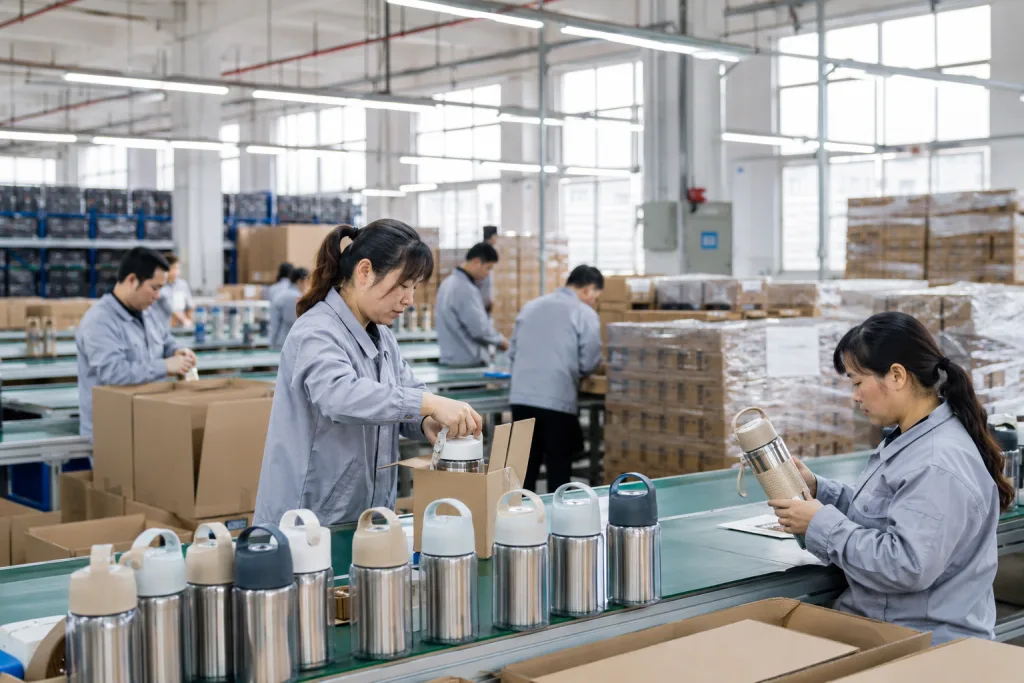
For outdoor retail and promo programs, the cheapest bottle on the sheet is often the wrong pick. At our Zhejiang factory, buyers usually line up polycarbonate against stainless because they do different jobs, and this is the wrong question to ask if you only compare unit price. We run these checks spec by spec: insulation, compliance, decoration method, MOQ, and what the end customer will accept once the bottle is on shelf. Last month a buyer flagged a PO typo on a 304 stainless program, but the bigger issue was simpler: the math did not work for a thermos that looked right and failed the heat-retention test.
The Spec Table Buyers Need
Most buyers open with price. That is usually where the spec sheet goes off track. For polycarbonate thermos flask wholesale, the first technical fact is simple: polycarbonate is not a thermal barrier. On our line, a single-wall PC body usually measures around 1.8-2.2 mm, and it still behaves like a bottle, not a true thermos. You can sell it as drinkware, a gym bottle, or a promo item. If the retailer expects 8-hour hot retention, this is the wrong question to ask. You are in the wrong category.
Here is the side-by-side table most procurement teams need before they ask us to ship samples. QC pulled the sample more than once because the PO said "thermos" while the drawing showed a single-wall PC body.
- Material: polycarbonate body vs 18/8 stainless steel inner and outer
- Typical structure: single-wall PC vs double-wall vacuum stainless
- Heat retention: 0-2 hours usable warm for PC, 6-12 hours practical for stainless
- Cold retention: 1-3 hours with ice for PC, 12-24 hours for stainless
- Impact resistance: PC handles drops better than glass, but it scratches faster than coated stainless after carton rub tests
- Taste and odor: stainless usually runs cleaner for coffee and tea; PC can hold odor after sweet drinks, and we have seen this go sideways in 48-hour syrup tests
- Decoration: PC works with screen print and heat transfer; stainless takes screen print, laser marking, UV print, and powder coat with better finish stability
- Compliance focus: PC needs extra attention on food-contact declarations and BPA-free resin traceability; stainless needs metal composition and coating tests
- Typical FOB price: USD 0.90-1.80 for PC bottle, USD 2.80-4.90 for vacuum stainless at 500 ml
If you buy for outdoor retail, stainless wins on function. We ship that category every week, and buyers usually ask for 500 ml and 750 ml vacuum bottles with hot-hold targets written into the spec. If you buy for short-cycle giveaways, conference kits, or low-cost bulk thermos alternatives, polycarbonate still has a place, usually from 3,000 pcs MOQ upward. The mistake is calling both products interchangeable. They are not. The return rate proves it fast.
Insulation Claims vs Real Use
The word thermos gets abused in wholesale listings. We see this every month. A buyer sees a clear body and flip lid on a PO, then expects vacuum performance from a non-vacuum bottle. That is the wrong question to ask. A proper stainless thermos manufacturer should quote test conditions: filling temperature, ambient room temperature, and retention after 6 or 12 hours. On our line, QC pulled the sample and logged lid-on retention at 20C room temp. Without those numbers, the claim is just marketing copy.
For a 500 ml factory thermos in 18/8 stainless with copper-coated inner wall, a realistic benchmark is:
- 95C fill temperature
- 20C room temperature
- 60-65C after 6 hours
- 45-50C after 12 hours
For polycarbonate thermos flask wholesale, even with a thicker wall around 2.5-3.0 mm, there is no vacuum layer. Heat moves fast. If you fill at 95C, the surface temperature climbs quickly, hand feel gets worse, and heat loss shows up early; we have checked this with an IR thermometer on 2.8 mm wall samples. In outdoor retail, customers notice it on the first hike or commute. They do not care that unit cost was USD 1.20 lower. We have seen this go sideways.
Where polycarbonate still works
Some programs still fit clear PC. A customized thermos look-alike can work for sports clubs, summer promotions, school programs, and branded hydration campaigns, especially when the drink is cold water finished within 1-2 hours. We ship this type for event orders at 3,000 pcs MOQ, usually with simple one-color logos. If you are sourcing distributor thermos assortments for camping, worksite, hunting, or winter gifting, stainless is the safer SKU. The math does not work for PC once the buyer flagged heat-retention claims.
You do not reduce cost by buying the wrong construction. You just move the cost into claims disputes, returns, and dead stock.
This is where experienced suppliers in Zhejiang, China push back a little. A good supplier thermos quote should ask about your sales channel, season, and claim language before it sends a final price. Last quarter one buyer wrote "thermal bottle" on the PO but actually approved a single-wall clear PC sample, and that 1-word mismatch caused 18 days of back-and-forth.
Durability, Safety, and Compliance
Outdoor retailers are stricter than promo buyers for one simple reason: the product gets knocked around. Scratches are normal. Leaks, cracked handles, and lid failure get returns. On stainless vacuum bottles, the weak point is usually the stopper assembly, not the body weld. We run a torque check on the cap at 1.8 N.m for this reason. On polycarbonate, the shell can survive a drop or two, but after repeated opening and closing, the threads, hinge pin, and silicone seal are where the line starts finding trouble.
Ask your thermos vendor for these checkpoints before approval:
- Leak test: 100% vacuum or pressure leak test for stainless, 100% water seal check for lids
- Drop test: 3 drops from 80 cm with retail pack for standard models
- Salt spray: 24-48 hours for metal parts if your cap has plated trim
- Dishwasher statement: body and print must match the declaration, especially on promotional thermos projects
- Food-contact compliance: REACH and LFGB where needed, plus BPA-free declarations for PC resin
- Children's use: ASTM or CPSIA review if the product crosses into kids category
For stainless units, ask for 304 stainless, or 18/8, on all liquid-contact parts. This is the right question. Some low-end manufacturer thermos offers use 201 stainless on the outer wall and 304 inside. That setup can work if the spec sheet says it clearly. We have seen buyers flag the words "food grade steel" on a PI because there was no material statement behind it. For polycarbonate, ask for the resin source, lot number, and batch traceability. QC pulled the sample on one PC flask order last year because the PO said "PC body, BPA free" but the raw material declaration was missing.
Inspection also needs to be written down before production starts. AQL 2.5 for major defects and 4.0 for minor defects is common for drinkware export from China. If your order is going to retail shelves in Europe or North America, add vacuum retention spot checks, coating adhesion, and barcode scan verification to final inspection. We ship with those checks on retail programs because the math does not work if 3 out of 500 units fail at shelf. A pretty pre-production sample means little if final QC finds weak vacuum on a 12-hour retention check.
Branding Options Change the Economics
Decoration is where custom thermos margins get eaten. Buyers often price only the bottle body, then the buyer flagged the quote after seeing the add-ons. The math doesn't work if you ignore them. A USD 3.20 stainless body can become USD 4.30 after powder coating, laser marking, individual box upgrade, and spare gasket packing. We see the same thing on polycarbonate once you add wrap print, insert cards, and custom lids, and the line has to stop for each pack-out change.
For stainless, the usual decoration ladder looks like this:
- 1-color silkscreen: +USD 0.08-0.15
- 2-color print: +USD 0.14-0.24
- Laser engraving: +USD 0.10-0.20
- Powder coat finish: +USD 0.25-0.45
- Full wrap digital print: +USD 0.35-0.70
For polycarbonate thermos flask wholesale, entry decoration usually starts lower, but premium decoration gets touchy fast. Screen print looks clean on a clear body; on the scratch test, though, marks show sooner, and some inks lose dishwasher resistance after 300 cycles. We have seen this go sideways on event orders at 3,000 pcs where the logo looked good in approval photos but softened after use. For a customizable thermos line for events or a thermos promotional campaign, that tradeoff can be fine. For a permanent outdoor range, stainless holds logo appearance longer.
Color consistency gets missed all the time. On our side, QC pulled the sample and checked coated stainless against the master chip under a D65 light box, while translucent plastic still shifted lot to lot because regrind ratio moved by a few points. If your brand book calls for exact Pantone matching across 20,000 units, ask the thermos factory about Delta E tolerance and regrind percentage. This is the right question to ask. A solid factory thermos partner will reserve virgin raw material for clear PC and control color shift; if not, shipment two may be off from shipment one by enough that sales reps notice it on the shelf.
That is why 7 out of 10 thermos distributors we ship to run stainless for evergreen programs and keep polycarbonate for price-sensitive seasonal drops.
MOQ, Lead Time, and Tooling Reality
MOQ is where the sales sheet and the factory floor split. For stocked stainless shapes, we run custom thermos orders with less risk. At our Hangzhou, Zhejiang plant, the usual MOQ is 1,000 pcs per color per size for a stocked 500 ml vacuum bottle, with 7-10 days for pre-production samples and 25-35 days for mass production after deposit and artwork approval. On the line, the 3D-printed color chip and carton dieline usually decide whether we ship on time. Repeat orders move faster if the packaging stays the same. Change the insert card by 2 mm, and you lose days.
Polycarbonate looks simple on paper. The mold shop says otherwise. If you want a fully custom molded body or a new cap, this is the wrong question to ask at 800 pcs, because the math doesn't work and we've seen this go sideways after the first mold trial:
- Tooling: USD 3,500-12,000 depending on body and lid complexity
- MOQ: 3,000-5,000 pcs minimum, sometimes 10,000 pcs for color-specific resin planning
- Sample cycle: 15-25 days for mold trial
- Mass lead time: 30-45 days after sample approval
This is why buyers asking for thermos bulk at 800 pcs with custom body geometry usually land on stainless. Existing stainless tooling is wider, and a manufacturer thermos catalog in China often has 30-50 ready body shapes already validated for vacuum, leak, and pack-out. QC pulled the sample last month on one new shape because the stopper torque was off by 0.3 N.m. That is the kind of detail that separates a ready model from a fresh development job.
Capacity matters too. A serious supplier should tell you what the factory can produce, not just what sales put on a quote. We usually tell buyers to ask for monthly output, vacuum yield, and peak-season planning. A workable benchmark is 500,000-800,000 units per month for mixed drinkware lines. If a suppliers thermos quote promises 12 days on a new branded project during Q4, ask more questions. The buyer flagged this exact claim on a PO last season, and the line could not even finish decal approval in 4 days. Good factories in Zhejiang do not need to oversell lead time. They need to hit it.
Which Material Fits Your Channel
Use-case fit is where new buyers get burned. We see it on the line. A bottle picked for a July giveaway often fails in an outdoor shop, so match the sales channel to the claim on the carton and the FOB target on the PO. Last month a buyer flagged a 0.5 mm wall bottle for a camping SKU. Wrong spec.
Best fit for polycarbonate
- Large event giveaways at USD 1.20-1.80 FOB targets
- Gym, school, or wellness campaigns where a clear body helps the design and the buyer wants lighter ship weight, often under 10.5 kg per export carton
- Short-lifecycle promotional thermos alternatives, usually 3-month to 6-month programs, where light daily use is expected and the MOQ has to stay friendly
- Programs where cold hydration matters more than heat retention, and the drink is finished fast instead of held for 6 hours
Best fit for stainless vacuum thermos
- Outdoor retailers selling camping, commuting, hunting, or travel gear, where customers ask for 6-hour or 12-hour heat holding and check the lid seal hard
- Distributor thermos assortments that need year-round sell-through, with fewer seasonal swings and fewer complaints from the field
- Corporate gifting with perceived value above USD 4.00 FOB, especially for 304 stainless models where gift-box weight and finish consistency matter
- Amazon or DTC packs that need better review protection and lower return risk; QC pulled the sample on one run and found cap wobble at 1.2 mm, which would have turned into bad reviews fast
If you run an outdoor retail channel, your customer expects real thermal performance, dent resistance, and leak control. Go stainless. We ship enough of both to say this plainly: this is the wrong question to ask if you start from color or shape first. Start from use. For a 5,000-piece July event, where the drink is consumed in 20 minutes and the budget is tight, polycarbonate still works. Do not print a heat-retention claim on it. We've seen this go sideways.
Here is the sourcing rule we use in Hangzhou: if your brand promise includes temperature, choose vacuum stainless; if it includes visibility, lighter carry weight, and lower entry cost, polycarbonate stays in play. Simple rule. The math works better, and it clears up most sourcing confusion whether you are buying from thermos suppliers, thermos distributors, or a direct thermos manufacturer. One PO we got even misspelled "vacuum" as "vaccum," but the bigger mistake was the material choice.
Send your target spec and we will sanity-check it
Share capacity, target FOB price, logo method, and sales channel. We will tell you quickly whether polycarbonate or stainless is the workable factory route.
Frequently asked questions
Can I source polycarbonate thermos flask wholesale and still market it as insulated?
Only if the construction is genuinely insulated, and most polycarbonate bottles are not. A single-wall PC body has no vacuum gap, so it will not perform like a stainless thermos. If your test starts at 95C fill temperature, a vacuum stainless bottle may still hold 60-65C after 6 hours, while a PC bottle can drop close to ambient in the same window. If you want to use the word insulated, ask your thermos supplier for lab or in-house retention data with time, starting temperature, and ambient conditions. Without that, the claim is weak. For outdoor retail, I would avoid calling a standard polycarbonate bottle a thermos at all. For promotional use, describe it as a hydration bottle unless the structure proves otherwise.
What MOQ should I expect for custom thermos orders from China?
For stocked stainless vacuum bodies, 1,000 pcs per color per size is normal, and some factory thermos programs can do 500 pcs if you accept higher unit cost and simple packaging. For fully customized thermos shapes, especially with new molds, MOQ usually starts at 3,000 pcs and can reach 5,000-10,000 pcs depending on the cap, finish, and packaging method. Polycarbonate projects often need higher MOQ than buyers expect because of resin setup and tooling recovery. In Zhejiang and other China drinkware clusters, repeat orders are easier once tooling exists and artwork is fixed. Ask for MOQ by body, by color, and by print method. Those are different numbers, and that is where quotation misunderstandings usually start.
How do I compare stainless thermos prices against polycarbonate fairly?
Compare by construction, not by photo. A 500 ml polycarbonate bottle at USD 1.10 FOB Ningbo is not comparable to a 500 ml double-wall vacuum stainless bottle at USD 3.60 FOB. They do different jobs. Build a landed-cost sheet with body price, decoration, packaging, test fees, and defect allowance. Add likely return cost if the channel is outdoor retail. A stainless custom thermos may cost USD 2.00 more up front, but if it cuts return rate by even 3-5%, it can be the cheaper SKU in practice. Also compare lid build, gasket material, steel grade, wall thickness, and test standard. A proper supplier thermos quote should state 304 contact parts, leak test coverage, and retention numbers before you start negotiating pennies.
What compliance documents should a thermos manufacturer provide for Europe and North America?
For Europe, ask for REACH declaration and, when relevant to your market, LFGB or other food-contact test support. For North America, review food-contact compliance based on your state and channel requirements, plus BPA-free documentation for polycarbonate or plastic parts where claimed. If the product may be used by children, add CPSIA or ASTM review depending on category. For stainless units, ask for material specification for 304 or 18/8 contact parts and coating test reports if powder coated. A reliable manufacturers thermos partner should also support AQL inspection criteria, usually 2.5 major and 4.0 minor. The right paperwork depends on the exact SKU, but if a factory in China cannot provide raw material traceability and recent test references, treat that as a sourcing risk.
Which option is better for outdoor retailers versus promotional brands?
For outdoor retailers, stainless vacuum is usually the correct choice. It handles hot and cold retention, gives better perceived value, and holds up better in real use. Typical FOB cost for a 500 ml stainless unit is USD 2.80-4.90 depending on coating and lid complexity, but the lower complaint rate often justifies it. For promotional brands, polycarbonate can work when the target is price, light weight, and fast-use hydration rather than all-day temperature control. Those projects often land around USD 0.90-1.80 FOB at 5,000 pcs. The channel decides the material more than the catalog does. Outdoor buyers care about performance. Event buyers care about budget and visual impact. If you mix those two priorities, you usually buy the wrong bottle.