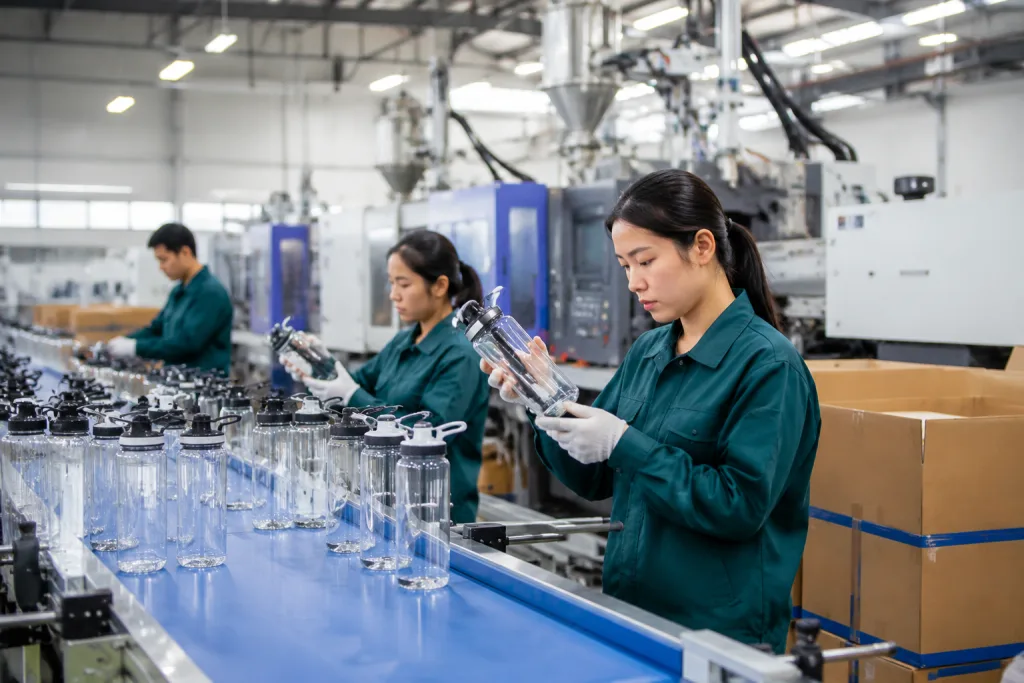
Key Takeaways
- A usable RFQ for a polycarbonate bottle should lock at least 12 specs, including capacity tolerance, wall thickness, lid material, logo method, carton pack, and AQL 2.5.
- Typical MOQ is 3,000 to 5,000 pcs per color for custom color injection, with sample lead time around 7 to 10 days and bulk lead time 25 to 35 days.
- For FOB China pricing, many 650 ml custom sport bottles land around USD 1.10 to 2.40 depending on resin grade, mold status, printing, and lid complexity.
- Your purchase order should define leak test, drop test, barcode placement, spare ratio, and packaging approval before deposit, not after production starts.
You can buy a sport bottle from almost any trading office in China. Easy part. The hard part is getting the same bottle, color, lid fit, logo position, carton count, and compliance paperwork again when your reorder lands 90 days later. We have seen this go sideways over a 0.8 mm logo shift, or a cap torque spec that never made it onto the PO. That is where buyers lose margin.
If you are sourcing from a polycarbonate sport bottle factory for private label, promotion, retail, or a canteen distributor program, build the process from the RFQ forward and lock it down again at sample approval and bulk production. In Zhejiang, where a large share of China drinkware capacity sits, suppliers that look the same on day one split fast once QC pulls the sample and you start asking for neck finish tolerance, lid leak test data, and master carton count by SKU. This is the right question to ask.
Start With A Real RFQ
Most bad projects start with a loose inquiry. A buyer asks for a price on a 700 ml bottle, the supplier sends 3 photos and 1 FOB number, and both sides act like they are talking about the same SKU. They are not. If you want a quote that means something, your RFQ needs enough detail so 2 factories in Zhejiang are costing the same job, not 2 different bottles from 2 different molds.
Send the RFQ in a simple table and ask the factory to reply line by line. We prefer that format on the sales side because the line can check each point against the mold drawing, material sheet, and packing spec without guessing. For custom drinkware, these are the minimum fields that matter:
- Capacity: for example 650 ml brimful, 600 ml nominal
- Material: food-contact polycarbonate body, PP lid, silicone seal
- Wall thickness: such as 2.2 mm plus or minus 0.15 mm
- Weight target: for example 148 g plus or minus 5 g
- Color: Pantone reference or translucent/clear requirement
- Logo method: 1-color silkscreen, heat transfer, in-mold label, or laser on cap insert
- Packaging: polybag, white box, color box, or PDQ display
- Carton pack: 48 pcs per export carton, carton drop requirement
- Testing: REACH, LFGB or FDA request, dishwasher stance, BPA statement
- Order quantity: 3,000, 5,000, 10,000 pcs by color or mixed
- Trade term: FOB Ningbo, FOB Shanghai, or DDP warehouse
- Target ship date: a real date, not just “urgent”
If you buy for a custom canteen, canteen promotional event, gym chain, or distributor drinkware program, include the sales channel. This part gets skipped too often. Retail buyers usually need barcode area in mm, warning text placement, and front-facing shelf appearance. Promotional buyers usually push for a larger imprint area, lower unit cost, and repeat orders that can run fast off the same screen. Last month a buyer flagged a PO that said “same as previous” with no artwork size, and the print area was off by 12 mm. A canteen manufacturer or canteen vendor quoting without channel context will usually send a generic answer, and we have seen that go sideways.
A factory that can quote a bottle in 20 minutes but cannot state resin grade, mold cavity count, or leak test method is usually not the real production team. QC pulled the sample, squeezed the body, and found the cap leaked at 0.03 MPa. This is the wrong question to ask: “What is your best price?” Ask what resin grade they run, how many cavities are in the mold, and how they test 100% sealing.
Qualify The Factory Before Sampling
Before you pay for samples, screen the supplier as if the PO is already on the table. A serious canteen factory or canteen manufacturer should answer shop-floor questions straight, without a sales deck and without dodging. Facts first.
Start with the basics: factory location, audit status, monthly capacity, and main export markets. In Zhejiang, a lot of plants sit 2 to 4 hours by truck from Ningbo port, which matters if you ship FOB and the booking gets tight. A practical range for a medium-size plastic drinkware plant is 300,000 to 800,000 units per month, based on how many injection lines and assembly lines we run. At BottleForge Industrial in Hangzhou, Zhejiang, a normal MOQ for a custom mold-ready bottle is 3,000 pcs per color, and bulk lead time is usually 25 to 35 days after sample approval and deposit. If a factory gives you a round number with no line count, no cavity count, and no shift plan, the math doesn't work.
Then move to compliance and QC. For Europe and North America, these are the checks buyers ask for first, and QC pulled the sample sheet on all of them last month:
- BSCI or Sedex social audit if you supply retail chains
- ISO 9001 process control if the project needs repeatability
- REACH and food-contact declaration for EU programs
- ASTM or CPSIA relevance if the bottle is for kids or school channels
- AQL plan for pre-shipment inspection, often Major 2.5 / Minor 4.0
Ask one more thing early: what is made in-house, and what is bought outside. This is where buyer risk usually hides. We have seen suppliers call themselves manufacturers while the lid comes from one workshop, the silicone seal from another, the straw from a third, and the color box from a fourth. That setup is not wrong by itself, but approval gets slower, and mass production drifts faster from the sample you signed. We have seen this go sideways over a 0.3 mm seal thickness difference.
Questions worth asking directly
- How many cavities is the body mold?
- What percentage of orders are export OEM?
- Do you keep Pantone chips and color master records?
- How is leak testing done: 100% inline or by sampling?
- Can you provide spare lids or seals at 1% to 2% with bulk order?
A canteen distributor or canteen distributors building a long-term assortment should watch reorder stability, not just the first quoted price. This is the wrong question to ask: “Can you do it cheaper?” Ask instead what happens on the line after six months, after the first mold polish, and after the buyer flagged a shade shift against the original Pantone chip.
Build The Sample Around Approval Points
Sampling is where a nice quotation turns into a product standard you can enforce. We’ve seen buyers approve a bottle from a phone video and then argue over a 1.8 mm logo shift after mass production. That approval is too loose. Your sample needs to lock dimensions, fit, finish, print position, and packaging. If those points stay soft, the bulk order drifts on the line.
For a standard existing mold, sample lead time is usually 7 to 10 days. For a new logo print setup and color match, allow 10 to 15 days. For new tooling, initial T1 samples often take 20 to 30 days depending on mold complexity. Sample charges vary, but a stock bottle with custom print is often USD 50 to 150, while a new mold can run from USD 2,500 to 8,000 for a plastic sport bottle body and cap set. Buyers push back on T1 timing all the time, but if the cap thread is off by 0.3 mm, rushing the first shot only costs more later.
Your sample approval sheet should list measurable checkpoints:
- Dimensions: body diameter, total height, mouth diameter, handle width
- Capacity check: brimful fill and usable fill line
- Weight: bottle, lid, and assembled unit
- Color match: against Pantone under D65 light or agreed standard
- Print position: distance from seam, bottom, and handle reference point
- Seal performance: upside-down leak test for 30 minutes
- Odor: no obvious resin smell after wash
- Packaging: barcode area, carton marks, insert text, FNSKU if needed
If you are buying a custom growler, customizable growler, or customized growler in the same sourcing cycle, keep those approvals separate. This is the wrong place to combine files. We ship sport bottles and growlers in different carton layouts, and QC pulled the sample on one mixed PO because the buyer flagged the wrong drop-test note against the wrong SKU. Separate SKU files save rework later.
For canteen custom or customizable canteen projects, decide early whether you need a translucent sport look or a premium matte finish. Matte coatings often look better on the table, but we’ve seen this go sideways in transit when the inner divider paper is too soft and units rub for 18 days at sea. Ask for the packed sample, not just the bottle. The actual packed unit should show the inner carton, insert fit, and barcode placement. That one check prevents a lot of claims once cargo lands in Europe or North America.
Write The PO Like A Specification
After sample approval, the PO is the control document on the line. If it only says “650 ml custom bottle, blue, logo, 5,000 pcs,” you left too much open. We’ve seen this go sideways. A solid PO reads like a short spec sheet, with enough detail that QC, printing, packing, and shipping all read the same thing off one page. This applies whether you buy from a canteen vendor, canteen vendors, canteen supplier, or a direct polycarbonate sport bottle factory in China.
These PO line items should be stated clearly:
- SKU code and revision: for example BF-PC650-A Rev02
- Approved sample date: tie bulk to one physical approval sample
- Quantity by color: 2,500 smoke gray, 2,500 translucent blue
- Unit price and trade term: USD 1.68 FOB Ningbo
- Mold/tooling ownership: buyer-owned or factory-owned, storage terms
- Material spec: virgin food-grade polycarbonate, PP cap, silicone ring
- Logo spec: 1-color silkscreen, PMS 186 C, 20 mm x 45 mm print area
- Packing spec: 1 pc/polybag/white box, 48 pcs/carton
- Carton details: carton size, gross weight limit, shipping marks
- Inspection level: AQL Major 2.5, Minor 4.0, Critical 0
- Functional test: 100% leak test before packing
- Drop test: packed drop test from 76 cm, no product breakage
- Spare parts: 1% extra lids and 1% extra seals free of charge
- Lead time: 30 days after deposit and artwork approval
- Payment term: 30% deposit, 70% before shipment or against copy BL
If you are a distributor canteen buyer or one of several canteen distributors serving multiple accounts, add a split packing appendix. Put the carton ratios, mixed outer labels, retailer-specific FNSKU labels, and any pallet note there. Last month a buyer flagged one PO because the outer mark said “Target East” on 320 cartons and “Target Easst” on the balance; that typo cost a relabel pass. Do not assume the factory will remember rules from the last order, even if it was only 45 days ago.
For customized canteen and customized drinkware orders, state the allowed overrun or underrun in plain numbers. This is the wrong question to skip. In Zhejiang, 12 factories out of 15 will ship plus or minus 3% unless the PO says otherwise, because the line plans by mold cavity count and carton pack. If your promotion needs exactly 10,000 pcs, write “no overrun, no underrun” before deposit. If 9,700 pcs is acceptable, say that too. The math doesn’t work if sales promised exact stock and production booked resin for a tolerance run.
Control Bulk Production And Inspection
Bulk production is where bottle projects usually get messy. On polycarbonate sport bottles, we see flow marks near the gate, color drift between cavities, gate blush on the shoulder, scratch complaints during packing, and cap fit moving by 0.3 mm. End-of-line inspection is too late. We run tighter control in the first 20% of output because once 8,000 pcs are packed, the math doesn't work.
Ask the factory for a pre-production confirmation set made from actual bulk materials: body, lid, logo print, and one packed unit. This matters if your approved sample was hand-built or printed on a pilot line with slower settings. We usually confirm color against the Pantone chip under a light box, then QC pulled the sample from line startup cartons, not from the sales shelf. Ask for in-process photos or short video from injection, printing, and packing. You are not running the line remotely. You are checking that the line matches the approved plan.
For most B2B orders, I recommend three control points:
- Pre-production review: confirm resin lot, masterbatch code, logo screen mesh count, and packaging material before the first 500 pcs
- During production: check the first packed cartons, cap fit consistency, and whether the buyer-flagged weak point shows up again on the line
- Pre-shipment inspection: use AQL with a third party or your own QC team after final carton count is locked
A solid pre-shipment checklist for custom drinkware should cover appearance, color variance, logo adhesion, barcode scan rate, leak test, smell, carton condition, carton count, and loading photos. If the order is for Amazon FBA or club retail, add carton weight, pallet pattern, and label placement at once. We ship orders where outer carton weight has to stay under 15 kg, and this is where buyers get stuck if the insert board was changed without notice. A canteen manufacturer that knows export should already work this way, but we've seen this go sideways when the PO had a typo on carton marks.
Defect language needs to be written tight. Classify leakage, cracked body, and missing parts as critical or major, then set minor issues like print offset within an agreed tolerance, such as less than 1.5 mm. QC pulled the sample, measured offset with a steel ruler, and the buyer still argued because the spec sheet only said "acceptable." This is the wrong question to ask. The right question is who signs off the tolerance before mass production, or QC disputes turn subjective fast.
Buyers ask all the time if 100% leak testing is realistic. For screw-cap and flip-top sport bottles, yes, in most cases it is. The common method is inline air-pressure testing or an inverted hold test before packing, and the reject bin tells you more than the sales pitch. Ask which method the factory runs and whether failed units are reworked or scrapped. We had one buyer push back on scrap rate at 1.8%, but that number was cleaner than mixing repaired units back into export cartons. That answer tells you a lot about actual process control in China.
Plan Reorders Before The First Shipment
The first order costs more because you spend time on every small decision: logo position, cap fit, barcode placement, even whether the hangtag hole is 6 mm or 8 mm. Reorders should be easier. If they are not, the factory did not record the job well enough. We’ve seen this go sideways. Buyers come back for a repeat, and the line is still asking which carton mark to print. Whether you buy as a canteen distributor, distributor growler account, custom canteen importer, or direct retail brand, reorder control is what turns a trial PO into a supply line we can actually run.
Before the first shipment leaves China, ask the factory for a reorder file pack. It should include approved artwork, Pantone references, carton marks, packing photos, barcode files, final BOM, and QC standard photos. Ask for the carton dimensions too, not just a photo; one buyer flagged a 5 mm height change because it broke their shelf pack. If the project used custom color resin, ask the factory to retain a sealed color chip and keep the same masterbatch formula on record. We usually bag and label that chip at the machine with the date and resin lot number. In Zhejiang factories with steady OEM business, this is normal practice, not a special favor.
Then review what changes on the next order. This is the right question to ask. Resin prices move. Freight moves. Packaging suppliers switch paper lots, and sometimes the burst strength drops even if the print looks the same. A bottle quoted at USD 1.42 FOB Ningbo may move to USD 1.51 if resin rises 6% and your quantity drops from 10,000 to 3,000 pcs. The math doesn’t lie. You do not need fixed pricing forever, but you do need cost logic your supplier can explain line by line.
For long-term canteen customizable or canteen customized programs, ask about inventory support on common parts such as lids and seals. Some factories can hold 5,000 to 10,000 pcs of black or white standard caps if you commit to rolling forecasts. We run this way on repeat SKUs because cap molds are stable and the storage risk is manageable. QC pulled the sample last month on a stocked black lid program and found the silicone seal hardness still matched spec after storage. That can cut repeat lead time from 30 days to around 18 to 22 days.
The buyers who handle this best are usually calm. They approve one standard, keep a clean PO history, and treat every reorder as a controlled repeat. Not a fresh negotiation every time. We ship better that way. One clean PO file matters more than people think; last year a buyer’s own typo swapped 750 ml and 700 ml on a repeat order, and the whole approval cycle reset. That is how you get consistent customizable drinkware from China instead of a new surprise in every container.
Send your bottle RFQ and get a technical quote
Share your capacity, lid style, logo file, target price, and ship date. We will review feasibility, MOQ, lead time, and compliance points before sampling.
Frequently asked questions
What MOQ should I expect from a polycarbonate sport bottle factory?
For an existing mold with custom color and logo, a realistic MOQ is usually 3,000 to 5,000 pcs per color. Some factories in China will quote 1,000 pcs, but that often means higher unit cost, limited color options, or shared production runs. If you need stock clear bodies with one-color printing, 1,000 to 2,000 pcs may be possible. For a fully custom bottle or lid, MOQ can move to 5,000 to 10,000 pcs because mold setup, color masterbatch, and packaging minimums all stack up. Ask whether the MOQ is per SKU, per color, or per shipment. Buyers get caught when a canteen factory says 3,000 pcs MOQ but means 3,000 pcs for each body color and each lid color combination.
How much should a custom polycarbonate sport bottle cost FOB China?
For a common 600 to 750 ml bottle using an existing mold, FOB China pricing often lands between USD 1.10 and 2.40 per piece. At the low end, you are usually looking at a simple body, basic screw lid, one-color silkscreen, and plain export packing at 5,000 pcs or more. At the higher end, cost rises with thicker walls, complex flip lids, two-color assembly, matte finish, heat transfer print, color box packaging, or retailer labeling. New tooling is separate. A new body and cap mold set can cost roughly USD 2,500 to 8,000 depending on cavity count and structure. Ask the factory to break out bottle, printing, packaging, and tooling so you can see where the money is going.
What tests matter for Europe and North America?
For B2B drinkware buyers, start with food-contact compliance and then move to functional testing. For EU projects, ask for REACH-related declarations and any applicable food-contact reports based on your market requirement. For North America, many buyers ask for FDA food-contact statements. If the bottle is targeted to children, ASTM or CPSIA-related checks may become relevant depending on age grading and accessories. On the functional side, specify a 100% leak test, odor check, logo adhesion check, and packed drop test, typically 76 cm. If the bottle has a straw or bite valve, add assembly pull-force or fit tests. The smart move is to state the tests in the PO and sample approval sheet before production, not after the goods are finished.
How long does sampling and bulk production usually take?
For an existing bottle mold, a pre-production sample with custom logo normally takes 7 to 10 days. If you add custom color matching, box artwork, or revised lid parts, allow 10 to 15 days. New mold development usually needs 20 to 30 days for first samples, sometimes longer if the mold needs correction after T1. Bulk production for a standard OEM order is commonly 25 to 35 days after deposit and final approval. During busy months in Zhejiang and wider China, especially before peak holiday shipping, that can extend to 40 days. If your launch date is fixed, build in 7 extra days for inspection, rework if needed, and trucking to Ningbo or Shanghai.
Should I buy from a factory directly or use a canteen supplier or vendor?
It depends on the order complexity and your internal bandwidth. If you have clear specs, stable SKUs, and someone on your side who can manage approvals, buying direct from a canteen manufacturer or polycarbonate sport bottle factory usually gives you better control and cleaner cost structure. If you are running mixed programs across bottles, tumblers, custom growler items, and gift sets from multiple materials, a capable canteen vendor can simplify communication. The risk is that some vendors in China are light on technical control and slow to surface production problems. Ask who owns the QC process, who handles claims, and whether you can see factory records directly. For orders above about USD 15,000, that clarity matters a lot.