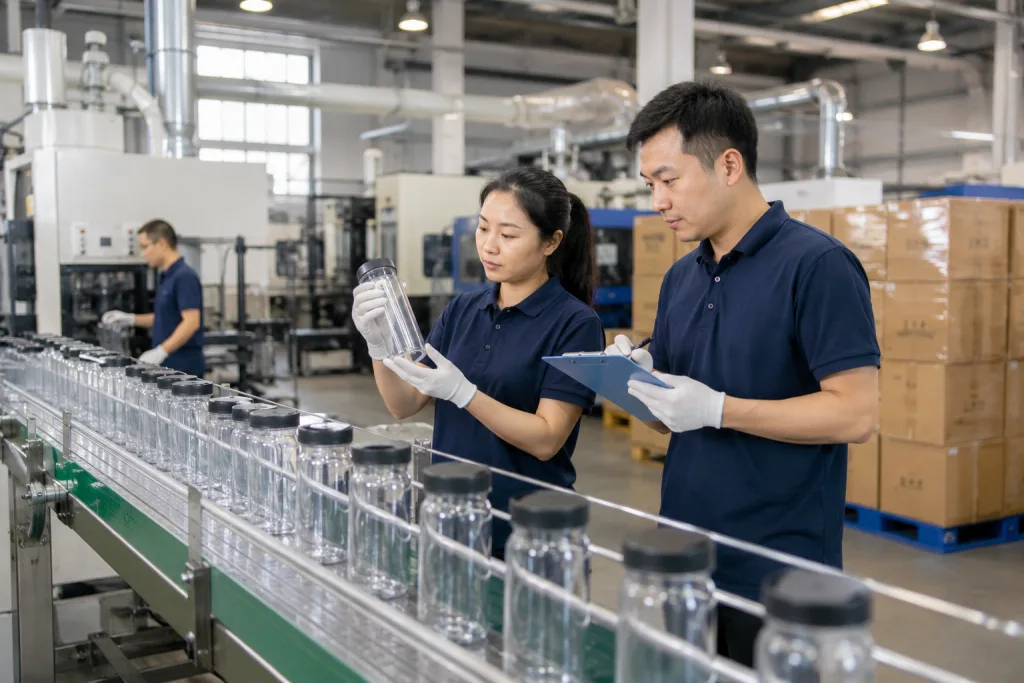
Key Takeaways
- For a new molded bottle, expect MOQ of 3,000-5,000 units and 30-45 days lead time after sample approval
- PP is usually lower cost than PC by about USD 0.18-0.45 per unit on a 700ml bottle at 5,000 pieces
- Set AQL at 2.5 for major defects and 4.0 for minor defects before deposit, not after production starts
- Decoration and packing can add 12%-28% to FOB China cost, which is often more than buyers expect
You are not buying a bottle. You are buying the same output on every run: correct resin, clean decoration, compliance passed, cartons that hold up in shipment, and a landed cost that still works if the vessel booking slips by 12 days. We have seen first orders go sideways here. The CAD drawing looked fine, the golden sample looked fine, then the line started and QC pulled the sample: cap leakage at 0.03 MPa, logo rub-off after tape test, or Delta E drift the buyer flagged on the second carton.
The better move is to walk the order step by step before you pay the deposit. If you source custom drinkware from Zhejiang, China, or from another China supply base, lock the material grade, tooling, print method, test plan, AQL, and packing details up front. Write it down early. We run projects like this with a signed spec sheet, pantone chip, and carton drop standard before MOQ 3000 goes to production, because this is the wrong question to ask after the mold trial. That is how a canteen custom project turns into a stable SKU instead of a headache.
Start With the Actual Sales Scenario
Say you are buying for a European outdoor chain, a North American promo importer, or a canteen distributor building a private-label line. You need one 700ml bottle for back-to-school and gym shelves. Retail target is USD 9.99, so landed cost needs to stay under roughly USD 3.10. We see this target a lot. Last quarter, one buyer flagged a USD 0.18 freight gap on a 24pcs carton, and the whole margin was gone. Your first shortlist usually has a polycarbonate polypropylene bottle supplier, one stainless option, and one glass option. Stainless misses the cost target for this program. Glass drives up freight and claims. So you stay with plastic and define the bottle first. Asking for "best price" is the wrong question.
The first real call is the material split. Most buyers say "PC bottle" but the actual build is a polycarbonate body with a polypropylene lid, inner straw, or carry handle. That is standard on the line because each resin has a separate job. PC gives clarity and stiffness, and we usually check body wall with an ultrasonic thickness gauge at 2.2mm plus. PP handles chemical resistance, hinge life, and food-contact paperwork on caps and fitments with less trouble. A reliable canteen manufacturer in Zhejiang should explain that in plain terms, not just send a catalog and wait.
For this scenario, your target spec might look like this:
- Capacity: 700ml to brimful, 650ml nominal fill
- Body: food-grade polycarbonate, wall thickness 2.2-2.5mm
- Cap: food-grade polypropylene, with TPR or silicone seal
- Leak standard: no leakage after 30 minutes inverted and 10 cycles drop test from 80cm
- Logo: 1-color silk screen, 1 position
- Packing: 1pc/polybag, 24pcs/export carton, carton drop-tested
- Compliance: REACH, LFGB or FDA depending on market, plus BPA-related declaration where required
Once you write the project this way, you can compare a canteen supplier, a canteen vendor, or a distributor drinkware partner on actual numbers. QC pulled the sample, checked the seal groove at 1.8mm, and that told us more than any sales pitch. Skip this step and the quotes look cheap on day one, then expensive after tooling, testing, and claim risk show up. We have seen this go sideways.
Choose Resin and Construction Properly
This is where sourcing goes wrong fast. We hear buyers ask for "food-safe plastic" on 7 out of 10 new inquiries, as if PC and PP run the same on the line. They don't. If you are buying from a canteen factory in China, ask for the exact body resin, cap resin, seal material, and whether any recycled content is used. Ask for the grade code on the spec sheet, not just a sales claim. For a branded retail line, I stay cautious on recycled content unless the compliance file is complete and the batch record is stable lot to lot. We have seen this go sideways after one PO typo changed virgin resin to mixed content.
What PC and PP each do well
- Polycarbonate body: glass-clear appearance, tighter dimensional control on a 700ml body, stronger shelf presentation, and usually a higher unit cost; we check clarity against the approved sample under a 6500K light box
- Polypropylene cap: lower weight, better hinge and thread performance in daily use, and suitable for hot-fill-adjacent applications only up to the supplier's tested limit; on our side, torque is checked with a cap torque meter before packing
- PP body alternative: lower cost and lower break risk, but translucent instead of clear, with more visible surface rub after carton shipment; this is often the better fit for canteen promotional programs at 3,000 to 10,000 pcs
For the 700ml scenario, a standard PC+PP bottle at 5,000 units FOB Zhejiang, China may price around USD 1.05-1.45 depending on mold status, lid complexity, and decoration. An all-PP bottle of similar size may land at USD 0.78-1.12. That spread is real. If your order is for a school campaign, charity run, or mass giveaway where margin is tight, a customizable canteen in PP often makes more sense than a crystal-clear PC body. We ship plenty of these in 24 pcs export cartons, and the math does not work if the end use is a giveaway table.
Be honest about the tradeoff. If your customer expects a premium retail look, lower-cost PP can trigger complaints about haze, scuff visibility, or perceived quality after the first shelf inspection. That is not a factory problem. That is a specification problem. Good canteen manufacturers in Zhejiang will send both options and show the delta in clarity, mold line visibility, and print adhesion. QC pulled the sample on one project last month, and the buyer flagged the PP body at the gate because the side wall showed a 0.4mm mold line under store lighting.
You do not save money by choosing the cheapest resin. You save money by choosing the resin that fits the channel and avoids returns.
Ask for bottle weight tolerance too. A 700ml PC body might target 110g plus or minus 3g, while a PP cap might target 28g plus or minus 2g. This is the right question. If the supplier cannot hold that range across 30 samples, or if QC finds 4g drift after shift change, sample approval means little. That tolerance tells you whether the factory controls molding consistently or just sells samples well.
Lock the Quote Before Sampling
Once the material is locked, get the quote sheet in writing. This is where a proper polycarbonate polypropylene bottle supplier shows its hand, because a factory quote will spell out unit price, mold status, MOQ, sample cost, tooling lead time, production lead time, carton data, and incoterm on one page. We still quote FOB Ningbo or FOB Shanghai for most Zhejiang export orders because the handoff is clean and the freight math is easy to check. Ask for carton size too; on the line we measure master cartons in mm before shipment, and the buyer flagged one PO last month because the outer carton data was missing.
For our example order of 5,000 units, the quotation should break out more than the bottle cost:
- Unit FOB price: USD 1.18 for stock mold PC body + PP flip lid
- Silk screen logo: USD 0.06 per color per position
- Pantone color matching on lid: USD 80-150 one-time setup
- Barcode sticker or FNSKU label: USD 0.03-0.06 each
- Custom insert card: USD 0.07-0.12 each
- Drop-test stronger master carton upgrade: USD 0.10-0.18 per carton
- Pre-production sample lead time: 5-7 days
- Mass production lead time: 25-35 days after deposit and sample approval
If the bottle needs a new mold, the math changes fast. A simple new bottle mold can range from USD 3,500 to USD 8,000, and a more complex flip-top or straw-lid mold can add another USD 2,000-6,000. That is why 10,000 units MOQ is common with new tooling, or the MOQ gets split by color, such as 3,000 black, 3,000 blue, 4,000 red. We have seen this go sideways when a buyer asks for five colors on a 10,000-unit run; the color-change scrap and setup time make the math not work. On our side, the mold shop will usually check gate size and parting line first, often down to 0.05 mm tolerance.
This is also where you ask a direct question: is the supplier the canteen manufacturer, or a canteen vendor lining up several subcontractors? This is not a problem by itself, but you need the real answer. If bottle blowing, injection molding, printing, and assembly are split across three China sites, your schedule risk goes up and root-cause work gets slower. QC pulled the sample on one split-site order and found lid-thread mismatch after assembly, which cost 6 extra days because the bottle body and lid came from different plants. This is the wrong question to dodge.
At BottleForge Industrial in Hangzhou, Zhejiang, buyers usually ask for the same three numbers first: MOQ, lead time, and monthly capacity. Fair enough. If a factory can output 400,000 units per month and your launch order is 8,000 pieces, capacity is not the issue. Process control is. We run line checks every 2 hours, and one of the first things we look at is net weight drift in grams because that tells you faster than a sales sheet whether the line is stable.
Approve Samples Like a Procurement Manager
Sampling is not a beauty contest. It is where you force production reality onto the table. For a custom canteen, customized drinkware, or customizable growler program, we usually ask buyers to approve 3 sample stages once the PO is large enough to matter: stock sample, pre-production sample, and golden sample. If the order is 5,000 pcs, skipping a stage is usually the wrong question to ask.
The stock sample shows shape and hand feel. That is all. It will not confirm your color, print rub resistance, or assembly tolerance. The pre-production sample should run with the actual resin, the actual Pantone target, the actual decoration process, and the final seal setup. On our line, QC pulled the sample after first-off and checks lid fit with a go/no-go gauge before approval. Then one signed unit becomes the golden sample for mass production reference.
What should you check?
- Thread engagement: cap should fully seat without cross-threading in 10 out of 10 manual closures
- Leak test: inverted 30 minutes, then shaken for 60 seconds, zero visible leak
- Print adhesion: 3M tape test or cross-hatch method after curing
- Odor: no strong chemical smell after 24 hours aired out
- Color deviation: define tolerance against Pantone, especially on PP lids
- Assembly fit: straw, handle, and seal should not loosen after repeated opening cycles
For promo and mass distribution orders, a lot of buyers accept minor cosmetic variance. For retail shelf programs, tighten the standard. We have seen buyers flag a logo only 2mm off-center even though the factory's internal check sheet passed it, because on a store peg that miss is obvious. This matters whether you are buying a canteen customized for a sports brand or a customized growler for event merchandise.
If the supplier suggests laser engraving on plastic, push back. On PP and PC bottles, that recommendation often falls apart once you test actual appearance and abrasion. We run silk screen, heat transfer, and IML depending on the resin grade, artwork detail, and target price; the math does not work if the decoration looks good on sample day but fails after 200 bag rubs. A serious canteen custom supplier should explain that tradeoff clearly instead of trying to sell one method for every project.
Build QC Into the Purchase Order
Do not write "we will check before shipment" on the PO and call it done. That line has no weight unless the check is spelled out. Put the inspection method, defect class, test requirement, and carton standard into the purchase order, line by line. On our side, QC pulled the sample against the signed golden sample and the PO rev number before sealing the first master carton. For most bottle programs, a third-party final random inspection using ANSI/ASQ Z1.4 with AQL 2.5 major / 4.0 minor is the normal baseline. For canteen promotional jobs where the target price is tight, some importers accept AQL 4.0 / 6.5, but the math does not work if you expect claim rates to stay low.
On bottle orders, major defects usually mean functional or obvious shipment problems. Leakage is one. Wrong material is another. We also classify wrong logo color, cracked body, missing seal, sharp flashing over 0.3 mm on the parting line, broken hinge, or carton short quantity as major. Minor defects are lighter issues, like scuffing, faint flow marks near the gate, or print position drift inside the agreed tolerance window. The buyer flagged this more than once on straw-lid SKUs because a 2 mm logo shift looks small on paper and bad on shelf.
Your QC checklist should call out process tests, not only final appearance. This is where weak POs go sideways.
- Incoming material verification by batch
- First article approval before full run
- In-process leak test every 2 hours or every 500 pieces
- Drop test on packed cartons from 76cm
- Quantity reconciliation before container loading
If the order is for Amazon FBA, add the polybag suffocation warning, carton size limits, and exact FNSKU position. We ship cartons that get remeasured, so write the limit in cm and kg on the PO instead of leaving it verbal. If it is for the EU, confirm REACH alignment and packaging-waste labeling obligations before mass production; we have seen outer carton artwork held for one missing recycling mark. If it is for North America children's channels, ask whether the final product touches any ASTM-related claims, especially if the product is sold to children rather than just used by them. This is the right question to ask early, before the line runs 20,000 pcs with the wrong label copy.
Plenty of factories in China can pass a one-time inspection if pressure is high enough. That is not the main question. Ask whether the factory runs a repeatable system: ISO-style records tied to lot code, CAPA tracking that people actually close out, and physical segregation of approved and rejected goods with marked pallets. We have seen rejected lids mixed back beside accepted stock because the area tape on the floor was ignored. Polished sales talk does not protect the reorder. A canteen distributors network lives or dies on repeat consistency.
Watch Packing, Shipping, and Claims
Production ends, and new buyers often relax too early. That is where freight damage claims start. PP and PC bottles are lighter than stainless, but we still see transit failures on the line when caps are torqued too tight, bottle bodies rub without a polybag, or the export carton board is too soft. For our 700ml example, a workable master carton is 58 x 38 x 42cm with 24 pieces, gross weight around 7.5-8.8kg depending on bottle weight and insert pack-out.
Ask your distributor canteen or direct factory supplier for these details before shipment booking. Do not wait for the booking sheet. We ship orders where the buyer flagged missing barcode placement only after QC pulled the sample carton, and then the vessel cutoff was 36 hours away.
- Carton board grade and burst strength
- Inner divider or polybag use to prevent scuffing
- Carton markings, barcode labels, country-of-origin marking
- Palletization pattern if shipping to a 3PL or big-box retailer
- Container load quantity for 20GP and 40HQ
For example, a 700ml bottle packed 24 per carton may load roughly 10,000-11,500 pieces in a 20GP and 24,000-27,000 pieces in a 40HQ, depending on carton air space and pallet use. If your supplier cannot give loading data tied to carton size and pallet pattern, the quote is still incomplete. This is the wrong question to ask: "How many bottles fit?" Ask for the container math based on actual carton dimensions.
Agree the claims process before balance payment. Put a time window in the PI, usually 15-30 days after receipt, for hidden defect reports with photos, carton counts, and lot numbers. We have seen this go sideways when a PO said "black lid matte" but the print file was gloss, and the buyer sent only 3 photos with no carton trace. In practice, suppliers in Zhejiang and across China usually settle by credit note on the next order, spare-part replacement, or partial refund if the defect rate exceeds the agreed tolerance. Put that in writing.
This matters more on customized canteen, customized growler, or other logo-heavy programs. Once branding is on the bottle, resale options get narrow fast. A 4% print defect on stock bottles is annoying. A 4% print defect on your private-label launch can kill the margin on 3,000 pieces.
Send your bottle spec and get a workable quote
Share capacity, material target, logo method, quantity, and destination market. We will review MOQ, compliance, packing, and lead time before you commit.
Frequently asked questions
Should I buy from a factory or a trading company for plastic bottles?
It depends on the order structure. If you are buying one bottle family in 3,000-20,000 units, a direct canteen factory or canteen manufacturer usually gives faster technical answers and cleaner QC accountability. If you are consolidating bottles, tumblers, custom growler items, and packaging from multiple lines, a capable trading company can still work well. Ask direct questions: who molds the body, who prints the logo, who assembles the cap, and who owns the quality file. Also ask for monthly capacity, typical MOQ, and lead time. A real factory in Zhejiang, China should answer with numbers, such as 400,000 units per month, 3,000-piece MOQ, and 30-day production after approval. If the answers stay vague, assume coordination risk.
What MOQ should I expect for a custom polycarbonate polypropylene bottle?
For a stock mold with custom color and logo, 3,000-5,000 units is normal. Some canteen suppliers will accept 2,000 units if you use standard colors and one simple print position, but the unit price usually rises by USD 0.08-0.20. For a fully new mold, expect 10,000 units or a mold charge of roughly USD 3,500-8,000 for the body and more for a complex cap. Color split matters too. A 5,000-piece order may need at least 1,000 pieces per color to keep molding and packing efficient. If you are a canteen distributor testing a market, ask for an existing mold first. That gives you a more realistic trial without carrying tooling risk in the first PO.
How do I compare PC and PP when the quotes look close?
Look beyond the ex-factory price. PC usually gives better transparency and a more premium shelf look, so it can support higher retail pricing. PP usually lowers unit cost by around USD 0.18-0.45 on a 700ml bottle at 5,000 pieces and can reduce breakage claims in transit. Then check weight, wall thickness, decoration fit, and channel. A canteen promotional order for events may do fine in PP. A customized drinkware SKU for sporting goods retail may need the clearer PC body. Also ask about print adhesion, odor, and seal performance. One supplier sample can hide weakness. You want tested data: body weight tolerance, leak test result, drop test result, and compliance documents for the exact resin grades used.
What compliance documents should I request before mass production?
At minimum, ask for a declaration of materials, food-contact test reports relevant to your market, and product drawings or spec sheets that match the final build. For EU sales, REACH and often LFGB-related testing are the usual checkpoints. For North America, FDA food-contact alignment is commonly requested. If the product targets children, check whether any ASTM-related claims or retailer-specific rules apply. Also request carton test data if the shipment will move through parcel channels. Compliance should match the final configuration, not a random old report from another bottle. If the bottle body is PC and the lid is PP with silicone seal, all three material components should be covered. Good canteen vendors in China can usually provide this within 3-7 working days.
How should I handle QC and payment terms on the first order?
For a first order, keep the structure simple and protective. A common setup is 30% deposit and 70% balance after inspection approval and before shipment. If the order is large, some buyers negotiate 20% deposit, but small and mid-size factories in Zhejiang may resist that. Put AQL, defect definitions, and inspection timing in the PO. I would use final random inspection at AQL 2.5 major and 4.0 minor, plus leak testing and carton drop testing. Approve a golden sample before mass production. If the product is customized canteen stock with Amazon labels, confirm FNSKU placement and carton marks before packing starts. Most avoidable disputes happen because buyers approve appearance but forget process and packing details.