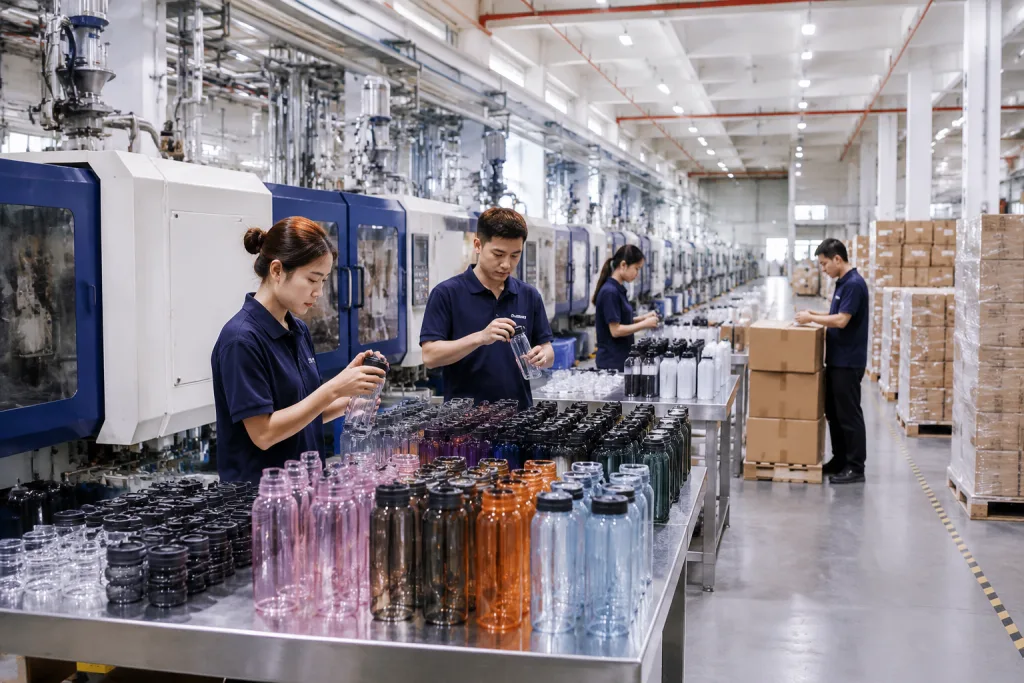
Key Takeaways
- PP bottles usually start around USD 0.85-1.60 FOB for 600-750ml stock models at 3,000 pcs, while PC bottles are often USD 1.10-2.10 depending on lid and decoration
- A new mold for a customized canteen body typically needs USD 3,500-12,000 and 20-35 days before pre-production samples
- For export programs, ask for REACH, LFGB or FDA contact compliance, plus AQL 2.5 inspection and leak testing at 100% before carton seal
- A realistic lead time from Zhejiang, China is 25-35 days for repeat orders and 35-50 days for new custom drinkware projects
You are not buying “a bottle.” You are buying resin grade, a compliance file, decoration setup, and a production plan that still has to pass customs, retail inspection, and daily abuse after shipment. On paper, 2 quotes can look close. Then samples land, QC pulled the sample, and one leaks at 0.03 MPa air test while the other clears drop test. That gap is where buyers lose time. A serious polycarbonate polypropylene bottle manufacturer should show those trade-offs early, not bury them under a low FOB number.
For buyers in Europe and North America, the questions are direct: PC or PP, custom mold or stock body, retail grade or promo grade, and what fail rate you will accept at incoming inspection. This is the wrong question to soften. We run into it every week at BottleForge Industrial in Zhejiang, China across custom drinkware, custom canteen, and distributor drinkware programs. One buyer flagged a lid color shift at Delta E above target; another had a PO typo on cap thread spec that held the line for 2 days. The wrong choice usually costs more in delay than in unit price, and we have seen that math go sideways fast.
Start with four buying decisions
Most sourcing mistakes start with the same move: buyers ask for price on day one. That is the wrong question to ask. Lock these four decisions first, and the quote gets cleaner, the sample round gets shorter, and we avoid the usual PO revision after the buyer flagged the lid fit on the first prototype.
- Decision 1: Material platform. Pick the resin first. Are you buying a polycarbonate bottle for glass-like clarity and better impact strength, or a polypropylene bottle for lower cost, easier color matching, and broad-format promo programs? On the line, PP usually gives us fewer color complaints because masterbatch adjustment is simpler.
- Decision 2: Product route. Decide if you need a stock body with a custom lid, color, and logo, or a full custom drinkware program with new tooling. A stock body can move fast; we have projects that went from artwork approval to shipment in 12 days vs 18 days for a new-mold review cycle. New tooling is not bad, but it needs tighter drawings—0.3 mm mismatch on the thread area will show up fast.
- Decision 3: Commercial channel. Retail, e-commerce, school, gym, and canteen promo orders do not use the same quality bar. Retail buyers usually ask for tighter packaging control and cleaner logo position; school and gym orders push harder on drop resistance and replenishment speed. QC pulled the sample on one school order last season because the straw bite mark showed whitening after repeated squeeze tests.
- Decision 4: Supply model. Decide whether you buy direct from a canteen factory in Zhejiang, China, or through canteen distributors bundling stock and local service. Direct buying can save margin, but the math doesn't work for every account if your order is split across 6 SKUs and each one sits below MOQ. We see this go sideways when a distributor PO has a typo on color code or carton mark and nobody catches it until packing.
These four decisions set your real cost. A canteen custom project with a new carry handle, unique bottle profile, and retail gift box might show only 18% more on unit price than a stock model. First-order landed cost is a different story. Add mold amortization, color masterbatch matching, drop testing, and slower decoration yield, and total cost often climbs 35-50%. We have seen silk-screen yield drop 6 points on dark PP bodies once the Pantone match got tight.
If you are a brand owner, the usual priority is differentiation plus compliance control. If you are a canteen distributor or distributor growler buyer, the pressure is often MOQ flexibility, print repeatability, and fast replenishment. We run these as separate project types in the factory because they do not behave the same on planning or QC. BottleForge Industrial currently plans capacity around 1.2 million units per month across plastic and metal drinkware lines, with MOQs from 3,000 pcs for stock PP bottles and higher thresholds for fully customized canteen tooling. On busy weeks, the line scheduler will hold custom decoration slots first if the approved golden sample comes in late.
A good supplier does not ask only, “How many pieces?” They ask where the bottle will be sold, how it will be decorated, and which failure modes you will not accept.
Choose PP or PC deliberately
Buyers often lump polycarbonate and polypropylene together because both make lightweight reusable bottles. That is the wrong question to ask. On the line, they run differently, sell differently, and get different pushback from retail buyers.
Where polypropylene works best
PP is the usual fit for large-volume customized drinkware, school bottles, budget sports bottles, and canteen promotional programs. The cost is lower, the resin takes color cleanly, and it works for translucent or opaque looks without fighting haze. Typical wall thickness on a 650ml PP body is around 1.8-2.5mm depending on geometry. For a stock 700ml PP bottle with screw lid and one-color silkscreen, you can often target USD 0.85-1.20 FOB Ningbo at 5,000 pcs. Add a straw lid, dual-color injection part, or shrink sleeve, and the math starts moving fast. We have seen buyers ask for a 1.6mm body to save a few cents, then complain about panel softness after drop test. QC pulled that sample twice.
Where polycarbonate fits
PC is picked for glass-like clarity, better impact resistance in use, and a more premium shelf look. It shows up a lot in gym, outdoor, and branded hydration projects where transparency sells the bottle before the customer touches it. Typical wall thickness is around 2.0-3.0mm. A comparable 650ml PC bottle can land at USD 1.10-1.70 FOB at 5,000 pcs before premium packaging. You still need to verify your market requirement carefully, because some buyers in Europe flag PC early and shift to PP, Tritan-like copolyesters, or stainless options for positioning reasons. We have seen this go sideways after artwork approval, not before. One buyer’s PO even said “PC clear” on page 1 and “PP body” on page 3.
For either material, ask your canteen manufacturer or canteen supplier four technical questions: odor control after molding, dishwasher recommendation, stress cracking risk around threads, and decoration adhesion after 72-hour cure. If the supplier answers in general terms, expect claims later. We usually tell North American buyers to run side-by-side pilot samples: same bottle geometry, same logo, one PP and one PC. Spend USD 200-400 more on validation now. It is cheaper than finding thread cracks or logo drop-off after launch, especially if AQL 2.5 passed but the first retail return photo still lands in your inbox.
Stock platform or new tooling
This is the biggest commercial fork in the road. Stock platform gets you selling faster. New tooling gives you a shape your competitor cannot copy from the same catalog, but the math does not work unless your volume is there.
A stock-body program usually means you pick an existing size like 500ml, 650ml, 750ml, or 1000ml, then change lid color, Pantone body tone, logo, hangtag, and carton. We run this route every week. On the line, the only change might be a silk-screen plate and a carton mark, which is why canteen vendors and canteen suppliers in China use it so often. It cuts tooling risk and can ship in 25-35 days after sample approval. MOQ is commonly 3,000-5,000 pcs per colorway. If the packaging is simple, we sometimes mix 2 colors in one body program, though buyers often ask for 500 pcs per color and that usually gets pushed back.
A fully customized canteen or customizable growler project means you pay for a new body mold, and sometimes a cap mold too, plus separate tooling for the handle, spout, or overmolded TPE parts. For injection or blow-mold related development, expect USD 3,500-12,000 for a bottle body tool, more if the lid mechanism is complex. T1 sample is usually 20-35 days. Then plan another 7-14 days for corrections after QC pulled the sample and found issues like a 0.3 mm parting-line mismatch or a thread fit that feels tight. Your first shipment may take 45-60 days from deposit.
The volume threshold decides it. If your forecast is under 20,000 pcs total, stock tooling is usually the sensible move. This is the wrong question to ask if you start with “custom or not” before you know annual sell-through. If your annual demand is 50,000-100,000 pcs and your channel is retail, a customized canteen body may pay back fast through margin and lower direct comparability. We have seen custom projects go sideways at 12,000 pcs a year because the mold cost sat on too few units.
- Choose stock when speed, lower MOQ, and price discipline matter most.
- Choose custom when shape ownership, premium pricing, or channel exclusivity matters more than first-order cash efficiency.
For canteen custom projects in Zhejiang, China, we often advise one compromise: keep a proven thread finish and cap interface, but customize the body silhouette. We ship more stable projects this way. A proven neck finish avoids leaks, cross-thread complaints, and cap torque surprises, while the new body still gives your brand something ownable on shelf.
Price beyond the FOB line
Buyers often line up three quotes from canteen manufacturers and compare only the bottle price. That misses the real cost. We see this on the line all the time: one FOB looks cheaper by USD 0.07, then the buyer adds testing, inner packing, and label work, and the “cheap” quote ends up higher. This is the wrong question to ask.
Build your comparison sheet with these cost blocks:
- Base bottle: body, cap, seal ring, standard PE bag, export carton
- Decoration: silkscreen, heat transfer, UV print, IML, emboss or deboss mold changes
- Packaging: white box, color box, PDQ, barcode label, FNSKU, instruction sheet
- Compliance: lab testing, migration testing, drop test protocol, retailer-specific document pack
- Quality control: third-party inspection, leak fixture testing, rework allowance
- Logistics: pallet standard, carton drop resistance, loading quantity, port charges
Take a 750ml PP sports bottle sold as customizable drinkware for promotions. A one-color logo might add only USD 0.05-0.08 per unit. Full-wrap heat transfer adds USD 0.18-0.35. A custom color box adds USD 0.22-0.48. We run these numbers every week, and the math changes fast once the buyer asks for a Pantone-matched lid and an insert card cut to 210 x 148 mm. Suddenly the “same” bottle is 35% more expensive.
Ask how the factory handles scrap and replacement. On a 10,000-piece custom drinkware order, a 2% decoration failure rate means 200 units. That is not small. QC pulled the sample on one order last month and found poor adhesion after cure because the line was checking print appearance but not oven temperature. If the print process has no in-line cure control, the actual problem can be worse than the pre-shipment sample suggests. A practical canteen vendor should quote the price and the process yield assumption behind it.
If you are buying as a distributor canteen program, ask for the breakpoints at 3,000, 5,000, and 10,000 pcs. The gap can be meaningful. In many China-made PP bottle projects, going from 3,000 to 10,000 pcs can reduce FOB by USD 0.10-0.22 per unit depending on lid complexity and decoration setup. We have also seen buyers lose this saving because the PO had a barcode typo and 10,000 color boxes had to be reworked. Small mistake, expensive result.
Compliance files and quality gates
B2B buyers in Europe and North America do not need “food grade” stamped on a quote sheet. You need the file names, the test scope, and the pass/fail rules. For plastic bottles, we usually start with material declarations and food-contact testing that matches the sales market. For the US, that often means FDA-related declarations. For Europe, buyers usually ask for a REACH review. Some German customers still push for LFGB-oriented testing on PP lids and straws, and the buyer flagged this more than once on school bottle programs.
Ask your canteen factory for a simple but complete technical file:
- Material specification for body, lid, gasket, straw, and color masterbatch
- Test report references with lab name and date
- Factory audit status such as BSCI or ISO-related management systems if applicable
- Product drawing with capacity, weight, neck finish, and tolerance
- Packaging specification and carton drop standard
Quality control needs the same level of detail. We run 100% leak testing before packing, not spot checks, because this is where claims start. On the line, operators use an air-pressure leak tester and hold each bottle for 3 seconds before it moves to packing. After that, QC pulled the sample for final random inspection under AQL 2.5 for major defects and AQL 4.0 for minor defects unless your customer sets tighter numbers. For retailer programs, AQL 1.5 on appearance defects is common, especially on bottles with large logo print.
Defect points on PP and PC bottles are predictable if the factory has done the work. We usually watch cap-thread flash, color variance against the approved chip, print misregistration over 1.0mm, stress whitening near the handle boss, and odor after 24-hour sealed storage. Last year, one inspection finding was a 0.8mm burr inside a straw port that did not show on the first sample but showed up after mold wear. Small issue. Big complaint later. If your canteen supplier cannot show a defect library with photos, rejection samples, and clear limits, they are managing by memory. We’ve seen this go sideways.
For children’s programs or school use, ask about ASTM-related checks where they apply to the full product design, especially for detachable accessories. This is the wrong question to ask if you only focus on resin grade. A customized growler or custom growler project for beverage retail usually needs stronger top-load and leak performance than a basic sports bottle. We have buyers ask for a 25kg top-load on stacked carton tests and tighter lid torque windows after transit simulation. The test plan should match actual use, not just the material listed on the spec sheet.
Match supplier type to channel
Not every buyer should source the same way. The right supplier setup depends on your channel: brand owner, importer, wholesaler, or a drinkware distributor running repeat POs over 3,000 pcs.
Direct factory buying fits teams with stable forecasts, in-house QC, and enough volume to clear MOQ without forcing dead stock. A direct canteen manufacturer in Zhejiang or elsewhere in China gives you tighter control on mold revision, Pantone matching on the line, and packaging details down to a 2 mm logo shift on the insert card. You also see the real lead time, not a sales estimate. We run repeat stock orders at 25-35 days in normal season; new custom development usually takes 12 days for samples and 18 days more once tooling changes are approved. Buyers push back on MOQ here, but the math doesn't work if the run is too small.
Working through canteen distributors makes sense if you need local warehousing, split shipments, smaller replenishment, or credit terms tied to sell-through. You pay for that margin. Sometimes it saves more cash than it costs, especially if the distributor can break one 40HQ into 4 deliveries and hold stock with pallet labels already sorted. We have seen buyers flag this after a PO typo on carton marks slowed a seasonal launch by 6 days. This model is common for canteen promotional programs and short seasonal windows.
Either way, qualify the partner with practical checkpoints. QC pulled the sample on one project because the spare seal hardness was off by 3 Shore A, and that is the kind of detail that matters:
- Can they support mixed-SKU orders, or does the line only run one model per PO?
- Do they understand FNSKU, pallet labels, and Amazon carton limits if you sell online?
- Can they manage custom logo approvals with signed artwork control and revision dates on the file?
- Do they keep spare parts like caps and seals for after-sales claims, and in what quantity?
Buyers often ask whether a canteen manufacturer and a custom growler supplier can be the same factory. Sometimes yes. Often, not efficiently. Bottle geometry, neck finish, and pressure expectations are different; a 38 mm neck on a PP canteen line is not the same job as a growler body that needs better wall consistency and cleaner thread control. A factory strong in promotional PP canteens may not be the best fit for premium customized growler programs. This is the wrong question to ask. Ask how often they make this exact type, what the monthly output is, and whether QC records show repeat production instead of one sample run. That tells you more than a glossy catalog does.
A practical RFQ that gets useful quotes
If you want quotes you can compare from canteen vendors or canteen distributors, your RFQ has to pin down the product. If not, each factory prices a different bottle, cap, and pack-out, then the numbers look close on paper but mean nothing on the line.
Send these basics in the first round:
- Target material: PP or PC, plus any restrictions
- Capacity in ml and target unit weight in grams if known
- Intended use: retail, school, gym, outdoor, promotional, or beverage service
- Decoration method and logo colors
- Packaging format and barcode requirements
- Destination market and required compliance documents
- Annual volume and first-order quantity
- Target incoterm: FOB Ningbo, FOB Shanghai, or another agreed basis
If you need a customizable canteen or customized growler from scratch, add a hand sketch, reference images, and the features you will not bend on: leakproof level, one-hand opening, carry loop load requirement, or dishwasher guidance. We run projects from rough inputs all the time, but vague RFQs add 3 days, sometimes 5, to each revision cycle. Last month a buyer wrote “sports lid” on the PO, and we still had to stop and ask whether that meant flip straw, screw chug, or push-pull.
For sample stages, say exactly what you need. A visual mockup is not a 3D print. A 3D print is not a pre-production sample from real tooling. And that is not a golden sample signed for mass production. QC pulled the sample last week and found the logo sitting 4 mm off center on a wrap print; on screen it looked fine. Approve one physical golden sample with a signed color chip, print position, and packaging standard before deposit for mass production. This is the wrong question to ask: “Can you match the artwork?” Ask what sample stage you are approving.
This discipline matters when you are sourcing customized drinkware at scale. It matters more when you are a canteen distributor handling 12 customer logos in one PO, because artwork control is where repeat orders break down. A practical supplier in Zhejiang should turn revised artwork proofs in 24-48 hours and standard pre-production samples in 5-10 days on stock models. If they cannot, your launch plan is already slipping. We have seen this go sideways when the buyer flagged barcode size after carton print, and the whole ship date moved from 12 days to 18 days.
Send your RFQ and get a usable factory quote
Share your target material, volume, logo method, and market. We will flag the key trade-offs before you waste time on the wrong bottle platform.
Frequently asked questions
What MOQ should I expect from a polycarbonate polypropylene bottle manufacturer?
For stock PP or PC bottles with standard lids, MOQ is commonly 3,000-5,000 pcs per model, often per color if decoration is simple. If you need mixed colors in one order, some factories in China can work with 1,000 pcs per color within a 5,000-piece total, but that depends on packaging and line efficiency. A fully customized canteen with new tooling usually starts higher in practical terms because you need to amortize mold cost. Even if the factory accepts 5,000 pcs, the economics often improve only from 10,000 pcs upward. Always ask for three price breaks: 3,000, 5,000, and 10,000 units.
How long does a custom drinkware project usually take?
For a stock bottle with custom logo, color, and export carton, a realistic timeline is 5-10 days for sample approval and 25-35 days for mass production after deposit. If the order includes custom packaging, add around 5-7 days. For a customized canteen with new mold, expect 20-35 days to first tooling sample, then 7-14 days for modifications if needed. Mass production normally follows in 25-35 days after final approval. In Zhejiang, China, the total first-project timeline is often 45-60 days if decisions are made quickly and artwork is controlled well.
What compliance documents should I request for Europe or North America?
At minimum, ask for material declarations for all food-contact parts, not just the bottle body. For Europe, buyers commonly request REACH-related review and may ask for LFGB-oriented testing depending on customer policy. For North America, many importers ask for FDA-contact declarations and current lab reports tied to the actual materials used. If the bottle is for children or school channels, ask whether any ASTM-related considerations apply to accessories or detachable parts. Also request carton specs, QC standard, and inspection level such as AQL 2.5. A serious canteen supplier should provide dated reports, not generic claims copied from old files.
Is it better to buy direct from a canteen factory or from canteen distributors?
Buy direct if your order volume is stable, you can manage approvals, and you want better control over unit cost, packaging, and change requests. Direct factory buying also gives you clearer answers on lead time, tooling, and spare parts. Use canteen distributors if you need smaller replenishment, local stock, or easier communication for many small customer accounts. The trade-off is margin: you usually pay more per piece than buying straight from a canteen manufacturer in China. For buyers ordering 10,000 pcs or more per SKU, direct often makes more sense. For fragmented promotional demand, distribution can be more efficient operationally.
How can I compare quotes from different canteen manufacturers fairly?
Force every supplier to quote on the same basis. Specify capacity, material, target weight, wall thickness range if known, lid style, seal type, decoration method, packaging, compliance scope, and incoterm. Then ask them to separate bottle price, logo cost, packaging cost, testing, and tooling. A quote that is USD 0.12 cheaper may be missing a color box, leak test, or stronger gasket. Also compare lead time and defect policy. Request AQL levels, replacement handling, and whether 100% leak testing is included. Fair comparison means total delivered specification, not just the FOB number printed on page one.