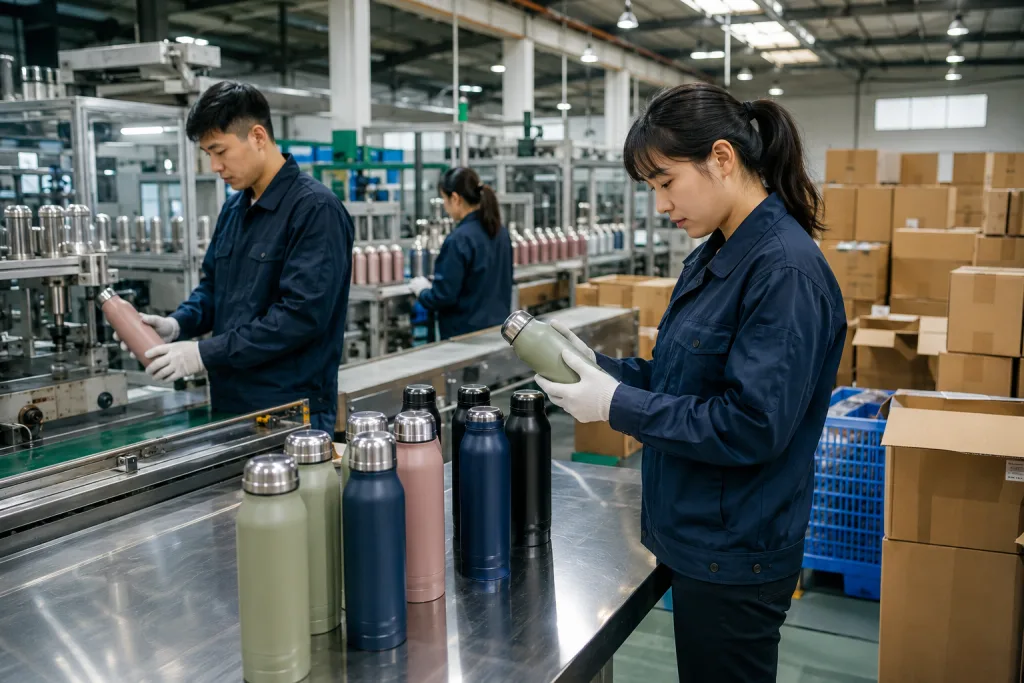
Key Takeaways
- A usable RFQ for a custom thermos should lock 12-15 specs, including 304 vs 316 stainless, PETG part color, leak test standard, and carton drop requirement
- Typical MOQ for a stainless factory thermos with custom color is 1,000-3,000 pcs per SKU; sample lead time is usually 7-12 days and bulk lead time 25-40 days
- For bulk thermos projects, plan USD 0.08-0.35 per unit for logo decoration and USD 80-250 for pre-production tooling or color matching where needed
- Use AQL 2.5 for major defects and 4.0 for minor defects, plus 100% leak test and vacuum retention checks before ex-factory release
You search for a petg vacuum flask factory, but in most RFQs the actual bottle is stainless steel, with PETG used only on the lid, straw, sleeve, or an outer trim part. That detail changes the quote. If your RFQ says only “custom thermos, 500 ml, logo,” factories will price on different assumptions, and you end up paying for two sample rounds after QC pulled the sample and found the lid resin was PP, not PETG.
For outdoor retailers and promotional brands in Europe and North America, the safer way is to source step by step: RFQ, quote alignment, pre-production sample, bulk approval, then shipment control. We run into this every week in Zhejiang. Buyers who lock PO line items early usually save 7-12 days instead of losing 18 days in back-and-forth, and they avoid the failures we see most on the line: wrong lid resin, coating adhesion below cross-hatch standard, and carton sizes that do not fit palletized delivery. This is the wrong question to ask if you start with price only. We’ve seen a PO typo on carton drop spec hold packing for a full day.
Start with the real product spec
The phrase petg vacuum flask factory sends plenty of buying teams in the wrong direction. PETG is not the vacuum body material. On the line, a true insulated flask is normally double-wall stainless steel, usually 18/8 or SUS304 inside and outside, with vacuum sealed between the walls. PETG usually sits in the lid cover, straw cap, clear collar, or other accessory parts where transparency and impact resistance matter. We’ve seen buyers ask for a “full PETG vacuum bottle.” That spec does not hold up once engineering reviews the cross-section.
If you are buying a customized thermos for outdoor retail, start your RFQ with the assembly broken into parts. This is the right question to ask. A usable spec sheet should list:
- Body material: SUS304 or SUS316 inner wall; outer wall often SUS304
- Body construction: double-wall vacuum, copper-coated inner vacuum area if required
- Wall thickness: common range 0.35 mm to 0.50 mm inner and outer
- Capacity: 350 ml, 500 ml, 750 ml, 1,000 ml actual fill volume
- Lid resin: PETG, PP, Tritan, or mixed construction with silicone seal
- Temperature target: for example, above 60°C after 12 hours from 95°C fill at room temp
- Surface finish: powder coat, spray paint, polished, brushed, hydrographic, or base for wrap
- Decoration: silk screen, laser engraving, heat transfer, digital print
This is the difference between a real inquiry and a fishing email. A good thermos manufacturer in Zhejiang, China can quote fast, but only if the spec is pinned down. We run costing off the BOM, mold status, and packing details, not guesses. Leave the lid material open and one supplier thermos quote may assume PP while another assumes PETG. Your price gap might be USD 0.18 per unit, which looks minor until it hits 20,000 pcs. The math doesn’t work if sourcing compares those quotes as if they are the same bottle.
PO line items to set now: model number, capacity tolerance, stainless grade, PETG component color, logo method, packaging type, testing standard, and destination market compliance. Put it in writing. We once got a PO with “316 outer” typed by mistake, and QC pulled the sample before production because the cost jump made no sense. If your market is EU, mention REACH and food-contact expectations. If it is North America, mention FDA/LFGB needs and any retailer protocol.
Build an RFQ that gets useful quotes
Most quote problems start before pricing. You ask for a custom thermos, 3 factories reply, and each one is costing a different bottle build, lid structure, and pack-out. We see this on the line all the time: one RFQ says “matte black” but skips whether the body is 0.4 mm or 0.5 mm, so the quotes are dead on arrival. The fix is simple. Put commercial terms and technical specs in one RFQ file.
Your RFQ should include the product drawing and the PO assumptions in the same set. For a distributor thermos program or promotional thermos order, lock these points before sampling, not after the first prototype comes off the mold bench:
- Annual forecast and first order quantity: for example 3,000 pcs now, 12,000 pcs annual
- Incoterm: FOB Ningbo or Shanghai is common from Zhejiang
- Target price range: be honest if you need landed cost discipline
- Packaging: white box, color box, PDQ, master carton dimensions, pallet standard
- Barcode needs: UPC, EAN, FNSKU, carton labels, shipping marks
- Audit or compliance needs: BSCI, ISO 9001, factory social audit, ASTM if relevant
- QC level: AQL 2.5/4.0 or your own retailer protocol
For outdoor retail, add use-case notes. A 750 ml hiking flask is not the same build as a desk tumbler for a promo campaign. Spell out the test points: carry loop at 10 kg pull force, base diameter at 72 mm if it must fit cup holders, powder coat thickness if shelf abrasion is a concern. QC pulled a sample last month where the buyer flagged scratch marks after carton rub testing, and the issue was the coating spec was never written into the RFQ. This is the wrong question to ask: “Can you quote your best price?” Ask what performance standard the bottle has to meet.
Price benchmarks help if the assumptions match. A basic 500 ml stainless factory thermos with PETG lid component and one-color logo often lands in the roughly USD 3.20-5.80 FOB range at 3,000 pcs, depending on steel grade, coating, and packaging. A more premium 750 ml model with 316 inner wall, two-piece PETG lid, and gift box may move to USD 5.80-8.90 FOB. If one offer is far outside that range, ask what changed in the build: steel spec, lid tooling, box type, or carton drop test requirement. We’ve seen this go sideways because one supplier quoted a white box and another quoted a gift box with EPE insert.
PO line items to add at RFQ stage: quantity by color, acceptable overrun or underrun, reserve parts percentage, logo size in mm, carton gross weight limit, and test report responsibility. Add one more practical point if you can: approved artwork file type and print position tolerance, such as +/- 2 mm. We ship cleaner orders when this is written early. Last week we caught a PO typo on color split before deposit, and that saved a 2,000 pcs relabel job. That keeps your thermos suppliers aligned before they price.
Compare factories without guessing
Once quotes come back, do not compare unit price alone. For a thermos factory, you are buying process control as much as steel and plastic. We have seen a quote land 4% lower, then turn into a bigger loss because the line could not hold a 0.3 mm color band cleanly and the shipment slipped 12 days vs 18 days from plan.
Ask each manufacturer thermos candidate for six things: product drawing, factory photos of the vacuum line, monthly output, sample policy, defect handling procedure, and recent test reports. At BottleForge Industrial in Hangzhou, Zhejiang, monthly output on stainless drinkware programs can reach 300,000 units/month across standard models. Still, this is the wrong question to ask if your order has 9 SKUs, 3 lid types, and split carton marks. Capacity only matters if the factory can run that mix without choking the line.
Look at these checkpoints:
- Vacuum process: ask how they control leak rate and insulation retention across the batch, and whether QC pulled the sample from each shift or only at the end
- Metalwork: check mouth roundness, weld consistency, thread accuracy, and base flatness with a ring gauge or flat plate, not by eye
- PETG molding: review clarity, color matching, gate mark control, and stress crack risk, especially near the hinge or corner radius where the buyer flagged whitening before
- Coating line: confirm the adhesion test method, color delta tolerance, and curing consistency; we usually ask for tape test records and oven temperature logs
- Assembly: verify lid torque standard, gasket fit, and 100% leak test capability, because a loose silicone gasket at 1.5 mm thickness will come back as a claim fast
If you are sourcing a customizable thermos across several colors and logos, ask how the factory separates production lots. This part gets missed. We have seen this go sideways during peak season when gasket bins sat side by side, the buyer flagged a lid swap, and the PO even had a typo on the logo code.
You do not need the cheapest quote. You need the quote that still makes sense after sample, inspection, and pallet delivery.
Commercial terms need the same pressure test. Check whether mold or setup fees are refundable at bulk order stage. PETG color matching may need a masterbatch adjustment fee of USD 80-150. New carton print cylinders or graphic setup may add USD 50-120. Those numbers are normal. The math does not work when a supplier adds small reorder charges every time we ship.
PO line items to confirm before supplier selection: approved factory address, production capacity, deposit terms, sample credit policy, spare unit percentage, and claim window after arrival. Confirm each item against the supplier's chop and the final PI. We have had buyers miss a factory address change by one building number, and that alone can derail an audit. That is how you compare thermos manufacturers on facts instead of sales talk.
Sample stage is where mistakes surface
Buyers rush sampling to catch a season. That is where the misses start, and they get expensive once thermos bulk runs on the line. We usually set 2 approval gates, not one: visual approval first, functional approval after. Last month a buyer signed off from phone photos, then QC pulled the sample and found a 1.2 mm logo shift on the PETG lid ring.
First sample: fit, finish, and assumptions
Your first sample should lock the basics: dimensions, hand feel, lid action, color family, logo position, and whether the PETG parts look good enough for your sales channel. Clear PETG looks clean on screen. On the bench, it shows gate marks, flow lines, and dust faster than opaque PP, especially under direct light. If your brand sits in premium outdoor retail, ask for photos under direct light and warehouse light, and ask for one short video of the lid opening and closing. This is the right stage to catch small stuff. We have seen buyers flag a cap sound they called "too hollow" only after the second round, and that burns 5 to 7 days for no good reason.
Second sample: pre-production standard
The pre-production sample, often called PPS, must match the bulk method in real terms: same steel, same coating, same gasket hardness, same print method, same carton. If it does not, it is a display sample. This is the wrong question to ask: "Does it look close enough?" Ask whether we run the same process and materials that will ship in mass production. On one PPS check, the buyer flagged color drift, and the issue was simple: the sample used hand-spray coating while bulk was set for the automatic line.
For a customized thermos project, request these checks on the PPS:
- Leak test: inverted for 30 minutes, then shaken for 1 minute
- Vacuum retention: target based on your claim, such as above 60°C at 12 hours
- Coating adhesion: cross-hatch or tape test after curing
- Dishwasher statement: only if you truly intend to claim it
- Odor test: especially important with silicone seals and PETG parts
- Drop test: common retail expectation is carton drop, not bare bottle drop, unless specified
Typical costs are plain enough. Existing model samples often run USD 35-80 each plus courier, and we ship those in 3 to 5 working days if the body and lid are in stock. Custom color or custom logo sample fees may reach USD 80-150. More complex lid changes with new PETG tooling can start from USD 1,500 and go much higher, so make sure the volume justifies it. We have seen this go sideways at 1,000 pcs MOQ—the math does not work if the tooling is only paid back across one trial order.
PO line items to lock after sample approval: approved sample date, Pantone reference, logo artwork code, seal material, temperature claim wording, warning label text, and packaging photos. This becomes the control file for bulk. Without it, your thermos custom order turns into a memory test between your team and the factory. It happens more than buyers think. We once got a PO with the artwork code typed as "A17-B" instead of "A17-8," and the buyer flagged the print only after 2,000 pcs were packed.
Convert approvals into a production PO
A bulk purchase order should read like shop-floor instructions, not an accounting note. We still get POs with 6 lines plus old email threads attached. Then the night-shift planner reads the wrong revision, or the carton supplier swaps from 350gsm to 300gsm board and the buyer flags crushed corners at unloading.
For a serious bulk thermos order, your PO needs a line-item structure the production team can run without calling sales three times before lunch. That is the standard. On our line, the supervisor checks the PO against the BOM and the first sample with a digital caliper before mass production. A clean structure looks like this:
- Item 1: SKU code, capacity, body shape, steel grade, wall thickness
- Item 2: Lid assembly, PETG color, silicone color, carry strap material
- Item 3: Surface finish, Pantone or texture reference, gloss or matte requirement
- Item 4: Logo method, location, size, artwork revision number
- Item 5: Unit packaging, insert card, barcode label placement
- Item 6: Master carton pack quantity, carton dimensions, drop standard
- Item 7: Inspection standard, AQL level, functional tests
- Item 8: Shipment terms, ship window, booking instructions
Lead time is the wrong question if the PO is still missing packaging details. For a standard manufacturer thermos model with one custom color and one logo, we usually run 25-35 days after deposit and artwork approval. If the order includes 3 Pantones, a custom gift box, and 2 lid colors, 35-45 days is closer to real factory timing. Before Chinese New Year or the August holiday rush, add 7-10 days. QC pulled the sample last month on a gift-box order because the insert slot was off by 2 mm, and that kind of miss burns time fast.
Payment terms from Zhejiang suppliers usually start at 30% deposit and 70% before shipment, though repeat buyers sometimes move to better terms after 3 or 4 clean orders. If you are a thermos distributor feeding multiple customers, split your PO by destination label set and carton mark. We have seen this go sideways. One buyer put EU and US carton marks on the same PO, and the forwarder charged relabeling on 480 cartons because the outer mark file did not match the booking note.
PO line items that buyers forget: desiccant requirement, country of origin mark, replacement parts packed separately, pallet pattern, and photo report before loading. Small details, real cost. We ship warehouse programs where receiving teams reject pallets over a 1.8 m height limit, so this paperwork needs to be nailed down before the line starts packing your distributors thermos order.
Control quality before the container closes
Once the cargo is on water, most problems are paperwork: label mismatch, carton count, a PO typo on the booking sheet. The technical work should already be locked. For a thermos supplier, quality control is not 6 nice photos from the line.
You want control at three points:
- Incoming material check: stainless grade records, PETG resin confirmation, silicone hardness and odor, with durometer readings logged before the lids go to assembly
- In-process check: neck threading, vacuum pass rate, coating adhesion, print registration, checked against the golden sample on the line
- Final random inspection: AQL 2.5 major / 4.0 minor, packaging check, barcode scan, carton drop, with QC pulled the sample from sealed cartons
For the vacuum body, ask how the factory checks insulation consistency by lot. This is the right question. A serious thermos vendor should run retention tests on each lot, not only the first-off sample, and we usually log the result by batch after vacuum inspection. For the PETG lid parts, check stress whitening around snap-fit areas and hinge fatigue on flip lids; we have seen cracks start at a 0.8 mm corner radius.
Promotional buyers need to watch print durability hard. We have seen this go sideways. A bottle can look clean at ex-factory, then pick up scratches after 3 days in event crates, and the buyer flagged it as a brand issue on arrival. If the bottles are for field sales, gyms, schools, or outdoor events, ask for abrasion comments on the finish and how the coating held after tape peel or rub testing.
Shipping details matter because the math does not work if packing is too heavy. A 500 ml stainless flask packed 24 pcs/carton can push carton weight past the comfortable range once a gift box is added; on our line, cartons above 15 kg usually get complaints from warehouse teams. Keep master cartons near 12-15 kg where possible for easier handling. If you ship to Amazon or 3PL, confirm FNSKU, carton label format, and pallet height before final packing, not after stretch wrap.
Factories in China that ship export orders cleanly will send a packing list, carton photos, barcode sample, and inspection summary before balance payment. We ship these as standard. If they cannot put that file set together cleanly, or the carton photo shows mixed label positions, production control is often looser than it looks.
PO line items to confirm before shipment: final quantity by SKU, inspection pass reference, booking date, carton count, pallet count if any, and claim document package. This is where disciplined thermos suppliers stand out. Traders who only pass messages usually get stuck when one carton count is off by 2 or the buyer flagged a barcode sample with the wrong suffix.
Send your RFQ and get a workable quote
Share capacity, lid material, logo method, and packaging target. We will review the PO structure and reply with practical pricing and lead time.
Frequently asked questions
Can a petg vacuum flask factory supply a true stainless insulated thermos?
Yes, but you should verify what “PETG” refers to. In most cases, the vacuum flask body is double-wall stainless steel and the PETG is used in the lid, collar, or clear accessory parts. A true insulated thermos should specify SUS304 or SUS316 for the inner wall, vacuum construction, and heat-retention targets such as above 60°C after 12 hours. If a supplier presents a PETG body for a “vacuum flask,” you are usually looking at a different product category. Ask for a section drawing, full bill of materials, and a sample cutaway photo. For bulk orders above 1,000 pcs, that simple check can prevent a wrong-material buy that delays launch by 3-4 weeks.
What MOQ should I expect for a custom stainless thermos with PETG lid parts?
For existing bottle molds, MOQ is commonly 1,000-3,000 pcs per SKU, depending on finish and packaging. A plain color box and one standard body color may allow 1,000 pcs. If you need custom powder coat, Pantone-matched PETG parts, printed gift boxes, and several logo versions, factories often push MOQ closer to 2,000-3,000 pcs per variant. New tooling changes for PETG lids can raise the commitment further. If your order is for promotional thermos programs split across customers, ask whether the factory can hold the same body and divide logos by 500 pcs each. Some China factories in Zhejiang will support that if the total reaches 3,000 pcs and artwork is simple.
How long do sample and bulk production usually take?
Existing-model samples usually take 7-12 days after artwork and color notes are confirmed. Courier transit to Europe or North America is often another 3-7 days. A pre-production sample built with real bulk materials may take a similar window. Bulk lead time for standard stainless thermos orders is typically 25-40 days after deposit, sample approval, and packaging confirmation. Complex retail packaging, multiple colors, or peak-season loading can push that to 45 days. If you are buying from Zhejiang, China before holiday peaks, add at least 7 days of buffer. A realistic plan from first RFQ to shipped bulk order is often 6-9 weeks, not 3 weeks.
What tests should I require before approving bulk shipment?
At minimum, require 100% leak testing, vacuum retention testing by lot, and final inspection to AQL 2.5 major / 4.0 minor. For decorated bottles, ask for coating adhesion checks and print registration checks. If your lid uses PETG, review clarity, stress marks, hinge function, and sealing performance after repeated opening. For EU and North American programs, request food-contact compliance documents for stainless, plastic, and silicone components where applicable. If the bottles are for retail shelf sale, include carton drop testing and barcode scan verification. For premium outdoor lines, you may also want strap pull-force checks and salt-spray comments on metal accessories. These controls cost far less than one rejected pallet.
What is a fair FOB price range for bulk thermos sourcing?
For a standard 500 ml double-wall stainless thermos with PETG lid component, one-color logo, and standard white box, a common FOB range is roughly USD 3.20-5.80 at 3,000 pcs. Move to 316 inner wall, larger capacities, premium powder coat, or gift packaging and you may see USD 5.80-8.90 or higher. Tooling, special inserts, or complex lid assemblies are separate. Decoration usually adds about USD 0.08-0.35 per unit depending on method and color count. If one quote is 20% below the others, check the steel grade, wall thickness, lid material, and packaging assumptions first. Most price surprises are specification differences, not factory generosity.