Key Takeaways
- For a 500ml stainless vacuum flask with PETG lid parts, practical MOQ is usually 1,000 to 3,000 units per color, with 30 to 45 days lead time from Zhejiang, China.
- A realistic FOB price for bulk thermos orders is often USD 2.80 to 5.90 depending on 18/8 stainless grade, coating, print method, and packaging.
- Vacuum heat retention claims should be tied to a test method and time point, such as 12 hours above 55C or 24 hours above 42C.
- For promotional thermos and distributor thermos programs, most quality disputes come from coating scratches, logo adhesion, and lid leakage, not from the vacuum body.
You search for petg vacuum flask custom, and half the listings online are mixing PETG sport bottles with stainless vacuum flasks. That mix-up costs money. The tooling, compliance file, heat-retention result, and landed cost are different by a wide margin. We had one buyer flag this on a PO last month after the body spec showed PETG and the drawing still called for a 304 stainless vacuum liner. If you buy for an outdoor chain or a promo brand, get the structure right first, then lock the logo, color, and carton plan.
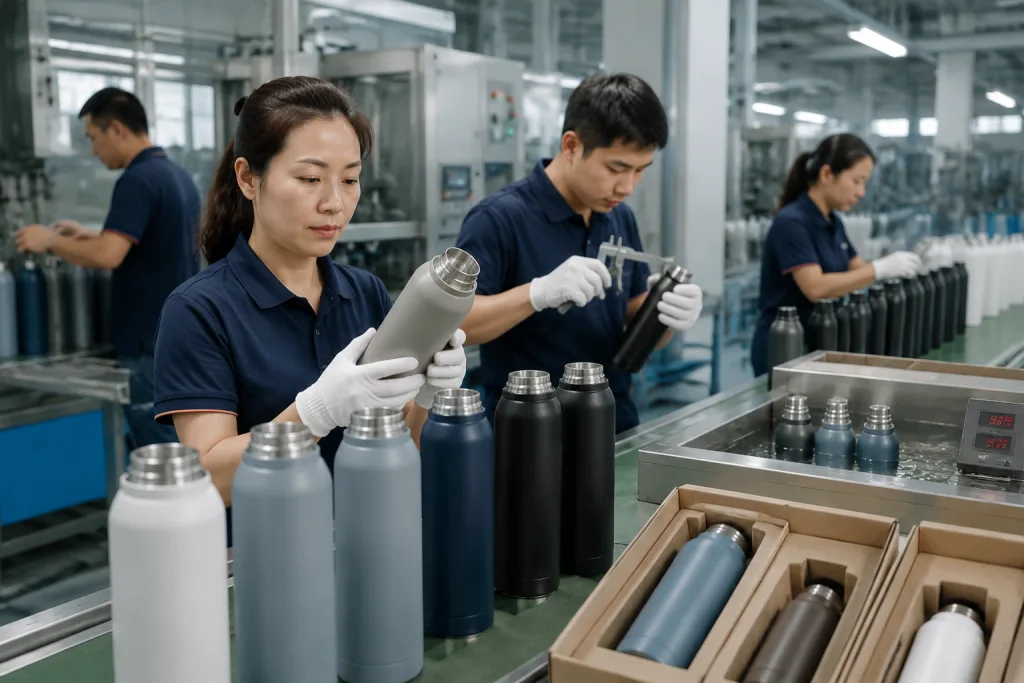
From Zhejiang, China, we see this every week on the line and in RFQs. A proper custom thermos program starts with the stainless inner and outer body, the vacuum step, the lid resin, the decoration method, and the test standard. PETG usually sits in the lid, straw, tea filter, or an accent ring, not in the vacuum body itself. QC pulled the sample on a 500ml item last quarter and the lid part was PETG at 2.2 mm, while the bottle body was 304 stainless with a vacuum gap. This is the wrong question to ask if you start from "PETG flask" instead of the actual bottle structure. Ask tighter questions, and you cut claims, trim delays from 18 days to 12 days, and get a cleaner FOB cost sheet.
What are you actually buying?
First, the base spec. A true petg vacuum flask custom item is almost never a full PETG vacuum body. PETG is a clear copolyester, and we usually run it on lid windows, outer cap shells, tea infusers, straw parts, or small add-on pieces. The vacuum body is normally double-wall stainless steel. In most RFQs we see, that means SUS304 inside, then SUS304 or SUS201 outside based on target cost and sales channel.
If you ask a thermos manufacturer in China for a full PETG vacuum flask, you usually get 1 of 3 results: a plastic bottle with no real vacuum layer, a stainless flask with PETG lid parts, or a quote that mixes the two and causes trouble later. We have seen this go sideways. One buyer flagged a sample after cut-open inspection because the drawing said "PETG bottle" while the line had already tooled a stainless inner with a PETG cap ring. For outdoor retail, stainless is usually the right call because you need drop resistance, heat retention at 6 hours and 12 hours, and clean compliance paperwork. For promo orders, PETG still has value since clear parts look better on-shelf and accessory cost can come in 8% to 15% under Tritan on some 3,000-piece programs.
Use this spec language when you RFQ
- Body: double-wall vacuum stainless steel, 18/8 inner, 0.4mm to 0.5mm wall thickness
- Lid: PP + PETG window or PETG outer shell, food-contact silicone seal
- Capacity: 350ml, 500ml, 750ml, or 1,000ml
- Finish: spray paint, powder coating, or electro-polish
- Logo: silk screen, laser engraving, heat transfer, or 360-degree digital print
If your supplier thermos quote does not clearly separate stainless body material from PETG accessory parts, expect trouble later on price, testing, and claims.
At BottleForge Industrial in Hangzhou, Zhejiang, most manufacturer thermos inquiries that mention PETG turn into stainless vacuum flask projects with PETG cap details. That is normal. This is the wrong question to ask: "Can you make the whole vacuum flask in PETG?" The better question is how the structure is split, what material touches the drink, and what the approved sample matches. We ship against the sealed sample and PO, and even a small typo like "SUS203" instead of "SUS304" can waste 4 days before production release.
Which specs change your cost fastest?
If you are buying thermos bulk, a few specs move cost fast. Capacity matters, sure. On the line, lid structure and surface finish usually move the quote harder than buyers expect. A plain 500ml customized thermos with a standard screw lid is one price; a 500ml flask with a PETG viewing cap, carry handle, tea filter, and an individual color box insert is a different build with more parts, more assembly time, and more QC checkpoints. We have seen buyers flag a 0.3mm lid gap on pre-shipment sample photos, so this is the wrong question to ask if you only focus on bottle size.
For a factory thermos quotation out of Zhejiang or other China clusters, these are the main cost drivers:
- Steel grade: SUS304 outside adds cost versus SUS201 outside, and the jump is easy to justify for outdoor use or premium retail where rust complaints come back fast.
- Weight: 220g versus 320g body weight can change FOB by USD 0.25 to 0.60 per piece. We run both, and the heavier body also changes freight math.
- Coating: powder coating is usually USD 0.18 to 0.45 higher than basic spray paint, depending on texture and rejection rate. A rough sand texture looks good, but QC pulled the sample before for pinholes near the shoulder.
- PETG component complexity: a clear lid window is cheap; a custom-molded PETG cap shell is not. New tooling, polishing, and fit check all add cost.
- Decoration: one-color silk screen may add USD 0.05 to 0.12, while laser engraving can run USD 0.08 to 0.20, and full-wrap print more. On curved bodies, we usually check logo position with a jig before mass print.
- Packaging: plain egg-crate packing is low cost; retail gift boxes can add USD 0.35 to 1.20. If the buyer asks for a 1.2m drop-test carton, the math changes again.
A workable FOB range for a 500ml custom thermos is usually USD 2.80 to 5.90 at 1,000 to 3,000 units. That is a wide band for a reason. A more premium customizable thermos for outdoor retail, with powder coat, PETG detail lid, stainless filter, and branded box, can land at USD 4.60 to 7.20 FOB. We ship both types every month, and MOQ usually starts at 1,000 pcs if the lid mold is already on hand.
Ask your thermos supplier for a price ladder at 1,000, 3,000, and 5,000 units. That exposes where the real breakpoints are. In one recent quote, 3,000 pcs cut unit cost by USD 0.38, while 5,000 pcs only saved another USD 0.11, so the bigger jump was obvious. Many suppliers thermos catalogs show a low headline price, but that number often excludes logo plate charges, drop-test packaging upgrades, or export carton changes. We have seen this go sideways over a PO typo on carton mark wording. A good manufacturers thermos quote should show mold cost if any, sample fee, FOB port, and carton dimensions.
How low can MOQ really go?
MOQ is where 7 out of 10 promo projects get stuck. A buyer asks for 300 units because the campaign is small, then the factory says yes. Two weeks later, the buyer flagged that the yes only covered blank stock, not a Pantone body, a custom PETG lid, or a retail box with a die-cut insert. We see this go sideways when a trading company quotes first and checks the line later. On our side, the jig and screen booking already tells the real limit.
For stainless vacuum flask programs with PETG lid parts, practical MOQs usually look like this:
- Stock color + 1 logo: 500 to 1,000 units
- Custom Pantone coating: 1,000 units per color
- New PETG lid mold or modified cap: 3,000 to 10,000 units depending on cavity count
- Retail gift box with custom insert: 1,000 units
- Amazon FBA prep with FNSKU labels: often 1,000 units minimum to keep labor cost sensible
Our own production planning in Zhejiang runs best when one vacuum flask SKU is at least 1,000 units, and combined output can exceed 300,000 units per month across core models. That does not make every low-MOQ request impossible. It means the setup has to be clean. If you need 600 units, use an existing body mold, one standard lid, one coating color, and one print location. We run those jobs faster because the spray line stays stable and QC pulled the sample against one approved golden sample instead of four versions. This is the wrong question to ask: not "how low can MOQ go," but "what spec can fit 600 units without the math breaking."
Checklist before you challenge MOQ
- Can you use an existing cap instead of custom tooling?
- Can you accept laser logo instead of multi-color print?
- Can you consolidate 3 colors into 1 or 2?
- Can you use shared master cartons instead of a custom PDQ display?
When a distributor thermos buyer says MOQ must be flexible, the honest answer is usually yes for decoration and packing, and no for brand-new tooling. New tooling is where the math doesn't work at 300 or 500 units, especially once the mold shop quotes a PETG cap insert and T1 sampling. We ship low-quantity orders every month, but only after the spec is trimmed before PO release. One typo on a PO color code can waste 12 days versus 18 days on a full remake, so fake flexibility costs more than a direct answer.
What tests should you ask for?
For outdoor retailers and promotional thermos buyers, compliance is not an end-stage box check. It needs to be tied to the bill of materials at RFQ stage. If PETG sits in any contact part, ask for the declaration for that exact resin grade, not a generic plastics letter dated 2021. We have seen buyers send a broad statement that covered nothing on the line. Same rule for silicone seals, paint, and ink—QC pulled the sample once and the lid gasket grade on the COA did not match the PO.
Typical document and test requests for Europe and North America include:
- REACH and LFGB for EU food-contact relevance where applicable
- FDA food-contact declaration for US-facing programs
- CPSIA or California Proposition 65 screening where retail channel requires it
- ASTM drop or functional testing for specific retailer standards
- BSCI or Sedex for social compliance if you supply large retail chains
- ISO 9001 quality system documentation if your sourcing policy requires it
On product quality, the real checklist is more basic and more useful. Ask the thermos vendor to verify vacuum performance, lid leakage, coating adhesion, odor, any dishwasher claim, and carton drop resistance. We run these checks every batch, and this is the wrong question to ask if a supplier only talks about certificates. Ask what failed last month. A standard AQL 2.5 major / 4.0 minor is common for drinkware, but premium brands often tighten it after one scratch complaint or one dent found in a 76 cm carton drop.
Good thermos controls usually include 100% vacuum check, 100% leak test on the lid assembly, and random salt spray or cross-hatch adhesion checks on coated pieces. For a 500ml flask, ask the factory team to state the actual heat retention target in numbers. Example: fill with 95C water, then record temperature after 6, 12, and 24 hours. We ship reports like this every week. The claim should be numeric, not marketing copy; the buyer flagged one report last year because the box said “24 hours hot” but the test sheet had no ambient temperature listed.
The fastest way to create claims is to print “24 hours hot” on the box without locking the test condition. The fastest way to avoid claims is to put the method on the spec sheet before mass production.
How do samples and lead times work?
Lead-time trouble usually starts with sample approval that was too loose. We see this a lot. A buyer says the sample is approved, but our team only got approval on bottle shape, not the powder-coat texture, logo position, or PETG clarity on the lid window. Then the line starts, QC pulled the sample, and the buyer flagged it. Split the sample process into stages and sign off each one with notes on color, finish, print size, and lid parts. This is the right question to ask.
A normal schedule for a stainless flask with PETG lid parts from China looks like this:
- Existing model plain sample: 3 to 5 days
- Logo sample on stock color: 5 to 7 days
- Pre-production sample with custom Pantone and packaging: 7 to 12 days
- Mass production: 30 to 45 days after deposit and sample approval
- Peak season extension: add 7 to 15 days before Q4 shipments
If your project involves a new PETG cap mold, add 20 to 30 days for tooling and first article confirmation. We usually check the first molded cap with a caliper at the hinge and thread points, often down to 0.2 mm tolerance on fit areas. Tooling for a simple PETG component might cost USD 1,500 to 4,000. A more complex multi-part lid can run higher. Most distributors stay with proven lid platforms unless the MOQ and repeat volume justify new development. We have seen this go sideways on small trial orders.
For distributors thermos business, do not approve only from photos. Get one retained golden sample and one sealed production reference. Simple fix. One stays with you. The second stays with the thermos manufacturer in Zhejiang, usually sealed after final check with the carton mark and sample date written on it. That avoids the usual fight where each side is comparing bulk goods to a different sample version.
Ask for the export timeline in plain terms: deposit date, artwork approval date, pre-production sample date, mass production completion, inspection date, booking cutoff, and ETD. We ship against that sheet every week, and if the buyer changes artwork on day 6 or the PO has a typo in the color code, the dates move. A capable factory thermos partner should give you the schedule without drama. If they cannot, that 35-day lead time is probably a sales guess, and the math does not work.
What should your PO checklist include?
This is where buyer discipline shows up fast. We see more PO trouble than welding trouble on the line. Most claim cases start with an incomplete order sheet, not with the vacuum seam or a bad pull on the leak tester. If your PO only says “500ml PETG vacuum flask custom, black, with logo,” the factory has to fill in the blanks. That is where gloss level shifts, lid torque feels too tight, logo position moves 6 mm, or the carton count lands wrong. We have seen this go sideways.
Your purchase order and spec sheet should lock these points:
- Body material: SUS304 inner, SUS304 or SUS201 outer
- Wall and weight: agreed piece weight tolerance, for example plus or minus 3%
- Lid structure: PP, PETG, silicone, filter, handle, color split
- Capacity standard: brimful and usable capacity
- Color: Pantone code and finish level, matte or gloss
- Logo: method, size in mm, position drawing, color code
- Packaging: polybag, white box, gift box, barcode, FNSKU, carton marks
- Testing: leak test, vacuum retention target, drop test if required
- Inspection: AQL level, critical defect definition, photo approval points
- Trade terms: FOB Ningbo or Shanghai, deposit ratio, balance timing
Outdoor retail orders usually need tighter carton rules than a standard promo flask job. The buyer flagged this on one PO last month: 5-layer export carton, 76 cm corner drop, and a moisture barrier note for sea freight after a wet-container claim. Promo brands push on different points. They care about print consistency, event-date delivery, and whether all 2,000 pieces match the approved gold tone under the same light box. Different channels mean different failure points.
If you buy from Zhejiang, China, ask who owns the tooling, where the vacuum body is made, and whether lid injection is in-house or outsourced. This is the right question. We run into schedule gaps when the flask body comes from one workshop, the PETG lid from another town, and the final assembly waits 2 days for missing silicone rings. Ask for traceable answers, not polished sales wording. QC pulled the sample once on a job where the PO even misspelled the color code, and that small mistake cost 4 days.
Get a workable thermos quote, not a vague one
Send your target capacity, lid concept, logo method, packaging, and order quantity. We will reply with a realistic MOQ, FOB price range, and lead time.
Frequently asked questions
Can PETG be used for the whole vacuum flask body?
Not for a true vacuum flask. Vacuum insulation needs a double-wall structure with an evacuated space, and in commercial drinkware that body is typically stainless steel. PETG is better used for lid windows, cap shells, infusers, or accent parts. If a supplier offers a full PETG vacuum body, you are usually looking at a non-vacuum plastic bottle or a misquoted item. For outdoor retail, specify SUS304 inner wall at 0.4mm to 0.5mm and then define PETG only where needed in the lid assembly. That gives you realistic heat retention, better impact resistance, and clearer compliance paperwork. It also reduces testing confusion when you ask for FDA, REACH, or LFGB documents on food-contact parts.
What is a realistic MOQ for a custom thermos with PETG lid parts?
For an existing stainless flask model with a standard lid and one logo, 500 to 1,000 units is realistic. If you need a custom body color, expect 1,000 units per Pantone. If you want a new PETG lid shape or modified cap tooling, MOQ usually moves to 3,000 to 10,000 units because mold cost and line setup have to be absorbed. Buyers often get caught by a low headline MOQ that only applies to blank stock. Ask the thermos manufacturer to state MOQ separately for stock color, custom coating, custom packaging, and new tooling. That gives you a real purchasing picture instead of a sales number that changes after artwork approval.
How much should I budget for bulk thermos pricing?
For a 500ml stainless vacuum flask with standard screw lid, one-color logo, and normal export carton, a typical FOB China range is USD 2.80 to 4.20 at 1,000 to 3,000 units. If you add powder coating, a PETG visual window, stainless tea filter, carry handle, or a branded gift box, the range often moves to USD 4.60 to 7.20 FOB. Tooling for a new PETG cap can add USD 1,500 to 4,000 upfront. Sea freight, duty, testing, and local warehousing sit outside that FOB number. The cleanest way to compare suppliers is to request the same spec grid from all of them and force them to break out logo, packaging, and tooling costs line by line.
What lead time should I expect from a thermos factory in Zhejiang, China?
For an existing model, plain samples usually take 3 to 5 days, logo samples 5 to 7 days, and a fully customized pre-production sample 7 to 12 days. Mass production is commonly 30 to 45 days after deposit, artwork approval, and sample sign-off. If you are opening a new PETG lid mold, add roughly 20 to 30 days for tooling and first article checks. Before Q4, add another 7 to 15 days because coating, assembly, and booking slots get tight across Zhejiang and wider China. Ask for a written milestone schedule covering sample date, inspection date, booking cutoff, and ETD. Without that, the quoted lead time is usually too optimistic.
What are the most common quality problems on customized thermos orders?
The top problems are usually lid leakage, scratches on coated surfaces, inconsistent logo placement, weak paint adhesion, and color drift between sample and production. Actual vacuum failure exists, but competent factories already run 100% vacuum checks, so cosmetic and assembly issues are more common. Put your controls where the risk is: AQL 2.5 major and 4.0 minor, 100% leak testing, cross-hatch adhesion checks, and sample retention for approved coating and logo position. If you sell into outdoor retail, ask for transit carton tests too. A flask can pass factory inspection and still arrive damaged if the inner dividers, carton strength, or pallet pattern are wrong.