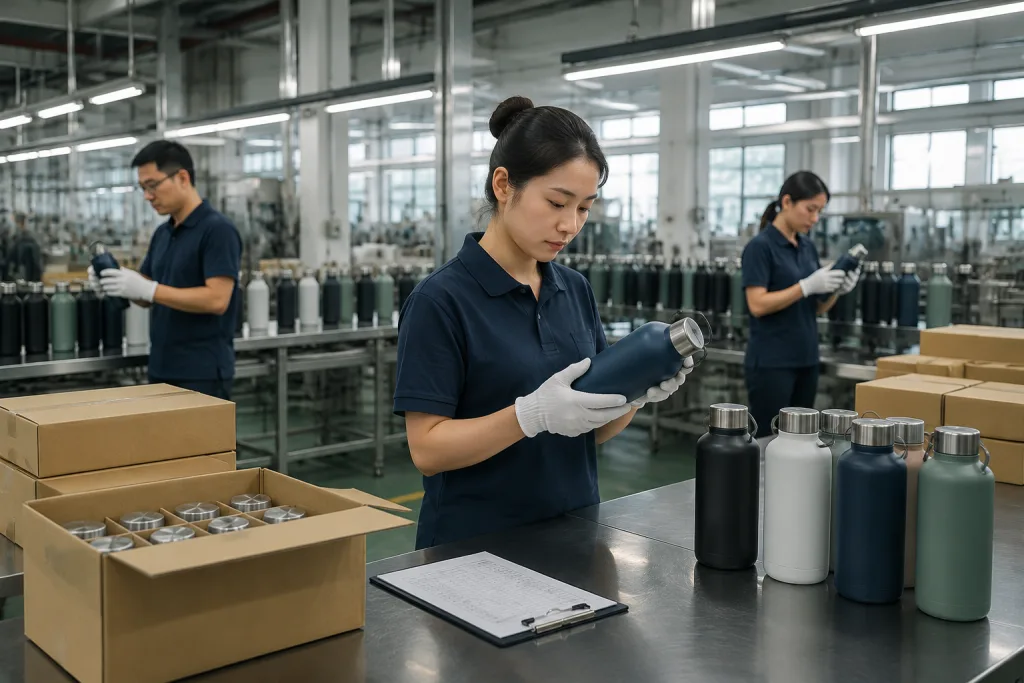
Key Takeaways
- Use 18/8 stainless for the vacuum body and PETG only for lid parts; typical MOQ is 1,000 pcs and repeat lead time is 25-35 days.
- A 500 ml bulk thermos usually lands around USD 3.20-5.80 FOB China depending on copper coating, powder coat, and print method.
- For outdoor retail, target 12-24 hour heat retention, 0.4-0.5 mm outer wall thickness, and AQL 2.5 final inspection.
- Promotional thermos orders save money with 1-color silkscreen or laser marking; full-wrap finishes can add 8-15 days.
You may be searching for petg vacuum flask bulk and seeing three different products mixed into one search result: PETG bottles, stainless thermos flasks, and factories making loose claims. We see this every week. The real buying job is narrower than it looks: decide where PETG fits, where stainless steel must stay, and how that choice changes unit cost, compliance risk, logo finish, and lead time. On our line, a 500ml double-wall stainless flask and a single-wall PETG bottle do not run on the same tooling, and the math does not work if a supplier treats them like the same item.
For outdoor retailers and promotional brands, the wrong call usually shows up 30 days later as leakage, denting, logo rub-off, or missing compliance files. That is where orders get stuck. A practical buyer in Europe or North America does not need marketing copy; they need a clear filter for the decision. If you are sourcing from Zhejiang, China, lock four points early: construction, actual use case, decoration method, and order model. QC pulled the sample on one rush order last month because the PO said “thermos” but the spec was PETG body with no vacuum layer, and the buyer flagged it after mass print approval.
Start With Four Buying Decisions
When buyers ask for petg vacuum flask bulk, we correct one point first: the vacuum body is stainless steel, not PETG. PETG fits selected parts such as lids, caps, inner stoppers, straws, or outer sleeves, where transparency, impact resistance, or color matching matter on the line. If a supplier quotes the whole flask as PETG and still calls it vacuum insulated, the buyer should stop there. We have seen this go sideways. Last month one RFQ even typed "PETG inner wall" on the PO draft, which is not a vacuum flask spec.
Your first decision is construction. For a serious custom thermos, use 18/8 stainless steel on the inner and outer body, usually SS304 inside and SS304 or SS201 outside depending on budget and market, then add PETG in the lid assembly if needed. Second is use case: outdoor retail usually asks for better heat retention and stronger drop resistance than a short-run promotional thermos, and we often check this with a 1.2 m drop test sample. Third is branding method: laser marking, silkscreen, heat transfer, digital print, embossed mold parts, and color-matched PETG each change the cost and the defect rate. Fourth is order model: open-stock customization, semi-custom tooling, or full OEM. This is the right place to get specific. The wrong question is "Can you make it?" The real question is which build can ship at your target price without QC pulling the sample for logo peel or color mismatch.
- Open-stock customization: fastest route, MOQ often 500-1,000 pcs per color.
- Semi-custom OEM: new lid, handle, or PETG cap color; MOQ usually 2,000-3,000 pcs.
- Full OEM mold: body and lid developed from scratch; MOQ often 5,000 pcs and up.
At BottleForge Industrial in Hangzhou, Zhejiang, we usually ask buyers to lock these four decisions before talking about carton marks or insert cards. It saves back-and-forth. More important, it stops you from approving a sample that will never hit your target FOB price once the line runs 3,000 pcs and the lid color delta comes back over tolerance.
Where PETG Fits In The Build
PETG fits some parts of a stainless thermos build, not the whole assembly. Buyers ask for it because the material is clear, takes masterbatch color cleanly, and looks sharper on shelf than cloudy plastics. On the line, we usually put PETG into a clear screw-lid window, a straw cover, a carry-handle shell with 1.8 mm wall thickness, or a decorative overcap. For a customizable thermos, it also works when the buyer wants a visible tea infuser or a measurement window for retail display.
The weak point is heat and scratch performance. PETG is a better fit for warm-contact or ambient-contact parts than for high-temperature structural parts sitting near steam pressure, and we have seen this go sideways when the buyer flagged cracking around the hinge after a 95°C fill test. Ask your thermos manufacturer where the PETG sits in the assembly, which resin grade they run, and how the gasket seals under hot-fill use. This is the wrong question to skip. In one 5,000-piece order, QC pulled the sample and found the silicone gasket compressed unevenly by 0.6 mm, which mattered as much as the resin choice.
Practical material split
- Body: SS304 inner, SS304 or SS201 outer, vacuum insulated.
- Lid shell: PP or PETG depending on design and transparency need.
- Drinking spout or straw cover: PETG is common.
- Sealing ring: food-grade silicone.
- Infuser: SS304 mesh is safer than plastic mesh for repeated hot use.
For outdoor retail, I would not push PETG into high-stress functional parts just to make the bottle photo look cleaner. The math does not work. A factory thermos that looks good in the first sample but leaks after 6 weeks will cost more in returns than you saved by avoiding a new mold, and we ship enough replacement lids each year to know that number fast. For promotional brands, PETG accent parts can make a standard body look different without paying for a full new steel mold; on one recent PO, the buyer even had "thermos coustom" typed in the artwork note, but the commercial target was clear. That is often the smarter path for thermos custom work.
You are not buying raw PETG by itself. You are buying a stainless vacuum flask with PETG features, and that distinction changes every quote line.
In China, especially around Zhejiang supply chains, that distinction separates an experienced manufacturer thermos program from a generic catalog item with a logo added later. We run into this every month: one factory quotes only the bottle body, then the buyer finds out too late the PETG window, mold cavity count, and AQL check standard were never scoped.
Match The Flask To The Channel
Outdoor retailers and promotional buyers both buy thermos bulk. They do not buy it for the same job. Outdoor retail cares about repeat sell-through, real heat retention, how the bottle feels in hand, and whether the durability claim survives a drop test from 1.2 m. Promo programs care about landed cost, logo area, and whether we ship before the campaign date on the PO. Mix those priorities and the spec goes wrong fast. You end up overbuilding promo or shorting retail, and we have seen this go sideways.
For outdoor retail, a practical spec is a 500-750 ml stainless vacuum bottle with a 0.4-0.5 mm outer wall, 0.3-0.4 mm inner wall, copper-plated vacuum layer, powder coat finish, and leak-tested screw lid. That is the core build we run most often on the line. A reasonable FOB China target is USD 4.20-6.80 depending on volume and cap complexity. For a distributor thermos line, you also need color consistency across reorders; our QC team usually checks Delta E on the powder sample before mass production and the buyer often flags carton shade mismatch before they flag the bottle.
For a promotional thermos, a 350-500 ml model with standard spray finish or plain stainless body, one-color silkscreen logo, and white box usually lands at USD 3.20-4.60 FOB at 1,000-3,000 pcs. This is where open-stock from a thermos supplier works. You can still build a decent customized thermos program, but this is the wrong question to ask if the team keeps chasing premium features first. The recipient will not notice a copper layer upgrade if the logo print is off-center by 2 mm or the event date slips by 6 days.
- Outdoor retail priorities: heat retention that holds up in a 6-12 hour usage window, drop resistance from shelf or tailgate height, powder coat adhesion after tape test, REACH documentation, and retail cartons with barcode position kept consistent across reorders.
- Promotional priorities: logo visibility, lower MOQ such as 1,000 pcs instead of 3,000, faster lead time like 12 days vs 18 days, mixed-color flexibility, and simple pack-out in a white box or PDQ.
- Amazon/FBA priorities: FNSKU labeling, suffocation warning, drop-tested packaging, and master carton weight control under marketplace limits; QC pulled the sample on one run because the carton came out at 23.4 kg, and the math does not work for FBA handling.
If you are a thermos distributor or thermos vendor managing both channels, the practical route is one shared steel body and two decoration packages. We ship this setup all the time. It keeps component purchasing efficient, trims dead stock on lids and boxes, and gives your sales team two clean price ladders without opening a new mold set.
Cost Drivers Buyers Usually Miss
A quote for petg vacuum flask bulk can swing more than 35% even when two photos look the same on a screen. We see this every week. The gap usually comes from details buyers skip in the first RFQ: inner steel grade, whether the vacuum chamber gets copper coating, how stable the powder line runs, lid mold cavity count, and whether packing is a plain kraft box or a retail set with insert card. On the line, a 0.2 mm wall difference already changes material cost. This is the wrong question to ask: "Why is your price lower?" Ask what is inside the price.
Here is where the money goes in a typical 500 ml manufacturer thermos program from China:
- Steel body: 40-50% of unit cost.
- Lid assembly and PETG parts: 15-25%.
- Surface finish and logo: 8-18%.
- Packaging: 6-15%.
- Inspection, wastage, and compliance admin: 2-5%.
Decoration is where new buyers overspend fast. A full-wrap digital print on a curved flask may add USD 0.35-0.80 per unit and stretch production by 5-8 days, because we run setup sheets first, then alignment checks, and QC pulled the sample more often for edge blur and color shift. A one-color silkscreen logo may cost only USD 0.06-0.12. Big gap. Laser engraving sits in the middle, and on powder-coated bodies it usually gives a cleaner retail look with fewer touch-up issues than a full-wrap print.
MOQ logic matters more than most buyers expect. A suppliers thermos quote with MOQ 300 pcs is rarely a real custom production run; in 8 cases out of 10, it is an open-stock body, 2 or 3 standard colors, and a regular export carton. True thermos customized orders with a custom lid color, molded PETG feature, or branded packaging are usually 1,000 pcs minimum, and 2,000 pcs is a more realistic cost break. We ship from Zhejiang, and our plant capacity is about 300,000 units per month across vacuum drinkware, but that does not cancel mold setup, color matching, and raw material MOQ from PETG and carton vendors. We have seen this go sideways when a buyer insisted on 500 pcs custom packing and the math did not work.
Ask for three quote tiers: 1,000 pcs, 3,000 pcs, and 5,000 pcs. Then compare the spread. If the FOB only moves by USD 0.01-0.02 across those breaks, the buyer flagged it for the right reason and you are probably looking at a trading quote built from guesswork, not a factory quote based on actual steel consumption, line time, and carton count.
Compliance, Testing, And Inspection
If you are importing into Europe or North America, paperwork matters as much as the sample on your desk. We have seen a good-looking custom thermos turn into a chargeback case because the factory could not show basic compliance files within 48 hours. For EU programs, ask for REACH and food-contact declarations that cover steel, silicone, coatings, inks, and PETG resin where applicable. For the US and Canada, ask for FDA-related material declarations first, then check whether ASTM or CPSIA applies for kids programs based on the product category and packaging claims. This is the wrong question to ask: “Do you have certificates?” Ask which material lot, which lab report, and which PO they match.
Thermal claims need a test method. A line on a PDF is not enough. If a factory prints 12 hours hot and 24 hours cold, ask for starting water temperature, room temperature, fill volume, and the pass threshold after the hold time. We run this check with a calibrated thermometer probe and record sheet, and the difference is obvious. A flask tested at 95C with 90% fill is not the same as one tested at 85C with half fill. Without those numbers, the claim is marketing.
Inspection points worth paying for
- Vacuum test: 100% in-line or batch test on every production lot. On our line, QC pulled the sample by lot number before packing started.
- Leak test: 100% with inverted pressure or water-fill method. Buyer pushback usually starts after 0.5% leakage, so this check pays for itself fast.
- Coating adhesion: cross-hatch tape test on painted body. We use a 1 mm grid cutter, because vague “scratch okay” comments mean nothing.
- Salt spray: if you need corrosion performance for outdoor retail hardware. Ask for the test hours and the failure standard, or the math doesn’t work.
- Final random inspection: AQL 2.5 for major defects, 4.0 for minor is common. We have seen this go sideways when the inspector and supplier used different defect photos.
For a distributor thermos or distributors thermos account, packaging inspection matters too. Check barcode readability, carton drop resistance, and inner partition fit with the actual bottle, not a sample shell 2 mm smaller. We ship Amazon orders every month, and the buyer flagged FNSKU labels placed over the seam of shrink wrap more than once. Carton marking typos also happen; one PO came through with “24 pcs/ctn” printed as “42 pcs/ctn,” and QC caught it before loading.
At BottleForge Industrial, we usually tell first-time buyers in China to lock three points before balance payment: pre-production confirmation, mid-line photo approval, and final inspection. That rhythm is normal in Zhejiang export factories. We run it that way because it cuts argument later. If a thermos supplier pushes back on basic AQL inspection, pay attention. A factory confident in its process does not argue about a standard check.
Lead Time, MOQ, And Reorder Logic
Most buyer frustration has nothing to do with steel or PETG. It starts with bad timing assumptions. For a standard bulk thermos with one-color logo, normal lead time after sample approval and deposit is about 25-35 days. We run that timing from approved pre-production sample, not from the day the PO lands with a typo in the color code. Add 7-12 days if you need a new PETG color match, custom molded insert, or gift box with stricter print control. Full new tooling can push development to 45-60 days before mass production even starts, and we have seen this go sideways when the Pantone chip and molded PETG part are off by 0.5 shade under the light box.
MOQs should match the customization level. There is no point pretending otherwise. This is the wrong question to ask if the buyer only wants the lowest starting quantity and not the real landed cost.
- 500 pcs: possible for stock colors, standard lid, simple logo. We usually run this on existing body stock with laser marking or one-color screen print.
- 1,000 pcs: normal MOQ for serious thermos promotional or open-stock branded orders. At this level, the line is more stable and carton count works better.
- 2,000-3,000 pcs: practical level for custom color lids, PETG accent parts, or upgraded packaging. This is where a custom master carton and insert usually stop looking expensive.
- 5,000 pcs+: where new molds and aggressive FOB pricing start to make sense. Below that, the mold amortization math often does not work.
Reorder planning is where experienced buyers save money. Keep one body platform and standardize carton dimensions, then vary color, finish, and logo by market. We ship faster that way. A 71 x 46 x 28 cm export carton used across 3 SKUs is easier for the warehouse team to stack, count, and reorder than mixed carton specs that change every PO. It also cuts obsolete packaging stock when one SKU underperforms and the buyer flagged last-minute artwork changes.
For ocean freight from China to Europe or North America, build in another 25-40 days transit depending on route and season. Count backward from warehouse arrival, not factory completion. Sounds obvious. Still, this is where projects miss the launch window. Last year one buyer booked ex-factory correctly, then lost 11 days on port congestion and document reissue, so the promotion landed after the campaign start.
The cleanest way to manage a thermos customizable program is to approve one golden sample, one packaging file set, one inspection checklist, and one tolerance sheet. QC pulled the sample, checked lid torque on the meter, and signed off against the same checklist used for repeat orders. Then the repeats become operational, not emotional.
Get a factory-level quote for your thermos program
Send your target capacity, lid concept, logo method, and delivery window. We will quote MOQ, FOB price, sampling time, and compliance options clearly.
Frequently asked questions
Can a PETG vacuum flask actually be fully vacuum insulated?
No. A true vacuum flask body needs a double-wall structure that is typically stainless steel, with the air evacuated between the walls. PETG can be used for lid parts, windows, sleeves, or accent components, but not as the full vacuum body in the normal drinkware sense. If you are buying petg vacuum flask bulk, the practical specification is a stainless insulated bottle with PETG parts. For most 500 ml programs, that means SS304 inner wall, SS304 or SS201 outer wall, silicone gasket, and PETG in the cap assembly if needed. Ask your thermos manufacturer for a parts breakdown drawing. If the supplier cannot show where PETG is used, you are not getting a reliable engineering answer.
What is a realistic MOQ for a custom stainless thermos with PETG lid parts?
For a stock body with custom logo and standard lid color, 500-1,000 pcs is realistic. For a customized thermos with a new PETG color, special handle, branded cap insert, or retail box, 1,000-3,000 pcs is more normal. If you want a new mold for the lid or body, start at 5,000 pcs and budget separate tooling charges. In Zhejiang and other export clusters in China, factories may advertise lower MOQs, but those are usually catalog programs with narrow options. A real thermos factory will explain the setup waste, color minimums, and tooling amortization behind the MOQ instead of just throwing out a number.
How much should I budget for bulk thermos orders?
For a 500 ml vacuum bottle, a practical FOB China range is USD 3.20-4.60 for a simpler promotional thermos and USD 4.20-6.80 for a better outdoor retail model with powder coat and stronger heat retention. Premium builds with more complex PETG lids, gift boxes, or full-wrap graphics can go above USD 7.00. Unit price depends on steel grade, copper coating, coating quality, lid complexity, and packaging. Freight, duty, and testing are extra. If you are comparing quotes, normalize the spec first: same capacity, same steel, same finish, same logo process, same packaging. Otherwise the cheapest supplier thermos quote is usually just missing cost in the details.
What tests should I require before placing a repeat order?
At minimum, ask for leak testing, vacuum retention testing, and a food-contact compliance pack covering steel, silicone, coating, ink, and PETG parts. For decorated units, add coating adhesion and logo rub tests. For outdoor retail, a drop test from about 80-100 cm on packaged goods is useful, plus carton compression checks if you ship by pallet. Final inspection at AQL 2.5 for major defects and 4.0 for minor defects is a practical export standard. If the product is for Europe, ask for REACH-related declarations. If you are shipping to FBA, confirm FNSKU, barcode scan quality, and carton labels before balance payment. These steps cost less than one bad container.
How do I choose between a thermos supplier, trading company, and factory?
Start with questions that expose control. Ask who owns the tooling, who runs in-line leak tests, what the monthly capacity is, and whether they can share a production inspection checklist. A real manufacturer thermos partner should answer with specifics such as 200,000-300,000 units per month, 25-35 day lead time, and standard AQL practice. A trading company may still be useful if they coordinate several product types, but then you need to know which plant actually makes the flask. For custom thermos programs with PETG components, direct factory communication usually reduces errors because lid assembly tolerances, resin choices, and decoration limits are easier to confirm with the engineering team.