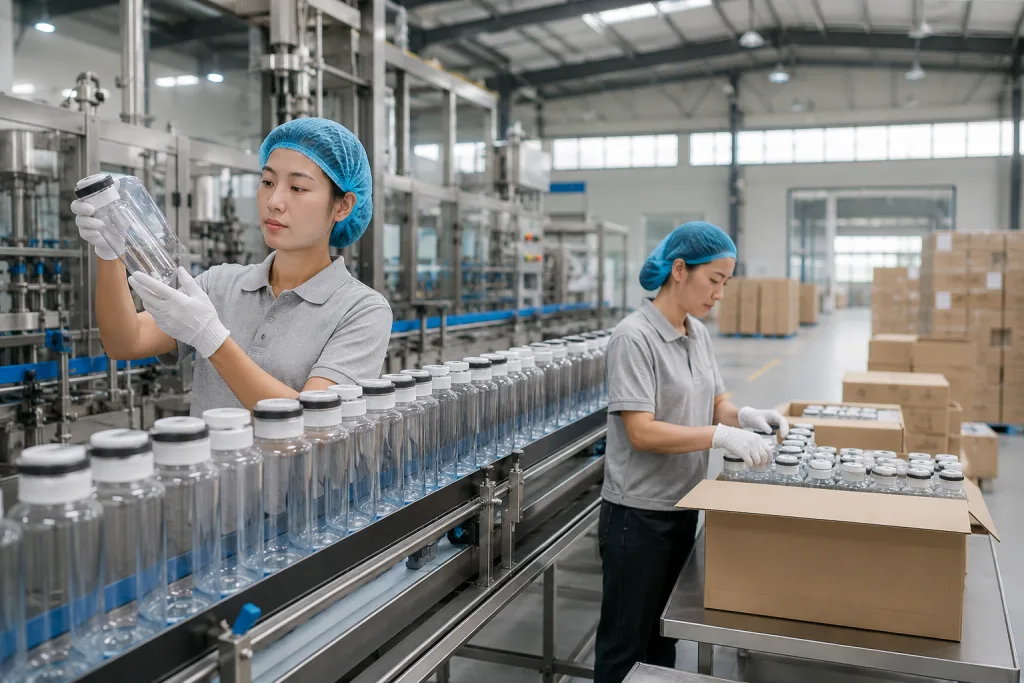
Key Takeaways
- A usable RFQ for petg tritan bottle wholesale should lock 12-18 specs before sampling, including capacity tolerance, resin, lid type, logo method, carton drop standard, and target FOB price
- Typical MOQ is 3,000 pcs per color for a custom Tritan bottle, while stock-color PETG programs can start around 1,000-2,000 pcs depending on lid tooling and print
- Pre-production samples usually take 7-12 days, and bulk lead time is commonly 25-35 days after deposit and artwork approval
- AQL 2.5 for major defects and 4.0 for minor defects is a practical inspection baseline for wholesale drinkware and canteen bulk orders
You can buy a bottle from almost any factory in China. Easy part. Getting the right bottle at the right compliance level, with decoration yield that holds on the line and a landed cost that still works after carton drop tests, is the harder part. We see this fast with petg tritan bottle wholesale for retail programs, gym chains, outdoor brands, and promo distribution, where a 0.3 mm wall change or a lid leak at 0.04 MPa turns into a claim after shipment.
Most sourcing problems start early. The RFQ is vague, the PO misses line items, or the sample gets signed off with no clear test standard. Then bulk drifts, and QC pulled the sample too late to fix the artwork position or thread fit without burning 7 days. At BottleForge Industrial in Hangzhou, Zhejiang, we see this pattern every month; one recent PO even had the straw lid code typed wrong, and the buyer flagged it only after carton print. A disciplined sourcing process saves more money than hard price bargaining in most cases. This is the wrong question to ask if you only compare unit price on wholesale drinkware, canteen wholesale programs, or a mixed drinkware bulk order from Zhejiang, China.
Start with a usable RFQ
If the first RFQ is loose, the whole project turns into repair work. We see this every week on the line. For petg tritan bottle wholesale, capacity and color are not enough to quote from. PETG and Tritan do different jobs in the market, and this is the wrong question to skip. PETG usually comes in lower on unit cost. Tritan usually sells better for premium programs, dishwasher use, and repeated drop testing where buyers expect fewer cracks. Ask 3 factories in China for "a 700ml clear sports bottle" and you can get 3 neck finishes, 2 wall thickness options, and 4 resin assumptions before anyone even talks about lid fit.
Your RFQ needs enough detail that we quote one bottle, not a broad category. That saves time. For procurement teams, the RFQ should read like the first controlled document in the PO process. We run sample checks with a digital caliper and bottle weight scale, so if the spec is vague, the quote will be vague too.
- Body material: PETG or Tritan, virgin resin only, food-contact grade
- Capacity: nominal and brimful, for example 750ml nominal, 790ml brimful
- Wall thickness: for example 0.8mm, 1.0mm, or 1.2mm
- Weight target: for example 138g plus or minus 5g
- Lid construction: PP screw lid, Tritan cap, silicone seal, carry loop, straw, or spout
- Color standard: Pantone reference or stock color acceptance
- Logo method: silkscreen, heat transfer, UV print, or wrap insert
- Packaging: bulk pack, egg-crate, white box, gift box, FNSKU label, master carton limit
- Compliance: REACH, LFGB, FDA, BPA-free declaration, California Prop 65 if needed
- Shipping term: EXW, FOB Ningbo, or DDP warehouse
Add the commercial items too: target MOQ, annual forecast, first order quantity, and launch date. Put numbers on it. "MOQ 3,000 pcs, first order 5,000 pcs, launch in September" gets a cleaner quote than "testing market." If the program may later extend into wholesale canteen, wholesale growler, beer tumbler wholesale bulk, or alcohol flask wholesale bulk categories, say that up front. We ship carton samples before mass production, and a factory that sees 12-month volume will quote tooling, color matching, and carton development with better logic. We have seen this go sideways after a buyer flagged a PO typo and the forecast doubled from 10,000 to 20,000 units mid-project.
You do not need a perfect RFQ. You need one detailed enough that QC can pull the sample and the supplier's quote can be audited line by line.
Compare material and construction choices
Once quotations come back, do not compare only unit price. We see this on the line every week. In Zhejiang and wider China, a 700ml Tritan bottle quoted at USD 1.62 FOB and a PETG bottle quoted at USD 1.28 FOB can look close on a spreadsheet, but the math does not work if you treat them as the same item. You are buying material, performance, and shelf position together. On one recent RFQ, the buyer flagged a 0.34 difference as small, then changed position after we put both bottles through 24-hour odor retention checks and 500 dishwasher-cycle data from the resin supplier.
PETG versus Tritan in real buying terms
- PETG: usually lower cost by about USD 0.12-0.35 per unit at 5,000 pcs, good clarity, decent toughness, suitable for promotional and mid-market drinkware wholesale; we run this often for MOQ 5,000 pcs where buyers need price room for color cartons or a second lid option
- Tritan: higher resin cost, stronger premium story, better resistance to odor retention and repeated dishwasher cycles, commonly preferred for the best wholesale drink bottle positioning; on premium programs, QC pulled the sample after heat-aging and the Tritan body held gloss better than PETG
Next, check the construction details that create hidden cost or failure risk. This part is where projects go sideways. A bottle body with 0.7mm wall may quote well, but if the shape has sharp shoulder transitions, we have seen sidewall deformation show up after drop tests from 1.2m. A soft TPE carry strap looks good on shelf, yet it adds assembly time and color migration checks with the spectrophotometer. A silicone seal that is too soft can lose leak performance after hot warehouse storage at 45C, and QC usually finds it first in the inverted soak test.
Ask the supplier for a cost split with at least these line items: bottle body, lid set, seal, decoration, unit pack, export carton, and tooling if any. This is the right question. It matters later when you need variants, a lid change, or a cheaper gift box for one market. We ship buyers who start with petg tritan bottle wholesale and then add bulk canteen, bulk drinkware, bulk growler, or growler wholesale SKUs in the same season. If a supplier cannot break cost by component, they usually struggle with engineering change control too. We have even seen a PO typo swap a matte lid for a glossy lid, and without a clear component cost sheet, the correction took 12 days vs 18 days.
At factory level, we usually tell buyers to settle three points before sampling, though this is the wrong question to ask if you start from bottle shape alone. First, define the target retail tier with an actual shelf price, such as USD 9.99 or USD 19.99. Second, define the abuse level of the end user, like school bags, gym drops, or office desk use. Third, confirm whether the bottle must survive dishwasher cycles. Once those are clear, about 80 percent of the PETG versus Tritan debate is already settled. For sampling, we normally run 2-3 prototypes per color, and the lid torque check is set on a digital torque meter before samples ship.
Put sample approval under control
The sample stage is where 6 out of 10 new buyers get misled by a clean prototype. A hand-made sample, or even a CNC appearance sample, shows the shape direction. That is all. It does not prove the line can run it at 3,000 pcs without cap fit drift or logo shift. For petg tritan bottle wholesale, separate each sample type in the PO and approval flow. This is the wrong question to ask: "Does the bottle look good?" Ask whether the 0.3 mm fit, print position, and leak result will hold in bulk.
- Visual mockup: checks silhouette, color direction, logo placement
- Pre-production sample: checks tooling output, fit, assembly, leak test, print adhesion
- Golden sample: signed approval standard kept by both buyer and factory
A workable sample PO needs clear line items: mold charge, sample making charge, courier cost, logo setup charge, and approval deadline. Put dates on it. We have seen a buyer send a PO with "Triton" typed instead of "Tritan," then flag the sample later because the paperwork was loose from day one. In our Hangzhou, Zhejiang operation, pre-production samples for standard bottles usually take 7-12 days; new molds take 18-28 days before first sample output. Bulk lead time then runs 25-35 days after deposit and final approval, depending on decoration complexity.
What should you actually test? At minimum, run the basics and record the result on one sheet. QC pulled the sample last month and found a cap torque spread from 11 kgf.cm to 16 kgf.cm, which is exactly how retail returns start.
- 24-hour upside-down leak test
- Dishwasher check if Tritan is marketed that way
- Drop test in packed carton, commonly 76cm to 100cm depending on carton design
- Print adhesion with cross-hatch and tape pull
- Odor check after 48 hours closed storage
- Assembly torque consistency on caps and spouts
If you are buying drinkware bulk for retail shelves, insist that the sample carton dimensions and net/gross weights are recorded early. We ship enough cartons to know the math does not work if you save $0.08 on unit price and lose $0.22 on freight because the carton grew by 18 mm. The same discipline applies when the project later expands into canteen bulk, growler bulk, beer growler in bulk, or alcohol flask in bulk assortments. Sample approval is not about liking the bottle. It is about locking the production reference before money multiplies the mistake.
Write the bulk PO properly
Once the sample is approved, the next risk is a weak PO. For petg tritan bottle wholesale, the bulk PO should read like a shop-floor instruction sheet, not a two-line commercial note. We run orders faster when the document is clear. On one 5,000 pcs bottle order, the buyer wrote "smoke gray lid" with no Pantone, and the line stopped at first article because sales and QC were looking at two different samples.
At minimum, include these PO fields:
- SKU code and revision number
- Material callout: PETG or Tritan, virgin food-grade resin
- Capacity, color, finish, and lid color combination
- Approved logo artwork file reference and print size
- Unit price by SKU and tooling charges if any
- Quantity by color, not just total quantity
- Packaging spec, insert, barcode, FNSKU, carton marks
- AQL standard, for example Major 2.5 / Minor 4.0
- Test requirements: leak test, drop test, migration declaration, carton test
- Trade term: FOB Ningbo or Shanghai, payment term, shipment window
Do not bury this in email text. Put it on the PO or on a spec sheet tied to a revision date, like Rev.B 2024-09-18. If you are buying a wider drinkware range, maybe with wholesale growler, beer tumbler in bulk, wholesale canteen, and alcohol flask wholesale items, use one master format across all categories. This is not admin trivia. We've seen this go sideways when one PO shows print size in mm and another only says "same as sample," then QC pulled the sample and found the logo was 18 mm shorter than the signed artwork.
Commercially, MOQs in China are usually straightforward. A custom Tritan bottle is often 3,000 pcs per color. PETG can sometimes start at 1,000-2,000 pcs on existing molds. Custom color seals, straws, or gift boxes can push the effective MOQ above the bottle itself. Ask which component sets the MOQ. This is the right question. The buyer flagged bottle MOQ on one project, but the real limit was a 10,000 pcs custom straw packed 1 pc per cup, so the math did not work.
Define overrun and underrun tolerance on the PO. Plus or minus 5 percent is common for custom decorated drinkware wholesale. If your launch quantity is fixed, say 10,000 pcs exact shipment only. If you do not write it, the factory will usually book tolerance as acceptable. We ship by carton count, not by hope, and one missing line on the PO can turn into 24 cartons extra or short at loading.
Check compliance before production moves
Do not treat compliance as a packing-day job. For Europe and North America, the document set changes by market, sales channel, and SKU setup. A PETG or Tritan bottle going to Germany does not use the same file stack as a promotional bottle for the US, even if both run on the same line with a 0.4 mm logo print. We still see buyers place 20,000 pcs before checking what the importer or retailer will ask for, and this is the wrong question to ask after deposit.
For petg tritan bottle wholesale, ask for the compliance matrix at quotation stage or before deposit at the latest. That sheet should mark what the factory already covers with valid reports and what needs fresh testing on the final decorated item, like a silk-screen print or a color-matched lid from a 3 kg sample batch. We ship faster when this is clear.
- EU: REACH, LFGB where requested, overall migration or relevant food-contact declarations
- US: FDA food-contact declarations, BPA-free claim support, Prop 65 review if applicable
- Children's channels: ASTM or CPSIA-linked checks if the product is positioned for children
- Factory system: ISO 9001 is common; BSCI or Sedex may matter for retailer approval
Be careful with stock reports. A resin report on natural material does not automatically cover your final printed bottle. Decoration inks, color masterbatch, silicone parts, and adhesive labels can all change compliance exposure; QC pulled the sample once on a 750 ml bottle because the buyer flagged a soft-touch label adhesive that was never in the original report set. If you need final product testing, state whether samples must come from pilot run or mass production. That point decides timing.
At BottleForge Industrial, we usually tell buyers in Zhejiang supply chains to split approval into three gates: factory documents, material approval, and final product testing. It sounds strict. Still, we have seen this go sideways when bulk finished on time and sat 12 days waiting for a missing report, versus 18 days if the issue shows up after booking space. One PO even had "Trtia n" typed on the item line, and the lab held the file until it matched the carton spec. Whether you are sourcing drinkware wholesale, beer growler wholesale bulk, or canteen wholesale packs, document timing sits inside lead time.
Manage production and inspection points
After deposit, your job is not finished. It shifts from sourcing to production control. A solid China supplier should give you a live schedule with milestone dates: raw material booking, color confirmation, injection or blow molding start, decoration start, packing, and inspection. We usually show this in 6 checkpoints with target dates on the PO. If a factory cannot show that, you are chasing updates after the line already moved, and we’ve seen this go sideways.
Use at least three control points on a bulk order:
- Pre-production meeting: review golden sample, artwork, carton marks, and QC points
- During production check: confirm color consistency, leak rate, print registration, and pack-out
- Final random inspection: AQL by third party or your own QC team before balance payment
For clear bottles, watch scratches, gate marks, black specks, and haze. On our floor, QC pulled the sample under a 6000K light box because tiny black specks get missed on a quick bench check. For lids, check torque consistency and flash; we normally record torque in kgf.cm and compare against the sealed sample. For printed bottles, check registration drift and adhesion after cure. This is where the math changes fast. A one-color silkscreen with a 98 percent pass rate runs one way, while a wrap print at 92 percent starts eating time, labor, and remake cost. Buyers often focus on resin price first. This is the wrong question to ask.
We recommend Major 2.5 / Minor 4.0 as a practical baseline, then tighten special defects separately: zero tolerance for leakage, wrong barcode, wrong colorway, or cracked body. If your order combines petg tritan bottle wholesale with wholesale growler, beer tumbler wholesale, or alcohol flask bulk items, inspect by SKU family and defect profile. We ship mixed programs like this every month, and the check points are not the same. A bottle leak issue is not judged the same way as coating rub on a metal tumbler. Last month a buyer flagged a barcode digit swap on outer cartons, while the product itself was fine; that still stops warehouse intake.
Our Zhejiang factory capacity is up to 1.2 million units per month across mixed drinkware programs, but capacity only helps if approvals are frozen on time. We run the line to plan, yet a 1 mm logo shift, a late carton revision, or missing compliance sign-off can push shipment to 18 days instead of 12 days. Most delayed shipments come from artwork changes, packaging edits, or late approvals, not from actual molding speed.
Think beyond the first container
The first order eats attention and time. That part is normal. The real test is what happens on the second and third runs: does the setup get cleaner, and do reorders drop from 18 days of back-and-forth to 12? Buyers who treat petg tritan bottle wholesale as a one-shot buy usually pay tuition twice. We have seen this go sideways when a PO says "smoke grey" on line 3 and the approved chip was "clear grey" at 0.8 mm wall.
After shipment, run a short supplier review with numbers, not gut feel. QC pulled the sample, then match the file against these points:
- Quoted lead time versus actual lead time
- Final defect rate found in inspection and after arrival
- Decoration pass rate
- Carton damage percentage
- Claim response time in days
- Unit cost changes caused by packaging or spec drift
If the supplier did the job well, standardize the next RFQ and PO package. Lock resin grade, wall thickness, cap torque range, print method, carton spec, barcode position, and inspection rule into a controlled spec sheet. We run this as one master file with revision dates, cap torque at 12-15 lbf.in, and a signed golden sample in the sample room. Future programs move faster, whether you are adding wholesale drinkware assortments, canteen wholesale projects, bulk growler programs, beer growler bulk, beer tumbler bulk, or an alcohol flask wholesale extension for the same customer base.
In practical terms, the best wholesale drink bottle program is rarely the cheapest first quote. This is the wrong question to ask. The better test is whether it reorders cleanly at 5,000, 20,000, and 50,000 pcs without an argument about approved color, logo position, or carton drop performance after the buyer flagged a split corner on 7-layer export cartons. Price still matters. Repeatability protects your margin once the product starts to move.
Send your bottle RFQ with real specs
Share capacity, material, lid type, logo method, target MOQ, and market. We will quote workable options, sample timing, and bulk lead time from Zhejiang, China.
Frequently asked questions
What MOQ should I expect for petg tritan bottle wholesale?
For standard existing molds, PETG bottles can sometimes start at 1,000 to 2,000 pcs per color, especially with simple bulk packing and one-color print. Tritan usually starts higher, commonly 3,000 pcs per color for custom production, because resin cost is higher and factories want cleaner planning on color and lid assembly. If you add a custom mold, special strap color, gift box, or multi-color decoration, the effective MOQ can move to 5,000 pcs or more. Ask the supplier which component drives MOQ. In many cases it is not the bottle body. It may be the custom cap, printed box, or low-yield decoration step. Put MOQ by component on the quotation sheet so you can negotiate intelligently.
How do I decide between PETG and Tritan for a retail bottle program?
Start with end use, not marketing language. If your bottle is for promotional distribution, event merch, or value retail, PETG often gives you acceptable clarity and impact resistance at a lower cost, usually saving USD 0.12 to 0.35 per unit at 5,000 pcs. If your product needs a more premium story, repeated dishwasher use, and stronger long-term durability, Tritan is usually the better fit. Then check the actual construction. A well-designed PETG bottle with 1.0mm wall can outperform a badly designed Tritan bottle with weak geometry. Also review compliance, decoration, and freight. For many buyers in Europe and North America, the right answer is a two-tier range: PETG for volume, Tritan for premium channels.
What should be written on the purchase order besides quantity and price?
A good PO for wholesale drinkware should include SKU code, revision number, material callout, nominal and brimful capacity, wall thickness target, bottle and lid colors, approved artwork file name, print size, packaging method, barcode placement, carton dimensions, AQL level, and shipment term such as FOB Ningbo. Add exact test requirements too: 24-hour leak test, drop test height, print adhesion standard, and any required compliance reports. Also define overrun or underrun tolerance, usually plus or minus 5 percent unless you need exact quantity. If your order includes mixed categories such as canteen wholesale, beer growler wholesale, or alcohol flask bulk, keep the same PO format across all SKUs. That reduces mistakes between purchasing, QC, and logistics teams.
How long does sampling and mass production usually take?
For an existing mold with standard components, a visual or pre-production sample typically takes 7 to 12 days after artwork and color confirmation. If there is new tooling, first sample timing is more commonly 18 to 28 days. Bulk production usually needs 25 to 35 days after deposit, sample approval, and final packaging confirmation. Add extra time for third-party testing, retailer packaging approval, or complicated decoration. Around Chinese New Year or peak summer export periods, you should build in another 7 to 15 days. Ask for a milestone schedule, not just one shipment date. You want to see raw material booking, molding, decoration, packing, inspection, and booking cut-off. That is far more useful for planning than a single promised ETD.
Do I need third-party inspection for a bottle order from China?
For small repeat orders with a stable supplier, maybe not every time. For first orders, new artwork, or any shipment above roughly USD 8,000 to 10,000, third-party inspection is cheap insurance. Use a final random inspection with AQL 2.5 for major defects and 4.0 for minor defects as a starting point. Also define critical defects separately: leakage, cracked body, wrong barcode, wrong carton mark, or wrong logo color should be zero tolerance. If your order includes multiple categories like petg tritan bottle wholesale plus beer tumbler wholesale bulk or growler bulk items, inspect by SKU family because defect profiles differ. A USD 250 to 400 inspection fee is usually much cheaper than a rejected import lot or retailer chargeback.