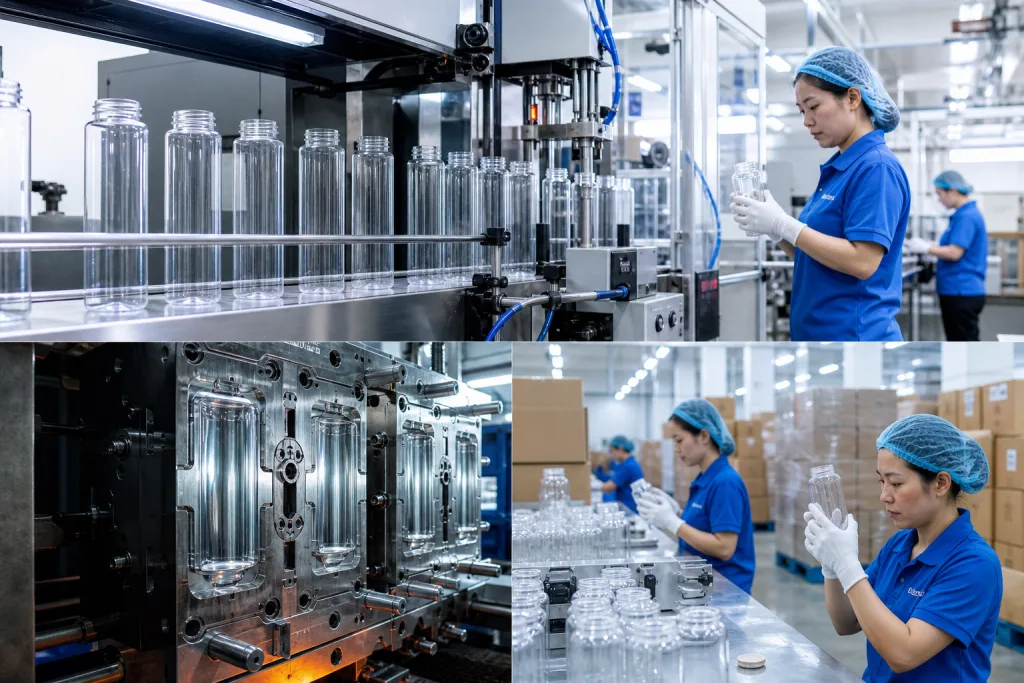
Key Takeaways
- PETG usually lands 8% to 18% cheaper than Tritan on comparable 700ml bottle bodies
- Typical MOQ is 3,000 pcs per color for stock molds and 10,000 pcs+ for new tooling
- Normal lead time is 7 to 12 days for samples and 25 to 40 days for mass production
- AQL 2.5/4.0 plus 24-hour leak testing catches most bottle defects before FOB shipment
You can buy a clear plastic bottle from almost any canteen supplier in China. The hard part is buying the right one: the right resin, the right print method, the right compliance file, and the right packing spec before the line starts. Miss one detail and you find out late that the lid leaks at 0.03 MPa, the logo scratches after 50 rubs, or the master carton fails the drop test. We’ve seen this go sideways. That is where custom drinkware projects lose time and margin.
If you are sourcing a petg tritan bottle custom program for Europe or North America, ask the hard questions early. Material first. MOQ next. Then real tooling lead time—12 days vs 18 days matters when the PO typo already cost 2 days—and the QC points that count before shipment. At our Zhejiang, China factory, we build around 600,000 units per month, and the buying pattern is predictable once you know what to ask. A buyer flagged this last month: “same clear bottle, why is Tritan higher?” This is the right question. The wrong question is asking only for the lowest unit price.
Start with the resin question
Buyers ask for a petg tritan bottle custom quote like PETG and Tritan are the same resin. They are not. Both are clear copolyesters for reusable bottles, but the line treats them differently on price, drop performance, dishwasher cycles, and where the product sits in your range. We see this confusion on RFQs every month, sometimes with the resin box on the PO left blank.
PETG is the practical pick if your target is a sharp landed cost on a custom canteen, event bottle, school program, or entry-level retail line. For a 700ml stock-shape bottle with PP lid and one-color silkscreen, FOB China pricing can be around USD 1.10 to 1.65 at 5,000 pcs, depending on wall thickness and packing. Tritan for the same structure is often USD 1.28 to 1.95. That 8% to 18% difference matters if you are a canteen distributor or distributor drinkware business living on narrow channel margins. On our side, a 0.8mm wall usually runs cleaner than 0.6mm on tall bottle bodies, and that affects scrap and final cost.
Tritan usually gives you stronger perceived quality and better stress-crack resistance over long use. If your customer wants a customizable canteen for gym, outdoors, or premium corporate gifting, Tritan is the safer call. PETG works for a lot of promotional programs. If the bottle will go through frequent dishwasher cycles or get knocked around in a backpack, Tritan cuts claim risk. This is the wrong question to ask: “Which resin is best?” Ask where the bottle will be used, how often, and what return rate your channel can tolerate. Last season, QC pulled the sample after haze showed up on a PETG bottle after repeated hot-wash testing.
- PETG: lower cost, good clarity, fits canteen promotional volume programs
- Tritan: better durability, more premium shelf position, stronger choice for long-term reusable programs
- Typical wall thickness: 0.6mm to 0.8mm for light single-wall bottles; 0.8mm to 1.0mm for more rigid feel
You are not just buying material. You are buying claim rate, user experience, and how much price pressure your sales team can absorb.
If you are speaking with several canteen manufacturers in Zhejiang or other parts of China, ask them to quote both resins on the same mold and same decoration. That gives you a clean comparison instead of three different bottles built on three different assumptions. We ship these side-by-side quotes all the time, and the buyer usually flags the same point first: same shape, same print, why is one bottle 12% higher? Then the decision gets easier.
What MOQ and pricing are realistic
Buyers lose 7 days asking every canteen vendor for MOQs that will never run on the line. For stock molds, a workable start is 3,000 pcs per color per capacity. Some canteen suppliers quote 1,000 pcs on existing models, but they make it back in unit price, limited decoration, or mixed-carton packing that your warehouse team will hate later. We’ve seen this go sideways. Last month a buyer flagged a mixed 24/36-pack carton after the PO typo changed the inner pack count.
For a new mold, the quote changes fast. If you want a canteen customized body shape, exclusive lid geometry, or an integrated carry handle, expect MOQ around 10,000 to 20,000 pcs and tooling charges from USD 2,500 to 8,000 depending on cavity count and complexity. A straight bottle body mold is one job. A lid with moving sliders, overmolded TPE, or a flip straw pushes cost up fast because the mold base gets bigger and trial shots take longer. On our side, the tool shop usually checks parting lines and hinge thickness down to 0.2 mm before steel cutting.
Useful budget ranges for stock programs
- 500-750ml PETG bottle, PP lid, one-color print: USD 1.10-1.65 FOB Ningbo
- 500-750ml Tritan bottle, PP lid, one-color print: USD 1.28-1.95 FOB Ningbo
- Laser mark on cap insert or metal badge: add USD 0.05-0.18
- Individual polybag + egg-crate carton: add USD 0.04-0.09
- Color box: add USD 0.18-0.45 depending on board grade and finish
If you are a canteen distributor, distributor canteen, or private-label importer, ask for price breaks at 3,000 / 5,000 / 10,000 / 20,000 pcs. That is the right way to read the quote. You will see where resin cost flattens and where labor starts to absorb better. In Zhejiang, we run planning a lot cleaner above 5,000 pcs because color batching, screen print setup, and carton consolidation stop fighting each other. QC pulled the sample on one 3,000-pc order last quarter and found 2 lid shades from split resin lots. At 8,000 pcs, that issue usually disappears.
The checklist is simple. Lock capacity. Lock resin. Lock lid style. Then ask for MOQ. This is the wrong question to ask at the start if the customized drinkware brief is still loose. Ask ten canteen vendors to quote an undefined project, and the numbers mean nothing.
Which bottle details actually change outcomes
New buyers stare at logo position. Experienced buyers ask about structure first. Two bottles can look the same in a render and run differently on the line once you lock neck finish, thread depth, gasket hardness, and base thickness. We’ve seen a 0.3mm thread change fix leak complaints. This is where a good canteen factory proves its value.
For a customizable drinkware project, ask these practical questions before sample approval. Skip the mood-board talk. This is the wrong question to ask if the sample still has basic function risk:
- Neck size: Is it wide-mouth, typically 55mm to 63mm, or narrow-mouth around 38mm to 45mm? A 63mm mouth is easier to fill with ice, but we ship fewer units per carton if the body has to grow with it.
- Lid system: Screw lid, flip lid, straw lid, chug cap, or tethered cap? The buyer flagged one flip lid last season because the spring pin backed out after 500 open-close cycles.
- Seal material: Food-grade silicone, Shore A 50 to 70, removable for cleaning? QC pulled the sample and found the ring twisted during assembly because the groove width was off by 0.2mm.
- Carry feature: Webbing loop, integrated handle, finger hook, or no handle? A sewn webbing loop adds labor, and the math doesn't work on a low-MOQ promo order.
- Base design: Flat base or push-up base, and is the bottle stable when filled? We run a flat-table wobble check, and unstable bases get rejected fast.
For example, a canteen custom bottle for school or daily office use usually works with a simple screw lid and 1-piece silicone ring. Fewer parts. Fewer returns. A sport-oriented customized canteen often needs a faster one-hand opening lid, yet every hinge and spring adds defect risk and assembly time. We’ve seen this go sideways on budget programs where the target price left no room for hinge tuning.
If your line extension includes a custom growler or customizable growler, the spec changes. Growler-style containers need stronger threads, tighter seal integrity, and thicker walls in most cases. Do not assume your regular bottle supplier gets this right. One buyer sent us a PO with the thread callout typoed, and the first sample failed the torque check at 14 lbf·in. A true canteen manufacturer should explain torque specs, leak-test method, and material behavior in plain terms, not hand-waving.
One more practical point: if the bottle is intended for Amazon FBA or club retail, packed dimensions matter almost as much as the bottle itself. An extra 8mm on lid height can reduce carton efficiency by 5% to 8%. We ship by carton math, not by nice renderings.
How decoration holds up in market
A bottle can pass appearance inspection at the factory and still come back with a complaint 14 days later. We’ve seen that happen. The bottle body was fine; the decoration failed in the customer’s hand. On clear PETG and Tritan, the usual options are silkscreen, heat transfer, digital printing, sleeve, pad print for small areas, and limited laser work on accessory parts. On our line, QC pulled samples after a 50-cycle rub test, and the weak point was almost always the ink, not the bottle.
For mainstream custom drinkware and customized drinkware projects, silkscreen is still the low-cost option that ships in volume. It prints clean lines and sharp logos, usually adding USD 0.03 to 0.10 per color depending on print area and order size. The tradeoff is abrasion resistance. If the bottle goes into a backpack with keys or coins, the print can scuff fast. We’ve had buyers flag this after a 1,000 pc promo run because the logo looked fine at packing and scratched after daily use. If that use case is obvious, silkscreen is the wrong question to ask.
Heat transfer handles gradients and wraparound artwork better on a customizable canteen. Typical add-on cost is USD 0.08 to 0.20. Full-body sleeve also covers resin clarity and the mold seam, which some retail buyers want because the graphics sell harder on shelf. Others reject it for the same reason: the bottle stops looking like premium clear Tritan. We’ve seen this go sideways when the PO said “clear body focus” and the artwork team still approved a 360° sleeve.
Quick decoration checklist
- Corporate gift, moderate use: silkscreen is usually enough
- Retail program with color-heavy art: heat transfer or sleeve makes more sense
- Dishwasher expectation: test decoration, do not trust verbal claims
- Premium line: consider matching cap color, molded logo, or metal badge instead of only surface print
If you are working with multiple canteen suppliers or canteen manufacturers in China, ask for cross-hatch adhesion testing and rub testing results on your exact logo colors. Ask for the real sample. Not a catalog photo. A serious canteen vendor will send a pre-production sample with your artwork, your Pantone callout, and the actual print area, even if the MOQ is only 3,000 pcs. We once caught a typo on a PO where matte white ink was approved instead of glossy white, and the logo looked dusty on clear stock. This matters for both customized growler and standard bottle programs, because decoration failure drives returns faster than a small cosmetic issue at the parting line.
Compliance files you should request
If your customer sells in the EU, UK, US, or Canada, do not treat compliance like paperwork to chase after the deposit. Screen it up front. A capable canteen supplier in Zhejiang should know the test path for food-contact plastic, and should tell you when raw material papers are not enough and the finished bottle needs third-party lab work. We see this on the line all the time: a 750ml PETG body passes on resin documents, then the printed logo ink still needs review.
For Europe, buyers usually ask for REACH SVHC screening and food-contact testing aligned with the applicable framework for plastic materials. For the US market, requests usually cover California Proposition 65 awareness and FDA-related declarations for food-contact suitability. If the item is for children, ASTM or CPSIA controls depend on product use and age grading. Ask that question early. If you source a customized canteen for kids, push on small parts, sharp edges, and drop safety. QC pulled the sample on one kids lid last season because the straw bite valve measured 31mm and the buyer flagged the pull-force result.
Operationally, also ask about factory systems:
- AQL standard: 2.5 for major defects and 4.0 for minor defects is common
- Audit status: BSCI or equivalent social compliance if your retail customer requires it
- Quality system: ISO-aligned procedures help, but ask how they inspect, not only what certificate is on the wall
- Material traceability: resin batch records, color masterbatch lot, and gasket material records
For any canteen customizable program, ask to see the actual test report format with product photos, not only a one-line statement saying “can pass.” This is the wrong question to ask: “Do you have a certificate?” Ask which SKU was tested, which lab ran it, and whether the report photo matches your lid, straw, and gasket set. We ship against that file set. Good canteen distributors and distributor growler importers already know one failed customs or retail compliance check can cost more than a $300 to $800 pre-shipment test package.
If a factory answers compliance questions in 3 minutes with all yeses, check whether they understood your market or just kept the quote moving. We’ve seen this go sideways over a PO typo and a mismatched report photo.
Lead time, QC, and shipping checklist
Lead time is where orders slip. For a stock-shape petg tritan bottle custom order with straight silk print, plan 7 to 12 days for pre-production sample approval and 25 to 40 days for mass production after deposit and artwork sign-off. If new tooling is involved, mold development usually adds 20 to 35 days, then another 5 to 10 days for first-shot correction. On our floor, the first sample usually gets checked with a digital caliper at the neck finish before QC pulled the sample for print position review.
A reliable canteen factory should give you a day-by-day time map, not one ship date on a WhatsApp message. This is the checklist we see serious procurement teams use, and frankly this is the right question to ask:
- Day 1-3: confirm drawing, Pantone, print position, packaging spec; we also check the PO for simple errors, and yes, we have seen "5000 pc" typed as "50000 pc"
- Day 4-10: make pre-production sample with actual resin and artwork; the line should run the real PETG or Tritan, not substitute material
- Day 11-25: material procurement, injection/blow molding, lid assembly; for a 10,000-piece run, this is usually where the schedule gets tight
- Day 26-35: decoration, leak test, aging check, final packing; QC pulled the sample here if the buyer flagged logo rub-off on a previous order
- Day 36-40: final inspection, booking, FOB handover; carton size and loading count need to match the booking sheet
Quality control should be just as concrete. We usually run 100% leak testing for 24 hours on filled bottles, standing and inverted by batch sampling protocol, then torque checks on lids, print adhesion checks, and drop tests on packed cartons from 76 cm. If you ship to Amazon or a 3PL, confirm carton marks, FNSKU labeling, and pallet height before production starts. We have seen this go sideways. One buyer approved the bottle and then flagged a 1.8 m pallet limit after packing, so the whole lot had to be restacked.
Most exports from Zhejiang, China move through Ningbo or Shanghai on FOB terms. If you are comparing several canteen suppliers or canteen vendors, do not look only at the ex-works bottle price. Compare defect allowance, repacking support, carton spec, and lead-time reliability, such as 12 days vs 18 days on sample approval. The math does not work if the bottle is $0.03 cheaper and you lose a week at port because the master carton burst test was wrong.
Get a practical quote for your next bottle program
Send your capacity, target price, market, and artwork needs. We will quote PETG and Tritan options with MOQ, lead time, and decoration advice.
Frequently asked questions
Should you choose PETG or Tritan for a promotional bottle program?
If your target is price-sensitive canteen promotional business, PETG is usually the first option to check. On a 600-750ml stock bottle, PETG can be 8% to 18% cheaper than Tritan at 5,000 pcs. For event giveaways, school programs, and short-cycle campaigns, that saving is often worth it. Choose Tritan when the bottle is positioned as a long-use retail item, premium corporate gift, or sport bottle expected to take repeated drops and dishwasher use. Ask your canteen manufacturer to quote both resins on the same mold, same lid, and same print so the comparison is clean. Also request a filled drop test and decoration rub test, because those two results usually tell you more than marketing language.
What MOQ is normal for a petg tritan bottle custom order?
For stock molds, 3,000 pcs per color per capacity is a realistic MOQ with most canteen manufacturers in China. Some factories will accept 1,000 pcs, but the unit price often jumps by USD 0.12 to 0.30 and decoration options may be limited. If you want a fully customized canteen shape or new lid tooling, MOQ usually moves to 10,000 to 20,000 pcs, with tooling from about USD 2,500 to 8,000. If your project needs multiple SKUs, ask whether the factory allows color mixing within one body mold. That can help a distributor canteen program hit MOQ without overbuying slow colors. Always confirm whether MOQ is per color, per lid, per print design, or total order.
How long does production really take from sample to shipment?
For a stock bottle, plan 7 to 12 days for a proper pre-production sample and 25 to 40 days for bulk production after approval. New molds usually add 20 to 35 days, plus time for corrections if the first sample needs thread or seal adjustment. If the order includes custom packaging, add 5 to 7 days for printed box production unless the canteen supplier already has the artwork approved. During peak season, especially from August to November, book at least 45 days for safety. Buyers in Europe and North America should also leave time for third-party inspection. AQL 2.5/4.0 final inspection and one leak-test report can save weeks of dispute after the goods leave Zhejiang or other China ports.
What tests matter most before you approve mass production?
Start with the basics: 24-hour leak test, lid torque test, visual inspection standard, and print adhesion check using cross-hatch or rub testing. Then match the tests to the sales channel. For retail and e-commerce, add packed carton drop test and barcode scannability. For kids or school bottles, review small parts, impact, and age-related safety concerns. For the EU market, ask for REACH-related declarations and food-contact documentation for the finished bottle, not just raw material sheets. For the US, ask your canteen vendor what support they provide for food-contact declarations and any retailer-specific compliance. Good canteen distributors ask for photos in the report, batch numbers, and date stamps so the documents can be tied back to the exact production lot.
How do you compare quotes from different canteen suppliers fairly?
Put every supplier on the same specification sheet. Fix the capacity, bottle weight, wall thickness, resin type, lid structure, seal material, decoration method, packaging, and inspection level. If one canteen manufacturer quotes a 62g bottle and another quotes 74g, the lower price is not a real saving. Ask for FOB port, lead time, MOQ per color, carton size, and defect policy. Also compare whether the quote includes sample charge refund, spare parts, and support for custom logo approvals. A quote from China that is USD 0.08 cheaper can become more expensive if the carton count is inefficient or the print scratch rate is high. Buyers who standardize their RFQ sheet get much cleaner pricing and better supplier behavior.