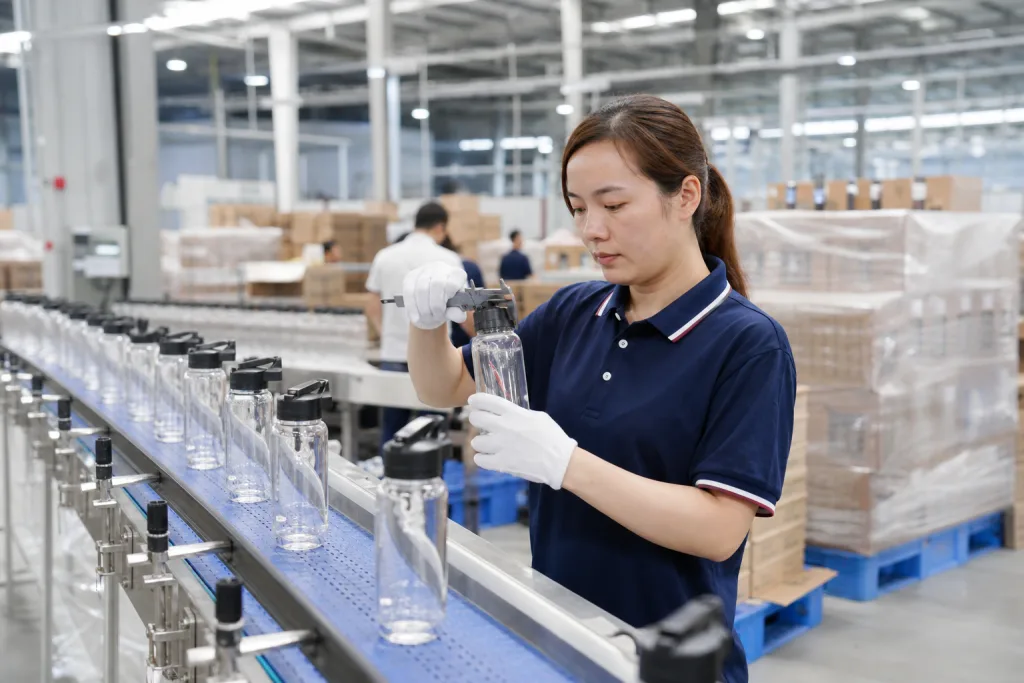
Key Takeaways
- For most private-label programs, MOQ starts around 3,000 pcs per color for a custom petg tritan bottle bulk order, with 25-35 days lead time after sample approval
- Tritan usually costs USD 0.18-0.45 more per bottle than PETG at 600-750ml, but reduces odor, haze, and drop-claim risk in repeated-use retail programs
- Leak complaints often come from cap and thread tolerance, not the bottle body; ask for 100% vacuum or upside-down leak testing plus AQL 2.5 final inspection
- Silkscreen is lower cost for wholesale drinkware, while wrap printing and laser-marked molds suit higher-volume brand programs above 10,000 pcs
You can buy a bottle from a photo, or you can buy it by failure mode. On our line, most mistakes in petg tritan bottle bulk start with a loose brief: “BPA-free, 700ml, sports lid, good price.” That is not a production spec. It usually ends with neck stress cracking after a 1.2m drop test, lid leaks at the silicone seat, cloudy walls after decoration, or a freight bill that kills your margin.
If you are buying for retail, promotions, gyms, outdoor brands, or private label, PETG versus Tritan is only part of the job. The real call is material risk, cap system sealing, decoration process, and landed cost by pack-out. We see this every week in Zhejiang: a buyer saves 8% on unit price, then loses 20% on claims after QC pulled the sample and found thread mismatch at 0.3 mm. A practical spec beats a cheap quote every time. Frankly, price-first is the wrong question to ask.
Start with the four buying decisions
If you are evaluating petg tritan bottle bulk, keep the decision tree simple. Four decisions drive most of the result: material, form factor, branding method, and supply model. Buyers who ask 10 suppliers for pricing before fixing these four usually end up with neat quote sheets and no fair way to compare them. We see this on the line all the time—one RFQ says 63mm neck, another says “standard mouth,” and the prices look close until tooling, cap weight, and packing break them apart.
First, choose the material by use case, not brochure language. PETG works for value-line drinkware where clarity sells and the bottle is not meant for 3 years of rough handling. Tritan is the safer call if you need better drop performance, less odor hold, and a more premium shelf story. Second, decide how the end user will actually use the bottle. A gym bottle, a school canteen bulk order, and a wide-mouth bulk canteen for outdoor use should not share the same spec sheet. Neck diameter, carry loop pull strength, wall thickness in mm, and cap style all shift fast once the buyer confirms who is drinking from it.
Third, lock the branding method early. This is the wrong question to ask late. A bottle built for one-color silkscreen is not the same item as one made for full-wrap graphics or in-mold effects. Decoration changes reject rate, setup cost, and carton protection. QC pulled the sample on one 8,000-piece run because the wrap print scuffed in transit, and the fix was not “print better”—it was divider change plus tighter pack-out. Fourth, choose your supply model: stock mold with custom logo, semi-custom body color, or full OEM tooling. In Zhejiang, China, buyers often over-customize too early. If you are below 5,000 units per SKU, standard molds usually make more sense. The math doesn’t work on fresh tooling if reorder volume is still guesswork.
- Entry private label: stock mold, custom Pantone body, one-color logo
- Mid-tier retail: custom lid colorway, wrap print, hangtag, retail box
- Brand-led OEM: new mold, exclusive cap, validated test plan, 10,000+ pcs
A factory with 400,000 units/month capacity can still be the wrong partner if your brief does not force apples-to-apples quoting. We ship plenty of volume, but if one supplier priced 0.6mm wall and another priced 0.8mm, the comparison is already broken.
PETG or Tritan: decide by risk
Buyers ask this every week: which material is better for wholesale drink bottles? The better answer is not “best.” It is risk, claim exposure, and where you need the FOB to land. PETG stays clear, looks clean on shelf, and usually costs less. Tritan resin costs more, but for branded repeat-use programs in Europe and North America, we ship Tritan far more often because the return math is cleaner. On the line, even a 0.3 mm wall variation can change how a bottle feels in hand. This is the wrong question to ask if price is the only filter.
For a 700ml single-wall bottle, a PETG body may land around USD 1.10-1.55 FOB China on a standard mold order of 3,000-5,000 pcs, depending on cap complexity and print. A similar Tritan version may be USD 1.30-2.00 FOB. That spread matters. After-sales cost matters more. If your channel includes e-commerce or sporting goods, the extra USD 0.20-0.35 often means fewer returns, fewer lid-fit complaints, and less argument after QC pulled the sample and drop-tested it at 1.2 meters. We have seen buyers push back on 15 cents, then lose the margin on replacements.
Where PETG makes sense
- Promotion programs with tight target pricing and a clear MOQ target, usually 3,000-5,000 pcs
- Short campaign cycles under 12 months, where the bottle is more giveaway than daily-use item
- Lower abuse environments such as office, event, or hospitality, where the buyer flagged looks first and dishwasher use was not in the brief
Where Tritan earns the premium
- Retail shelves where clarity still has to hold after repeat handling, carton pressure, and sample checks with a haze meter
- Kids and fitness or outdoor channels, where bottles get dropped, squeezed, clipped to bags, and used 4-6 days a week
- Programs sensitive to odor, staining, or dishwasher-related complaints, because this is where PETG savings can go sideways fast
Do not approve resin only by a supplier statement saying “food grade.” Ask for material declaration, REACH status, and migration testing aligned to your market.
For Europe, ask how the supplier supports REACH and food-contact compliance documentation. For North America, align testing to the use case and requested standards. If the same supplier also offers bulk growler, wholesale growler, or alcohol flask wholesale lines, that is fine, but do not assume expertise transfers automatically across resin bottles, stainless steel, and insulated beer tumbler wholesale bulk products. We run all three categories, and they fail for different reasons: resin can stress-whiten, stainless welds can leak, and insulated tumblers can miss vacuum on inspection. Different categories fail in different ways.
Bottle geometry decides user complaints
Too many bottle projects go wrong because the buyer signs off color chips and logo size first, then treats body geometry like a small detail. It is not. The bottle shape drives filling speed, brush access during cleaning, carton count per master case, and transit breakage. For petg tritan bottle bulk, we watch four points on the line: neck finish, body diameter, wall thickness, and base design. This is the right place to argue, not the Pantone callout.
A common 650-750ml sports bottle body uses wall thickness around 2.0-2.8mm depending on height and shape. We usually check this with an ultrasonic thickness gauge at 3 points on the body. Thin walls look cheaper on the quote sheet and worse after use. Too thin, and the bottle can deform near the thread or grip panel, which hurts cap seal. Too thick, and resin cost jumps by 8%-12% on a 10,000 pcs run without adding enough shelf value. The math does not work.
If you are buying canteen wholesale or wholesale canteen programs for outdoor stores, a wide mouth makes cleaning and ice filling easier, but leakage control and thread consistency get tighter. We have seen buyers flag lid wobble at 0.3 mm thread variation. For school or office drinkware bulk, a narrower neck usually cuts spill complaints. Finger loop caps, flip spouts, screw tops, and straw lids do not carry the same risk, and we have seen this go sideways when the PO only says "standard lid."
- Narrow-mouth bottle: lower spill risk, easier sealing, slower cleaning with a standard 35mm brush
- Wide-mouth bottle: better for ice and powder, higher cap tolerance sensitivity at the thread start
- Integrated carry loop: common for canteen bulk orders, but check pull strength at 8-10 kg before approval
- Soft-touch overmold parts: better hand feel, but adds mold complexity and more defect points on the overmold line
Ask for drop testing with actual filled weight, not empty-body drops only. QC pulled the sample last month on a 700ml bottle filled to shipping weight, and the base cracked on the third drop at 1.0 meter after inner-box packing. A bottle that passes six empty drops from 1.0 meter may still fail when filled and packaged for Amazon FBA. Also ask how many cavities are on the mold and whether cavity variation is checked. Good factories in Zhejiang track neck dimension and weight by cavity during pilot production, often on an 8-cavity mold with hourly records. That matters more than a polished sample photo.
The cap matters more than the body
If you remember one sourcing rule, use this one: leak claims usually start at the cap system, not the bottle body. We ship good Tritan bodies every month, then see a program go sideways because the lid was copied from an old sample and the gasket spec stayed vague. On the line, a body wall can hold 0.6 mm tolerance and still lose the job if the cap stack is wrong.
For petg tritan bottle bulk, ask for the full cap bill of materials: lid resin, gasket material, straw if any, spring if any, and colorant. Get the actual spec sheet. Silicone hardness in Shore A, gasket cross-section in mm, thread pitch, and closure torque all change sealing results. Buyers often approve caps by hand feel after opening 2 or 3 samples. That is the wrong question to ask. We have seen buyers flag a cap as "smooth" on a Zoom call, then QC pulled the sample later and found torque spread from 8 to 15 lbf·in.
A practical QA pack should include:
- 100% upside-down leak test for assembled bottles before packing
- Random vacuum or pressure leak verification by lot
- Torque range standard for screw caps
- Pull test for carry handle or loop components
- Odor test after 24-hour water hold
For final inspection, many buyers use AQL 2.5 for major defects and 4.0 for minor, but your standard should match channel risk. A lid that leaks 2% in a pallet shipment is not a minor issue if you sell direct to consumer. The math does not work. In one 5,000-piece order, that is 100 leaking bottles, 100 complaint emails, and a rework bill nobody wants. Ask the supplier whether they run incoming inspection on silicone gaskets, what durometer range they accept, and whether lid assembly is manual or semi-automatic. We have seen semi-auto lines miss a twisted gasket seat by 1.2 mm if the feeder track is not dialed in.
This is also where buyers get distracted by adjacent categories like alcohol flask bulk, alcohol flask wholesale bulk, or beer growler in bulk. We have seen this go sideways. Those categories often use simpler closures or stainless constructions, while a resin sports bottle with a one-hand flip top has more moving parts, tighter fit points, and spring action to control. A plain screw-cap wholesale growler is easier to run than a flip-top bottle with a PP lid, silicone seal, and hinge pin. Treat the cap as its own sourced component and give it its own approval file; one buyer even sent us a PO with "garter" typed instead of "gasket," and nobody caught it until sampling.
Branding, packaging, and landed cost trade-offs
At quote stage, buyers look at unit price. At shipment stage, you pay for the full stack: print setup, insert cards, retail boxes, master carton size, pallet loading, and claim rate. We ship what fits the container, not what looks cheap on page 1 of the quote. On one 40HQ run, changing a master carton from 58 cm to 62 cm cut pallet efficiency enough to move landed cost up 11%. The cheapest drinkware wholesale quotation is often not the lowest landed cost.
For standard petg tritan bottle bulk programs, one-color silkscreen is usually the safest branding choice. We run it fast on the line, setup is simple, and registration is easier to hold within 1.5 mm. QC pulled the sample on a 5,000-piece promo order last month, and the buyer flagged wrap print scratches after carton vibration testing. That is common. Heat transfer and wrap decoration look better on shelf, but they add handling and raise rework risk. Full-color methods fit higher-ticket channels; for a basic promo order, the math doesn't work.
Retail packaging is where margin slips. If you ship to distributors, a plain polybag plus divider is often enough, and MOQ stays cleaner at 3,000 pcs. If you ship to stores, a color box helps presentation but adds cube fast. We have seen carton size changes push ocean freight from 12 days vs 18 days routing choices into a different cost bracket, even when bottle FOB barely moved. Ask for carton dimensions, gross weight in kg, and pieces per carton before you sign off the box size. This is the right question to ask.
- Simple export pack: lowest cost, best for distributor replenishment
- Retail color box: better shelf presentation, more cube, more scuff and crush risk on the line
- Amazon-ready pack: barcode, suffocation warning, drop-tested carton, stricter labeling
If your assortment also includes beer growler bulk, beer tumbler bulk, or wholesale drinkware across multiple materials, standardize the packaging logic early. Shared carton specs and fixed label positions cut warehouse mistakes; we have seen one PO typo swap left-side and right-side barcode placement on 2 SKUs. That cost a relabel job before loading. In China, especially across Zhejiang sourcing bases, factories that answer packaging questions with carton drawings, tape specs, and loading numbers usually answer production questions the same way. That correlation is real.
How to qualify a China supplier fast
You do not need a six-month audit cycle to screen a supplier. You need a tighter checklist. For petg tritan bottle bulk, ask the questions that show whether the factory runs the process or just forwards your PO to another workshop. We have seen this go sideways. A trading company can work, but you should know who owns molding, silk screen printing, assembly, and final inspection on the line.
Start with the factory basics: monthly capacity, core product categories, export markets, and main certifications. Then get into process control. Ask whether bottle blowing, injection, and assembly are in-house or sent out 20 km away to a partner plant. Ask for normal MOQ, sample lead time, and production lead time. A practical answer sounds like this: MOQ 3,000 pcs/color for standard mold, pre-production sample in 7-10 days, mass production in 25-35 days after deposit and artwork approval. If the sales rep cannot give you that in one pass, the buyer usually ends up waiting on the workshop manager.
Next, ask for evidence instead of claims. QC pulled the sample; paper alone is cheap:
- BSCI or similar social compliance if your retailer requires it
- ISO-style quality procedures or equivalent documented checkpoints
- Recent AQL inspection report format
- Food-contact or material compliance documents
- Packaging photos from actual export shipments
Then test responsiveness with one technical question: “What is the wall thickness and bottle weight of this 700ml model, and what is the leak test method?” That question works fast. A serious supplier will answer with numbers like 1.8 mm wall thickness, 142 g bottle weight, and a 0.2 MPa air-pressure leak test with a 30-second hold. Weak suppliers go back to price. This is the wrong question for them because they do not have the data sheet in hand.
If you are building a broader line with growler wholesale, beer growler wholesale bulk, alcohol flask in bulk, or beer tumbler in bulk, check whether the supplier actually specializes in all of them. Different process, different line. We run PETG and Tritan bottles with one setup, but stainless flask deep drawing is another factory skill set, and the math does not work if one vendor is buying half the range outside. Sometimes the buyer flagged this after seeing a 12 days vs 18 days sample gap between categories. It is often better to split categories by manufacturing process than force one supplier to cover everything. The best sourcing result is not the fewest suppliers. It is fewer avoidable problems.
When to use stock molds or OEM
Custom tooling sounds good on paper. On the line, the math often does not work unless your annual volume can carry it. For most buyers entering petg tritan bottle bulk, stock molds are the right first move. You save the upfront tooling spend, sampling usually moves in 7-10 days instead of 3 weeks, and the factory has fewer sealing issues to chase with the plug gauge and leak tester.
A stock mold with custom color and logo is usually the cleanest launch. Risk stays manageable. We run these projects with no tooling charge in some cases, or only a small cap insert cost, and lead time stays closer to 25-30 days. Full OEM body tooling can add USD 2,000-8,000 depending on size and complexity, and we have seen this go sideways when the first pilot shows a lid misfit of 0.3 mm or a weak thread start. If your forecast is under 20,000 units a year, spend that money where it shows up faster: better packaging, better testing, or a second SKU.
Use OEM when one of these is true:
- Your brand needs a proprietary silhouette or a utility feature the buyer can spot in 2 seconds on shelf
- Your target retail price can carry a visible product difference without killing sell-through
- Your forecast can absorb tooling over 12-18 months, and your MOQ plan is clear
- You have time for pilot runs, corrective sampling, and at least 1 sealing review after QC pulled the sample
For buyers building a wider catalog that may later include wholesale canteen, beer growler wholesale, alcohol flask wholesale, or best wholesale drink bottle selections across channels, start with products we can repeat without drama. This is the wrong question to ask if the team is focused only on shape count. One standard bottle SKU that ships clean for 3 orders beats six new shapes with unstable yield, scratched bodies, and a PO typo on cap color in the third shipment.
Get a workable bottle quote, not just a low price
Send your target capacity, cap style, decoration, MOQ, and market. We will match a stock mold or OEM path with realistic FOB pricing and lead time.
Frequently asked questions
What MOQ should I expect for petg tritan bottle bulk orders?
For standard molds, most factories in Zhejiang, China will quote MOQ around 3,000 pcs per color per model. Some can do 1,000-2,000 pcs for trial orders, but unit cost usually rises by USD 0.10-0.25 and decoration choices become limited. If you want a custom Pantone bottle plus custom cap color, expect the practical MOQ to stay near 3,000 pcs because resin changeover and printing setup need volume. Full OEM tooling is different. You may still produce 3,000 pcs for a first run, but the tooling cost only makes sense if your annual demand is higher, usually 10,000-20,000 pcs or more.
Is Tritan always better than PETG for wholesale drinkware?
Not always. Tritan is usually the better long-term retail material because it handles repeated use better and tends to reduce odor and haze complaints. But PETG can be the right choice for promotional drinkware bulk, event programs, or price-sensitive distributor orders. The key is your channel. If the bottle sells online, in sporting goods, or under a premium brand, Tritan often justifies an extra USD 0.18-0.45 per unit at 600-750ml. If the order is a short-term campaign and the target FOB must stay near USD 1.20-1.40, PETG may be commercially smarter.
What tests should I require before approving production?
At minimum, ask for leak testing, drop testing, odor check, and logo adhesion verification. A practical approval set for a 650-750ml bottle includes 100% upside-down leak test during assembly, random vacuum or pressure checks by lot, six drop tests at 1.0 meter with filled bottle, and a 24-hour water-hold odor test. For decoration, request tape adhesion or rub testing based on the print method. For compliance, ask for food-contact documentation suitable for your destination market and REACH-related support for Europe. Final inspection can follow AQL 2.5/4.0 unless your retailer requires a stricter plan.
How long does production usually take from sample approval?
For stock molds with custom color and logo, a normal lead time is 25-35 days after deposit, artwork approval, and sample sign-off. Pre-production samples usually take 7-10 days. If you need a new cap color, custom packaging, or multiple SKUs in one shipment, add around 5-10 days. Full OEM projects are longer. Tooling, trial shots, cap fit corrections, and pilot assembly can push the first order to 45-70 days. Before you confirm a PO, ask for a dated production schedule with resin prep, printing, assembly, inspection, and booking milestones.
Can one supplier handle bottles, bulk growler, and alcohol flask wholesale too?
Sometimes, but you should separate sales convenience from manufacturing capability. A supplier may offer petg tritan bottle bulk, growler bulk, beer tumbler wholesale bulk, and alcohol flask bulk in one catalog, but those products often rely on different materials, tooling, and QC routines. Resin sports bottles need strong cap-seal control. Stainless wholesale growler or alcohol flask wholesale lines depend more on welding, vacuum performance, and surface finishing. If one supplier truly manages multiple categories well, ask for process details and recent inspection records by category. If answers stay general, split the sourcing.