Key Takeaways
- For a 500 ml stainless vacuum bottle, common MOQ is 3,000 pcs per color and FOB China pricing often lands at USD 3.20-5.80 depending on steel grade and print method.
- 18/8 stainless inner and outer walls with 0.40-0.50 mm thickness usually give better dent resistance and lower complaint rates than lighter 0.32 mm builds.
- A realistic lead time for customized thermos orders is 7-12 days for pre-production samples and 35-50 days for mass production after deposit and artwork approval.
- Ask for AQL 2.5 inspection, REACH or LFGB contact material testing, and drop, leak, and heat-retention reports before approving a thermos bulk shipment.
You searched for a petg thermos supplier, but a lot of buyers are actually trying to sort out PETG bottles versus stainless vacuum flasks. We see this every week. Last month alone, 11 inquiries mixed the two on the first RFQ, and one PO even listed “PETG vacuum bottle” for a 304 stainless body. That confusion costs money. Outdoor retailers and promotional brands get quotes that look close on paper, then the sample arrives and the gap shows up in net weight, heat retention at 6 hours, coating rub test results, or compliance paperwork. If you buy bulk thermos programs for Europe or North America, the spec sheet matters more than the catalog photo. This is the wrong question to ask: “Which one is cheaper?” Ask what material and test target you are actually buying.
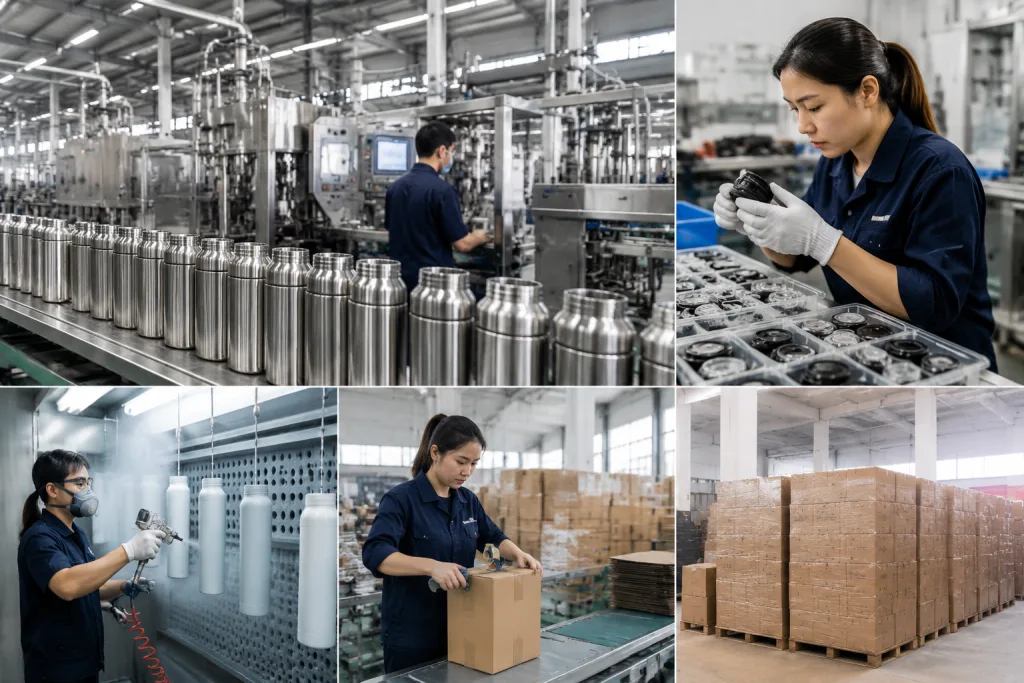
At BottleForge Industrial in Hangzhou, Zhejiang, China, we build both plastic and stainless programs, so we catch where buyers get pushed in the wrong direction. A proper custom thermos review should go line by line: steel grade, 0.4 mm or 0.5 mm wall thickness, vacuum level, lid resin, coating system, decoration method, test standards, packing details, shipping terms. QC pulled the sample on one recent 500 ml run and found the lid looked the same, but the resin had changed and failed a drop test at 1.2 m. A factory in Zhejiang can quote USD 3.20 and another USD 4.10 for a 500 ml bottle; the difference is usually hiding in those lines. We’ve seen this go sideways, and the math doesn’t work if you save USD 0.90 up front and lose 18 days replacing bad stock.
Start with material line items
The first line on the spec sheet tells you if you are even in the right product family. Buyers asking for a petg thermos supplier often get 3 different offers: PETG single-wall bottles, PETG outer shells with stainless liners, or true double-wall stainless vacuum bottles. Those are different products, full stop. On our line, the wall section drawing usually shows the answer in 0.4 mm and 0.5 mm callouts before the sales sheet does. PETG is clear and impact-resistant, good for cold-drink programs, but it does not replace a stainless vacuum flask if your outdoor retail customer expects 12-24 hour heat retention.
For a serious factory thermos project, read these details carefully:
- Steel grade: 18/8 stainless, also called SUS304, is standard for food contact. If the quote says 201 on the outer wall to save USD 0.12-0.20 per unit, ask whether that corrosion risk is acceptable for your market. We have seen coastal-market buyers push back on this after a 48-hour salt spray check.
- Lid resin: PP is common for internal parts. Tritan or PETG works for visible components or windows. If you need a PETG visual element, specify BPA-free grade and dishwasher limits. QC pulled the sample once because the window turned hazy after the buyer asked for top-rack dishwasher wording.
- Seal material: food-grade silicone should be listed. If it is missing, ask. Odor complaints usually start here, not with the steel. On incoming inspection, this is the part we squeeze and smell first.
For promotional and distributor business, the safest wording in your PO is simple: inner and outer wall SUS304, PP lid structure, food-grade silicone seal. Put it in black and white. If your thermos manufacturer cannot confirm exact resin and steel composition, you do not yet have a controlled product. This is the wrong question to skip. We still see suppliers in China quote by appearance first and BOM second, and we have seen this go sideways when the PO says "steel mug" and nothing else for a 3,000 pcs run. That is risky when you are building a customizable thermos line under your own brand.
A cheap quote is usually a light BOM, not a miracle factory.
If the product really needs a PETG body for visual merchandising, call it what it is: a PETG bottle, not a vacuum thermos. That clarity saves first orders. One buyer flagged this after receiving a clear-body sample that held heat for 2 hours, not 12-24 hour retail expectation.
Wall thickness, weight, and dent risk
Most buyers skip thickness and stare at capacity and logo size. Wrong question. Wall thickness decides dent resistance, hand feel, and freight cost. For a 500 ml stainless vacuum bottle, common ranges are 0.32 mm to 0.50 mm per wall. On the quote, some thermos suppliers show only total weight and hide the gauge. Ask for both. On our line, QC checks wall readings with an ultrasonic thickness gauge before we release the pre-production sample.
Here is the practical impact:
- 0.32/0.32 mm build: lower cost and lighter parcel weight, but it dents faster in Amazon FBA handling or retail replenishment. We have seen corner-compression drops leave a 6-8 mm flat spot on the shoulder.
- 0.40/0.40 mm build: the normal commercial balance for distributor thermos orders. This is the spec we run most often at MOQ 3,000 pcs per color.
- 0.50 mm outer wall: stronger hand feel with fewer dent claims, but it usually adds USD 0.18-0.35 and pushes carton weight up. Some buyers ask for this, then push back when the freight math doesn't work.
A 500 ml bottle with 0.40 mm walls often weighs around 280-340 g depending on the lid system. If your quote shows 220 g for a stainless vacuum bottle of that size, your thermos factory is probably cutting steel thickness or simplifying the lid. We ship both types, and the difference is obvious once you hold them. A light build may pass for a promotional giveaway; it usually fails the shelf-durability expectation of an outdoor retailer. Last season one buyer flagged base dents after store replenishment, and the root cause was a thinner outer wall, not packing.
This is where manufacturer thermos and supplier thermos wording means less than engineering control. Ask for a cut sample or a cross-section photo. A reliable plant in Zhejiang, China should be able to send it fast. We also suggest a simple section measurement at the body and shoulder, because this is where thinning shows up first after deep drawing. Our own monthly output on stainless categories is up to 600,000 units, but capacity means nothing if the gauge is not locked before mass production.
For thermos bulk buying, write the thickness into the approved sample record. Put the target bottle weight there too, with tolerance, such as 310 g ± 10 g. Skip this step and the second order can come back lighter by 20-30 g. We have seen this go sideways. Sometimes the cartons arrive, the warehouse team signs off, and only then does someone notice the hand feel changed.
Vacuum performance is not a brochure claim
Heat retention gets printed in big type, but in this trade it is one of the loosest claims on the sheet. One customized thermos sample says 12 hours hot, another says 24 hours hot, and nobody shows the test setup. Ask your thermos vendor for four items: starting water temperature, ambient temperature, fill rate, and the final reading point. QC on our line logs this with a digital probe thermometer, not guesswork.
For a 500 ml double-wall vacuum bottle, a sensible factory target is 95 degrees C filled water, tested at 20 degrees C ambient, over 6 hours and 12 hours. That is a clean baseline. Good commercial performance is usually in this range, and if a factory avoids giving the range, that is the wrong question to skip:
- After 6 hours: 68-78 degrees C
- After 12 hours: 55-65 degrees C
- Cold retention after 12 hours: below 10 degrees C depending on ice ratio
If a thermos supplier advertises 24-hour hot retention on a slim, light 350 ml bottle with a plastic-heavy lid, question it. We have seen buyers flag this on first sample review, and they were right. Lid structure matters. Mouth diameter matters too. So does the vacuum process itself. Better factories run online sampling, then hold samples for an aging test before packing because slow leaks do show up late. QC pulled the sample once on a 0.3 mm sealing issue at the stopper seat, and the temperature drop was obvious after 12 hours.
For outdoor retail channels, ask for leak test and vacuum test records by lot. For promotional thermos business, you might accept a lower retention target if the quote has to hit a strict number, but write the accepted performance range into the PO. We ship plenty of promo orders this way. Without a written range, the math does not work and disputes turn into opinion. We have even seen a PO typo turn "55-65 degrees C" into "65-75 degrees C," which is how claims go sideways.
One useful buyer habit
Run your own benchmark. Fill three production samples with 95 degrees C water, seal them, and record the liquid temperature after 6 and 12 hours. Then compare that with the approved sample data. Three pieces are enough to catch a problem early. This is basic. It works. We have seen it catch hidden changes from thermos manufacturers before a full rollout, especially after a lid supplier change or a vacuum hold-time adjustment on the line.
Lids, drinking parts, and failure points
Most complaints start at the lid, not the bottle body. On the spec sheet, the lid looks like one line. On the line, we break it into five checks: leak path, drinking feel, cleaning access, spare-part control, and print area. A serious custom thermos buyer should ask for an exploded view with gasket position and thread size. We’ve seen this go sideways when a PO said “black lid same as sample” and the vent plug was missing.
Common lid options include screw cap, flip lid, carry loop lid, cup-cap, and push-button auto open. The trade-offs are straightforward:
- Screw cap: lowest leak risk, lowest tooling cost, simplest for thermos custom projects. Fewer parts. Less to fail.
- Push-button lid: easier one-hand use, but it adds springs, pins, and a latch. QC pulled the sample more than once for button jam after cycle testing, and this style usually adds USD 0.35-0.80.
- Cup-cap flask lid: fits outdoor and worksite channels, but it eats carton space. On a 24-piece master carton, the cap height can force a larger box size and push freight up.
If your program uses PETG or clear plastic in the cap window, ask about stress cracking and dishwasher resistance. This is not a minor detail. We run impact checks on the clear insert because a 1.8 mm PETG window behaves differently from a thicker part under repeated knock tests. PETG works well for display windows and some straw parts. It is not the right choice for every threaded structural part, and a real petg thermos supplier should say that early instead of after mold steel is cut.
Ask if the silicone gasket comes out by hand, if replacement seals are stocked, and if the lid passes a 1-meter drop test with the bottle full. Ask how many drops, too; one drop is the wrong question to ask. We usually check 3 positions. If your market is Europe, add migration and REACH checks for any contact plastic. If your market is North America and the product is for youth programs, review applicable CPSIA or ASTM points based on actual use. The buyer flagged this before on a straw lid where the mouthpiece resin was approved, but the color masterbatch paperwork was missing.
For distributors thermos orders, a spare gasket bag at 1% of order quantity is cheap insurance. The math works. On a 10,000-piece order, 100 extra seals weigh little, pack fast, and save a lot of after-sales email with channel partners. We ship these in a labeled PE bag by lid code so the warehouse does not mix 64 mm and 68 mm sets.
Decoration spec decides brand durability
Buyers often ask for a customizable thermos. That is not the real issue. The real issue is whether the decoration survives the sales channel. A trade show giveaway, an outdoor retail shelf, and parcel handling from e-commerce do different damage to a logo. We have seen a buyer approve the sample, then flag logo scratching after 12 days on Amazon returns. Your thermos distributor or retail buyer does not care which print method you chose if the mark is gone in week two.
The common options are powder coating plus silkscreen, heat transfer, laser engraving, UV print, and full-wrap digital transfer. On stainless bottles, the ranking is usually clear on the line: powder coat + laser first, then powder coat + silkscreen. UV print works when artwork has gradients or 4-color detail, but the abrasion result is weaker. QC pulled the sample last month after a carton rub test, and the UV logo showed edge wear before the laser-marked bottle did. This is the wrong question to ask: do you want the cheapest decoration, or the one that still looks clean after 18 days in retail handling?
- Silkscreen: low setup cost, strong spot-color fill, usually 1-2 colors, economical for MOQ 3,000 pcs. We run this often on straight-body bottles because registration stays tighter.
- Laser engraving: premium look, strong wear resistance, slower process, often adds USD 0.08-0.20 depending on size. On 304 stainless, the mark stays stable if the coating window is controlled.
- Heat transfer or digital wrap: better for promotional graphics with photo detail or fewer color limits, but adhesion testing is not optional. We have seen this go sideways on shoulder curves if the film tension is off by 1-2 mm.
A serious thermos customized order should lock the decoration spec before price approval: coating thickness, Pantone tolerance, and logo position tolerance. Ask for a cross-hatch adhesion test result and, if your channel needs it, the dishwasher test or rub test method used by the factory. We usually recommend powder coat thickness around 60-80 microns for a balanced finish. Too thin, and scratches show early. Too thick, and thread areas or lid fit start drifting; we measured one batch at 95 microns and the cap torque went out of range.
Outdoor retailers usually ask for quieter finishes: matte black, navy, olive, with laser mark. Promotional buyers usually push for bright Pantones and oversized logos. Both are valid. They should not share the same default print spec. We had one PO last season with “mat blak” typed on the finish line, and the buyer still expected a glossy Pantone match, so now we confirm finish and artwork side by side before sampling. That is why a real manufacturer thermos partner asks where you will sell the bottle before quoting.
Compliance, QC, and shipment details
The final third of a spec sheet is where experienced buyers save money. Testing, inspection, carton specs, and trade terms are shipment controls, not admin. They decide if goods arrive sellable or land in a claims pile. A quote from China should state at minimum: unit packing, master carton count, carton size, gross weight, QC standard, and Incoterm such as FOB Ningbo or FOB Shanghai. If the carton size is missing, ask for it in mm; we have seen buyers approve a PO, then find the pallet plan does not fit the warehouse racking.
For Europe and North America, ask your thermos manufacturers for these checkpoints:
- AQL: commonly Major 2.5 / Minor 4.0 on final random inspection. QC pulled the sample by carton count, not by guesswork.
- Food-contact compliance: REACH and LFGB for many EU programs; FDA-related declarations are common for US-facing projects. The buyer flagged one project last year because the lid gasket test report covered the wrong color batch.
- Factory audits: BSCI, Sedex, or ISO 9001 depending on your customer requirement. Ask for the valid report date, not just a logo on the sales deck.
- Performance tests: leak, drop, coating adhesion, salt spray when applicable, and heat retention. On the line, we usually run a vacuum hold check and a 1.2 m drop test for packed samples.
For a standard bulk thermos order, MOQ is often 3,000 pcs per model per color, though some factories in Zhejiang can support 1,000 pcs from stock colors for repeatable lids and bodies. Sample lead time is usually 7-12 days. Production lead time is commonly 35-50 days after deposit, artwork approval, and pre-production sample sign-off. If your suppliers thermos quote says 20 days in peak season, challenge it. This is the wrong question to ask anyway; ask how many lines they run, whether the spray booth is shared, and if the lid injection schedule is in-house or outsourced. We have seen this go sideways when a PO typo changed matte black to rubber black and the approval loop ate 6 days.
Packing details matter. A 500 ml bottle may fit 24 pcs per carton, but if the insert design is weak, transit dents rise fast. Ask whether the factory has performed carton drop tests and whether inner trays are pulp, corrugated partitions, or EPE. We ship plenty of 24-pack cartons, and the weak point is often the top pad compression after 3-high stacking, not the bottle body. For Amazon or DTC programs, add barcode placement, FNSKU labeling, and carton weight caps below 15 kg when possible. If the gross weight comes out at 15.8 kg, the math doesn't work for warehouse handling claims.
Good buyers do not compare price alone. They compare delivered complaint risk. That is the real number behind every quote from Zhejiang, China. A cheaper unit price means little if final inspection finds 3 mm paint skips around the shoulder or if the master carton fails on the first drop.
Send your thermos spec sheet for a real review
If you have drawings, a target price, or just a competitor sample, we will mark up the specs and tell you where the risk and cost really sit.
Frequently asked questions
Can a petg thermos supplier also handle stainless vacuum bottles?
Yes, but you should verify whether the supplier is truly a stainless factory or only a trading source for that category. Many China suppliers sell PETG bottles and also quote stainless vacuum flasks, yet the engineering depth is different. Ask for monthly stainless output, production photos, and recent test reports. A solid manufacturer should confirm steel grade, wall thickness, vacuum retention data, and lid resin details within 24-48 hours. For example, if they claim 500,000 units per month, ask how many are double-wall vacuum items, not total bottles. Also request a cut sample or cross-section photo. If they can only discuss color and logo, they are not controlling the critical specs.
What is a realistic MOQ for custom thermos orders?
For a standard 350-750 ml stainless vacuum bottle, realistic MOQ is usually 3,000 pcs per model per color for a fully customized thermos order with custom coating and logo. Some factories can do 1,000-2,000 pcs if they use stock bodies, stock lids, and simple one-color silkscreen. New mold lids, special finishes, or unique pantones may push MOQ to 5,000 pcs or more. If a supplier offers 300 pcs for a fully custom bottle, check whether they mean stock goods with a basic logo only. For promotional programs, it is often better to buy a stock structure at 1,000 pcs and invest budget in decoration rather than pay for tooling too early.
How much should a stainless thermos cost FOB China?
For a 500 ml double-wall SUS304 vacuum bottle, FOB China pricing typically falls around USD 3.20-5.80 depending on wall thickness, lid complexity, coating, and print method. A simple screw-lid model with stock powder coat and one-color silkscreen might land near USD 3.20-3.80 at 3,000 pcs. A push-button lid, thicker outer wall, custom mold details, and laser plus print can move it to USD 4.50-5.80 or higher. If you see a quote under USD 3.00, ask what has been reduced: steel grade, wall thickness, vacuum standard, gasket quality, or carton protection. Low pricing is possible, but it is rarely free of trade-offs.
Which compliance documents should I ask for before placing a PO?
At minimum, ask for food-contact material declarations for stainless, PP or PETG parts, and silicone seals, plus recent test reports relevant to your market. For Europe, REACH and often LFGB-related contact testing are common asks. For North America, buyers often request FDA-related declarations and, depending on channel, additional chemical screening. Also ask for factory audit status such as BSCI, Sedex, or ISO 9001. On quality control, specify AQL 2.5 for major defects and request leak, drop, and heat-retention test records. If the product is for retail distribution, carton specs, barcode format, and labeling position should be approved before production starts, not after goods are packed.
How long does a typical thermos bulk order take from sampling to shipment?
For a standard custom thermos program, plan 7-12 days for pre-production samples once artwork and color references are clear. After sample approval and deposit, mass production usually takes 35-50 days, depending on season, coating queue, and whether custom packaging is involved. Carton or gift box delays can add another 5-7 days. In peak periods before summer outdoor season or Q4 promotional demand, some suppliers in Zhejiang or wider China may need 55-60 days. If you need faster delivery, choose stock molds, standard lid colors, and simple decoration. The biggest avoidable delay is incomplete approval: unclear logo files, changing pantones, or unconfirmed carton marks.