Key Takeaways
- A usable RFQ should lock 8 core items before quoting: capacity, material, lid structure, logo method, color, packaging, testing scope, and Incoterm
- For custom stainless vacuum flasks, common MOQ is 1,000-3,000 pcs per SKU, while sample lead time is usually 7-12 days and bulk lead time 25-40 days
- AQL 2.5 for major defects and 4.0 for minor defects is a practical inspection baseline for promotional thermos and outdoor retail orders
- Most quote disputes come from missing PO line items such as carton marks, spare parts ratio, barcode placement, and whether tests are included or charged separately
You might start by searching for a petg thermos flask supplier, then find out the buying call is less clean than the keyword suggests. One quote is for a PETG outer bottle, another is for a 304 stainless vacuum flask, and a third comes from a trader who replies in 20 minutes but stalls when the buyer flagged 0.4 mm wall thickness, vacuum rate, or REACH test scope. We have seen this go sideways. If you sell to outdoor retail chains or promo buyers, the confusion shows up fast: sample approval slips by 6 days, the unit price moves after artwork, and the gift box arrives 3 mm short on insert fit.
If you want a custom thermos program that lands on time, a quote sheet is not enough. You need a sourcing process with checkpoints before the line runs. At BottleForge Industrial in Hangzhou, Zhejiang, China, we handle around 600,000 units per month across stainless and polymer drinkware, and most of the trouble starts before production: the PO has a color typo, the logo file is low-res, or QC pulled the sample and found the lid torque out of spec at 1.6 N.m. This is the right place to get strict.
Start With The Right RFQ
Start by dropping the idea that petg thermos flask supplier is just a material keyword. PETG usually fits clear outer shells, caps, or windows. A real stainless vacuum thermos is built around 18/8 stainless, vacuum structure, optional copper coating, and a lid seal that passes leak test on the line. If a China supplier sends back only a unit price and asks zero technical questions, we’ve seen this go sideways. In most cases, that is a trader, or a factory quoting blind after glancing at one old 500 ml mold.
Your RFQ needs enough detail that two suppliers in Zhejiang quote the same bottle, not two different ideas. This is the wrong question to ask: “What is your best price?” Ask what build they are pricing. Outdoor retail and promo orders do not run the same. A retail thermos for shelf sale usually needs drop resistance from 1.2 m, barcode position locked on the dieline, and color repeat within a tight Pantone window that the buyer flagged before. A promotional project is usually about lower MOQ, logo sample speed in 3 to 5 days, and a delivered cost that still works after carton count is confirmed.
Put these line items in the RFQ
- Body material: SS304 inner and outer, or PETG outer with stainless inner if you really need a hybrid concept
- Capacity: 500 ml, 750 ml, 1,000 ml, with fill tolerance if relevant
- Structure: double-wall vacuum, single wall, tea filter, handle, carry loop
- Wall thickness: typical 0.4 mm inner and 0.5 mm outer for a standard stainless flask
- Lid type: screw lid, flip lid, cup cap, straw lid, leakproof requirement
- Finish: powder coat, spray paint, brushed, PETG clear body color, pantone reference
- Logo: silk screen, laser engraving, heat transfer, 1 color or full wrap
- Packaging: polybag, white box, color box, PDQ, master carton count
- Compliance: REACH, LFGB, FDA contact test, BPA free statement, ASTM if for kids use
- Trade term: FOB Ningbo, FOB Shanghai, or DDP to your warehouse
For a manufacturer thermos quote, ask one more thing up front: are mold charges, sample charges, and test fees included or not? This matters. We ship quotes every week where the first price looked low, then the buyer found another $180 sample fee, a mold charge on the stopper, and lab cost added back later. QC pulled the sample on one job because the PO even had the logo position typoed at 18 mm from seam instead of 8 mm. A clean RFQ saves 2 or 3 email rounds, and your quote comparison starts to mean something.
Separate Stainless From PETG Claims
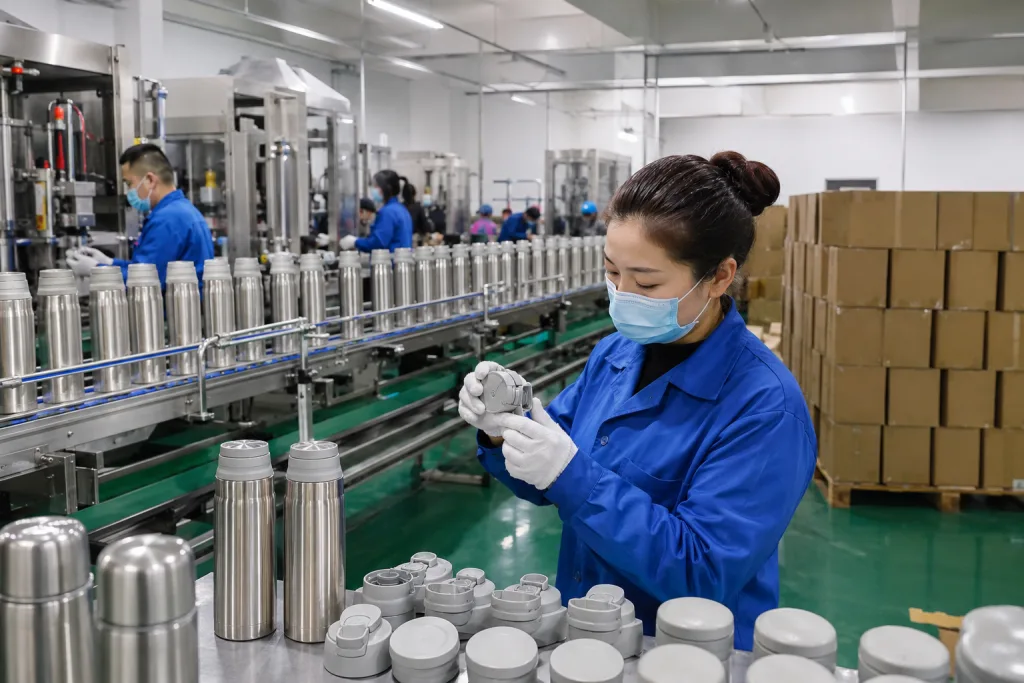
This is where 7 out of 10 buyers lose time. Search results for thermos supplier or thermos vendors mix PETG sports bottles with vacuum flasks, and the catalog looks fine until you ask what the line actually runs. For a custom stainless thermos, the core work is tube forming, seam welding, vacuuming, polishing, powder coating, and 100% leak testing with an air-pressure rig. If the supplier mainly runs PETG injection or blow molding, they usually outsource the stainless body and control less than they claim.
Ask direct questions. That saves weeks. We have seen buyers lose 18 days on sampling because the factory was trading semi-finished bodies from another workshop 40 km away. This is the right filter.
- Do you produce vacuum stainless flasks in-house or outsource semi-finished bodies?
- What is your monthly output for stainless vacuum bottles?
- What is your standard vacuum retention target, such as 12 hours above 55 degrees C for hot water starting at 95 degrees C?
- What percentage of units get 100% leak testing?
- Do you have BSCI, ISO 9001, or audited social compliance records?
- Can you provide recent REACH or LFGB reports from an accredited lab such as SGS, TUV, or Intertek?
On the factory floor, a solid thermos plant will answer fast on neck thread tolerance like +/-0.15 mm, silicone hardness like 50 to 60 Shore A, powder coat adhesion, and actual vacuum failure rate. A weak one will keep talking about logo print and FOB price because the buyer flagged cost first. This is the wrong question to ask. For outdoor retail, I would pay USD 0.18 more per unit to a real thermos manufacturer than spend three months chasing lid leaks from a loose supplier thermos network after QC pulled the sample and found seepage at the cap seat.
A product can be stainless, customizable, and cheap. Pick two first, then see whether the third still survives after testing.
China has plenty of capable plants, but the gap is real. In Zhejiang alone, I can name 12 suppliers that run sports bottles well and struggle on insulated flasks, while another 8 are strong on vacuum products and weak on PETG decor work. We ship from this region every week, and the math does not work if you judge a factory by catalog width alone. Buyers searching manufacturers thermos or thermos manufacturers should be checking process ownership, not just whether one PDF shows 304 stainless next to PETG items.
Build A Sample Brief That Works
Once your shortlist is down to two suppliers, move to samples. Do not write a loose note like “same as your catalog but premium finish.” We have seen this go sideways. You get a good-looking desk sample that the line cannot repeat in mass production. Your sample brief should read like a mini PO, with print size in 28 mm, finish code, lid structure, and target weight all written down.
For a custom thermos or customizable thermos project, ask for three sample stages if the program matters. This is not the wrong place to spend time. We run these as separate checkpoints because each one answers a different production question, and QC pulled the sample more than once after a logo position drifted 2 mm from the drawing.
- Reference sample: confirms shape, capacity, hand feel, and lid structure
- Pre-production logo sample: confirms pantone, print position, and finish
- Golden sample: signed after all changes and held as the production benchmark
A realistic sample timeline from Zhejiang, China is 3-5 days for an unbranded stock sample, 7-12 days for a customized thermos with logo, and 15-20 days if you need a new mold or special lid tooling. If a thermos custom supplier promises everything in 48 hours, check what is actually being sampled. We ship stock bodies fast, but a new lid tool still needs machining, fitting, and a leak test on the bench.
Sample PO line items to include
- SKU code and capacity
- Material callout: SS304 inner and outer, PETG component if applicable
- Finish code and pantone number
- Logo file version, print size in mm, and location drawing
- Leakproof requirement after upside-down test for 30 minutes
- Insulation test method and acceptance range
- Packaging type for sample shipment
- Courier account or freight billing method
Ask the supplier to send actual weight, product dimensions, and carton dimensions with the sample approval. The math does not work if these numbers come late. A 0.18 kg gap on unit weight or a carton height change from 42 cm to 46 cm hits landed cost and Amazon FBA or retail shelf planning fast. We have handled thermos bulk orders where the buyer flagged the sample as approved, but the PO had one typo in the carton spec and nobody locked the measurable details.
Price The Bulk Order Properly
After sample approval, buyers often stare at the ex-factory unit price and miss the full cost stack. That is the wrong question to ask. For bulk thermos and promotional thermos programs, compare total landed cost per sellable unit. We ship by carton math, not by headline price. A quote at USD 2.85 FOB can lose to USD 3.02 FOB if the cheaper factory wastes space in a 58 x 39 x 32 cm master carton, runs a 4% defect rate, or sends goods that need separate testing and repacking.
Typical stainless vacuum flask pricing from China for standard sizes looks like this at 1,000-3,000 pcs per SKU: 500 ml basic powder-coated flask at USD 2.60-3.40 FOB, 750 ml at USD 3.20-4.20, and 1,000 ml handle flask at USD 4.10-5.80. The range moves for clear reasons. A PETG outer decorative structure, a special lid with a new top cap tool, or a gift box with 3 mm E-flute board can add USD 0.25-1.20 fast. MOQ for a stock mold custom logo order is often 1,000 pcs; a fully new mold may start at 3,000-5,000 pcs.
For distributor thermos and thermos distributor business, ask the supplier to quote these items separately. QC pulled the sample on one order last month, and the buyer flagged that the straw gasket cost was buried in the lid price. That creates arguments later.
- Unit price by quantity break: 1,000 / 3,000 / 5,000 pcs
- Logo setup charge and repeat order charge
- Color box cost, barcode sticker cost, carton mark cost
- Lab test cost and whether it is refundable on bulk order
- Sample charge credit policy
- Spare parts price: lids, straws, gaskets
- Sea freight loading quantity per 20GP and 40HQ
If you are buying as a distributors thermos program for multiple regions, ask whether the same flask can run mixed colors under one PO. We run this all the time, but the line still needs discipline. Good factories in Zhejiang can combine 3-4 colors in one order if total MOQ is met, and each color still needs a floor such as 300-500 pcs. We have seen this go sideways when the PO said "navy" but the artwork file was marked "Naby Blue." That flexibility usually saves more money than chasing the last USD 0.05.
Write The Purchase Order Like QC
A purchase order should read like a factory work sheet, not a sales email. We run production, QC, packing, and booking from that document. If you are buying thermos customized or thermos promotional products, the PO is your first quality document. Miss one line, and the line fills the gap with its own assumption. We have seen a 3 mm logo shift turn into a full rework claim.
Experienced buyers are blunt on this point: if it is not on the PO, it does not exist. Put in the carton drop standard, barcode direction, accessory packing method, and who signs off at each stage. This is the wrong question to ask after mass production starts. Last season, a buyer flagged a PO typo on the barcode suffix only after 1,200 color boxes were printed.
Bulk PO line items that prevent problems
- Product identification: item code, full description, capacity, approved sample date, and the exact lid match; on our floor, one wrong cap code can mix two molds that differ by 0.5 mm
- Material specification: SS304 inner/outer, PP lid grade, silicone gasket, PETG parts if used; write the resin callout clearly because QC pulled the sample before on a mixed-material lid set
- Performance: leakproof standard, insulation retention target, corrosion requirement, odor free; if you want a hot hold result, state the test method and hour target, not just "good insulation"
- Decoration: pantone, finish standard, print artwork revision, acceptable logo tolerance in mm; we check this with a Pantone book and caliper, not by eye
- Quality standard: AQL 2.5 major, 4.0 minor unless otherwise agreed
- Packaging: inner pack, color box artwork version, export carton dimensions, gross weight limit such as 18 kg; this line matters because a 19.6 kg carton will get pushed back by some warehouse teams
- Marks: shipping mark, FNSKU, country of origin, suffocation warning if required; write label position too, left side vs top panel, because the buyer has flagged this before
- Commercial terms: unit price, Incoterm, deposit, balance, delivery window; the math does not work if the delivery window is open-ended and booking is in peak season
- Claims rule: defect reporting window, replacement or credit method; put the deadline in days, such as 7 days after receipt, so nobody argues later
For factory thermos orders shipping to Europe or North America, specify whether REACH, LFGB, FDA, or California Proposition 65 documentation is required before balance payment. Also state whether you need photo approval before packing, and how many photos: 6 carton views or 12 random unit shots. About 8 out of 10 suppliers will do this if you ask early. Ask after container booking, and we ship late or reopen 2,000 cartons by hand. We have seen this go sideways.
Control Production Before Goods Leave
After the deposit is paid, your work is not done. This is where a thermos supplier shows whether the approved sample can run on the line at volume without drifting. Standard lead time for a custom stainless order is usually 25-40 days after deposit and artwork confirmation. In our Zhejiang factory schedule, lid sourcing and coating oven slots are usually the bottleneck, not body forming on the hydraulic press.
Set 3 checkpoints and lock them early: pre-production confirmation, in-line update, and pre-shipment inspection. For thermos bulk orders above 5,000 pcs, we usually ask buyers to check in-line when 20%-30% is finished, not after packing. QC pulled the sample at 1,200 pcs on one 6,000 pc order and caught logo shift by 2 mm, lid color mismatch, and thread fit problems before the cartons were sealed. That saves money. We have seen this go sideways when buyers wait for the final report only.
- Pre-production: confirm approved sample, carton artwork, barcode sheet, QC checklist
- In-line: inspect coating adhesion, weld finish, threading, logo position, leak rate
- Pre-shipment: random inspection by AQL, packaging verification, drop test, count check
A solid inspection set for stainless flasks includes vacuum test sampling, 100% leak test, coating cross-hatch adhesion test, dishwasher warning verification if not dishwasher safe, and odor check after 24 hours sealed with hot water. We run the cross-hatch with a 1 mm cutter, and QC checks logo rub resistance on promotional orders because event items still trigger claims when the print peels after 7 days. Buyers sometimes ask only about insulation hours. This is the wrong question to ask if the branding fails first.
If you buy from thermos manufacturers in China regularly, agree on one point early: what counts as a major defect. A pinhole on hidden base paint may be minor. A tilted logo, leaking lid, sharp rim, or failed insulation is major. Write it on the PO and QC sheet. We once saw a PO typed as “matel flask” with no defect standard attached, and the buyer flagged 86 pcs after shipment for rim sharpness that should have been screened at pre-shipment. Good thermos factory teams want that definition in black and white because it cuts rework and chargebacks.
Handle Shipping, Claims, And Reorders
The last stage decides whether we run a stable program or start over every season. After inspection passes, lock the final packing list, carton photos, pallet standard if needed, and the shipping document set. For FOB shipments from China, commercial invoice, packing list, and bill of lading details should be checked before vessel cutoff; we have seen a PO typo in the consignee name hold documents for 2 days. If the order ships to Amazon or a 3PL, carton labels and FNSKU handling need checking before loading. Not after arrival. QC pulled the sample and matched the outer carton mark to the packing file on the line for this exact reason.
Ask your thermos vendor to keep one sealed production sample from the exact lot shipped. Keep one in your office too. If a claim shows up 45 days later, both sides need the same reference bottle, same lid, same print position. This is the wrong question to skip. For claims, set the process in hard numbers: photos within 15 days of receipt, quantity breakdown by defect type, and settlement by credit note, replacement, or deduction on the next PO. We usually tape the retained sample carton shut with date code and lot number written in marker, then store it on the rack above the drop-test bench.
The reorder stage is where you judge the supplier thermos relationship honestly. Did lead time hold at 12 days vs 18 days promised? Was color repeat stable within an acceptable delta? Were cartons within weight spec, such as 18.2 kg instead of creeping past the buyer limit? Did actual defect rate stay below 1.5% major and 3.5% minor? If yes, you have a workable manufacturer thermos partner. If no, do not bury the issue under a lower unit price on the next order. The math does not work, and we have seen this go sideways after one good shipment and one bad bulk lot.
For outdoor retailers, the best long-term setup is usually one or two core flask bodies with seasonal color changes and controlled packaging variation. For promotional brands, it is often one stock mold with flexible decoration and box options. Either way, a reliable thermos supplier in Zhejiang or wider China matters only if they can repeat the same build under the same SOP, from a 0.4 mm logo line to the carton drop result. Anyone can ship one decent sample. The job is to ship the same product 10,000 times. We ship reorders faster when the mold, spray code, and inner tray all stay fixed at MOQ 3,000.
Send your RFQ and get a technical quote
Share your target size, material, logo, packaging, and ship date. We will review feasibility, MOQ, lead time, and likely risk points before sampling.
Frequently asked questions
Can a petg thermos flask supplier also be a real stainless vacuum flask factory?
Sometimes, yes, but you need proof. Many suppliers in China sell PETG bottles and stainless flasks from the same catalog, yet only one category is produced in-house. Ask for stainless production details: monthly vacuum flask output, such as 300,000-600,000 pcs; standard wall thickness, usually 0.4 mm inner and 0.5 mm outer; and whether 100% leak testing is done. Also ask for factory audit records like BSCI or ISO 9001 and recent REACH or LFGB reports. If they cannot explain vacuum retention targets or lid sealing structure, they are probably trading the stainless item. That is not always a deal breaker, but it changes your risk level, lead time control, and claim handling.
What MOQ should I expect for a custom stainless thermos order?
For a stock mold stainless vacuum flask with custom logo, MOQ is commonly 1,000 pcs per size and around 300-500 pcs per color, depending on the coating line setup. If you need a customized thermos with a new lid, special handle, or custom base, MOQ can move to 3,000-5,000 pcs plus tooling cost. Gift box packaging may also have its own MOQ, often 1,000 pcs. Promotional projects can sometimes run lower if you accept stock colors and a simple 1-color screen print. For outdoor retail, do not push MOQ too low if you need repeatable quality. Very small runs often carry higher unit cost, less process stability, and weaker carton efficiency.
How long do samples and bulk production usually take?
A stock sample normally takes 3-5 working days. A logo sample for a custom thermos is usually 7-12 days after artwork approval. If the project needs new tooling, expect 15-20 days for development samples and another round for corrections. Bulk production for stainless vacuum flasks is typically 25-40 days after deposit, approved sample, and packaging confirmation. During peak season from August to November, lead times in Zhejiang and other China drinkware clusters can stretch by 7-10 days, especially for powder coating and lid sourcing. If you have a hard ship date, put it on the PO and ask for a production timeline with milestone dates rather than only a final delivery promise.
Which tests and inspections matter most for stainless thermos orders?
Focus on the tests that affect customer complaints first. For the product, that means 100% leak test, vacuum retention sampling, odor check, coating adhesion, and food-contact compliance such as REACH, LFGB, or FDA depending on market. For kid-focused items, ASTM requirements may also apply. On inspection, AQL 2.5 major and 4.0 minor is a practical baseline for most distributor thermos orders. Major defects usually include leaks, failed insulation, sharp edges, wrong logo, wrong barcode, or visible body dents. Minor defects may include small hidden paint dust or slight carton print issues. Ask the supplier to define defect categories before production starts. That avoids argument when the third-party inspection happens.
What should I put on the purchase order besides price and quantity?
More than most first-time buyers expect. Your PO should include SKU code, capacity, body and lid materials, approved sample date, finish code, pantone, logo artwork version, print size and position, packaging type, carton dimensions target, gross weight limit, barcode format, shipping marks, compliance documents required, inspection standard, Incoterm, payment terms, and claim handling method. If the order goes to Amazon or a 3PL, include FNSKU placement and pallet rules. Also state whether sample charges or test fees are credited back. Missing line items are where bulk thermos orders go wrong. A PO with 15-20 clear lines usually prevents more trouble than ten emails sent after production has started.