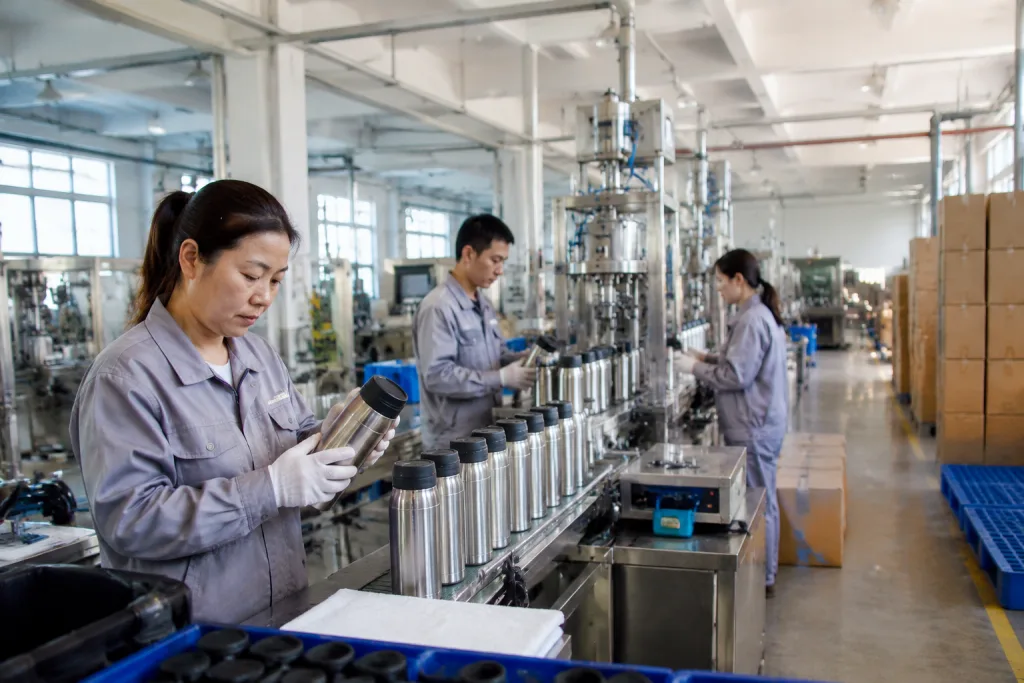
Key Takeaways
- Lock the bottle structure first: PETG component only, or stainless vacuum body with PETG parts, because this can shift unit cost by USD 0.40 to 1.20
- For bulk thermos orders, MOQ is usually 1,000 to 3,000 pcs per size/color, while custom logo add-ons often start at 500 pcs per artwork
- A realistic production lead time in Zhejiang, China is 25 to 35 days after sample approval and 30% deposit for standard customized thermos models
- Use AQL 2.5, REACH, LFGB or FDA as needed, and require 24-hour heat retention data plus drop and leakage testing before shipment
You search for a petg thermos flask manufacturer, then the quotes start and the terms get loose fast. One factory is talking about a PETG outer shell with a stainless liner. Another is pricing a standard stainless vacuum bottle with a PETG lid or carry loop. We see this every month. Last week, a buyer flagged a 0.8 mm wall spec on the RFQ, but the PO still said “PETG thermos body,” which was the wrong build. If you buy for outdoor retail or promotional campaigns, that mix-up costs time, margin, and sometimes a failed compliance check.
The practical way to buy is to lock four points first: structure, capacity, decoration, and compliance level. This is the right starting point. Once those are fixed, the custom thermos quote is easier to compare across China suppliers because you are matching the same build, not four different samples from four lines. In Zhejiang, where a lot of drinkware factories are clustered, the gap between a usable RFQ and a vague one can mean 12 to 18 extra days and a 6% to 15% cost swing. We run into this on the line all the time, and the math does not work if the MOQ is 3,000 pcs but the artwork file and lid spec are still open.
Start With The Product Structure
The first call is not color, logo, or capacity. It is the actual construction. When a buyer asks for a petg thermos flask manufacturer, we usually see 3 different products hiding in that wording, and this is where the PO starts going off track. Last month one RFQ on our line even spelled the item as "thermo flash."
- Type A: PETG single-wall bottle. This is not a true thermos. It is light, lower cost, and usually built for cold drinks. On sample checks, QC pulled the bottle and the wall thickness was around 2.2 mm, which is normal for this type.
- Type B: Stainless steel vacuum flask with PETG lid, handle, straw cover, or outer shell parts. This is what most outdoor retailers actually ask us to quote. We run this structure every month because it gives insulation performance without making the mold set too complicated.
- Type C: Stainless inner plus PETG outer body. This is less common and more sensitive on tooling fit. We have seen this go sideways when the outer shell tolerance drifts by 0.3 mm and the assembly starts showing gaps.
If you need real heat retention, Type B is usually the practical choice. A 304 stainless double-wall vacuum body with 0.4 mm inner wall and 0.5 mm outer wall will beat a PETG-heavy build and cut warranty claims. For a 500 ml custom thermos, a standard 304/304 vacuum bottle may hold hot water above 55 degrees C after 12 hours. A better build with copper coating can push that to 65 degrees C after 12 hours, depending on the stopper design. We check this with a temperature gun and vacuum test on the line.
This matters for one reason. Buyers compare quotes from 2 or 3 suppliers in China and miss that the structures are different. One supplier thermos offer may be a proper vacuum flask. Another may be a PETG bottle made to look close on the outside. The price gap can be USD 1.10 versus USD 2.80 FOB Ningbo, but you are not buying the same thing. The wrong question is "why is one factory cheaper?" The right question is "what exactly are they building?"
So your RFQ should state the exact stack:
- Body material: SUS304 or SUS316 inner, SUS201 or SUS304 outer
- Plastic parts: PETG, PP, Tritan, or silicone grade
- Insulation: vacuum, with or without copper coating
- Lid structure: screw cap, push button, flip lid, straw lid
- Use case: hiking retail, corporate promotional thermos, or distributor thermos stock item
That one step cuts about half the confusion we see in thermos quotations from Zhejiang factories and other China sourcing hubs. We ship cleaner offers when the structure is clear, and the buyer stops flagging price gaps that come from mismatched specs.
Decide Your Retail Or Promo Position
The second call is channel position. Outdoor retail and promo buying run on different math, and we’ve seen this go sideways when a buyer uses one flask spec for both. The problem shows up 60 days later as dead stock, leak claims, or a return from one dent test on the shelf sample.
For outdoor retail, the bar is higher. Buyers usually ask for stronger heat retention, tougher coating, and cleaner fit at the lid and base, so we run checks on powder coat at 60 to 80 microns, seal compression, and thread engagement with a go/no-go gauge. Retail teams also look harder at carton drop results, spare lid supply, and how easily the body picks up a dent. A 0.5 mm outer wall often sells better on the shelf than a thin body that saves a few cents. The math doesn't work if the first customer squeeze leaves a flat spot.
Promo programs are different. The buyer flagged this more than once: hit the event date, keep the logo big, and stay on budget. In that case, a standard 6 to 8 hour hot retention claim is often enough, and a 450 ml or 500 ml vacuum mug with screen print can be the right customized thermos. A realistic FOB range for a basic 500 ml model in thermos bulk can be USD 2.20 to 3.10 at 3,000 pcs, while a more retail-ready insulated bottle with premium powder coat and gift box can reach USD 3.80 to 5.50. We ship both, but this is the wrong question to ask if you start from "what is your cheapest bottle?"
Use channel-specific filters
- Outdoor retail: leakproof testing, dent resistance, replacement parts, barcode application, color consistency, hangtag support
- Promotional brands: logo process, low MOQ variants, fast sampling, carton pack flexibility, landed cost target
- Distributors thermos business: repeatable stock colors, shorter replenishment cycles, mixed-case packing, neutral packaging option
You do not need the best bottle on the market. You need the bottle your channel can actually sell without quality claims eating your margin.
That is why experienced thermos suppliers ask where you will sell it before they quote. A good thermos manufacturer in China should push back a little. QC pulled the sample on one PO last month because the customer typed "mat black" instead of "matte black," and that small miss turned into a color approval delay. If a factory never asks these questions, they are probably forwarding a catalog.
Set The Cost Drivers Early
The third decision is cost architecture. Buyers often chase unit price first and miss the 6 quote drivers that move faster than any small bargaining round: material grade, capacity, coating spec, lid structure, logo method, and packaging. This is the wrong question to ask at the start. On our side, the line can quote the same 500 ml shape three different ways just by changing the outer wall from 304 to 201, the print from silkscreen to laser, or the insert from plain white box to gift tube.
Material is the first lever. SUS304 inner and outer costs more than 304 inner plus 201 outer, but for promotional thermos projects the mixed structure is often accepted after salt-spray and weld checks. We see this on 1,000 to 3,000 pcs gift orders. If you sell outdoor gear in Europe or North America, 304/304 is easier to defend when the buyer asks for the mill cert and QC pulled the sample with an XRF gun. SUS316 inner works for stronger corrosion resistance, but not every project needs it. You pay for it, usually around 8% to 15% above a similar 304 bottle.
Capacity changes more than steel weight. A 750 ml bottle is not just 50% more steel than a 500 ml bottle, because the lid, neck diameter, carton count, and packing rate all shift at the same time. We have seen a master carton drop from 24 pcs to 20 pcs on taller models, and then the freight math doesn't work. In practice, the FOB jump may be 20% to 35% depending on the model. Decoration also catches buyers off guard. A one-color silkscreen on a stainless body may add USD 0.08 to 0.18 per unit. Laser engraving may add USD 0.10 to 0.25. Wrap print, heat transfer, or a metallic finish can push cost up fast, and QC pulled the sample more than once for edge blur or color shift over 1.5 mm.
Typical cost checkpoints for bulk thermos sourcing from Zhejiang, China:
- MOQ for stock model with one logo: 1,000 pcs
- MOQ for custom body color: 2,000 to 3,000 pcs
- MOQ for new lid mold or major plastic change: often 5,000 pcs and tooling from USD 2,500 to 8,000
- Sample time: 5 to 7 days for existing mold, 15 to 25 days for new tooling
- Mass production: 25 to 35 days after pre-production sample approval
A capable manufacturer thermos plant in Zhejiang may run 300,000 to 500,000 units per month, but your order still does not ship just because the monthly number looks big. We ship by bottleneck, not by brochure. Lead time usually comes down to coating line slots, logo queue, and whether packaging is ready on time; last month one PO even had "gift ox" instead of "gift box," and the buyer flagged it before print approval. Ask for the critical path and the actual choke point on the line, not the best-case date.
Check Compliance Before Decoration
The fourth decision is compliance depth. Buyers leave this to the last step all the time, and that is the wrong question to ask. If you sell into the EU, UK, US, or Canada, compliance needs to lock the material plan before logos, gift boxes, and barcode layout are approved. We have seen POs where the cap artwork was signed off first, then the buyer flagged the PETG spec two weeks later.
For stainless vacuum bottles with PETG parts, first confirm what actually touches the drink. This sounds basic. On the line, we mark the beverage path parts on the BOM and cross-check them against the exploded drawing. If PETG is only used on the outer cap shell or handle, the test scope is usually narrower. If PETG touches the beverage path, ask for migration testing and declaration support from day one. By market, that usually means FDA-contact positioning for the US, LFGB expectations for Germany-focused buyers, and REACH screening for relevant substances in Europe.
For kids-oriented or family-use programs, ASTM and CPSIA questions can come up fast if the presentation drifts into children's product territory. A serious thermos factory should know where that line sits. We have seen this go sideways over one carton visual. The buyer said "family bottle," retail read it as kids use, and suddenly the document list changed. Ask whether silicone seals, coatings, and printed inks have supplier declarations on file; QC pulled the sample once on a lid set because the ink declaration covered the body print but missed the straw cap mark.
Minimum document pack to request
- BSCI or SMETA audit summary if social compliance matters to your brand
- ISO 9001 certificate for the production site
- Material declaration for stainless grade and plastic resin
- Recent test reports covering food contact, lead, cadmium, and applicable REACH items
- Packaging spec if you need Amazon FNSKU labeling or retail barcode placement
There is also a practical quality point here. Decoration should not be approved before the substrate is stable. We run a cross-hatch adhesion check after coating, and if the prep is off by even 0.1 mm on edge buildup, powder coating adhesion, logo abrasion, or color shift can fail. Good thermos manufacturers sequence this in the right order: raw material check, forming, vacuum performance check, coating, logo, final inspection, then packing. That is standard shop-floor logic. Still, we ship projects every season where the buyer locked the vessel date first, and the math does not work once AQL 2.5 inspection, reprint time, and carton confirmation all start stacking up.
Audit The Factory Like A Buyer
Once structure, channel, cost, and compliance are clear, audit the factory itself. This is where 7 out of 10 buyers get pulled off track by showroom photos and staged sample walls. The real question is repeatability. Can the plant run the same bottle at 10,000 pcs with the same vacuum result, same thread fit, and the same finish thickness checked with a film gauge?
Ask direct questions and wait for direct answers. What is the monthly output for vacuum bottles? How many automatic polishing lines, vacuum furnaces, and powder coating lines are on site? What is the normal AQL standard? For a bottle program, AQL 2.5 for major defects and 4.0 for minor defects is common, but this is the wrong question to ask if the factory cannot show how the line applies it lot by lot. We have seen factories quote AQL 2.5, then QC pulled the sample and found the check sheet was missing the neck-thread item.
If you are buying custom thermos units for retail, inspect the control points that create complaints first. On our floor, the buyer flagged lid wobble at 0.3 mm once, and that single point delayed shipment 4 days:
- Vacuum retention test rate: every piece or sampling only
- Leak test method: inverted time and pressure standard
- Coating adhesion test: cross-hatch or tape test
- Salt spray expectation for painted components if used outdoors
- Thread fit tolerance between lid and neck
- Incoming inspection for PETG parts, especially transparency, brittleness, and color variance
A solid thermos supplier in Zhejiang should be comfortable sharing in-process photos, QC forms, and packaging test results. If they push back on every operations question but reply on price in 12 minutes, take that seriously. We ship enough programs to know how this goes sideways. When you ask for wall thickness, gasket hardness, or carton burst strength, the answer should come back as numbers like 0.5 mm, 70 Shore A, or 200 lbs — not soft sales copy.
At BottleForge Industrial in Hangzhou, Zhejiang, for example, a straightforward project normally starts at 1,000 pcs, with sample approval in about 7 days for existing models and mass production in 30 days. Those numbers tell you more than a fast promise does. We run projects where the PO even has a typo in the lid color code, and an organized team still catches it before production. Any thermos vendor can promise speed. The better question is whether the process behind that promise is visible.
Build An RFQ That Gets Usable Quotes
The last call is the RFQ. Most bad quotes start with thin input. If you want apples-to-apples pricing from thermos distributors, factories, and suppliers thermos partners in China, send an RFQ that cuts the guesswork. We see this on the line all the time: buyer asks for "best price," then the quote comes back on three different bottle structures and two wall thicknesses, usually 0.4 mm vs 0.5 mm.
Your RFQ should spell out the non-negotiables and the trade-offs still open. That lets the factory suggest a smarter route without moving the core requirement. A vague request like "need customizable thermos, premium quality, best price" usually gives you three unusable offers. One is overbuilt. One is underbuilt. One was copied from an old 750 ml project with the wrong lid thread, and the buyer flagged it after sampling. This is the wrong question to ask.
Better RFQ structure:
- Product type: stainless vacuum flask with PETG lid shell, 500 ml
- Market: EU outdoor retail or North America promotional thermos campaign
- Target FOB: USD 2.80 to 3.40 if feasible
- MOQ: 2,000 pcs total, 1,000 pcs per color
- Logo process: laser engraving or 1-color screen print
- Packaging: white box or kraft gift box, 12 pcs master carton
- Required tests: leakage, 24-hour thermal test, REACH-related support, drop test
- Timeline: sample by specific date, shipment window by specific date
Ask for two quote tiers. One should match your spec as closely as possible. The second should be the supplier's value-engineered option. That side-by-side quote is where good thermos custom sourcing usually gets clear. We ship plenty of projects this way. A standard lid can save USD 0.22 per unit and cut lead time to 12 days vs 18 days for a custom cap. QC pulled the sample on one soft-touch order last year, and changing to regular powder coat dropped surface defects by 3% at AQL 2.5.
That is how you use a petg thermos flask manufacturer search term sensibly. You are not looking for a name on Alibaba or a catalog page. You are trying to find which China factory can turn your target market, compliance level, and cost ceiling into a bottle that ships on time and does not come back as a claim. We have seen this go sideways when the PO says "PETG top" but the drawing calls out a PP inner cap, so get the spec sheet tight before the quote stage.
Get a usable thermos quote, not another vague catalog reply
Send your target spec, MOQ, market, and timeline. We will review the structure, cost drivers, and compliance points before quoting your stainless thermos project.
Frequently asked questions
Can a PETG thermos flask really keep drinks hot like stainless vacuum bottles?
Usually no, not by itself. PETG is a useful plastic for lids, shells, windows, or carry parts, but it is not the insulation layer that gives you true thermos performance. If you need 8 to 12 hour hot retention, you normally want a double-wall stainless vacuum body, typically SUS304 inside with a 0.4 mm inner wall and 0.5 mm outer wall. PETG can still be part of the design, especially in the cap assembly. Ask the factory to state the exact construction and provide actual test data, such as water filled at 95 degrees C and measured after 6, 12, and 24 hours. A serious thermos manufacturer should give numbers, not generic claims like long-lasting insulation.
What MOQ should I expect for a custom thermos order?
For an existing stainless vacuum model, 1,000 pcs is a normal starting MOQ in China. If you want a stock body with one standard logo process, some factories can work at 500 to 1,000 pcs, but your unit price will be higher. Custom body colors usually need 2,000 to 3,000 pcs per model to run efficiently through coating lines. A new lid mold, major PETG part change, or unique body tooling often pushes MOQ to 5,000 pcs or more, plus tooling charges from roughly USD 2,500 to 8,000. If you are an outdoor retailer or promotional distributor, ask for separate MOQs for bottle, logo, and packaging because those three numbers are often different.
How do I compare quotes from different thermos suppliers without getting misled?
Use a fixed comparison sheet. At minimum, line up stainless grade, wall thickness, vacuum or non-vacuum structure, PETG part location, lid type, coating, logo process, packaging, MOQ, and FOB port. Two quotes can differ by USD 0.70 to 1.50 per unit simply because one uses 304 inner plus 201 outer while another uses full 304, or because one includes a gift box and the other does not. You should also compare testing scope and lead time. A 25-day offer with no compliance support is not equal to a 32-day offer with REACH paperwork, AQL 2.5 inspection, and leak testing. If the quote does not specify these details, ask the supplier to revise it before you compare anything.
What quality checks matter most for outdoor retail thermos programs?
For outdoor retail, the core checks are leakage, thermal retention, coating durability, dent resistance, and thread fit. Leakage should be tested with inverted time checks and, ideally, pressure-assisted methods on sampling. Thermal performance should be measured with a stated protocol, for example 95 degrees C fill temperature and readings at 6, 12, and 24 hours. Coating adhesion should pass tape or cross-hatch checks, and powder coat thickness is commonly around 60 to 80 microns. Carton drop testing matters too, especially for e-commerce. For incoming and final inspection, AQL 2.5 for major defects is common. If PETG parts are visible, check transparency, brittleness, gate marks, and color lot consistency before approving production.
How long does a customized thermos project usually take from sampling to shipment?
For an existing model with only logo and color changes, sample time is often 5 to 7 days, and mass production is typically 25 to 35 days after sample approval and deposit. If you need a new PETG cap component, a custom handle, or any new mold, development can add 15 to 25 days for tooling and trial samples before mass production even starts. Packaging can also become the hidden delay, especially if you need retail gift boxes, barcode placement, or Amazon FNSKU labels. In Zhejiang and other China manufacturing clusters, the fastest quoted lead time is not always the real one. Ask for a dated production schedule that separates sampling, material purchase, coating, logo, assembly, inspection, and booking.