Key Takeaways
- For insulated stainless thermos projects, MOQ is typically 1,000-3,000 pcs per SKU, while simple PETG drinkware can start around 500-1,000 pcs.
- A 500 ml double-wall 304 stainless custom thermos usually lands around USD 2.80-4.60 FOB China depending on coating, lid structure, and print method.
- Normal lead time is 7-12 days for samples and 30-45 days for bulk thermos production after deposit and artwork approval.
- Use AQL 2.5 for major defects, REACH and LFGB checks for EU orders, and ASTM or CPSIA screening when a kids-adjacent design is involved.
You searched for a petg thermos flask factory. If your end market is outdoor retail or branded merchandise, you do not just need a factory. You need the right material, a MOQ that fits the launch plan, and production that does not turn into warranty claims 90 days after launch. That is where teams get stuck. PETG looks easy on a spec sheet. Stainless costs more upfront. We have seen this go sideways after shipment, when the buyer flagged freight cost, a 1.5 mm lid leak path, or a failed drop test from 1.2 meters.
From Zhejiang, China, we see this every week on the line: a buyer asks for a custom thermos, but the real requirement is shelf appeal, 12-hour heat retention, and compliance for Europe or North America. QC pulled the sample, checked thread fit with a go/no-go gauge, and the gap between PETG and stainless got obvious fast. If you are comparing a factory thermos program in PETG against a stainless steel flask program, ask for practical numbers and test records. Sales talk is the wrong question to ask.
Why buyers ask about PETG
About 7 out of 10 sourcing teams start with petg thermos flask factory as a catch-all search term, then end up buying stainless. We see this every month. PETG does have clear uses: lower unit cost, lighter shipping weight, and easier color matching for promo programs when the Pantone chip lands on the line. For event giveaways, gym bottles, or low-retail-price programs, a PETG body can fit the brief.
The issue is the word thermos. On actual retail shelves, outdoor buyers usually mean heat retention, cold retention, and a tougher hand feel after a 1.2 m drop test. PETG is a plastic copolyester. It works for single-wall drinkware, shaker bottles, or clear infuser styles where the buyer wants visibility. It is not the right first pick for a serious insulated flask. If you need 6-12 hours of hot retention, vacuum stainless is the standard, and this is the wrong question to ask. A PETG body does not replace a double-wall vacuum structure.
A solid thermos supplier in China should push back on the brief a little. We do. If your request says "PETG thermos flask" but the sales channel is camping shops, ski resorts, or winter promo packs, check the use case before tooling starts. We have seen buyers flag this after sample approval because the PO said PETG while the target price assumed vacuum performance, and then the math doesn't work.
- PETG: lower unit cost, lighter carry weight, better transparency for visible drinks, weaker insulation, and more surface scratching after abrasion checks.
- 304 stainless vacuum flask: higher cost, better thermal performance, stronger shelf value, and a better fit for outdoor retail where QC pulled the sample for heat-retention testing.
- Hybrid use: PETG for lids, straws, sleeves, or accessory parts, while the flask body stays stainless for insulation.
At our Zhejiang, China factory, most buyers who start with a petg thermos flask factory search switch to stainless after they compare retail positioning, claim-rate risk, and carton loading. We ship both, so this is not sales talk. In a 40HQ, the stainless option often wins once the buyer checks damage risk, return cost, and how the line packs 24 pcs per carton.
Checklist before you request quotation
If you want pricing you can actually compare, do not send only a rough photo. We see this every week. The fastest way to burn 7 days is sending the same vague RFQ to five suppliers and asking for thermos pricing without capacity, material, or pack-out; the line will still quote, but the numbers will be all over the place.
Ask yourself these buyer questions first
- What is the target channel: outdoor retail, corporate gift, club store, or e-commerce?
- What capacity do you need: 350 ml, 500 ml, 750 ml, or 1,000 ml?
- Is the product single-wall PETG, double-wall plastic, or vacuum stainless?
- What hot/cold retention claim will be printed on packaging: 6, 8, 12, or 24 hours?
- What branding method fits the budget: silkscreen, heat transfer, laser engraving, or powder coat with logo?
- What compliance applies: LFGB, REACH, FDA contact test, California Proposition 65, CPSIA, ASTM?
- What pack-out do you need: polybag, white box, color box, PDQ, or Amazon FNSKU labeling?
For a customized thermos order, these points set most of the cost. A plain 500 ml bulk thermos in 18/8 stainless with spray paint and one-color print may be USD 3.10 FOB Ningbo. Add copper plating for better heat retention, a textured powder coat, a custom molded lid, and individual color boxes, and the same bottle may move to USD 4.70-5.40 FOB. We run this math on sample sheets every day, and this is the wrong question to ask if you only want the lowest opening price. Last month a buyer flagged a lid change after sampling, and the new mold added 18 days.
A serious thermos factory should also state its operating limits in plain numbers. Our monthly capacity is about 300,000 units across stainless drinkware lines, with common MOQ at 1,000 pcs per color for existing molds and 3,000 pcs for some custom components. We ship against booking windows, not promises. QC pulled the sample once on a 0.4 mm paint edge issue, and that single defect pushed approval by 2 days. That matters more than a cheap first quote from a manufacturer thermos source that cannot hit your ship window.
When stainless beats PETG clearly
If the item will be sold as a custom thermos, not a basic water bottle, stainless is the safer commercial choice in most programs. Buyers push back on piece price all the time. Last month one EU buyer flagged a gap of USD 0.68 per unit on a 5,000 pc quote. Fair point. Still, unit price is the wrong question to ask. The real comparison is margin at retail, return rate, and how the product looks after 90 days on shelf and in use.
For outdoor retail, we usually run double-wall vacuum 304 stainless with a 201 or 304 outer wall, based on budget and price band. Common body thickness is 0.4 mm inner and 0.5 mm outer. On the line, QC checks wall thickness with an ultrasonic gauge before welding. Better-performing items may add a copper-coated inner wall, which improves insulation by roughly 8-15% in controlled tests. A 500 ml bottle built this way can typically hold heat above 60 degrees C for 6-8 hours and keep cold for 12-24 hours, depending on ambient conditions and lid design.
PETG does not reach that level. It also shows scratches faster once we ship in master cartons and the bottles rub during distribution. We have seen this go sideways. On one 8,400 pc distributor order, QC pulled the sample after a drop-carton check and found visible scuffing on the shoulder area before store delivery. Retailers often log those complaints as cosmetic, not functional, but they still ask for credits.
You do not buy stainless because it looks trendy. You buy it because it handles freight, shelf wear, and repeat use better than a plastic body when the product is sold as a thermos.
There are still cases where PETG is correct:
- Large-volume promotional thermos lookalikes where insulation is not the main selling point and MOQ starts at 3,000 pcs.
- Visible beverage programs where transparency matters, such as fruit tea or color-layer drinks the buyer wants customers to see.
- Budget-sensitive campaigns under USD 2.00 FOB target, where the math does not work for vacuum stainless.
If you are supplying thermos distributors, outdoor chains, or private-label retail, stainless is usually the stronger commercial answer. We ship both materials, so this is not a sales line. It is what the claims data shows. That is why a search for petg thermos flask factory often ends with a stainless thermos customized order from Zhejiang or elsewhere in China.
MOQ, tooling, lead time realities
This is where first-time buyers get surprised. We usually quote 3 customization routes on the same 500 ml flask, and each one shifts MOQ, tooling spend, and lead time on the line.
Typical customization levels
- Stock bottle + logo: MOQ 500-1,000 pcs, no new mold, 25-35 day production.
- Stock bottle + custom color + packaging: MOQ 1,000 pcs, 30-40 day production.
- New lid or base part: tooling USD 1,500-4,500, MOQ 3,000-5,000 pcs, 45-60 days after sample approval.
- New full bottle mold: tooling USD 6,000-20,000+, MOQ often 5,000 pcs and up depending on complexity.
For buyers asking about thermos bulk production, split sample timing from mass production timing. They are not the same. Pre-production samples usually take 7-12 days for existing molds. If you need custom spray color matched to Pantone, laser logo position approval within 2 mm, and a packaging mockup, expect closer to 10-14 days. New tooling can add 20-30 days before a final sealed sample is ready. QC pulled the sample last month because the lid thread felt rough after 300 open-close cycles. We have seen this go sideways when the buyer only asks for the first sample date and skips the sealed sample date.
From China, shipping lead times matter almost as much as factory lead times. FOB Ningbo or Shanghai remains the cleanest term for most experienced buyers. We ship this way every week. This is the wrong question to ask: "Can you do DDP?" Ask for carton count, HS code, and destination warehouse limits first. One buyer flagged a quote after finding the PO said "40HQ estimate" but their warehouse capped pallets at 1.6 m. That kind of miss moves landed cost fast.
One practical point: some manufacturers thermos quotes look cheap because they exclude leak test labor, color box assembly, or third-party inspection support. The math does not work if those services show up later as extras. Ask whether the quote includes 100% vacuum check, 100% leak test, and export carton drop standard. On our line, operators run the air-pressure leak tester batch by batch, and QC checks drop test cartons at AQL 2.5 before we ship. Those are normal controls for a custom thermos program that you want to reorder.
Quality control that actually matters
For drinkware, buyers often ask the wrong quality questions. Mirror finish and logo sharpness look good on the table, but they do not drive the big claim cost. The expensive problems are leaks, weak vacuum hold, lid-part odor, coating chips, and cartons collapsing after a 76 cm drop test. We have seen this go sideways. A buyer once flagged a perfect-looking sample, then the first 3,000 pcs came back because the silicone seal was cut 0.3 mm thin and the line missed it.
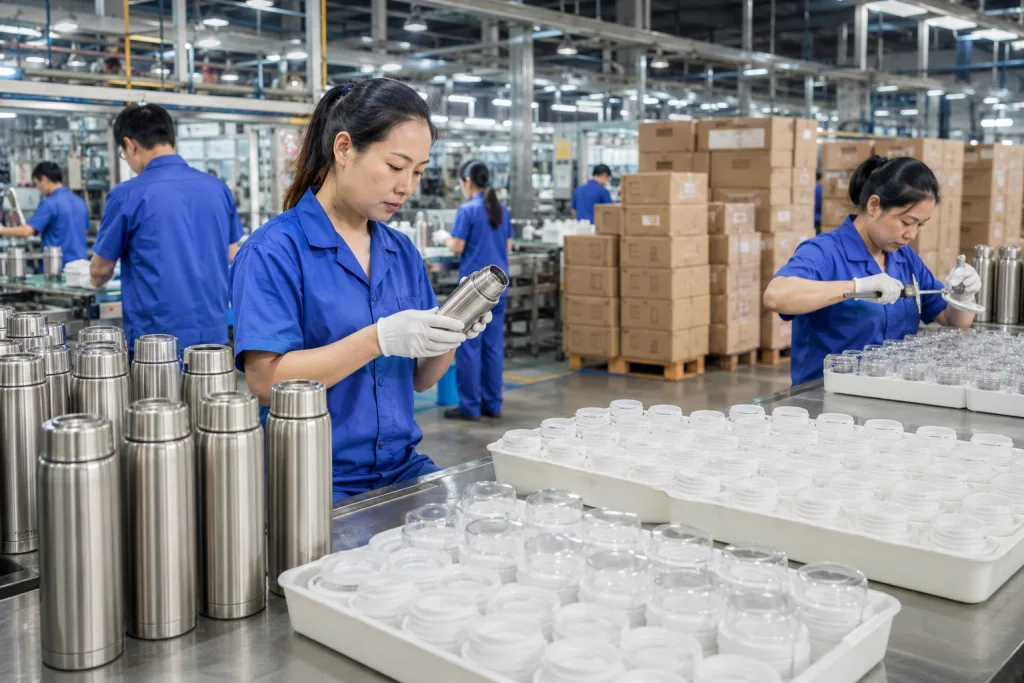
A competent thermos factory should run a documented QC flow tied to ISO-style process control, even if the buyer never asks for the file. For stainless vacuum items, expect incoming material checks, weld inspection during production, vacuum checks, paint adhesion testing, and final AQL inspection. On our line, QC pulled the sample every 2 hours and logged neck size with a digital caliper to 0.05 mm. Pretty surface is easy. Stable process control is what saves money.
- Incoming material: verify SUS 304 or 316 declaration, thickness tolerance, and plastic resin traceability for PP, Tritan, or PETG parts. We usually check wall thickness at 0.4 mm or 0.5 mm by model, and the buyer should ask for the resin lot record, not just a verbal promise.
- In-process: welding seam inspection, neck dimension control, lid thread matching, and powder coat thickness. We run thread-go gauges on the lid fit, and powder coat is commonly checked around 60 to 80 um depending on the finish spec.
- Functional tests: 100% leak test, vacuum retention sampling, salt spray test for coated metal parts where applicable. This is where claims start. A 100% air-pressure leak test catches bad sealing fast, and vacuum retention sampling should show a clear target like 12 hours or 24 hours, not vague wording.
- Final inspection: AQL 2.5 major, 4.0 minor is common for export orders. Before we ship, QC checks print position, dents, barcode scan, and carton marks; last month we caught a PO typo on the outer carton before loading.
For Europe, REACH and LFGB are the usual conversation. For North America, FDA food-contact expectations are basic, and Proposition 65 may matter depending on materials and market. If the design goes into youth or school channels, ASTM and CPSIA screening should be discussed early, even for a manufacturers thermos program that is not marketed as a toy. This is the wrong question to ask late. We have had buyers wait until mass production, then ask for extra migration testing after the lid mold was already running.
If you are working with distributors thermos buyers, ask for a pre-shipment inspection window before balance payment. In Zhejiang and wider China, that is standard practice. Most buyers ask for a 3 to 5 day window after production and before container loading, and that timing matters because rework on 2,000 pcs is still manageable. A factory that resists third-party inspection is telling you something useful. The math does not work if inspection starts after the truck leaves the gate.
Branding options and cost tradeoffs
Most custom thermos projects do not fail on the bottle body. They fail because the decoration choice does not fit the sales channel. We have seen this go sideways: a buyer ran a 90-day promotion with the same logo spec as a premium outdoor SKU, then pushed back when the unit cost was up USD 0.28 and the sell-through did not justify it. A 500ml campaign bottle should be built like a campaign bottle. Shelf retail is different.
For stainless bodies, the usual options are silkscreen, heat transfer, laser engraving, digital printing, and powder coat with masked logo. The extra unit cost is often not the hard part; setup is. On the line, a 1.5mm logo stroke that looks fine on screen can fill in after curing, and QC pulled the sample on one order last month for exactly that reason.
- Silkscreen: lowest cost for 1-2 spot colors, usually +USD 0.05-0.15 per color depending on size. We run this most for promo orders at 3,000 pcs MOQ because the math does not work for complex artwork.
- Laser engraving: durable and clean, usually +USD 0.10-0.30 per unit. Good for logos that need to stay sharp after carton friction and hand carry. We check depth and edge clarity with the sample from the laser station.
- Heat transfer: better for multi-color artwork, often +USD 0.20-0.45 per unit. This is where the buyer flagged scratches most often, so we usually ask for a tape test and a packed-drop check before approval.
- Embossed or molded lid logos: requires tooling, better for long-run thermos custom programs. Tooling sounds cheap until you open the mold and change a 0.3mm logo line, so this is the wrong question to ask on a first order.
For PETG or other plastic accessory parts, check print adhesion and scratch resistance harder. Not every effect survives distributor handling. We ship plenty of bottles where the stainless body passes, but the PETG lid band picks up marks after 2 rounds in a carton test. For a trade show order, that may pass. For outdoor retail with a 12-month shelf life, use tougher decoration and stronger carton dividers.
We usually tell buyers in Zhejiang export programs to keep first orders simple: existing mold, one body color, one logo method, standard export carton, and white or kraft inner box. That is the safer start for 1,000-3,000 pcs. One PO even came in with "laser engrave" typed as "lager engrave," and the bigger issue was not the typo, it was that the buyer wanted custom lid tooling before market feedback. After the first 1,000-3,000 pcs sell through, then spend on full customized thermos packaging and custom lid tooling. That protects cash and gives your thermos supplier a cleaner repeat-production plan.
Get a practical quote for your next thermos program
Send capacity, target price, logo file, and market requirements. We will tell you plainly whether PETG or stainless is the better factory route.
Frequently asked questions
Can a petg thermos flask factory also make stainless vacuum flasks?
Sometimes yes, but you should verify whether the supplier owns stainless vacuum production or only sources it. Many China drinkware companies handle both PETG and stainless projects, but the actual manufacturing lines are different. Ask for factory photos of tube forming, neck shrinking, vacuuming, and leak testing. Ask monthly capacity and current MOQ. A real stainless thermos factory should quote 500 ml vacuum items with specifics like 0.4 mm inner wall, 0.5 mm outer wall, 100% leak test, and a 30-45 day lead time. If the answer stays vague and only talks about bottle shape or logo printing, you may be speaking to a trader rather than a manufacturer thermos source. That is not automatically bad, but you should price and manage the risk accordingly.
What is a realistic FOB price for a custom stainless thermos?
For a standard 500 ml double-wall vacuum flask in 304 stainless with a PP lid, spray finish, and one-color logo, USD 2.80-4.60 FOB China is a realistic range at 1,000-3,000 pcs. A simpler stock-body project may sit near the lower end. If you add powder coating, copper lining, a carry handle, custom color box, and multi-color branding, expect USD 4.80-6.20. A 750 ml or 1,000 ml item naturally runs higher. Be careful with quotes below USD 2.50 FOB for vacuum stainless unless you clearly understand the steel grade, wall thickness, testing scope, and packaging standard. Low pricing often hides reduced QC, lighter gauge steel, or omitted accessories. Ask the thermos supplier to break out unit price, packaging, tooling, and test cost separately.
What MOQ should I expect for bulk thermos orders?
For existing molds, most thermos manufacturers in Zhejiang or other parts of China will work at 500-1,000 pcs per color for logo-only orders and 1,000 pcs per color for custom coating plus branding. If you need a new lid mold, MOQ usually rises to 3,000-5,000 pcs because tooling amortization and trial production cost have to be covered. Full new bottle molds often start at 5,000 pcs and may require USD 6,000-20,000 in tooling depending on complexity. For promotional brands, the practical first order is usually 1,000-2,000 pcs using an existing body shape. That keeps inventory risk reasonable while still giving you useful landed cost. Ask whether MOQ applies per SKU, per color, or per order total. Different suppliers thermos teams define it differently.
Which tests should I ask for before shipment?
For stainless thermos orders, ask for 100% leak test and 100% vacuum check as standard. Then request retention testing on production samples, coating adhesion test, and carton drop verification. For export compliance, REACH and LFGB are common for EU programs, while FDA food-contact expectations apply to the US market. If any product may be sold through school, youth, or kids-adjacent channels, discuss ASTM and CPSIA screening early even if the item is not a toy. Your final inspection standard should be written down, with AQL 2.5 for major defects and 4.0 for minor defects as a normal starting point. If the order is over USD 15,000, paying USD 250-400 for a third-party pre-shipment inspection in China is usually money well spent.
Should I start with PETG or stainless for an outdoor retail launch?
For outdoor retail, start with stainless unless you have a very specific price-driven concept. The shelf expectation in that channel is durability and temperature retention. A 500 ml vacuum stainless bottle can justify a healthier retail price and usually survives freight and repeat use better than PETG. PETG makes more sense for transparent hydration bottles, shaker concepts, or low-cost promotional thermos style campaigns where the word thermos is being used loosely. If your target retail price is above USD 14.99 and you want repeat orders from dealers or thermos distributors, stainless is usually the safer commercial choice. A sensible launch plan is 1,000 pcs in one or two colors using an existing mold, then expand to a fully customized thermos version after you validate sell-through and claim rate.