Key Takeaways
- For a custom stainless thermos, practical MOQ is usually 1,000 to 3,000 units per SKU, while stock-color programs can start around 500 units.
- A 500ml double-wall 304 stainless factory thermos typically lands at USD 3.20 to 5.80 FOB China before premium coatings and complex logo work.
- Normal production lead time is 25 to 35 days after sample approval and deposit; new mold parts for lids can add 12 to 18 days.
- Inspection should be set at AQL 2.5 for major defects and AQL 4.0 for minor defects, with 100% vacuum and leak checks before packing.
You searched for a petg thermos factory, but the real buying call is usually about product structure, not the search term. We see this every month. Buyers use PETG as shorthand for clear plastic drinkware, then the spec shifts after the first sample review: the outdoor line needs stainless steel vacuum construction, heat hold closer to 12 hours hot instead of 3, and fewer complaint cases from dented or sweating bottles. On the line, QC pulled the sample and the wall thickness was 0.32 mm thinner than the approved drawing. That is where bad RFQs start, wrong quotations go out, and desk samples pass while retail performance fails.
If you source from China or Zhejiang often, you already know factory labels get loose. One supplier called itself a thermos factory on a PO last month and still outsourced the bottle body while making PETG lids, PP straws, and silicone seals in-house. This is the wrong question to ask. What matters is whether the supplier can make your exact custom thermos, pass the compliance required for Europe or North America, and hold repeat quality at 10,000 pcs, not just at a 500-pc sample run. We ship these programs with leak testing at 0.03 MPa, and we've seen this go sideways when the buyer flagged the lid fit only after mass production.
Why buyers ask for PETG
Let's be direct. A true thermos is stainless steel vacuum ware, not a PETG bottle. PETG works for clear outer parts, infuser pieces, some lid windows, or lower-cost cold-drink bottles, but it is the wrong body material for a hot-hold outdoor thermos. We have seen buyers send a PO that says "PETG thermos 500ml" and then ask for 12-hour heat retention after the sample stage. That is where projects slip. If you are an outdoor retailer or promo brand, clean up the spec before you ask any thermos supplier for pricing.
What buyers often mean by petg thermos factory is usually one of these 3 cases:
- A factory that can make stainless steel thermos bodies plus PETG accessory parts, often with a 3,000-piece MOQ on the steel body and a separate mold charge for the clear part.
- A source for a customizable thermos with a transparent lid, sip cap, or packaging window; the buyer flagged this on one lid project because they wanted to see the tea filter position through a 2 mm clear cap.
- A trading company in China using PETG as a generic keyword while selling bulk thermos products, with production split across 2 or 3 plants.
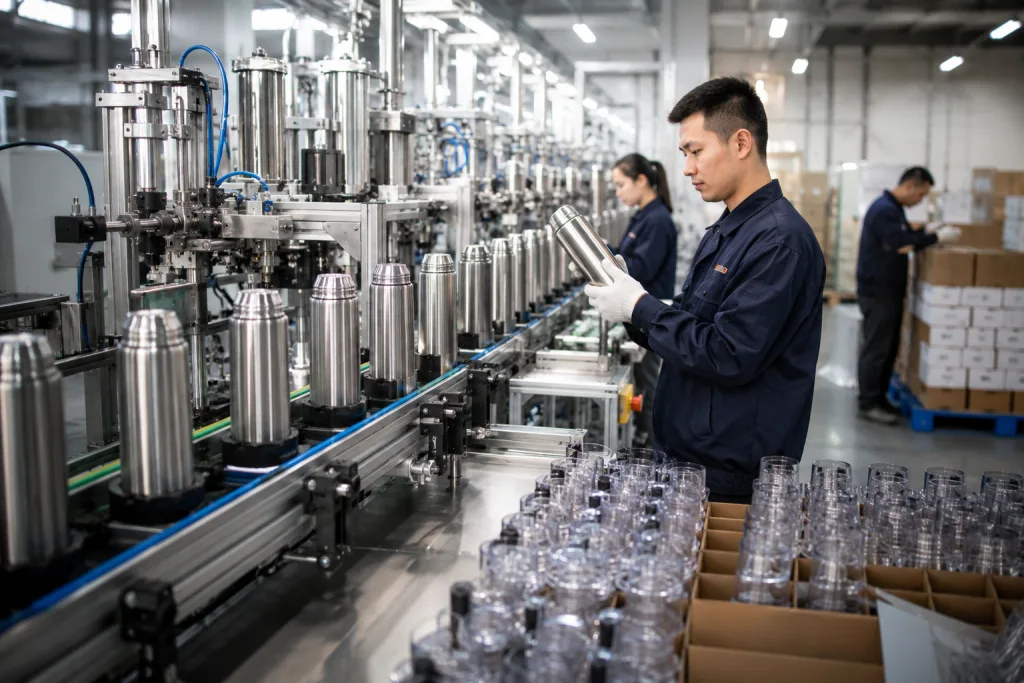
That distinction changes cost, tooling, and compliance. A stainless body needs tube forming, welding, vacuuming, polishing, powder coating, and heat-retention testing on the line. PETG parts need injection molding and migration testing, and QC pulled the sample on one order because the gate mark on the lid window was too visible. If one supplier claims they run everything, ask what is in-house and what is outsourced in Zhejiang. This is the right question.
Procurement checkpoint
- Body material: 18/8 stainless steel, usually SUS304 inside and outside.
- Optional upgrade: SUS316 inner wall for tea, coffee, or electrolyte drinks.
- Lid components: PP, Tritan, or PETG depending on transparency and impact needs.
- Seal: food-grade silicone, typically Shore A 50 to 60.
A factory that stays vague on materials at quotation stage usually stays vague on claims, testing, and chargebacks later.
At BottleForge Industrial in Hangzhou, Zhejiang, we see this mistake 2 or 3 times a month: the search term says PETG, but the brief needs a stainless manufacturer thermos with stable thermal performance and retail-safe decoration. We run vacuum tests and decoration adhesion checks before shipment, and the math does not work if you compare a cold-drink PETG bottle supplier against a real thermos factory. Fix the brief first. Then compare factories.
What to ask a thermos factory
If you are screening a thermos factory, skip the sales talk and ask operating questions. A serious thermos supplier should answer with numbers. We run roughly 450,000 to 600,000 drinkware units per month across standard categories in Zhejiang, but that top-line figure is not the main point. Ask how that volume is split by process on the line: vacuuming stations, powder-coating booths, laser marking machines, and final assembly benches. This is the right question. Last month one buyer pushed on total capacity, but QC pulled the sample and the real bottleneck was one leak-test station, not the body forming line.
Use this checklist in your first RFQ round:
- MOQ by SKU: 500 units for stock body plus simple logo, 1,000 to 3,000 for customized thermos colors and packaging, 3,000+ if new mold parts are needed.
- Lead time: 7 to 10 days for pre-production sample, 25 to 35 days for mass production, 40+ days in peak season.
- Price basis: FOB Ningbo or Shanghai, not just ex-works China.
- Material declaration: SUS304/SUS316, lid resin type, silicone grade, paint system.
- Factory audit status: BSCI, ISO 9001, or equivalent documented system.
- Testing scope: REACH, LFGB where needed, California Proposition 65 for relevant components, ASTM or CPSIA for kids-related designs.
For promotional thermos orders, also ask whether the line is set up for mixed-logo programs. We ship these every season. A common distributor order is 5,000 units split across 10 logos, and this is where the math goes sideways if the quote is not clean. Some factories show a sharp unit price first, then add USD 35 to 80 per logo per color for setup. One PO we got even had "logo collor" typed on it, and the buyer flagged it because the charge table was missing.
A good thermos manufacturer should tell you where they are inefficient. If your program needs 12 body colors, 4 lid colors, low MOQ, gift box insertion, barcode labeling, and drop shipping, you are buying complexity. Not a basic thermos run. We have seen this go sideways on 3,000-piece orders where carton mix rules changed after sampling, and the packing line lost half a day re-sorting labels by SKU. Complexity costs money, floor time, and more recheck points.
Stainless thermos specs that matter
Outdoor retail buyers care about field performance, not slogan copy. Promo buyers watch looks just as hard, because most complaint cases we see come from three places on the line: lid leaks, coating rub after the tape test, and logos fading after 200 to 300 dishwasher-style wipe cycles. Different channels, same job. Lock these specs before you ask for the final bulk quote, or the buyer flagged issue will show up after sampling instead of before PO.
- Capacity: 350ml, 500ml, 750ml, and 1,000ml usually run fastest on our line with lower changeover waste; for most factories, these are the efficient bulk sizes.
- Wall construction: double-wall vacuum, commonly 0.4mm outer and 0.4mm inner stainless thickness, checked with an ultrasonic thickness gauge before forming.
- Inner material: SUS304 for standard use; SUS316 if your market sells the bottle for acidic drinks like lemon water or electrolyte mixes.
- Coating: spray paint for lower cost, powder coat for better abrasion resistance; we normally check adhesion with a cross-hatch cutter.
- Lid type: screw lid, flip lid, spout lid, or cup-cap assembly; this is the wrong question to ask unless you also lock leak standard and drop-test target.
- Heat retention claim: for a 500ml vacuum bottle, 60C or above after 6 hours is a reasonable commercial benchmark; 12-hour claims need the test method, fill temperature, and ambient condition written down.
Be careful with customized thermos claims like “keeps hot 24 hours.” Yes, a lab can hit that number under fixed conditions, but we have seen this go sideways in winter retail once the end user gets 8 to 10 hours during actual use. Ask the vendor for the exact internal test protocol: starting fill temperature, ambient temperature, fill volume, and pass threshold. QC pulled the sample on one project because the report used 95C fill at 23C room temp, while the buyer assumed outdoor use at 5C.
For a custom thermos built for hiking, commuting, or outdoor retail, I would pick a slightly heavier body with stable vacuum yield. Thin-wall cost cutting looks smart on paper, then dents start. Saving USD 0.18 by thinning steel can raise dent risk, vacuum failure, and warranty claims, and the math doesn't work. We ship plenty of 500ml bottles around 320g to 360g net weight because that range usually holds up better in carton drop tests.
If your project includes visible plastic parts, ask whether they are PETG, Tritan, or PP. PETG gives good clarity and cleaner processing cost, but Tritan often does a better job on premium transparent lids where buyers want fewer stress marks near the hinge pin. The correct call depends on your target price and use case. We had one PO with “TRITON” typed for a carry loop that was actually molded in PP, and that small typo turned into a full sample approval delay.
Cost drivers buyers usually miss
A custom thermos quote can move by 25% or more even when two bottles look almost the same on screen. New buyers often look at capacity and body color first. That is the wrong question to ask. On our line, a 0.3 mm wall difference, a second polishing pass, or a changed lid insert can shift cost fast.
Here are the cost drivers that usually move a thermos customized quotation:
- Steel grade: SUS316 inner wall can add USD 0.20 to 0.55 per unit versus standard SUS304, depending on size and market conditions. We see this most on 500ml and 750ml vacuum bottles where the buyer flagged salt-resistance claims after sampling.
- Surface finish: matte powder coat usually costs more than plain spray paint; rubber finish costs more again. The line speed changes here. Powder coat needs better coverage control, and QC pulled the sample before because the bottom edge showed thin film at about 15 to 20 microns.
- Decoration: 1-color silkscreen may add USD 0.05 to 0.12; laser engraving often runs USD 0.10 to 0.25; wrap printing is higher. A 1-color logo sounds simple until the artwork lands too close to the seam and we have to reset the screen fixture.
- Lid complexity: a basic screw cap is much cheaper than a multi-part flip lid with lock, straw, and carry handle. This part goes sideways often. One extra silicone seal, a spring, and a wider hinge pin can push both unit cost and assembly time.
- Packaging: white box is standard; color box, PDQ display, EVA insert, and mailer-tested packaging all add cost. Buyers miss carton math all the time. A 5-layer mailer box at 1,000 pcs MOQ costs more than a plain white box, and it also slows packing on the floor.
- Inspection and compliance: third-party lab testing can add USD 300 to 1,200 per SKU depending on the test package. We ship this every month, and the cost is not just the lab fee; sealed samples, courier, and retest risk all sit in the number.
Typical FOB China pricing for a 500ml thermos supplier program looks like this: stock model, standard screw lid, powder coat, and 1-color logo at 1,000 units may be around USD 3.20 to 4.10. A more premium promotional thermos with custom lid color, gift box, and laser mark may be USD 4.60 to 5.80. Add new lid tooling and the first order cost rises again. We have seen buyers miss one small PO typo here too: cap color marked as "black" on the sheet and "Pantone Black 7C" in artwork approval, which forced a remake sample.
For distributor thermos and thermos distributors programs, ask about carton efficiency. If one design packs 24 units per carton and another only 20 because of a wider handle, your freight per unit increases. The math does not work if the quote saves USD 0.08 on product but loses USD 0.18 in freight. We run carton drop tests after packing, and a handle that sticks out 8 mm can change both carton size and load quantity for Europe and North America when freight rates jump.
The cheapest quote is often the one with the most missing assumptions. Put every assumption on the table before you compare suppliers thermos offers.
Quality control before you place
You do not control quality by writing “good quality” on a PO. You control it by locking test points, tolerances, and the fail action for each lot. This is where promotional buyers lose money. We have seen this go sideways when a custom thermos is treated like a simple giveaway, then the first 2,000 pcs hit the line and QC pulled the sample with vacuum loss and a 1.8 mm crooked logo.
Your purchase order or quality appendix should cover these points:
- Incoming material checks: stainless grade certificates, color standard, lid resin confirmation, gasket hardness. We usually confirm gasket hardness with a Shore A meter and match the approved swatch under the light box.
- In-process control: welding inspection, vacuum retention testing, coating adhesion checks, thread fit verification. On our side, the line checks thread fit with a go/no-go gauge, because this is the wrong question to ask after packing.
- Finished goods checks: 100% leak test, 100% vacuum check, random drop test, logo position, barcode scan. We run 100% leak and vacuum before packing, then QC pulls the sample again if a buyer flagged carton damage on the last shipment.
- AQL standard: AQL 2.5 major, AQL 4.0 minor is common for this category. If your order is 3,000 pcs MOQ, write the sampling level into the appendix instead of leaving it for inspection day.
- Defect definitions: vacuum loss, leakage, strong odor, sharp edge, coating peel, crooked logo, wrong carton marks. Put photos beside each defect if you can; one buyer wrote “logo center” on the PO, but the print file was off by 3 mm and the factory read it differently.
For outdoor retailer programs, include thermal testing on retention claims and cap torque range. Put the torque range in numbers, such as 8-12 kgf.cm, not “tight enough.” For Amazon or other e-commerce channels, include packaging drop tests and FNSKU placement rules if needed. We ship lots that pass factory inspection and still get blocked by the channel because the FNSKU was 5 mm too low or the carton mark used the old PO number.
Ask whether the supplier uses in-house QC or a separate quality team. Ask what percentage of finished bottles are reworked. If a factory says zero, the math does not work. Real production has defects, whether it is dust in the coating booth, thread drag on 2 out of 50 lids, or a weld mark found during inline inspection. What matters is whether they catch it early and whether the rework process is controlled with records.
In Zhejiang and across China, the better factories will share inspection photos, vacuum test records, and CAPA notes when a problem happens. That tells you more than a polished brochure. If you are buying thermos bulk for repeat programs, build the scorecard on numbers: defect rate, on-time shipment rate, claim response time, and corrective action closure. We usually review this monthly, and a 12-day claim closeout beats an 18-day closeout every time.
A practical sourcing decision checklist
Once your shortlist is down to 2 or 3 thermos manufacturers, score them with a weighted checklist and stop chasing a USD 0.12 gap. We have seen this go sideways: one late vessel booking or a 3% complaint rate wipes out that saving fast, and the line still has to recheck lids with a go/no-go gauge.
Shortlist checklist
- Commercial fit: MOQ matches your forecast, payment terms work for your cash flow, and the FOB quotation includes spare parts, packaging, and mold cost if any.
- Technical fit: confirm the steel grade, lid material, capacity tolerance in ml, heat-retention target, and packaging spec; this is the wrong question to ask if the buyer only asks for "best price."
- Quality fit: AQL agreed, inspection plan written, sample signed, golden sample stored, and QC pulled the sample against a 1.0 mm print-position tolerance before mass production.
- Compliance fit: REACH/LFGB/Prop 65 path is clear, factory audit documents are ready, and test cost is assigned before the PO lands with a typo on the lid material line.
- Execution fit: sample speed under 10 days, mass lead time under 35 days, and replies within 24 hours on working days; we run faster when artwork, carton mark, and barcode are locked early.
For a distributors thermos business, I would also score logo flexibility and repeatability. First sample is easy. Matching that logo across 20,000 units from different production dates is the hard part, and the buyer flagged it more than once when the red drifted 1 Pantone step after a screen change. Ask how the factory controls Pantone, what print-location tolerance they hold in mm, and whether laser files are archived by SKU.
If your brief started from the keyword petg thermos factory, end with a clean technical pack. Call the product a stainless vacuum thermos, list PETG parts separately, and spell out what is custom: body color, lid assembly, strap, print position, carton, insert, or retail box. We ship cleaner quotes that way. It cuts the back-and-forth, and the math does not work if 4 suppliers are quoting different lid builds on the same RFQ.
That is the difference between browsing and buying. Once the spec is tight, with details like a 304 stainless body, 0.5 mm logo offset tolerance, and a signed pre-production sample, the right thermos factory in Hangzhou, Zhejiang or elsewhere in China is easier to identify.
Get a usable thermos quote, not guesswork
Send your target size, lid type, quantity, logo method, and market. We will review the spec, flag weak points, and quote the right stainless program.
Frequently asked questions
Can a petg thermos factory really make stainless thermos products?
Sometimes yes, but you need to separate marketing terms from manufacturing capability. Many suppliers in China use broad keywords to catch searches, then source stainless vacuum bodies from partner factories and mold PETG or PP parts elsewhere. That setup is not automatically bad, but you should ask what is in-house. A reliable answer includes monthly capacity, in-house processes, and lead time by component. For example, a supplier may assemble 80,000 to 150,000 thermos units per month, while outsourcing injection-molded PETG lids within Zhejiang. Ask for the BOM, steel grade, resin type, and which plant performs vacuuming, coating, and final QC. If they cannot map the process clearly, they are not ready for a repeat custom thermos program.
What MOQ should I expect for a custom thermos order?
For standard stainless shapes with existing tooling, 500 units can work if you accept stock colors and a simple one-position logo. A more realistic MOQ for a customized thermos is 1,000 to 3,000 units per SKU, especially when you want custom powder coat, retail packaging, or multiple accessories. If you need a new lid mold, handle, or cup-cap structure, expect 3,000 to 5,000 units and a tooling charge from about USD 1,500 to 6,000 depending on complexity. Promotional brands sometimes push for 300 units, but that usually means using an existing body, one print color, and limited packaging choices. The lower the MOQ, the less efficient the pricing will be.
How much does a bulk thermos usually cost FOB China?
A standard 500ml stainless vacuum thermos with SUS304 body, powder coat, and a basic screw lid usually falls around USD 3.20 to 4.10 FOB China at 1,000 units. If you move to a premium custom thermos with SUS316 inner wall, laser logo, custom gift box, and a more complex lid, pricing often lands between USD 4.60 and 5.80. Larger 750ml or 1L formats can add USD 0.40 to 1.20 depending on steel weight and carton efficiency. Watch the hidden extras: logo setup, barcode labels, third-party inspection, and lab testing can add another USD 0.10 to 0.60 per unit on smaller orders. Always compare on the same FOB and packaging basis.
What tests should I require for Europe and North America?
Start with the product structure and target channel. For stainless thermos sold in Europe, buyers commonly ask for REACH compliance and, in many cases, LFGB-related food-contact testing depending on the market and customer requirement. For North America, relevant parts of Proposition 65 may apply, especially coatings and plastic components. If the bottle is for children, ASTM or CPSIA-related requirements can become relevant. Beyond regulatory tests, require functional checks: 100% leak test, 100% vacuum test, coating adhesion, and thermal retention verification. Budget roughly USD 300 to 1,200 per SKU for external lab work depending on the number of materials and claims. Ask your thermos manufacturer to identify every food-contact component first, or the test plan will be incomplete.
How do I reduce risk on my first order with a new thermos supplier?
Do not start with your most complicated SKU. Begin with one proven body, one lid, one coating, and one packaging format. Keep the first PO around 1,000 to 2,000 units if the economics allow. Before deposit, lock a signed pre-production sample, approved artwork, carton marks, AQL standard, and a defect list. During production, require progress photos and clear dates for material arrival, assembly start, and inspection window. Use a third-party final inspection at AQL 2.5/4.0 if the order value justifies it. Also confirm that the supplier stores your logo files, color standard, and golden sample for repeat orders. First-order risk in China usually comes from ambiguity, not from one dramatic failure.