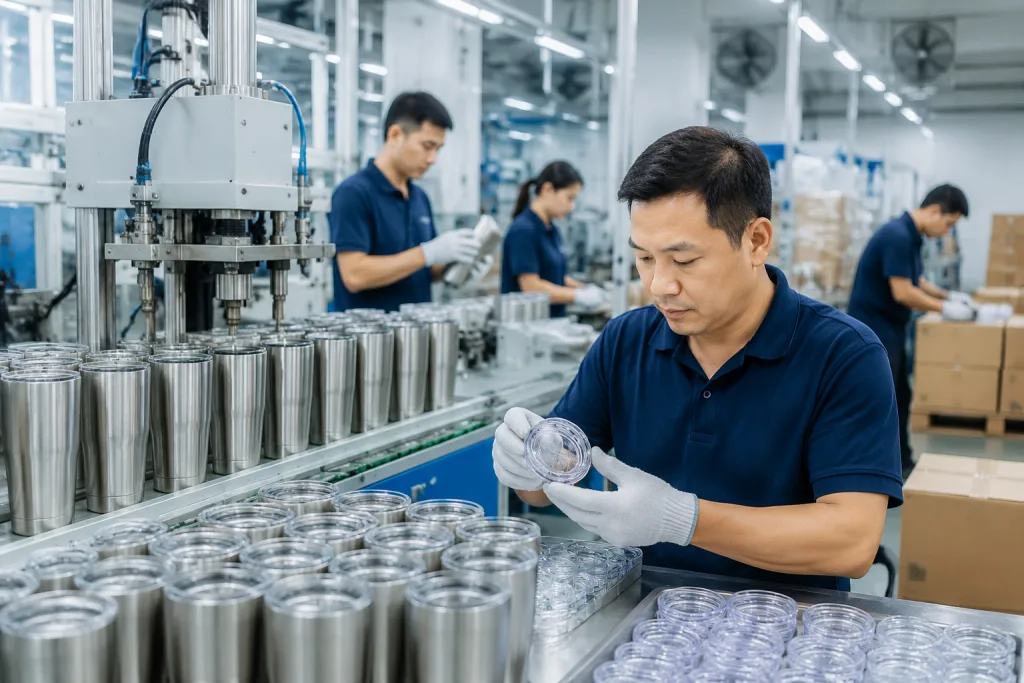
Key Takeaways
- For a custom thermos project, lock material, capacity, finish, logo method, and packaging before sampling; MOQ is often 1,000 pcs for PETG and 500-1,000 pcs for stainless steel.
- A pre-production sample usually takes 7-12 days, while bulk lead time from Zhejiang, China is commonly 25-35 days after deposit and artwork approval.
- Write PO tolerances clearly: capacity +/-3%, color within approved standard, leakage at 0 defects under AQL critical level, and spare units at 1%-2%.
- For promotional thermos and distributor thermos programs, packaging details can change freight cost by 8%-15%, so carton size and unit weight belong on the RFQ.
You search for petg thermos custom, and half the factories come back with stainless vacuum bottles. That is not bad advice by default. In Europe and North America, buyers use “thermos” as a loose term, but PETG and stainless fit different jobs on unit cost, heat retention, compliance, and logo finish. We ship both, and the gap shows up fast on the line: PETG wall thickness might be 2.2 mm, while a stainless vacuum body runs as a double-wall build with copper coating. If you run an outdoor retail line or a promotion, the wrong pick shows up later in leakage claims, soft repeat orders, or margin loss after freight and rework. This is the wrong question to ask if the only question is price.
From Zhejiang, China, we see this every month, around 20 to 30 RFQs: vague specs, samples approved with no drop test or insulation target, then bulk orders drifting on color, print position, or carton marks. Last month the buyer flagged a PO typo on carton label text, and QC pulled the sample again before packing. A better process is simple. Lock the spec first. Confirm the sample against measurable standards like color tolerance, logo position in mm, and packing details, then write a PO that leaves less room for argument.
Start by fixing the product brief
If you send five thermos suppliers one photo and the line “need custom logo,” you will get five prices that do not match up. We see this every week. A clean RFQ is where sourcing starts. For petg thermos custom, first fix the product type, because this is the wrong question to ask if “thermos” just means any drink bottle on the PO. Do you need a PETG single-wall bottle, or a stainless vacuum bottle? Those are different products, different tooling, and different cost structures. Outdoor retail buyers usually expect heat retention, so 18/8 stainless with double-wall vacuum is the standard call. Promo programs often go to PETG because the unit cost is lower, the bottle is lighter, and we can ship more pcs per carton on the same CBM.
Your RFQ should show the commercial spec, not ad copy. On our line, once the lid drawing is missing by even 0.5 mm, quotes start drifting. At minimum, list:
- Material: PETG body, PP lid, silicone seal; or 304 stainless inner/outer with food-grade PP lid
- Capacity: 500 ml, 750 ml, or 1,000 ml
- Wall structure: single-wall PETG or double-wall vacuum stainless
- Logo method: silkscreen, heat transfer, UV print, laser engraving
- Color: Pantone reference or approved sample
- Packaging: polybag, white box, color box, PDQ, barcode label
- Target market: EU, US, Canada, Amazon FBA, outdoor retail, or event giveaway
Add the compliance request at the start. Do not leave it for after sampling. For PETG, ask for REACH and food-contact declarations where applicable. For stainless, ask for LFGB or FDA-style food-contact documentation depending on your market. If the bottle is for children’s use, ASTM and CPSIA-related checks can drive the project more than first-time buyers expect. QC pulled the sample on one kids’ item last quarter because the print rubbed off in the tape test, and the buyer flagged it before approval.
At this stage, add PO line items even before a formal PO exists. Put them in your RFQ sheet: item code, description, quantity, target FOB Ningbo or Shanghai price, and required ship window. Use real numbers. Say 3,000 pcs, FOB Ningbo, ship in 12 days vs 18 days if timing is tight. We have seen this go sideways over one typo in an RFQ line, where “1,000 ml” became “1000 pcs.” A factory thermos quote is useful only when every supplier is pricing the same object.
Price the bottle the right way
Buyers lock onto unit price too early. That is the wrong question to ask. A lightweight PETG bottle at USD 1.10 is not the same build as a vacuum stainless customized thermos at USD 3.20, and we have seen buyers flag this after sample review when the wall thickness came in at 0.35 mm on one option and a double-wall vacuum body on the other. Price the landed value for your sales channel.
For a quote you can actually use from a manufacturer thermos source in Zhejiang, China, ask the supplier to split the offer into cost blocks. We run quotes this way on the line because a one-number offer hides too much. A solid sheet should show:
- EXW or FOB price per unit
- Tooling charge if a new lid, handle, or mold insert is needed
- Logo cost by print method and number of colors
- Packaging cost per unit
- Master carton quantity and carton size
- Sample charge and refund terms
The ranges are not complicated. A 700 ml PETG custom thermos with single-color silkscreen and white box may land around USD 1.20-1.90 FOB at 3,000 pcs. A 500 ml stainless vacuum custom thermos with powder coat and laser logo may sit around USD 2.80-4.50 FOB at 1,000 pcs. Add a carry-loop lid, a tea filter mesh, or a two-color coating, and the quote moves fast; one buyer pushed back on a loop-lid upcharge last month until QC pulled the sample and showed the extra assembly step and 18 g added lid weight. Freight changes the math again. A larger gift box can lift CBM enough to cut margin harder than a USD 0.10 print upgrade.
PO line items to lock here: currency, Incoterm, mold ownership, sampling fee, logo charge, carton spec, and whether over/under shipment is allowed. For thermos bulk orders, I recommend writing over/under at +/-5% for stock-body programs and tighter for fully bespoke retail packs. We ship against what is written on the PO, and if the PO is silent, 7 out of 10 thermos vendors will use their own tolerance. We have even seen a PO typo on carton spec turn into the wrong packout.
If a suppliers thermos quote looks unusually cheap, check steel grade, vacuum rate, coating thickness, and carton strength before you celebrate. QC should pull a sample, run a coating-thickness gauge, and check carton board spec in kg before approval.
Confirm samples against measurable standards
The sample stage is where custom thermos orders get expensive. We see this on the line all the time: the buyer approves a bottle that looks good in photos, then bulk lands and nobody wrote down what “approved” was. For PETG and stainless alike, check the sample against a short test plan with numbers, photos, and pass/fail points. Not your memory. This is the wrong question to ask: “Does it look okay?” Ask what the sample must hit in mm, g, and hours.
For PETG promotional thermos projects, check clarity under normal light, gate marks at the injection point, cap fit, odor after opening, print adhesion, and leakage after 24 hours upside down. QC pulled the sample once because a cap torque of 1.2 N.m felt fine by hand but still wicked at the thread after 18 hours. For stainless vacuum samples, add hot and cold retention, weld quality, powder coat adhesion, and base stability on a flat table. A common stainless benchmark is keeping water above 42 degrees C after 6 hours from a 95 degrees C fill, but some buyers ask for 12 or 24 hour data, and we ship the actual test sheet. Ask for records. Sales claims are not enough.
What to approve on the sample
- Weight tolerance, usually within +/-5 g to +/-10 g depending on bottle size
- Capacity tolerance, commonly within +/-3%
- Logo position with an approved artwork file and dimensioned placement
- Color standard, using a signed sample or Pantone reference
- Leakage result: 0 leaking units in your test batch
- Packaging: insert, barcode location, carton marks, FNSKU if needed
Most pre-production samples from China take 7-12 days. If you need a new mold or a custom thermos part, first sample usually takes 20-30 days, and we have seen this go sideways when the PO says “urgent” but the cap tool still needs T1 correction by 0.3 mm. A serious supplier should also state whether the sample is hand-made or built from production tooling. That point matters a lot. Hand-finished samples often look cleaner than bulk, and the math does not work if you judge mass production by a bench-made piece.
PO line items to add after sample approval: approved sample date, reference sample number, artwork revision, test standard, and golden sample custody. Put one golden sample with your team and one in the factory sample room; we label ours by PO and revision because one buyer flagged a carton mark issue that came from a typo on the PO, not production. If there is a dispute during bulk, both sides need the same physical standard on the table.
Write the purchase order like engineering
A purchase order for a custom thermos is not just quantity and price. It is the last cheap checkpoint before we ship. Buyers at outdoor retail chains usually know this already, because one vague PO line can turn into 28 days of back-and-forth and a blocked balance payment.
Your PO should read like an engineering sheet, not a sales note. This is the right question to ask. We run production from line-item specs, tolerance calls, and packing instructions, not from a sentence like “thermos customized black with logo.” Write the full item description: “500 ml double-wall vacuum bottle, 304 inner/304 outer, 0.4 mm inner wall, 0.5 mm outer wall, powder coat black Pantone Black 6C equivalent, laser logo 35 x 25 mm, BPA-free PP lid, silicone sealing ring, white E-flute mailer box.” On the line, our staff will check wall thickness with an ultrasonic gauge and logo position with a steel ruler, so the PO needs to match that level of detail.
Then define commercial controls:
- MOQ: 500 pcs per color for stock stainless body, 1,000-3,000 pcs for PETG bottle by color depending on mold and decoration
- Payment: 30% deposit, 70% before shipment or against copy documents
- Lead time: 25-35 days after deposit and sample approval
- Inspection: AQL 2.5 major, 4.0 minor, critical 0
- Compliance: REACH, LFGB/FDA declaration, packaging rules, label language
- Cartons: drop-test standard, carton burst strength, shipping marks
If you buy for Amazon or a large retail chain, add the routing guide, pallet rules, carton weight limit, and barcode format. Put the carton cap in kg. We have seen buyers flag cartons at 18 kg because their PO forgot to state a 15 kg limit. If you sell through regional distributors, state whether mixed carton assortments are allowed, because that one point changes packout speed on the warehouse floor.
From our Hangzhou, Zhejiang planning side, the PO lines that save the most trouble are the boring ones. QC pulled the sample last month and found the logo rub test method was missing, so the buyer and factory argued over 50-cycle dry rub versus 100-cycle alcohol rub. Add spare lids quantity, acceptable scratch standard, replacement-parts requirement, and even small label details. We have seen this go sideways over a PO typo that said “5000 pcs black lid” instead of “500 pcs black lid.” Boring details protect margin.
Control production before goods are finished
After the deposit lands, 7 out of 10 buyers go quiet for 30 days and wait for photos. That is too passive. Good buying is not micromanaging the line, but you do need stage control. Whether you buy from a thermos manufacturer, thermos supplier, or trading company, ask for a production schedule with checkpoint dates, not a loose promise. We have seen this go sideways when the PO said "black lid" and the artwork file showed matte navy.
A practical sequence looks like this:
- Day 1-3: confirm PI, artwork, and packaging file
- Day 4-10: raw material booking, color panel, logo plate, packaging proof
- Day 11-20: body production, vacuum process or bottle blowing, coating/printing
- Day 21-28: assembly, in-line QC, packing
- Day 29-35: final inspection and booking
If the order is large, say 50,000 units, ask for one mid-production report with photos, yield rate, and an issue list. One report is usually enough. A capable factory thermos operation in Zhejiang may run 600,000-800,000 units per month across categories, but your order still fights for line time with other projects, especially in peak season. On our floor, QC pulled the sample at the 5,000-piece point and checked logo position with a 0.5 mm tolerance card before full packing.
For stainless, confirm vacuum pass rate and coating quality during production. For PETG, check bottle transparency, stress marks near the shoulder, and cap torque consistency; we usually record 1.2-1.6 N.m on the torque tester for stable sealing. If you have a promotional thermos project with a hard event date, put a late-shipment penalty or at least a required escalation clause into the PO. Some suppliers thermos partners will refuse penalties, and that is their call, but this is the wrong question to ask late. Ask it before the line starts.
PO line items to monitor here: production start date, ex-factory date, booking deadline, approved substitute materials, and defect handling process. Get specific. If print is off-center on 8% of units, what happens? Rework at factory, discount on invoice, or spare shipment by air? Decide before the cartons are sealed. The buyer flagged this once on a 24,000-piece order after packing, and the math did not work for anyone.
Inspect bulk with realistic tolerances
Final inspection is where buyers protect themselves, or miss the problem and argue after arrival. Do not check appearance only. On thermos bulk orders, we run the checklist across workmanship, function, packaging, and count accuracy, and QC pulled the sample against the golden sample before sealing cartons.
Use AQL sampling that matches the order risk, not a generic template. AQL 2.5 major and 4.0 minor is common for drinkware. Leakage should be critical, with acceptance at 0. If the bottle is stainless vacuum, add temperature retention spot checks with a timed hold test; on our line, we log the result by lot number. If it is PETG, add drop and cap engagement checks, because cracked necks after a 1.2 m drop and cross-threaded lids create most field complaints. This is the wrong question to ask if a buyer only asks, "Does it look good?"
Typical bulk inspection points
- Visual defects: dents over 1 mm, scratches, coating voids, print blur, color mismatch against the approved swatch
- Functional defects: leakage, lid fit, unstable base, weak handle, poor vacuum retention
- Packaging defects: wrong insert, missing manual, barcode error, wrong carton mark
- Quantity defects: short-packed cartons, missing accessories, wrong assortment ratio
Also verify net and gross carton weight against the approved pack spec. We ship by actual weight and dimensional weight, and the math doesn't work if a carton grows 20 mm and pushes the courier charge into the next bracket. Promotional brands get hit first. For Amazon-linked programs, give FNSKU placement and carton label format their own check, because we have seen one PO with the FNSKU printed 15 mm too low and the buyer flagged the whole batch.
A decent thermos factory or manufacturer thermos partner should accept third-party QC without a fight. In our export orders, about 7 out of 10 buyers in Europe and North America book pre-shipment inspection when the order is 80% packed. That timing matters. At 20% packed, the sample size is thin. At 100% loaded, the problem is already on the truck, and we have seen this go sideways.
PO line items to close here: inspection level, re-inspection responsibility, claim window after arrival, and spare policy. I usually advise 1%-2% spare units or spare lids for customized thermos orders with multiple parts. For one 12,000-piece distributor order, the buyer typed "1% spare kid" on the PO instead of "lid," and we still stopped to confirm it before production. Small typo, expensive mistake.
Ship with paperwork that matches reality
The last sourcing step is paperwork. This is where solid thermos factories still lose orders. The goods pass, but the invoice does not match the carton count, or customs asks for a missing test page and the shipment stalls at the port. We have seen this go sideways over one PO typo on a 5,000-unit order.
For a standard FOB shipment from China, your document pack should normally include commercial invoice, packing list, bill of lading draft check, and any origin or compliance documents your market needs. If your buyer is a retailer or a large thermos distributor, they may also ask for BSCI audit status, ISO records, factory profile, and material declarations. If you sell a PETG item into an eco-sensitive program, be careful with marketing claims. “Reusable” is fine. “Sustainable” needs support. The buyer flagged this before on a hangtag claim that did not match the lab file.
Before balance payment, check five things against the PO: total units, total cartons, unit price, carton marks, and HS code. Then compare sample photos from finished goods to the approved golden sample. Use the wrong question to ask here? No. Ask whether the shipped goods match the approved file, down to 2 mm logo position and carton mark spelling. QC pulled the sample on one run and found the art said “THERMOS SEREIS” instead of “THERMOS SERIES.” Basic issue, still common.
Lead time discipline affects the next order too. If your first custom thermos run ships clean, your reorder usually moves faster because artwork, carton layout, and testing references are already fixed. Stock-body stainless programs can drop to 20-25 days for repeat orders. On our line, repeat decoration with the same jig often runs in 12 days vs 18 days for a new setup. Fully customized thermos projects with new packaging may still need 30 days or more.
That is why experienced thermos suppliers in Zhejiang and elsewhere in China care about repeatability more than heroic rush orders. The math does not work if a factory saves 3 days and creates a document mismatch that costs 10 days at destination. We ship cleaner on the second PO because the dieline is fixed, the carton marks are locked, and the pack-out count per carton has already been checked on the floor.
Send your thermos RFQ with full specs
We review material choice, MOQ, logo method, packaging, and lead time from our Hangzhou, Zhejiang team and return a practical quote sheet.
Frequently asked questions
If I search petg thermos custom, should I buy PETG or stainless steel?
Use the sales channel to decide. PETG makes sense when you need a lighter, lower-cost bottle for promotions, schools, gyms, or short-cycle campaigns. At 3,000 pcs, a PETG bottle may be USD 1.20-1.90 FOB China depending on lid and print. Stainless vacuum makes sense when your outdoor retail customer expects real heat or cold retention, better durability, and higher perceived value. At 1,000 pcs, a 500 ml stainless bottle is often USD 2.80-4.50 FOB. If your end user will compare temperature performance, PETG is the wrong product. If your goal is giveaway cost control and visual branding, PETG can be the better choice. Put the intended use on the RFQ so the supplier quotes the right structure.
What MOQ should I expect for a custom thermos order?
MOQ depends more on body type and decoration than on the word “custom.” For stock stainless vacuum bodies with a simple laser logo, 500 pcs per color is realistic from many Zhejiang factories. For powder coat plus screen print, 1,000 pcs is more common. PETG bottles often start at 1,000-3,000 pcs because blowing setup, color control, and packaging minimums make small runs inefficient. If you ask for a new lid mold, custom base, or fully bespoke shape, MOQ can jump to 5,000 pcs or more. Ask for three quote tiers, such as 500, 1,000, and 3,000 pcs, and require the supplier to break out tooling, print, and packaging separately. That shows whether the MOQ is technical or simply commercial.
How long do samples and bulk production usually take?
For a stock-body project with custom logo, a pre-production sample usually takes 7-12 days after artwork approval. If you need custom packaging with an insert or color box, add 3-5 days. If the project needs a new mold, expect 20-30 days for first sample depending on tool complexity. Bulk production for drinkware from Zhejiang, China is commonly 25-35 days after deposit, approved sample, and packaging file sign-off. Repeat orders with the same bottle, print, and carton can drop to 20-25 days. During peak season from August to November, add at least 5-10 days buffer. If the event or retail launch date is fixed, put ship date, booking deadline, and delay handling terms directly on the PO.
What tests should I require before I approve the sample?
Keep the sample approval tied to measurable checks. For PETG, require leakage testing, cap fit, odor check, print adhesion, and a basic drop test. For stainless vacuum bottles, add hot retention, cold retention, coating adhesion, weld finish, and base stability. Capacity tolerance at +/-3% is common. Weight tolerance is usually +/-5 g to +/-10 g depending on size. For bulk inspection, set AQL at 2.5 major and 4.0 minor, with leakage treated as critical at 0 acceptance. If the bottle sells in the EU, ask for REACH-related declarations and relevant food-contact documents. If your program involves children’s use or retailer compliance packs, ask early for the exact standard instead of assuming a generic report will be accepted.
What should be written on the PO so the supplier cannot change details later?
Write the PO like a specification sheet. Include item code, capacity, material grade, wall structure, color reference, logo method and size, packaging type, barcode position, carton marks, quantity, unit price, Incoterm, payment terms, and ship window. Add approved sample number and artwork revision. For quality, specify AQL 2.5/4.0, critical defects at 0, and leakage as critical. For logistics, state carton quantity, carton size, gross weight limit, and whether mixed assortments are allowed. For claims, define spare units at 1%-2%, re-inspection responsibility, and arrival claim window such as 15 or 30 days after receipt. Most disputes on custom thermos orders come from missing PO detail, not from malicious suppliers.