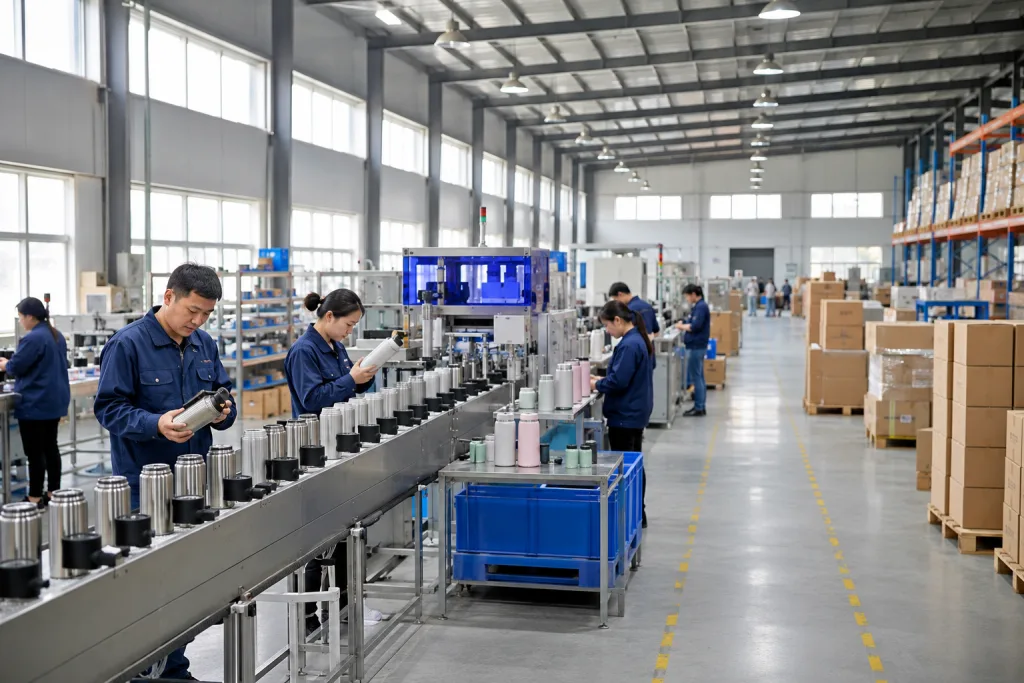
Key Takeaways
- PETG bottles are lightweight and clear, but they are not vacuum-insulated thermos products; use 18/8 stainless for 6-12 hour heat retention
- Typical MOQ is 1,000 pcs for custom PETG and 500-1,000 pcs for standard stainless custom thermos programs from Zhejiang, China factories
- Expect sample lead time of 7-10 days and mass production of 25-40 days depending on decoration, lid tooling, and packaging complexity
- For bulk thermos buying, confirm AQL 2.5, REACH contact compliance, drop testing, leak testing at 100%, and carton specs before deposit
You searched for petg thermos bottle wholesale, and the first issue is usually the product name. PETG bottles are common for clear, lightweight drinkware, often in 500 ml and 750 ml retail formats. A true thermos is usually double-wall stainless steel with vacuum insulation. Buyers get mixed listings, mixed quotes, and mismatched samples. We’ve seen this go sideways. A buyer asks for heat retention and gets a clear PETG body that cannot hold heat like 18/8 stainless, then QC pulled the sample and the wall structure was single-layer from the start.
If you buy for outdoor retail or promotional campaigns, you need a tighter checklist. Check what can be customized, what needs testing, what MOQ fits the project, and where PETG works versus where stainless is the only practical option. This is the wrong question to ask: “Which one is cheaper?” The better question is which one fits the use case and return rate target. At BottleForge Industrial in Zhejiang, China, we run both categories on the line, so the comparison is direct, based on actual quoting, tooling, and sample approval—not sales talk.
Start by fixing the product definition
Most sourcing mistakes start with one line on the inquiry sheet: petg thermos bottle wholesale. PETG and thermos are different builds. PETG is a copolyester plastic for clear bottles, shaker cups, infuser bodies, and lightweight promo drinkware. In normal trade language, a thermos means an insulated vessel, usually double-wall stainless steel with a vacuum gap. On our line, QC pulled samples more than once where the buyer asked for “thermos” but approved a single-wall clear body.
If the bottle is for hiking, winter commuting, camping, or premium retail, buy a custom thermos in stainless steel, not a PETG body. If it is for giveaways, school programs, summer events, or shelf display where color and liquid visibility matter, PETG makes sense. This is the wrong question to ask: “Which one is better?” Ask what job the bottle has to do. We have seen buyers flag “poor heat retention” on a PETG quote that never included insulation in the first place.
- PETG bottle: usually single wall, light, transparent, lower unit cost, suited to cold or ambient drinks. A common spec is 700 ml single-wall with a 2.0 mm body.
- Stainless thermos: usually 18/8 or 304 inner and outer wall, vacuum insulated, suitable for 6-12 hours hot and 12-24 hours cold depending on capacity and lid design. A standard build we run is 500 ml with 0.4 mm inner and 0.5 mm outer.
- Hybrid programs: stainless inner with plastic outer parts, or PETG body with insulated sleeve. These exist, but they are not the same as a true vacuum flask. The math doesn’t work if you expect vacuum performance from a sleeve.
When you ask for quotations from thermos manufacturers or suppliers thermos listings online, use exact wording. Ask for capacity, body material, wall structure, insulation type, lid resin, and target temperature retention. A solid factory thermos quote should show details like 500 ml, double-wall vacuum, 0.4 mm inner/0.5 mm outer, 304 stainless, PP lid, silicone seal, powder coat. We ship quotes like this every day. If the quote only says “thermos bottle” with one photo and one price, you still cannot compare factories. Last month, one PO even had “vaccum” typed in the item name, and the buyer still expected a full spec sheet.
When PETG makes sense anyway
PETG still has a place in a bottle program, even if you mainly buy stainless. We see this with mixed catalogs all the time: a buyer wants a premium vacuum flask line, then asks for a lower-ticket cold bottle beside it. Last month one EU outdoor account ran 2 stainless SKUs and 1 PETG 700 ml bottle in the same PO, and the carton drop test was easier on the PETG line because the unit weight stayed under 0.4 kg. Promotional customers ask for the same thing. They want the thermos look, custom logo space, and lower entry cost without paying for double-wall steel.
PETG fits cold-drink programs where clear appearance sells the item. It gives better transparency and color clarity than a lot of brittle clear plastics, and it holds up better on the line when QC pulled the sample for a cap-fit check. For distributor thermos projects, we usually see PETG on 600-1,000 ml cold bottles, infuser bottles, and gym styles with carry lids. Unit pricing in China can be around USD 1.10-2.20 FOB Ningbo or Shanghai for standard 700 ml custom-logo PETG bottles at 3,000 pcs, depending on cap design and packaging. Stainless vacuum bottles of similar size might land at USD 2.80-5.80 FOB for standard models at similar volumes. Buyers push back on that gap, then we show them freight, return risk, and use case. If the bottle only needs to hold cold water, the math can work.
Use PETG if your checklist looks like this
- Cold beverage use only, typically under 50°C fill temperature.
- Visual product appeal matters more than long heat retention.
- Target retail is value-oriented, or the item is thermos promotional merchandise.
- You need lower freight weight and lower first-order cash outlay.
You can sell PETG in outdoor channels, but do not position it as a heat-retaining thermos. We’ve seen this go sideways. One buyer flagged a hangtag that said “keeps hot for hours” on a single-wall bottle, and the return claim wiped out the margin fast.
At our Zhejiang facility network, custom PETG MOQ is usually 1,000-3,000 pcs depending on mold status and print method. Standard stainless thermos MOQ is often 500-1,000 pcs. This is the wrong question to ask if you only compare piece price. Stainless is not always the expensive minimum buyers assume. We run side-by-side quotes often, and sometimes the PETG order needs 3,000 pcs for silk print while the stainless model clears at 500 pcs with laser marking. If you are comparing thermos bulk options, ask your thermos vendor to quote both PETG and stainless side by side with actual carton weight, CBM, and decoration cost. Ask for the outer carton spec too, like 5-ply vs 7-ply. We ship both, and that detail changes the landed number more than most buyers expect.
Questions to ask before requesting quotes
Smart buyers don't ask for price alone. They ask the questions that expose production risk before the PO is cut. Whether you buy from thermos distributors, thermos manufacturers, or direct factory thermos sales in China, the checklist is the same. On our side, QC usually starts by checking lid fit with a go/no-go gauge and seal compression in mm, not by staring at the quote sheet.
- Material grade: PETG body supplier? Stainless 304 or 201? Food-contact silicone? BPA-free declaration?
- Performance: Leakproof under inversion for 30 minutes? Hot retention after 6 hours from 95°C fill? Cold retention after 12 hours?
- Decoration: silkscreen, heat transfer, UV print, laser, embossing, water decal? One-color or full wrap?
- Packaging: polybag, white box, color box, PDQ tray, mailer-safe carton?
- Compliance: REACH, LFGB where needed, Proposition 65 screening, ASTM testing for kids programs if relevant?
- QC method: AQL level? 100% leak test? Incoming inspection on lids and seals?
For promotional brands, logo durability matters more than some suppliers will say out loud. We've seen this go sideways. A customized thermos with low-cost silkscreen may look fine on packing day, then fail after 20 dishwasher cycles or after cartons rub together in transit. QC pulled the sample on one order last year because the red logo came off after 15 alcohol-rub passes. If the item is a premium campaign piece, ask for adhesion and rub tests. For outdoor retail, check powder coating on stainless for scratch resistance. For PETG printing, ask for alcohol rub resistance if the bottle is sold in active-use channels. This is not a small detail.
Ask monthly output too. Capacity tells you if your order will run on the line as planned or get pushed behind a bigger account. A practical benchmark: a stable Zhejiang, China source for stainless vacuum drinkware should handle at least 150,000-300,000 units/month across standard models. We usually break this down by line count, shift count, and peak-day output, because "we can do it" is the wrong answer. One buyer asked us for 80,000 pcs in 12 days; another supplier promised it, then shipped in 18 days after the buyer flagged missing lids. If the factory gives you a vague number or no MOQ by model, expect the same vagueness on lead time.
MOQ, tooling, lead time, and price reality
This is where new buyers save money or lose 2 to 3 weeks. A customizable thermos program usually breaks into four cost layers: the bottle body, the lid or accessory mold, decoration, and packaging. Most buyers stare at the unit price first. Then the PO lands on the table and the one-time charges show up. We have seen this go sideways after sample approval because a buyer missed a USD 2,800 handle mold and a 1,000 pcs color box MOQ.
For stocked shapes, common MOQ ranges look like this:
- PETG bottle with standard cap: 1,000 pcs for logo print, 3,000 pcs for custom body color.
- Stainless vacuum bottle: 500-1,000 pcs for standard body and custom logo.
- Custom lid or handle mold: usually USD 1,500-6,000 depending on complexity and cavity count.
- Custom color box: often 1,000 pcs MOQ, sometimes bundled with product MOQ.
Lead time from Zhejiang, China is usually 7-10 days for pre-production samples after artwork approval, then 25-35 days for mass production on repeat structures. If the artwork file is clean and the Pantone callout is clear, we run samples fast. Add 5-7 days if you require third-party inspection booking, Amazon FNSKU labeling, or more complex packouts. In peak season from August to November, 25-35 days can turn into 40-50 days. Powder-coated stainless and gift-set assembly are the usual bottlenecks, and QC pulled the sample more than once last year for carton drop issues on a gift set insert.
Price ranges vary, but rough FOB guidance helps. A 500 ml PETG custom-logo bottle may sit at USD 0.95-1.80 FOB in thermos bulk quantities if the cap is simple. A 500 ml stainless vacuum bottle with powder coat and one-color logo is more likely USD 2.60-4.30 FOB. Add USD 0.08-0.30 for retail box upgrades, and more for full-wrap decoration. This is the wrong question to ask if you only ask for the cheapest FOB. The better question is what spec sits behind that number: 0.4 mm or 0.5 mm outer wall, copper coating or none, plain white box or a mail-test box.
If a suppliers thermos quote is 20% below the market cluster, ask what has been removed. Usually it is thinner steel, lighter lid parts, no copper coating, weaker packaging, or no 100% leak test on the line. Last month a buyer flagged a quote gap like this, and the issue was a missing silicone ring plus a lower carton burst strength. The math does not work. Cheap custom thermos buying rarely stays cheap after claims.
QC checkpoints that actually matter
Not every QC point matters the same. For bulk thermos orders, focus on the 5 or 6 checks that stop returns, chargebacks, and bad reviews. We have seen buyers spend two days arguing about carton font size, then miss a 0.3 mm lid fit issue that caused leaks on the line. Whether the item is PETG or stainless, your purchase order should spell out objective QC standards. This is the right place to get strict.
Use this practical inspection checklist
- Leak test: 100% test before packing. For stainless vacuum bottles, also test lid torque consistency, usually with a torque meter and an agreed range on the PO.
- Vacuum performance: sample check per lot. Example: fill at 95°C, measure after 6 hours and 12 hours based on agreed tolerance. QC pulled the sample from each lot, not from one clean-looking carton.
- Appearance standard: AQL 2.5 for major defects, AQL 4.0 for minor defects is common for export orders. Define what counts as a dent, scratch, or print shift in mm, or the buyer will flag it later.
- Coating adhesion: cross-hatch or tape test on painted surfaces; rub resistance for printed PETG graphics. We usually check printed areas after 20 to 30 rub cycles with a dry cloth.
- Drop test: packaged drop from 76 cm or agreed retail standard, especially for e-commerce channels. The math does not work if you skip this and then ship single-unit parcels through Amazon FBA.
- Odor test: check silicone seals and cap inserts after 24-hour closed storage. This catches the odd silicone batch fast, and it is one of the first things end users complain about.
If the item is for Europe, ask for REACH SVHC screening and material declarations from the thermos manufacturer. If your customer is in North America, ask whether any food-contact or packaging components need extra screening for state-level requirements. If this is a kids range, the testing scope changes again. We had one PO where the buyer typed the lid insert resin code wrong, and that small mistake delayed lab paperwork by 4 days.
A serious thermos factory will also document vacuum rate, incoming stainless coil or tube specs, and assembly defect rate. Ask for the defect categories from the last three orders, not just “our quality is good.” Good suppliers in China can tell you whether the recurring issue is logo position by 1.5 mm, denting at the neck after necking, cap color variation against the approved chip, or carton crush after stacking 6 layers high. That tells you they are measuring the line, not guessing.
Decoration choices for retail and promotions
The right decoration depends on where the bottle will live. A trade show giveaway gets knocked around for 6 hours in tote bags and car trunks. An outdoor retail bottle gets tested for months on shelves, in backpacks, and at return counters. Buyers send artwork first. Then the buyer flagged scratches after pilot run, because the print method did not match the bottle surface.
On PETG, the usual options are silkscreen, heat transfer, and UV print. Silkscreen works well for 1-2 spot colors and keeps setup cost under control, especially from 1,000 pcs MOQ. Heat transfer handles full-wrap graphics and fine gradients, but we run tighter temperature control on the line or the film can shift by 1-2 mm. UV print gives crisp detail. It costs more, and for heavy-abrasion use the math does not work unless the artwork sits in a recessed area or away from hand contact.
On stainless, powder coating plus laser engraving stays popular because it holds up and the logo stays clean after repeated use. We ship a lot of this combo on 304 stainless bottles with matte coating thickness around 60-80 um. Pad print and silkscreen still fit lower-cost customized thermos projects. If you buy for distributors thermos channels, ask whether the logo area is flat enough for registration tolerance on tapered bodies. This is the right question. We have seen a 0.8 mm taper change make artwork look crooked even when the print file was correct.
- Promotional use: go after low setup cost and a clear logo with basic rub resistance. A 1-color silkscreen logo usually does the job.
- Outdoor retail: focus on finish quality and scratch resistance. Buyers in this channel usually reject glossy areas once carton rub marks show up in drop test review.
- Corporate gift sets: focus on packaging consistency and color match across bottle, box, and insert. QC pulled the sample on one set because the EVA tray was half a shade off the lid color.
Request a pre-production sample with final artwork, not a digital mockup only. We check this on the bench with a Pantone book and a steel ruler before mass production starts. For repeatable branding, specify Pantone references and acceptable variation. Also confirm logo placement tolerance, for example ±2 mm. That detail matters when your thermos custom order is 10,000 pcs and the brand team only sees drift after arrival. We have even seen a PO typo swap left-hand logo placement to right-hand placement, and then the whole run had to be reworked.
If your bottle will ship to Amazon or other e-commerce channels, make sure the packaging protects the finish. This is where orders go sideways. A good-looking powder-coated bottle in a weak single-wall gift box is not a finished supply solution. We test with 5-layer outer cartons, 10 mm EPE, and corner drop checks. Without that, it is postponed damage.
Get a clear quote before you commit volume
Send your target capacity, material, logo method, and quantity. We will quote PETG and stainless options side by side with MOQ, lead time, and FOB pricing.
Frequently asked questions
Can PETG really be sold as a thermos bottle wholesale item?
You can sell PETG bottles in the same drinkware category, but technically PETG is usually not a true thermos construction. A thermos normally means vacuum insulation, most often double-wall 304 stainless steel. PETG bottles are better for cold or ambient drinks, transparency, and lower cost. If your buyer expects 6-12 hours of heat retention, PETG will not meet that expectation. For wholesale programs, PETG MOQ is often 1,000-3,000 pcs, while standard stainless thermos MOQ can be only 500-1,000 pcs. If your use case is outdoor retail, stainless is usually the safer specification. If it is a summer promotion or low-cost giveaway, PETG may be the right fit.
What is a realistic FOB price for bulk thermos and PETG bottle orders from China?
For a standard 500-700 ml PETG custom-logo bottle, a realistic FOB China price is often USD 0.95-2.20 depending on cap complexity, print method, and order quantity. For a 500 ml stainless vacuum thermos with powder coat and one-color logo, FOB is more commonly USD 2.60-4.30. Premium lids, copper-coated vacuum layers, gift boxes, and laser engraving can push that higher. If a quote is 15-20% below the normal range, ask what changed: steel grade, wall thickness, packaging strength, or leak test coverage. Freight is separate, so compare CBM per carton and gross weight, not just unit price. That is where cheap quotes often stop looking cheap.
How long should custom thermos production take with logo and retail packaging?
A normal schedule is 7-10 days for pre-production samples after artwork approval, then 25-35 days for mass production if the body and lid are standard. Add 5-7 days for color box proofing, FNSKU labeling, or third-party inspection booking. If you need a new mold for a lid, handle, or base component, tooling development can add 20-35 days before sample approval. Peak season in Zhejiang and broader China sourcing cycles usually stretches stainless drinkware lead times to 40-50 days from August through November. If your launch date matters, back-calculate from vessel booking, not just ex-factory completion.
What compliance documents should I request from a thermos supplier?
Start with material declarations for all food-contact parts: stainless grade, PETG resin, PP or Tritan lid components if used, and silicone seals. For Europe, ask about REACH compliance and whether LFGB testing is needed for your market position. For North America, many buyers also request Proposition 65 screening on relevant components and coatings. If the item is intended for children, ASTM-related testing scope may apply depending on the exact product category and accessories. You should also request packaging specs, carton drop standards if relevant, and the factory's quality plan such as 100% leak test plus AQL 2.5 final inspection. Documents should match the actual SKU, not a random old test report.
How do I choose between a factory thermos supplier and a trading company?
The practical answer is to judge control, not labels. A good direct factory should clearly state monthly capacity, common MOQ, in-house processes, and QC steps. For example, if a stainless drinkware source can produce 200,000 units/month, offers 500-1,000 pcs MOQ on standard items, and confirms 100% leak testing, you have useful operating data. A good trading company can also work well if they manage multiple specialized factories and own the project tightly. Ask who controls sampling, who signs off artwork placement, where inspection happens, and who handles claims. If the answers are vague, expect delays when issues appear. Operational transparency matters more than the business card title.